
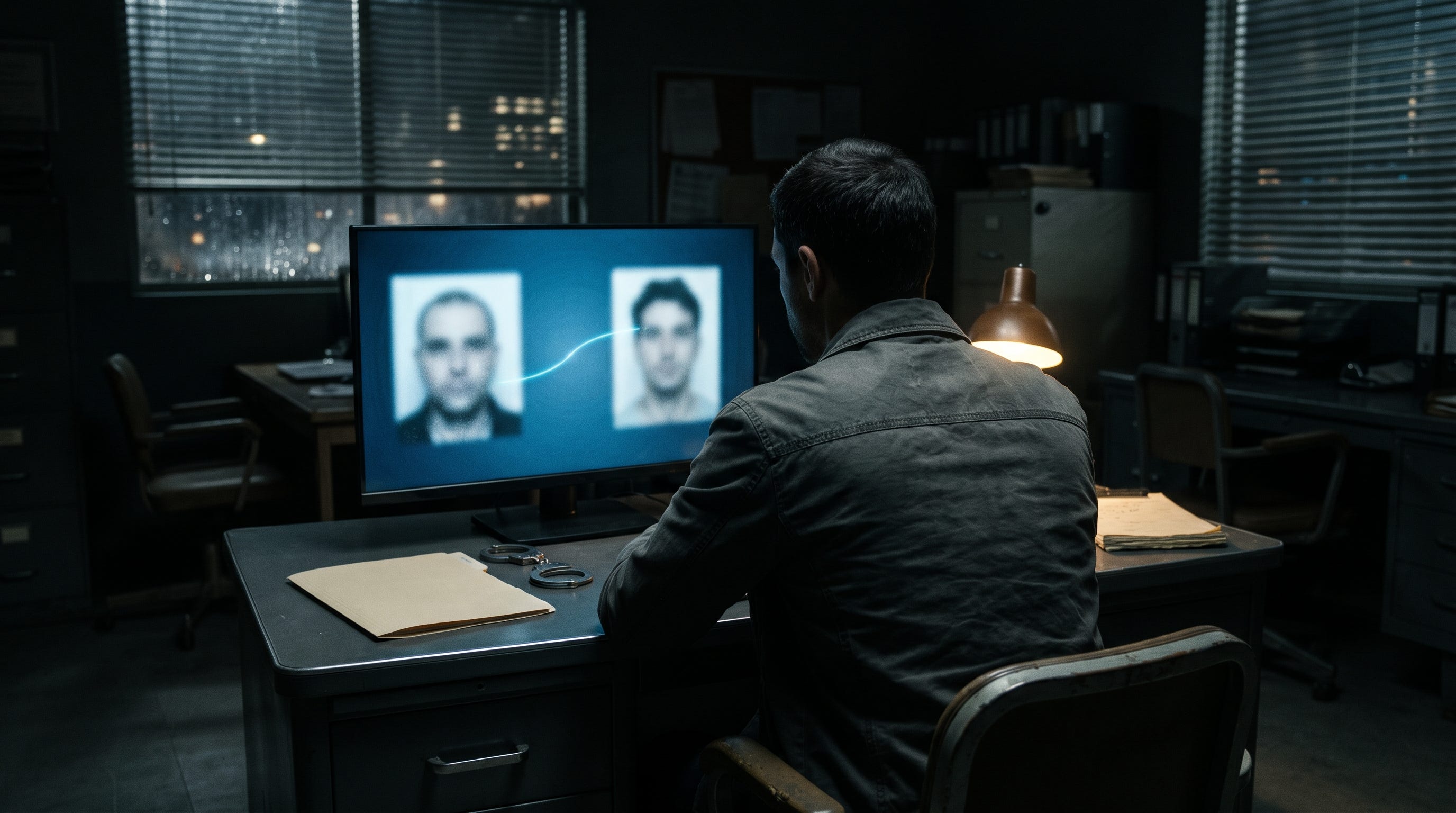
Starting today, HAIA comes once a week instead of once a day. Each issue sets what companies, agencies and officials said against the record, with the dates you can act on, and an essay still comes now and then when an argument needs the room. This week leads with a federal judge's ruling that a detective can't hand probable cause to a face-matching AI, which matters to anyone whose face sits in a booking photo or on social media. Everything below is current as of Saturday, November 14.
The detective wrote "investigative tools." The lawsuit says it was one AI match.
Start with two sentences from a sworn criminal complaint. A detective in Florence, Kentucky, wrote that he "used pictures of the [subject's] face and using investigative tools was able to find a booking photo that appears to match the subject in the security camera footage." Then: "At that point this detective observed that the subjects matched."
According to the lawsuit that followed, those "investigative tools" came down to one: AI facial recognition, with nothing to back it up. On November 9, a federal judge refused to let the detective out of that lawsuit, and his reasoning fits in one sentence: "The Fourth Amendment to the United States Constitution does not allow a detective to delegate to AI the task of assessing probable cause."
(One caveat governs everything below. The ruling came at the pleading stage, so the judge had to take the man's account as true, "which the Court must do at this juncture," in his words. Nothing has been proven, and he wrote that discovery "might show that there is more to the story.")
So what happened, according to the complaint? On August 30, 2024, a man calling himself "Ernesto Ramirez" "tried to cash a suspected fraudulent check at the Heritage Bank in Florence, Kentucky." Detective Ryan Kilmer took a screenshot from the bank's security footage. "Then, he used AI facial recognition technology to match the screenshot with a booking photo and a Facebook profile image." And, in the court's summary of the allegations: "Relying solely on the AI identification, Detective Kilmer concluded that the match was accurate."
The man the warrant named was Alain Vizcay Osorio, who lives in Nebraska. Officers arrested him in Florida on January 9, 2025. He was extradited to Boone County, Kentucky, charged with possessing a forged instrument, and, he alleges, jailed "for more than two weeks" before he was released on bond. In May, prosecutors dismissed the indictment with prejudice "because Osorio had proved that he was working in Nebraska at the time the allegedly fraudulent check was presented." What did he have in common with the man in the footage? Reading the photographs, the judge put it plainly: "the only thing Osorio has in common with the suspect is that he is a black male with facial hair."
Where's the gap between the claim and the record? Florence's own police policy, as the court quotes it, calls AI facial recognition "advisory" and says it does not "establish probable cause without further investigation." Kentucky has had a law on this since 2022: every police agency that uses facial recognition must have a written policy and file it with the state. And the state's own model policy is blunter still: a match "does not establish probable cause to arrest or obtain a search warrant, but merely serves as an investigative lead."
The judge read the detective's sworn words against his department's rule. "In other words, the policy put Detective Kilmer on notice that he should not have been relying solely on AI to make arrests, and yet he allegedly did so anyway." And he "compounded the problem by failing to inform the reviewing court that he had relied solely on uncorroborated AI information." The technology, the judge allowed, "is likely more reliable than a Magic 8 Ball," but "placing unquestioned reliance on such technology is still not much different in principle from placing unquestioned reliance on a Magic 8 Ball."
What does the detective say? Kilmer argued that no earlier case had clearly established that relying only on AI facial recognition for probable cause violates the Fourth Amendment, so he should be immune from the suit, and that, even if he had used only one tool, writing "investigative tools" was an immaterial error. The judge rejected both for now and said the detective could still win: "It is certainly possible that discovery might uncover facts that would entitle Detective Kilmer to qualified immunity." Both sides are due back in court on November 19.
Is the technology the villain? Not exactly, and it's worth being fair about that. The security industry's trade group says "facial recognition combined with human analysis is more accurate than human recognition alone," and that eyewitness identifications are "notoriously prone to error." The same group says police should never use it "as positive identification of an individual, or as the sole basis for an arrest." Kentucky's model policy says it, Florence's policy says it, and so does the industry. The fight in this case is over the second step every one of those rules requires.
Maryland has already written that second step into law. Since October 2024, its code has said facial recognition results "may not serve as the sole basis to establish probable cause"; they count only when "supported by additional, independently obtained evidence establishing probable cause or a positive identification." Kentucky put its version in a model policy and required every department that uses the technology to write its own. Florence wrote one; the lawsuit says its detective didn't follow it.
What does this mean for you?
A match is supposed to be a lead, not an answer. Kentucky's model policy, Maryland's law and the industry's own principles all say so. If police ever come for you on the strength of a face match, the question that matters is what else they had.
In Kentucky, every department that uses facial recognition has to file its written policy with the state's Justice and Public Safety Cabinet. You can ask your department, or the Cabinet, for a copy.
In Maryland, if you're charged, the state must disclose to your defense whether facial recognition was used, which systems and databases, and the results that led to more investigation.
Anywhere in the U.S., you can search your town in the Electronic Frontier Foundation's Atlas of Surveillance to see whether your local police are known to use facial recognition (an empty result isn't proof they don't).
Also this week
The White House says data centers will pay their own way; the grid's own watchdog says they've already added $29.4 billion to customers' costs. On Tuesday, a presidential message said the biggest tech companies had signed a pledge, agreeing to pay for the new power generation and grid upgrades their data centers require. On Thursday, the independent market monitor for PJM, which runs the grid for 13 states and Washington, D.C., said PJM "has failed to implement" that pledge, and that counting data centers in its capacity auctions has caused "an irreversible increase of $29.4 billion in capacity market costs for all customers to date." PJM fundamentally disagrees that it can take control of how those costs are shared; that's up to state regulators, a spokesman said. (In fairness to the signers, the pledge covers new plants and grid upgrades; the $29.4 billion comes from PJM's market rules.) The Senate, meanwhile, voted 73 to 25 on Monday to advance a bill declaring it federal policy that data centers "bear the full cost" of the power and infrastructure built to serve them. It still needs a final Senate vote and the House.
Character.AI is selling off its business in bankruptcy, and it says its privacy policy lets users' data go with it. The company told the court its privacy policy "permits the sale and transfer of user data." The Justice Department's bankruptcy watchdog called the policy "ambiguous" and said a privacy ombudsman is needed. In a November 12 filing, the company said it and the watchdog had "agreed to the appointment of a consumer privacy ombudsman," but it and the states couldn't agree on the order, so as of that filing the judge had two versions to choose from. The opening bid, Disney's $20 million, is a technology license that excludes users' data, their chats and the consumer apps. If you'd rather not wait to see where yours end up, the privacy policy says you can delete your account from your profile page, though it may keep some information.
Four nonprofits have asked a California court to freeze five AI companies at whatever they had built by November 12. On Thursday, Public Citizen and three other groups sued five AI developers in San Francisco: Anthropic, Google, Meta, OpenAI and SpaceX's AI unit. (A disclosure: this issue was drafted with help from Anthropic's Claude.) They want an immediate injunction barring all five from developing or deploying anything more capable than their most capable systems on the day the groups filed. The legal hook is California's Unfair Competition Law: the groups allege the companies' conduct amounts to a public nuisance, and they quote each company's own leaders and researchers back at them. That law lets a private group sue only if it has "lost money or property"; the groups say they've diverted money and staff to respond. The companies didn't immediately respond to requests for comment, the Associated Press reported.
Workday told a court its customers, not its AI, decide who gets hired; its own filing says the AI grades applicants who never see the grade. In a November 10 motion to break up an age-discrimination collective of more than 15,000 applicants, Workday says it "does not make or participate in" its customers' advancement and rejection decisions. The same motion says that under its HiredScore Spotlight tool "the same applicant can receive an A for one requisition and a C for another," and that "Candidates do not know what grade they received, if any." Workday says the grades are informational ("recruiters can consider or ignore them"), and its product page promises AI that helps recruiters decide "without replacing human judgment." The applicants' case, which a judge let proceed as a nationwide collective in May 2025, is that Workday's AI is used to "score, sort, rank, or screen applicants." The court hears the motion on March 9, 2027; if Workday wins, each applicant would have to proceed alone.
Canada's news publishers can sue OpenAI at home, Ontario's top court ruled on Friday. OpenAI had argued the case should be heard in a U.S. courtroom; on November 13 the Court of Appeal for Ontario dismissed its appeal, so the publishers' suit, the first Canadian case over training generative AI on copyrighted work, goes ahead in Ontario. According to The Canadian Press, which is itself one of the plaintiffs, the decision noted that OpenAI filed no evidence that a Canadian judgment would conflict with U.S. law. Nothing has been decided on the merits. The publishers argue OpenAI is using their reporting to train ChatGPT without permission or payment; OpenAI has denied the allegations and has said its training is grounded in fair use.
Deadlines
November 18, 4 p.m. Eastern — The deadline to object to Character.AI's sale. Objections must be in writing and filed with the bankruptcy court in Delaware; the order sets the procedure but doesn't say who may object. Bids follow on November 24 and an auction on December 1.
November 30 — Comment on the FTC's advance notice asking whether platforms whose ad tools further impersonation scams should answer for them. It names Meta's Advantage+ and Google's ad AI as examples and calls the platforms' voluntary measures inadequate. For anyone who has seen a fake "government" or brand ad; people reported nearly $3.5 billion lost to imposters last year.
December 2 — In the EU, two new AI Act bans apply: on AI systems that make intimate images of a real person without consent, or child sexual abuse material, where that's their purpose or a foreseeable result they lack safeguards against. Generative systems already on the EU market before August 2 must also start marking their output as machine-made.
December 3 — The EU's feedback window on its KIDS Act proposal closes at midnight Brussels time, a week later than the November 26 I gave you in October; the Commission moved it. Responses go on the Commission's Have Your Say page.
Follow-ups
The streaming-fraud deadline moved. "Comment by 11:59 p.m. Eastern on Monday, November 23," I wrote on November 3 about the Copyright Office's inquiry into streaming fraud. The Office has since extended the comment periods: first comments are now due December 18 at 5 p.m. Eastern (an earlier hour than before), and replies January 29, 2027. A comment filed by November 23 still counts.
The Anthropic settlement's first payments. First payments to authors "are expected on or before November 15, 2026," I wrote on October 8. In a joint filing on October 23, both sides told the court they now anticipate the first payments the week of November 23, for works whose allocation nobody disputes and whose payment details are complete. If you're a claimant and Sunday passes quietly, that's why.
Europe's Digital Fairness Act arrived on schedule. My October piece noted it was "tentatively listed for the Commission's November 11, 2026 meeting." On November 11 the Commission adopted the proposal. Article 17 would make services built, or reasonably foreseen, to encourage compulsive use give adults tools to switch off "features and system behaviours that encourage continued use by simulating interpersonal relations," and a recital names "AI companions and general conversational chatbots." It's an off switch, not a ban, and still only a proposal.
xAI's permanent turbines kept their permit. "The appeal is pending," I wrote in October, after the NAACP and two local groups appealed the state air permit for xAI's permanent plant in Southaven, Mississippi. On November 10, after a two-day hearing, the state's Permit Board voted to deny the petitioners' appeal, finding insufficient evidence for their claims; the permit covers 41 gas turbines. The petitioners say it leaned on a pollution analysis provided by xAI itself.
The tournament's crowdfunding is live. The organizer's campaign to cover other winners' costs, which Thursday's piece mentioned, went live on Friday. This morning it showed $525 pledged from two backers against a $500 first goal, with 44 days left. Until it raises more, the piece's advice stands: "if you place second through eighth, plan to pay your own registration." Entries close December 24 (UTC). (As on Thursday: the organizer asked me to help spread the word, and I have no role in the tournament.)
That's the first weekly. If it earned its place in your inbox, forward it to someone who'd want those dates; if it didn't, hit reply and tell me what to cut.