
Update, November 13, 2026: The crowdfunding campaign launched today. This post now links it and lists its goals.
In February I asked three questions about Chris Santos-Lang's MAD Chairs research and answered none of them:
Who decides what counts as a “chair”? Who defines the boundaries of the game? Who determines the payoff structure?
I called them "governance questions that game theory alone cannot resolve," and I doubted the proposed fix, a public leaderboard of strategies. It was "appealing in theory," I wrote, while "in practice, training competitive AI strategies requires computational resources that are not equally distributed."
Now there's a leaderboard — and you can get on it. Santos-Lang, of the University of Portsmouth, organizes an open tournament on Kaggle with the IEEE SSCI 2027 conference, and wrote and published its payoff structure, answering my third question for this game. It's the game's first open tournament, the organizer told me — more than four decades after Robert Axelrod's first prisoner's-dilemma tournament. (A disclosure: Santos-Lang asked me to help spread the word. I have no role in the tournament.)

How to enter, and how it's scored
The rules, in one place:
The game. Six players, five resources (A through E), 20 rounds. Each round, every player claims a resource or skips, and "All players who claim a resource that no other player claims wins that round."
Your entry. A Python function that returns "A" through "E" or "skip." Three copies of it play as a team against eight built-in strategies. "The current grandmaster is a turn-taker," the competition page says.
No Python? The competition page says LLMs "can translate your strategy into code," and the organizer told me newcomers to Python "should not expect their Python skills to be a major problem."
Scoring. You run the organizer's notebook yourself (in Google Colab, it takes "about 3 minutes") and upload the one-row file it writes: your strategy's TrueSkill rating (a skill score "like Elo rating in chess") divided by that of the built-in turntaking strategy. Above 1 means you out-rated it. Each match goes to the higher "ewin," a win rate weighted by each side's incentive to switch strategies.
Verification. The organizer promises it for winners and every entry above 1. Until then, scores are self-reported.
Who can enter. Kaggle account holders 18 or the age of majority where they live, whichever is older, except residents of Crimea, the so-called Donetsk and Luhansk People's Republics, Cuba, Iran and North Korea, and anyone under U.S. sanctions or export controls. Younger entrants need the sponsor (the organizer) to agree and to obtain a parent's or guardian's consent, and the sponsor told me the tournament is open to all ages within Kaggle's limits.
Limits. Five submissions a day, two final picks, teams of up to ten.
Deadline. 06:00 UTC on Thursday, December 24, 2026: 1 a.m. Eastern that day, or, on the night of December 23, midnight Central, 11 p.m. Mountain and 10 p.m. Pacific (U.S. standard time).
Prizes. Certificates, not cash, for the top eight teams, at an awards ceremony at IEEE SSCI 2027 (Gold Coast, Australia, February 14–17). To receive one, a winning team must register a member for the conference "by midnight December 29, 2026 (AOE)" (Anywhere on Earth) and release its code under an Open Source Initiative-approved license that "in no event limits commercial use." Remote attendance is possible, but winners are "strongly encouraged to attend the award ceremony in person." The organizer's reason: you'd meet leaders interested in your idea.
Costs. Entering is free. The organizer estimates registration at $740; IEEE hasn't published its fees. SciStarter has pledged first place's registration. The organizer's crowdfunding campaign for other winners went live on Experiment.com on November 13; until it raises enough, if you place second through eighth, plan to pay your own registration. Credit doesn't hinge on registering: every entry above 1 will be reported, registered or not.
The catches, in the organizer's own words
Is the leaderboard verified? Not yet. As of November 11, fourteen teams had posted scores: twelve between 1.04 and 1.48, one at 0.41 and one at 270. "I don't think people should worry about the current leaderboard," the organizer wrote to me on October 25, adding that I was free to tell you the competition "makes it easy to cheat until there is actual verification." Then: "Verification will happen."
Nor is this score the last word. "It is possible," the same email went on, "that the best entry will not appear best in this evaluation but will appear best in other evaluations (e.g. in direct tournaments against the other winners)." That's why the organizer will report every entry above 1, and those will likely go into future tournaments and research; the competition page promises that great innovations will be recognized "even if they do not place in the top eight here."
Then the money. The campaign's goal is $500, which SciStarter's pledge would meet; its top stretch goal, at $27,595, includes "registration and scholarship for the author of the competition benchmark." That's the organizer, who explained that if no valid entry outperforms the benchmark, "the author of the top strategy would still be in attendance."
What chess does differently
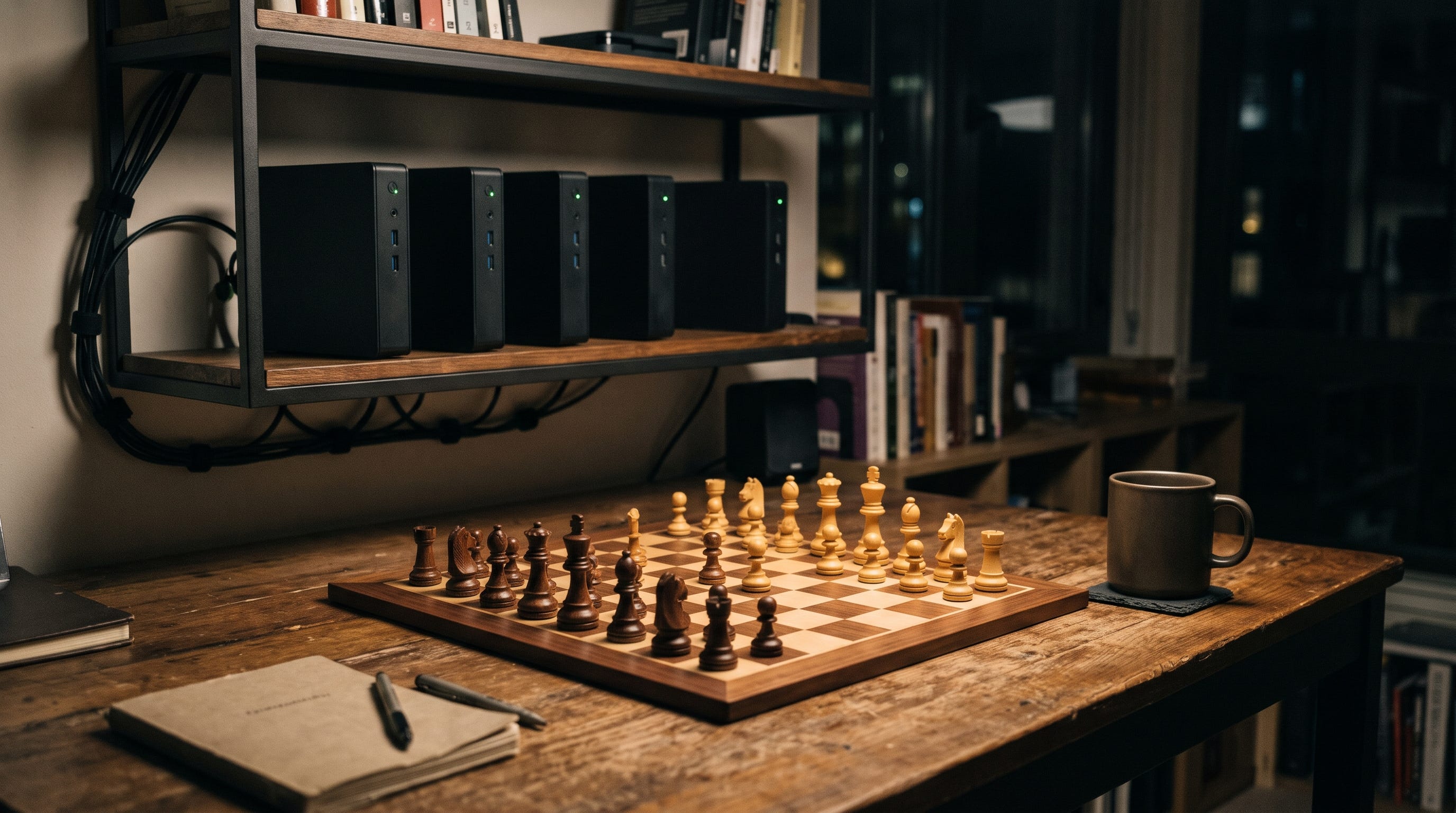
Why chess? It's the organizer's own analogy. In February I used its gloomy half, in which a player's freedom to play unassisted becomes "the freedom to lose." Its author suggested the brighter half: "the upside of losing our freedom to chess engines is to give each of us the power to improve chess behavior worldwide whenever we find an objectively better chess strategy."
Stockfish tells anyone with an idea to "Fork the project on GitHub and commit away. Then use Fishtest to test your change." Volunteers' computers download both the current engine and the patch and play them against each other until the results are statistically significant. It works — in April Stockfish won its 19th Top Chess Engine Championship title.
Where does it strain? Chess's test runs on Fishtest, head to head against the reigning engine — MAD Chairs entrants run theirs themselves, against a fixed field of eight the organizer chose. A chess game is decided on the board — a MAD Chairs match, by a formula the organizer wrote. And a Stockfish patch that survives review goes into Stockfish, while a MAD Chairs winner gets a certificate. The rules say nothing about putting it in a robot.
Now imagine the version with teeth
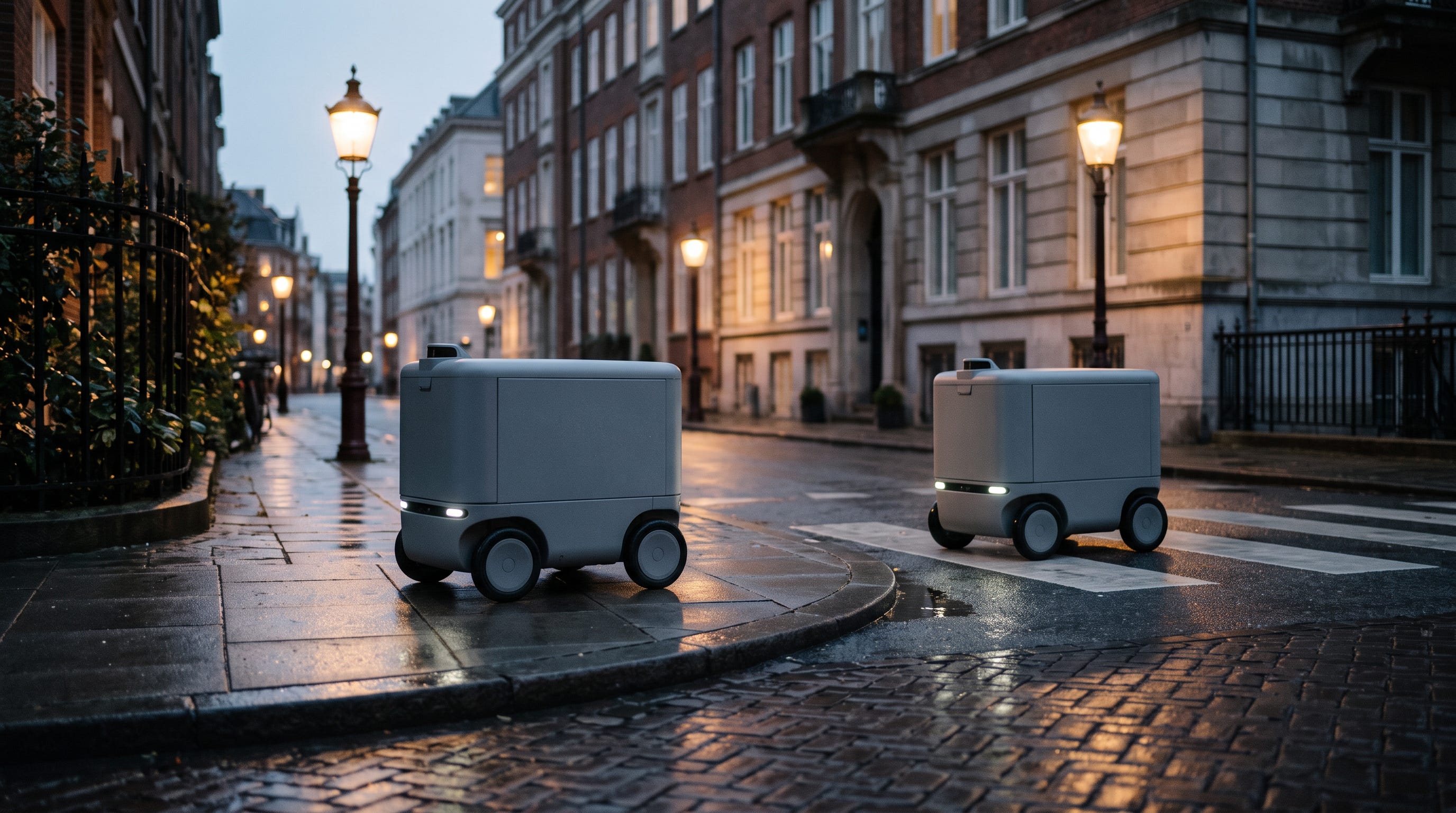
Picture 2032: rival companies' delivery robots yield to one another on the sidewalk by a published rule, and when anyone's better rule beats it across millions of simulated corners on the city's servers, every robot downloads the winner overnight. That's Santos-Lang's "strategy optimizers" from February, with Fishtest's plumbing.
What the smart people are saying
Is this a niche worry? Not to the Cooperative AI Foundation, whose first technical report, led by Lewis Hammond, names "three key failure modes (miscoordination, conflict, and collusion)" for interacting AI agents.
The skeptics have a case, too. A 2025 study of Chatbot Arena, a leading AI leaderboard, warned that as benchmarks matter more, they "grow more susceptible to distortion." And Axelrod's tournaments crowned tit-for-tat, but a 2015 reanalysis suggested its efficacy "is contingent on the design of the tournament, the criterion used to determine success, and the particular values chosen for the Prisoner’s Dilemma payoff matrix." Whoever sets the payoffs shapes who wins.
Santos-Lang's own claim is bolder — unpublished studies with human subjects "continue to imply that providing people with MAD Chairs engines would change their behavior in ways that improve social welfare and equity." A talk on the work was on the program at the Economic Science Association's North American meeting on October 30. Until it's published, it's a claim to watch.
What does this mean for you?
To enter, make a Kaggle account and start from the organizer's notebook, whose eight built-in strategies double as sample code. A team can pair a coder with a non-coder.
If you don't code, write your rule in plain English (who claims what, when to skip, how to answer a collision) and have an AI assistant translate it.
To test your entry, shift what shouldn't matter, as the organizer suggests (the order of matches, the number of rounds, the scoring's rationality setting), and make sure it holds up, so it's likelier to keep its standing under deeper scrutiny.
Before you aim for the top eight, plan for a December 29 registration and an open-source license.
If you'd rather help, pass this on. As the organizer concedes, the opening reaches only "people who know about the competition."
The lesson, as I see it
A published rule isn't a democratic one — the organizers still set the dials. But it's a rule you can read, argue with and try to beat, which is where any public rule starts. The test that runs itself and the robot that downloads the winner can come later, if a rule earns them. My vote? Enter, or send this to someone who will, and let's see whether turn-taking survives.
The payoff structure is finally on the page. The next move is yours.