
On September 21, 2026, the Justice Department told a federal judge in Mississippi that the Clean Air Act's citizen-suit provision "must be interpreted to allow the United States to dismiss any complaint brought by a private citizen." Any complaint. In the same brief, it described what the lawsuit in front of her put at risk: "a facility that enables effective targeting of enemy positions for the Department of War."
If you live near a smokestack, that provision was written with you in mind. Congress put it plainly: "any person may commence a civil action on his own behalf" against a polluter violating the Act, after 60 days' notice, unless EPA or the state "has commenced and is diligently prosecuting" its own case. You have probably never used it. It exists for the day the regulators don't act — and the department now says it may close that door on any citizen's Clean Air Act case it chooses.
This time the people at the door are the NAACP and its Mississippi State Conference. On September 28 they told the court that the gas plant they are suing over is "far and away the largest industrial source of NOx" (nitrogen oxides, which help form smog) in the 11-county Memphis metro, and that regulators "have issued ozone action alerts for 26 days through September 2026, compared to just 10 days in all of 2025." Those are the NAACP's figures, untested in court, and ozone has many sources.
In September I wrote that the federal government had "walked into a private lawsuit between newspapers and an AI company, told the judge how the case should come out, and needed nobody's leave to do it." In Mississippi it wants inside a case so that it can end it. If you are tempted to file this under Elon Musk versus his critics, or this administration versus its opponents, hold that thought (I will give the department and xAI their own words throughout). As I put it then, "The instrument has no politics. It has an owner, and the owner changes every four or eight years." A power to end citizen suits would belong to every president who comes next.
What the neighbors are suing over
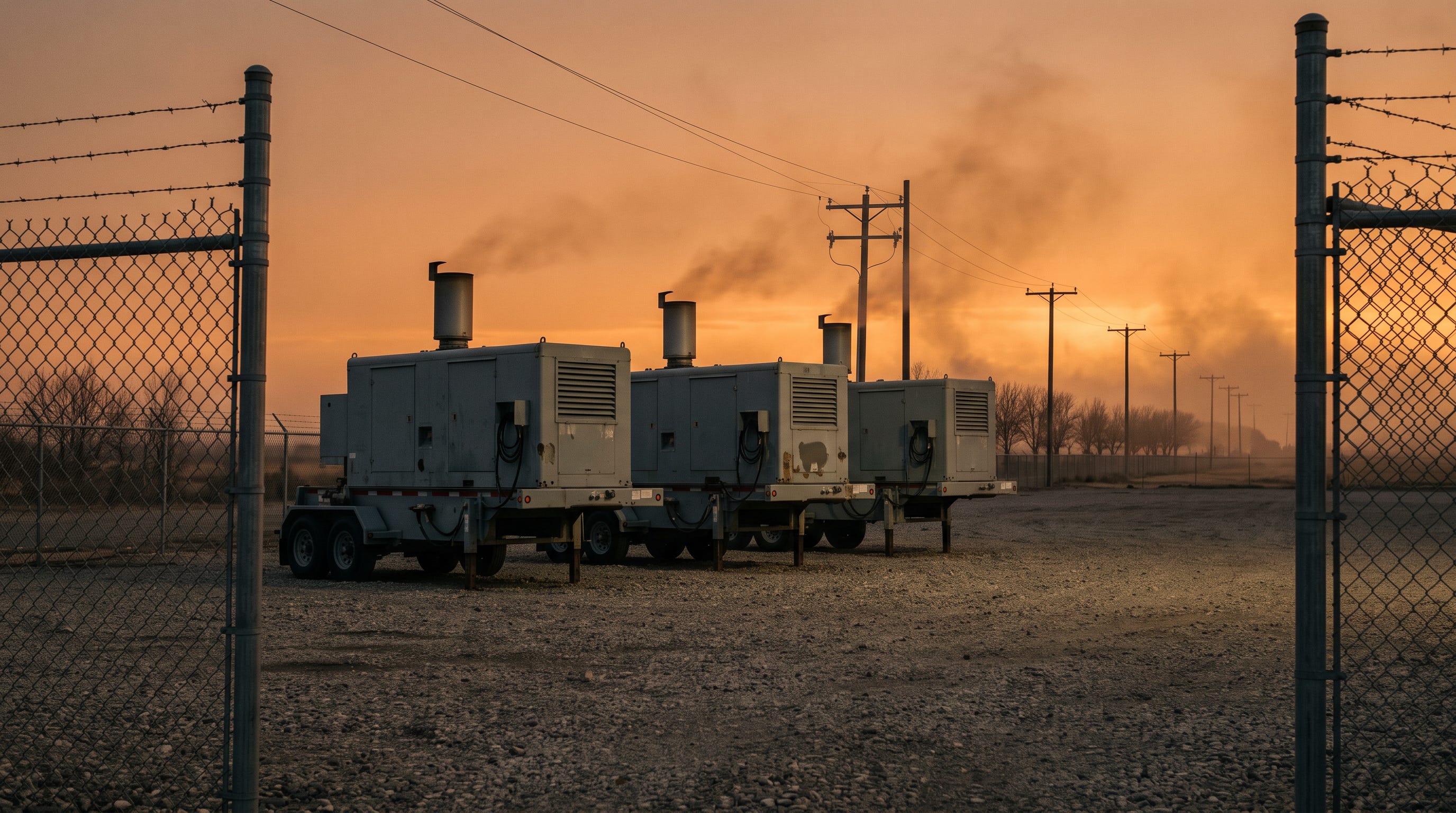
What exactly is in Southaven? The NAACP's complaint, filed April 14, 2026, targets a fleet of portable gas turbines on Stanton Road in Southaven, Mississippi, part of the Memphis metro. It calls them the Colossus Gas Plant and says the plant "supplies power to xAI's Colossus 2 data center," about a mile away. The NAACP sent a 60-day notice of intent to sue in February, as the statute requires; the Southern Environmental Law Center (SELC) and Earthjustice represent it. (The defendants are X.AI Corp. and its subsidiary MZX Tech LLC. SpaceX acquired xAI in February, and the company has since rebranded as SpaceXAI; I will stick with xAI, as the court caption does.)
The fleet grew fast. xAI brought 18 generators to the site in August 2025, Mississippi Today reported; by the NAACP's count there were 27 by December and 57 in satellite images taken on May 12, 2026. A state order signed July 30 counted 69 and barred any more after July 15. On September 22, xAI said it had "already permanently shut down nearly a dozen temporary turbines"; six days later the NAACP described a "now 59-turbine" plant. (If the numbers wobble, so does the fleet.)
Why no air permits? In July 2025, Mississippi's environmental regulator, MDEQ, told xAI the turbines were "exempt from permitting requirements" as long as they stayed mobile (on trailers) and temporary (each on site less than twelve months). In May, Mississippi Today reported that, by the agency's account, xAI was "not required to tell the agency" when it brought in more. The July 30 order goes further: MDEQ and the company agree that running the turbines without separate permits "has not violated Mississippi air permitting requirements," and the order sets a retirement schedule that runs to July 14, 2027.
The NAACP's case is that federal law required permits anyway. Its June brief says xAI has "not obtained a single air permit for these turbines" and that "only the 14 smallest are equipped with appropriate controls to reduce emission of smog-forming pollutants." One federal document complicates the state's reading: EPA's January 2026 turbine rule says a turbine "may, however, be mounted on a vehicle (or trailer) for portability and still be considered stationary." That rule sets emission standards rather than deciding who needs a permit, so it settles nothing here. It does make the NAACP's argument a serious one.
The temporary fleet is not the whole picture. MDEQ has also permitted a permanent 41-turbine plant, "the permanent power source for MZX's advanced computing facilities," which xAI says it began building in May 2026: "As permanent power generation becomes available, the temporary portable turbines will be removed." The NAACP and two local groups have appealed that permit, and the appeal is pending. So when you read that xAI's turbines are unpermitted, the precise version is this: the temporary ones have no air permits and the state says they need none; the permanent ones have a permit, and it is contested.
What does the NAACP want? A preliminary injunction (a court order, before trial, to stop the turbines) and civil penalties that the department puts at "$124,426 per day of violation," payable to the U.S. Treasury, not to the neighbors. xAI answers that such a shutdown order has, to its knowledge, "never been granted in any case since the Clean Air Act was enacted in 1970," and that without the plant's power, "Grok would largely cease to function." The same brief says the computing facilities the plant supplies also run "other frontier AI models, including Anthropic's Claude and Google's Gemini." (A disclosure: this piece was drafted with help from Anthropic's Claude.) Grok — xAI's AI model — is how national security entered an air-pollution case.
The sentence the Clean Air Act leaves out
So does the Clean Air Act let the government end a citizen's case? Start with what it says. EPA's administrator, "if not a party, may intervene as a matter of right at any time in the proceeding." Congress added "at any time in the proceeding" in 1990. The section covers notice, timing and penalties; it contains no provision for the government to dismiss a citizen's suit.
Compare the False Claims Act, which lets whistleblowers sue over fraud against the government. There, Congress wrote the power down: "The Government may dismiss the action notwithstanding the objections of the person initiating the action," provided the person gets notice and a chance at a hearing.
The department builds on a 2023 Supreme Court decision about whistleblower suits, Polansky, which held that the government may move to dismiss a False Claims Act case whenever it has intervened, and that such motions "will satisfy Rule 41 in all but the most exceptional cases." Its July brief reasons that its "express and unconditional right to intervene in this citizen suit necessarily includes the right to unilaterally dismiss the case in its entirety," after which a court "has no adjudicatory role." It has determined, it says, that "no relief sought by this civil enforcement action ... is consistent with federal policy and the public interest."
The Supreme Court has pictured an objecting government before. In Laidlaw, a 2000 Clean Water Act case, the majority wrote that if the executive branch "opposes a particular citizen suit," EPA's administrator may intervene and "bring the Government's views to the attention of the court," and that the government "retains the power to foreclose a citizen suit by undertaking its own action." Make your case to the judge, in other words, or enforce the law yourself. Ending a citizen's suit while declining to enforce is the department's reading, not the Court's.
An appeal from a ruling that was never written
How did this reach an appeals court so fast? The department first moved on June 15, asking the judge to dismiss the suit "in full with prejudice," which would bar refiling, and refiled on July 7 with EPA's administrator as the moving party. The preliminary-injunction hearing before U.S. District Judge Debra M. Brown, set for August 24, was continued "until further notice"; she held a telephone status conference that day instead.
What she said there, the public knows only from the parties' filings. By the department's account, the court "indicated it would deny the amended motion at some unspecified time in the future" and planned a preliminary-injunction hearing in October. The transcript's public-release restriction runs until November 24, 2026. On September 2 the department announced that "[b]arring a written ruling entered on or before September 10," it would "treat the absence of a written ruling as a constructive denial." No written ruling appeared. On September 18 the United States, "acting on behalf of Lee M. Zeldin as Administrator of the U.S. Environmental Protection Agency," appealed what it called the court's "August 24, 2026, constructive Order."
Three days later it asked the judge to pause everything, and that stay request is where the sentences at the top of this piece come from. Given what it calls its right to dismiss, the department wrote, "Plaintiffs have no cognizable interest in these proceedings moving forward." It added that "The public interest is best served if the United States can continue to achieve results like Operation Epic Fury," and asked for a written order by September 28. As of October 9, 2026, the public docket showed none: no ruling on the stay, no new hearing date, no written order on intervention.
xAI backed the stay, warning of "catastrophic financial, operational, and business harms." The NAACP opposed it, calling the notice of appeal "a procedural misadventure" and arguing that "the United States has nothing to appeal and the Fifth Circuit has nothing to review." The appeal, No. 26-60806, is now pending in the Fifth Circuit; the record on appeal is due October 19.

"Targeting facility": read the brackets
Why would an air-pollution case come wrapped in national security? Because of a sworn declaration from the Pentagon's top AI official. As the department's July brief tells it, Grok's availability "is a matter of paramount national security," and during Operation Epic Fury (the U.S.-Israeli strikes on Iran that began February 28, 2026), Grok, "through the Department's Maven Smart Systems," "enabled U.S. forces to deploy over 2,000 munitions to 2,000 distinct targets within 96 hours."
("Department of War" is a secondary title the president authorized in September 2025; statutory references to the Department of Defense "shall remain controlling." I use it only when quoting.)
Read the declaration's own sentence, though, and its subject is different. AFP, working from the scanned document, gives that subject as "[t]he project's Maven Smart Systems (MSS)," and the department's own July brief, quoting the same sentence, shows that it ends by calling the result "a testament to the greatly increased operational efficiency made possible by the Grok Gov Model." The sentence credits the model; it never says where the model ran. Then look at how the department quoted that sentence in its September stay brief. The subject becomes a bracketed insertion, "[Department of War, the Grok Gov Model AI services from this facility]," followed by the declaration's words: "enabled U.S. forces to deploy over 2,000 munitions to 2,000 distinct targets within 96 hours during Operation Epic Fury." In legal writing, square brackets mark words the person quoting has supplied. The words that tie those strikes to this facility are the department's.
Its description of the place has shifted, too. In June, the department's press release described "an AI data facility which trains and develops new AI models that are critical to the economy and the Department of War." By September it was "an advanced Department of War targeting facility." The NAACP adds that Grok's government work "began before the Southaven Colossus Gas Plant was constructed," and says xAI rents spare capacity at data centers the turbines don't power "to competitors for more than a billion dollars a month."
None of this shows the declaration is false; no court has tested it, in either direction. What it shows is narrower and more important: the link between those strikes and this facility rests on words the department supplied.

Could the department be right?
The department's position has serious company, and you deserve to hear it at full strength.
The argument runs like this. Article II gives the president the executive power, and enforcing federal law against private parties is executive power. In June, in a case about removing a federal trade commissioner, the Supreme Court said that when an agency executes a congressional mandate against private parties, "it exercises executive power—no ifs, ands, or quasis about it." That case did not involve citizen suits, but the logic travels. Nicholas Almendares, a law professor at Indiana University, argues that "you can't really have complete presidential control over enforcement without also disallowing citizen suits," and that the department "is just trodding the pathway the Supreme Court has laid out for it." (He dislikes where the path leads; his point is that the Court drew it.)
Justices have signaled doubts before. In the 2023 whistleblower case, Justice Kavanaugh, joined by Justice Barrett, agreed with Justice Thomas that there are "substantial arguments that the qui tam device is inconsistent with Article II" (qui tam is the whistleblower suit's legal name). In Laidlaw, Justice Scalia, joined by Justice Thomas, called a penalty-seeking plaintiff "a self-appointed mini-EPA." Even the Court's friendlier language cuts both ways: in 1987 it suggested that the citizen suit is "meant to supplement rather than to supplant governmental action," a line the department now quotes against this suit, while the NAACP leans on the same opinion's point that citizen suits exist for when the government "cannot or will not command compliance."
Then there is Mississippi. Its regulator decided the state's own rules exempted these turbines, and the state told the court the requested relief "would usurp Mississippi's authority." xAI says there is "a retirement schedule in place for every single one of the temporary turbines." And to be fair to xAI, the region's ozone trouble predates the turbines: the American Lung Association's 2026 report, grading 2022–2024 data, ranked the Memphis metro "27th worst in the nation for ozone pollution."
So where does the argument slip? Choosing not to enforce a law is one thing; deciding that no one may hold a company to it is another. Even Greenberg Traurig, a corporate law firm, wrote that the department's position "appears to blur an important distinction between enforcement discretion and a decision not to require compliance in the first instance." The department already has a lawful way to take over a case it dislikes: bring its own enforcement action, which can foreclose the citizen's. Instead it declares that no relief serves the public interest, while its own brief concedes that "Congress has the power to authorize private parties who have suffered Article III injury to sue to enforce certain federal statutes." The NAACP says its members are just such injured parties.
A retired scientist, a county away
What would this dispute look like in a country that has written the public's right to challenge into a treaty? Ireland is a useful test, because it has Mississippi's problem in concentrated form: its energy regulator says data centers went from "5% of national electricity demand in 2015 to 22% in 2024."
Ireland is one of 48 parties to the Aarhus Convention, the 1998 treaty on public participation and access to justice in environmental matters; the list includes the European Union, all 27 of its member states and the United Kingdom. Ireland ratified in 2012. The United States never joined. Article 9 commits each party to ensure that members of the public, "where they meet the criteria, if any, laid down in its national law," can "challenge acts and omissions by private persons and public authorities which contravene provisions of its national law relating to the environment," through procedures that provide "adequate and effective remedies" and are "fair, equitable, timely and not prohibitively expensive." Each country sets its own rules on who may bring a case (that is what "criteria, if any" means), but the floor is a promise of access.
What does that look like on the ground? In September, An Coimisiún Pleanála, Ireland's national planning body for appeals, refused permission for a data center in County Mayo that the county council had approved: a project 1.8 kilometers south of Killala that would have drawn 50 megawatts on average. The appeal came from a retired scientist, Colin Doyle, from Ennis in County Clare, another county altogether. The developer, which intended its own backup generators "using fossil gas and/or biodiesel," had not shown "a fixed connection agreement to the electricity grid," the board found, and had "failed to demonstrate that the proposed development would be in accordance with the overarching objectives of the Climate Action Plan 2025." The grounds were the grid and the climate plan, not air pollution.
Not everyone in Mayo was pleased: a local council member, Jarlath Munnelly, said the plan had drawn "no local objections," though the novelist Sally Rooney, a Mayo resident, "was among those who had objected to planning permission." The ruling "can be challenged only by way of a judicial review, which must be made within eight weeks of the decision being formally published"; none had been reported as of early October.
Here is where things get interesting. Ireland's answer to the power crunch resembles what xAI did in Southaven. Under a December 2025 decision, the regulator requires new large data centers to provide "dispatchable onsite or proximate generation and/or storage capacity which matches their MIC" (their maximum draw from the grid) and to meet "at least 80% of their annual demand with additional renewable electricity projects generating in the Republic of Ireland." Environmental lawyers were "given the go-ahead by the High Court to challenge" the rules in April; the groups bringing the case say the rules breach Ireland's climate law by locking in long-term dependence on fossil fuels, and it is pending. Ireland is nudging data centers to bring their own power — and the public can take that policy to a judge.
To be clear, Ireland is not a paradise of open courtrooms. Since May 18, 2026, a new fee scale has capped the legal costs recoverable in successful environmental cases; before, "a public body was liable for the legal costs of a successful applicant." The government insists the caps "do not limit access to justice or constrain the right of individuals or communities to challenge decisions, which remains a central part of our planning process." An Taisce and Friends of the Irish Environment are challenging them; their case was listed before the High Court for directions in October, and no outcome had been reported as of October 9. The Irish Times editorial board split the difference: the caps will "discourage environmental activists and others from taking judicial reviews," yet the case for "putting some limits on the ability of people to object to these projects is a strong one." And access is not victory: in Ennis, challengers to another data center lost in the High Court, where a judge called their climate argument "inherently implausible."
So compare. In Ireland the argument is over how hard and how expensive it should be for a member of the public to challenge a data center and its power supply, and even a government capping what winning challengers can recover calls the right central. In the United States, the Justice Department argues it can end a citizen's Clean Air Act case outright. One country is haggling over the price of the courthouse door. The other is arguing over who holds the key.
Imagine the next plant
What follows is my extrapolation, not a forecast, and no court has adopted the department's theory. But every piece of it is already on paper somewhere.
Imagine it is 2029 and the theory has won in a court that matters. The department's brief notes that other environmental citizen-suit provisions (the Clean Water Act's among them) are "similar to the Clean Air Act's provisions." Steve Vladeck, a legal scholar who discloses that he sits on the board of Earthjustice (co-counsel for the plaintiffs), warned in June that the theory, "taken to its logical limits," would let the executive "shut down any citizen suit under any environmental statute, against any defendant, whenever the government decides that non-enforcement better serves its policy goals." So when neighbors file, a company's first call goes to Washington — well before it goes to its engineers.
Imagine the permit question simply going away. Axios reported in September that EPA is "considering a rule that could treat some temporary gas turbines as mobile equipment," according to the Natural Resources Defense Council's John Walke (no such proposal had appeared in the Federal Register as of October 9). EPA has also proposed letting builders start non-emitting construction "before an owner or operator obtains an NSR air permit" and letting states decide "whether, when, and to what extent public participation" happens on smaller permits. Neither is final. Stack them, and the next data center's power plant might never need the permit the NAACP sued over.
Imagine the national-security umbrella opening wider. In 2025 the Pentagon's AI office signed frontier-AI contracts with xAI, OpenAI, Anthropic and Google, "each worth up to $200 million." In the stay brief, the Pentagon "relies on xAI as a primary classified computer infrastructure provider." Any of those companies' data centers could be described the same way in a future brief. (A possibility, not a prediction; the template now exists.)
And imagine neighbors bought out before they reach a courtroom. In Southaven, MZX Tech is offering to buy homes near the plant, and owners who accept "would give up the right to take part in a class action lawsuit over the noise," DeSoto County News reported (that is a separate class action over the noise, not the NAACP's case). Southaven's mayor calls the offers "all voluntary" and says the company has "not broken any federal, state, or local law." Picture that waiver as standard in every siting deal, and any Clean Air Act suit that remains subject to an executive veto.
Who else is worried, and who isn't
Who else sees it this way? The answer does not sort neatly by party.
The case against citizen suits has a long pedigree on the right. The Pacific Legal Foundation, a libertarian law firm, says the Clean Water Act's citizen-suit provision "wrongfully gives unchecked power to anyone who wants to wield it." A commentary in American Thinker puts the democratic objection bluntly: "Private advocacy groups cannot be voted out of office." And the department's June press release quoted Associate Attorney General Stanley Woodward: "Ultimate responsibility for enforcing federal law belongs to the Executive Branch, not private interest groups."
Some of the sharpest objections come from people who grant that debate is real. The UnPopulist, a liberal anti-authoritarian publication, grants that conservative and libertarian doubts are "a legitimate debate for Congress and the courts," and still calls the department's ask "a standing executive veto over lawsuits Congress expressly authorized." Greenberg Traurig suggests that "A narrow statutory ruling may be more likely than a sweeping constitutional decision." Vladeck says the motion "turns on a dangerous new constitutional claim" and that the analogy to the whistleblower case "collapses on a single structural difference": the NAACP "filed in its own name, asserted its members' own injuries."
The academics are pointed, too. Erika Kranz of Harvard's Environmental & Energy Law Program calls it "the first time the United States has intervened in a citizen suit against a private defendant and argued that the suit must be dismissed," and notes that "no court has adopted the central argument the government makes here" (still true on the public docket as of October 9). Deborah Sivas of Stanford warns that, if courts accept it, it "could significantly weaken citizen suits as a backstop when government regulators choose not to act." Sarah J. Morath of Wake Forest counts citizen-suit provisions "used in over 2,000 lawsuits" since the 1970s. And three scholars in the California Law Review argue that the history runs the other way: "Founding Era lawmakers passed reams of statutes empowering private plaintiffs to sue for wrongs done to society."
On the left, Balls & Strikes sets the two statutes side by side and concludes, "The Clean Air Act has no such provision." A consumer-law blog hosted by Public Citizen worries that if the theory spread to consumer law, "favored businesses could violate federal consumer protection laws with impunity," while hoping "Vladeck's fears are overblown." For the plaintiffs, Earthjustice's Laura Thoms says, "There is no moral or legal precedent for this," and the NAACP's Abre' Conner puts the stakes in one line: "A data center should not be a potential death sentence for a community's health."
Strip away the heat and there is more agreement than you might expect. The department concedes that Congress may let injured people sue. The NAACP concedes the government can likely take part in the case in some form. The fight is over who decides whether a citizen's case goes forward: the court, or the executive.
What does this mean for you?
Look up what is near you. EPA's Enforcement and Compliance History Online lets you "search for facilities in your community to assess their compliance with environmental regulations."
Report what you see. EPA's site lets you "report suspected environmental violations." A report is not a lawsuit, but it costs nothing.
Know your rights as they stand today. Any person may sue a violator after 60 days' notice to EPA, the state and the company, unless the government is already "diligently prosecuting" its own case. As of October 9, 2026, that is still the law; no court has accepted the department's theory.
Comment on permits, and keep a copy. If a major plant near you needs an operating permit, anyone can later petition EPA to object, but only on concerns "raised to the permitting authority during the notice and comment period." Skip the comment window and you may lose the argument. From October 26, 2026, an EPA rule limits when those petitions can revisit a plant's preconstruction permit (its permit to build) if that permit was issued with public comment and a chance at court review, so raise those concerns when it is proposed. EPA's proposal to let states decide how much the public takes part in smaller permits is not final; watch your state's rules, and the Federal Register for any proposal to treat portable turbines as nonroad engines (none had been published as of October 9).
Get the ozone alerts. Find out who issues them where you live. Near Southaven, Mississippi publishes daily ozone forecasts for DeSoto County from April to October, the Shelby County Health Department issues a "Code Orange Air Quality Forecast Advisory" for the Memphis metro, and on an Air Quality Action Day sensitive groups are asked to limit exertion outdoors.
Follow the case yourself, for free. The public docket linked above carries the filings (NAACP v. X.AI Corp., No. 3:26-cv-00074, Northern District of Mississippi).
Read the fine print on any buyout. Southaven owners who accept MZX Tech's offers give up the right to join the noise class action. Before you sign anything like it, ask a lawyer what you are giving away.
Ask your members of Congress one question. Should the Clean Air Act say, in plain words, whether the government may dismiss a citizen's suit? The False Claims Act does. Whatever answer you prefer, it belongs in a statute, not a brief, though if the department's Article II argument wins, even a statute may not settle the matter (Almendares, for one, is "pessimistic that any amendments to the Clean Air Act or similar statutes would make a fundamental difference").
The lesson, as I see it
Reduce this case to its frame and it is about a door. Congress cut one into the Clean Air Act so that people who breathe the air could walk through it when those paid to enforce the law would not. The department says it holds a key, and may lock that door on any case it chooses.
The courts may agree; the Supreme Court's recent reasoning gives the argument a path. But consider what changes if they do. A citizen suit would survive only when the government of the day does not object, which means only in the cases the government never minded in the first place. And time matters even if the department loses: every month without a hearing is a month the remaining temporary turbines keep running toward a retirement date already set for mid-2027. As I wrote in September about a very different fight, a right you cannot enforce in time is "not much of a right."
What should you watch? A ruling on the stay, which could come any day; October 19, when the Fifth Circuit's record is due; and November 24, when the transcript restriction ends and you should be able to read what the judge said in her own words. And watch Ireland, where a retired scientist from one county stopped a data center in another, at least for now.
My vote? Keep the door open, argue as hard as you like about who may walk through it and at what cost, the way the Irish do, and let Congress, not a brief, decide whether anyone gets to lock it.
For now, the right the Clean Air Act gives "any person" still belongs to you. The HAIA Foundation keeps watch on how AI's hunger for power reshapes rights like that one; subscribe and follow the case with us.