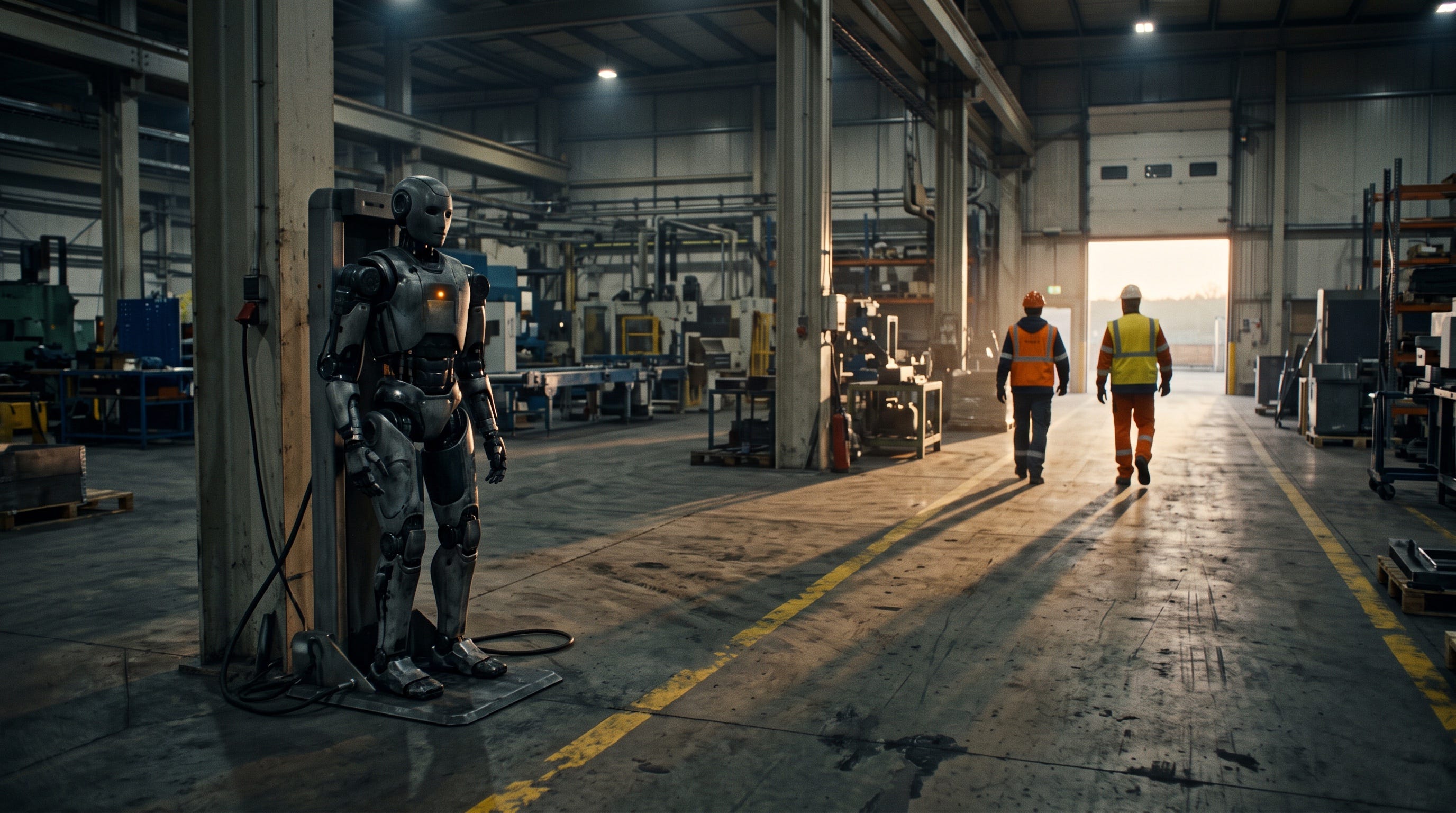
You have seen the clip. Everyone has seen a version of the clip.
A machine shaped like a person coils on a mat and throws a backflip that lands clean. Or it picks up a towel and folds it — clumsily at first, then with something that looks unnervingly like patience. Or it walks a stage, hands a bottle to a presenter, and the crowd makes the noise crowds make when the future turns up ahead of schedule.
I watch these the way I suspect you do: two parts wonder, one part suspicion I try not to feel smug about. I want them to be real, and I have no interest in being the person at the party who says "it's just a demo" about everything.
So I asked three deliberately boring questions instead. Not can it do a backflip. These:
Who is paying that robot?
To do what, exactly?
For how many hours — and who counted them?
I expected the answers to take a while to assemble. They did not. Strip out the concept videos and the stage lighting and what remains is a short list of names, a shorter list of tasks, and a set of published hour totals you could fit inside a single paragraph.
Here is the part that surprised me, and it is why I wanted to write this rather than dunk on anybody: the honest answer is genuinely good. Real machines are doing real, repetitive, documented work for real customers right now, and some have been at it for years. It is just that the work is much smaller and much duller than the clip implies — and the word doing the heaviest lifting in this entire industry, deployed, turns out to mean about six different things depending on who is saying it.
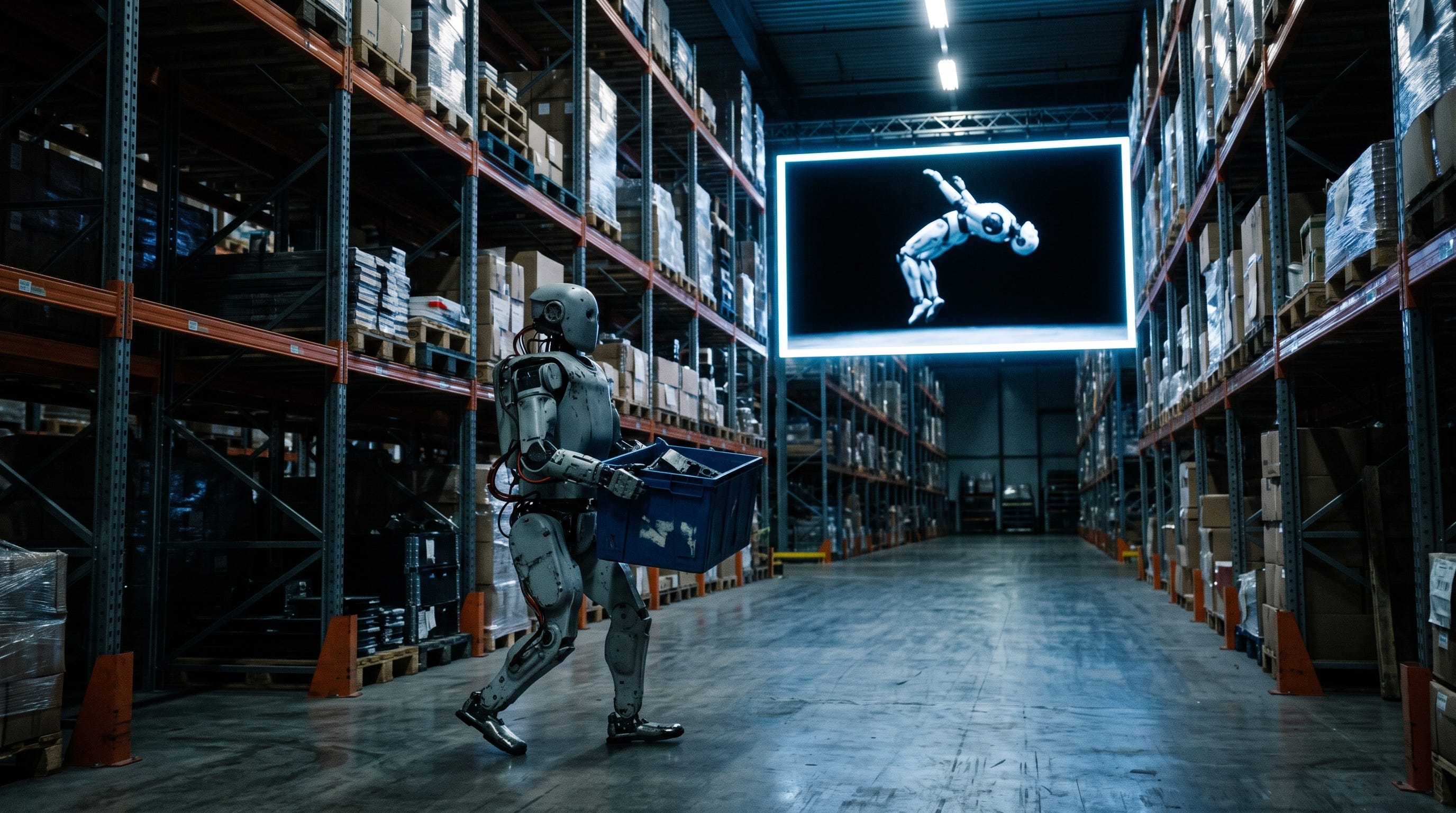
Start with the invoice, not the highlight reel
The cleanest way into this is to stop reading press releases and start reading the documents companies sign their names to when lying is expensive.
Two of them stand out.
The first is Figure's account of its robot on a real production line. Over an eleven-month program at BMW's Spartanburg plant in South Carolina, the company reports 1,250+ hours of runtime and 90,000+ parts loaded, contributing to the production of more than 30,000 X3 vehicles — running ten-hour shifts, Monday to Friday, against a target of better than 99% success per shift. That is not a stunt. That is a machine clocking in.
The second involves the totes in the title. Agility Robotics reports that its robot Digit has moved more than 100,000 totes at GXO's Flowery Branch facility in Georgia — picking items on and off an autonomous mobile robot, feeding a conveyor, stacking totes. Again: not a stunt. Also not a backflip. It is the industrial equivalent of carrying laundry baskets between rooms, forever, without complaining.
Now for the numbers that matter most, because they come with a securities filing attached. As part of the paperwork for going public through a SPAC merger at a $2.5 billion pre-money valuation, Agility filed an investor presentation with the SEC claiming nine committed customer facility deployments, 65,000 hours of operations, and a customer list running from Amazon to Toyota Motor Manufacturing Canada to Schaeffler and Mercado Libre. The same document describes an industry "increasingly defined by demonstrations, prototypes, and teleoperated systems" — which is a fascinating thing to write down when your competitors can read it.
To be clear about what those numbers are and are not: the filing's word is committed, not running today. The hours are company-reported in an investor deck carrying the usual forward-looking-statements disclaimer — a supplier's disclosure, not an audit. And the widely-quoted $300 million in orders for the next-generation Digit is, in the company's own careful phrasing, subject to the realization of certain contractual milestones. The transaction has not closed either; the company is going public, not public.
I am belaboring this because the precision is the story. Even with every caveat stapled on, Agility and Figure are at the top of the class. That is how thin the air is up there.
So the humanoids are a bust? Not remotely
Here is where I have to argue against myself, because the deflationary read is easy and half wrong.
The bull case is not nothing. Morgan Stanley doubled its forecast for China's humanoid shipments this year to 50,000 units, nearly twice its previous projection — and that figure counts external sales only, "excluding those produced for prototypes, pre-order trials, or internal use." Which is to say: it is a real-customer number, the strict kind, and it is still large.
Volume exists too. Unitree ships more humanoids than anyone — more than 5,500 delivered in 2025, an estimated 32.4% of global market share. Boston Dynamics has fleets scheduled to ship to Hyundai's Robotics Metaplant Application Center and Google DeepMind in the coming months, with 2026 production already fully committed. Capital is flowing at a scale that is hard to wave away: Figure raised more than $1 billion at a $39 billion post-money valuation.
So: real robots, real orders, real money, real shipments. Anyone telling you humanoids are a hoax is not paying attention.
But notice how quickly the same evidence turns. That 50,000-unit forecast is China-only. The global denominator, from the research firm Omdia in the same report, is about 13,000 humanoids shipped worldwide last year — with Chinese firms holding the top five slots, Figure seventh and Tesla ninth. And shipping units is not the same as running a business: Unitree's adjusted net profit in the first quarter of 2026 fell 52.55% year on year, with the company itself flagging "revenue growth deceleration and operating performance fluctuations" at the top of its risk warnings.
Both things are true. The sector is real, and the sector is much smaller and much more fragile than the valuations imply. Holding both is the whole discipline here.
The comparison that matters isn't between countries. It's between two columns
Normally at this point in an essay I reach for geography — here is how Europe handles it, here is what Singapore tried. Not this time. The comparison that actually clarifies this story is not between places. It is between two columns of the same spreadsheet.
On 11 July 2026, an analyst database did something almost nobody in this industry does: it graded every humanoid factory claim by the strength of its evidence rather than the confidence of its wording. It sorts each case into one of eight statuses — commercial deployment, paid pilot, technical pilot, internal test, demonstration, announced partnership, memorandum of understanding, or claim without sufficient evidence — on the stated principle that the status follows the available proof, not the most ambitious wording in a press release.
That is one analyst's framework, not an official register, and it deserves to be argued with. But apply it and the fog lifts fast.
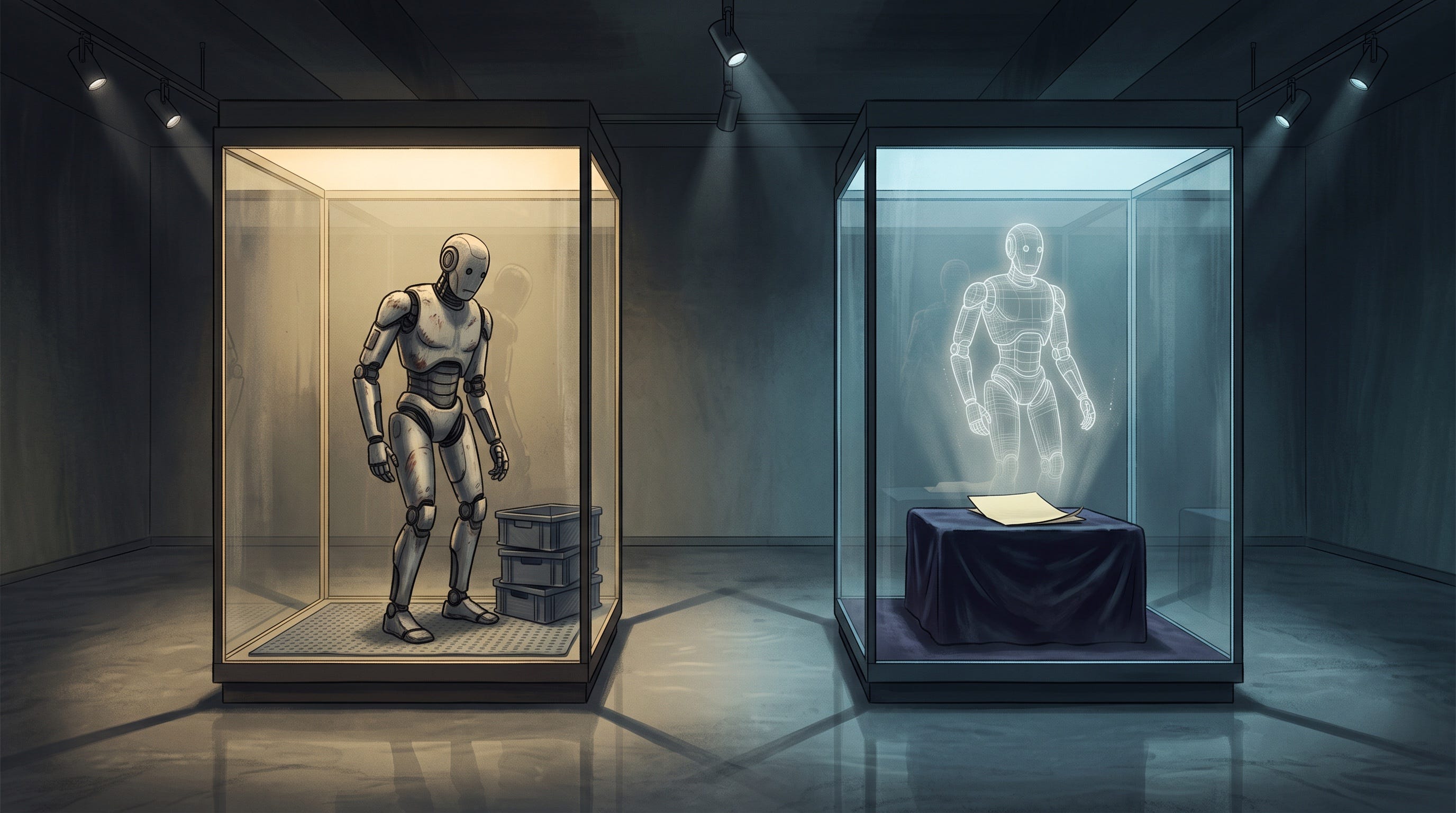
The left-hand column — things somebody paid for and can count. Figure's hours at BMW. Digit's totes at GXO. Bounded, repetitive material-handling work at named sites, with numbers attached and customers willing to be named alongside them.
The right-hand column — things that have been announced. Boston Dynamics' new Atlas is scheduled to ship, which is not the same as shipped; Hyundai's own newsroom puts Atlas at its Metaplant America plant in Savannah by 2028, initially focusing on processes with proven safety and quality benefits, such as parts sequencing. That is a credible plan from a serious company. It is also two years away.
And then there is the case everyone actually argues about. Tesla's Optimus sits in the internal-test column, and the reason is not snark — it is the company's own filings. Tesla's second-quarter 2026 shareholder update lists Optimus at two sites with status "Construction" and states that the initial Optimus builds will be used in our Optimus Academy for training data collection and further functionality development. On the call, Musk described it as the hardest product to scale manufacturing that we've ever made at Tesla, adding that there is "no existing supply chain" for it.
Tesla has built Optimus units. It has shown them, moved them, filmed them. What it has never published is a production count, an hour total, or a stable fleet number. The absence is easiest to see in the document where such a number would naturally live: Tesla's quarterly production release, which reports that it produced over 450,000 vehicles and deployed 13.5 GWh of energy storage products — and contains no robot figure anywhere. The company that counts everything is not counting this.
Wall Street has noticed. Days before the call, one trade outlet put it plainly: on how many Optimus units exist, nobody outside Tesla knows — and Morgan Stanley's lead analyst applies a 50% probability discount to the program's $60-per-share valuation contribution.
Even the left-hand column comes with an asterisk, and the grading framework is honest enough to say so. BMW itself calls Spartanburg a pilot project, and describes its new German program as a pilot with the actual pilot phase starting in summer 2026 after a preliminary test deployment. And Figure's impressive hour count belongs to the previous generation of hardware, in a program that has ended; the newer robot is a different machine on a different workflow, and its evidence clock starts at zero.
Which brings me to the summary line that has been rattling around my head for two weeks. Run the exercise against company filings, as one technology outlet did in mid-July, and the claims of tens of thousands of deployed units do not survive contact. What survives is a handful of robots doing real, documented, repetitive work at a small number of named sites.
That is not a scandal. It is just an enormous distance between a demo reel and an invoice — and we have been reading the reel as if it were the invoice. It is the same trick we watched companies pull with layoffs blamed on AI because it "plays better" with stakeholders: not a lie, exactly. A label doing unearned work.
Now run the tape forward
Here is where I get to be imaginative, so treat what follows as a plausible sketch rather than a forecast.
Give this five years and I think the boring column widens — slowly, unevenly, and in a shape nobody is currently filming. Procurement departments will decide this, and procurement departments do not buy wonder. They buy uptime. The first serious humanoid contract with a penalty clause attached — hours delivered, cycles completed, downtime capped — will shape this industry more than any keynote.
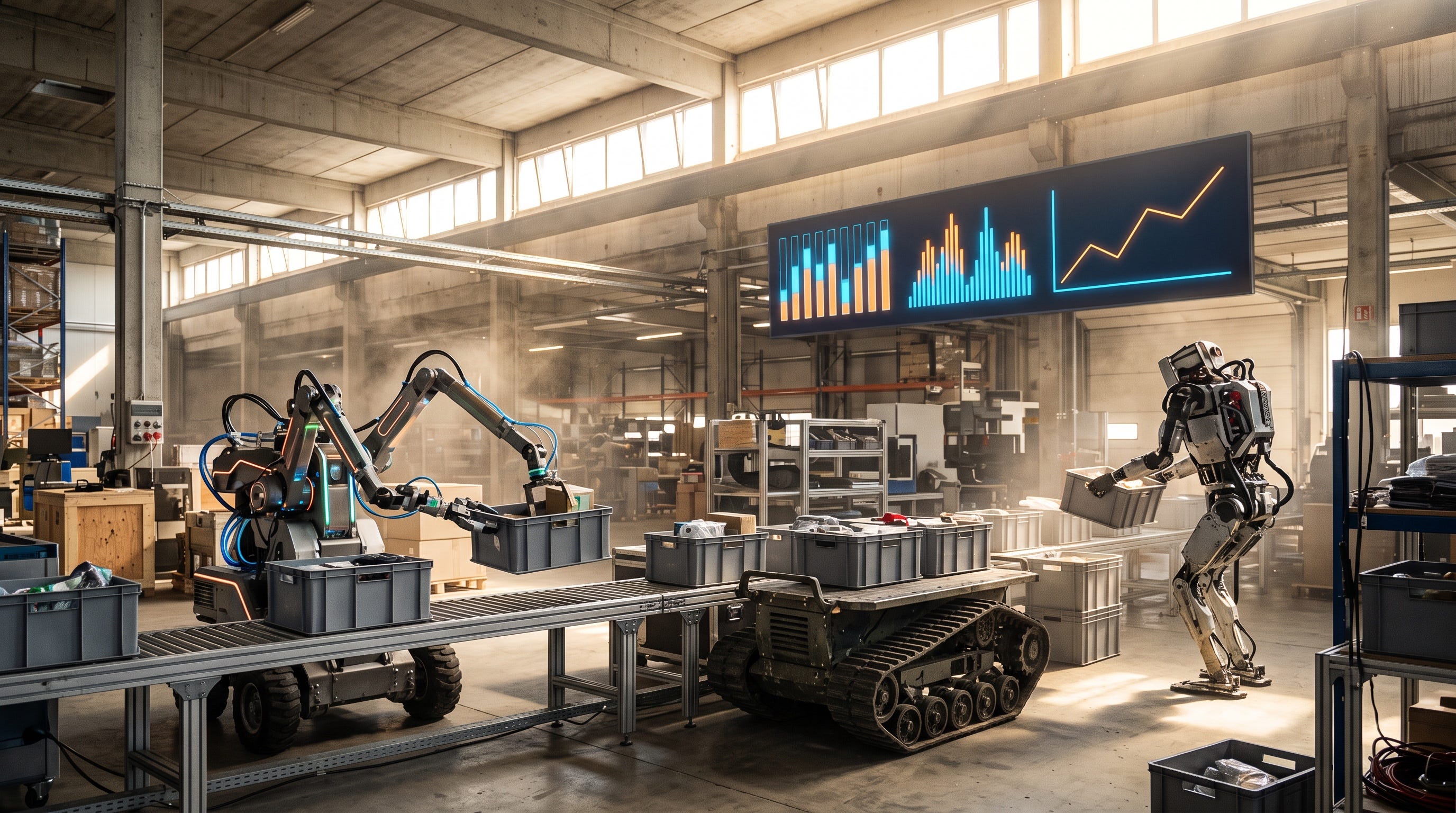
Picture 2031. A mid-sized distribution center runs three shifts. On the floor: a wheeled machine with two long arms, a low tracked unit that never lifts anything above waist height, and exactly one legged humanoid, kept because a stairwell and a legacy pallet rack make legs cheaper than a rebuild. Nobody films it. The dashboard on the wall tracks hours, faults and cost per tote, and the humanoid earns its slot there or it goes back.
Meanwhile the demo reels keep getting better — genuinely spectacular — and the gap between the reel and the dashboard becomes the single most useful thing a citizen can learn to see. My optimistic scenario is that we develop a norm the way we eventually did for drug trials: a boring, standard disclosure. Hours logged. Sites named. Tasks described. Human hours displaced, if any. Not a regulation necessarily — just an expectation that a company claiming deployment shows the log. The firms leading today would benefit most, which is exactly why one of them wrote the criticism of the industry into its own SEC filing.
What the people who build these things are saying
The sharpest skeptics here are not journalists. They are roboticists — which is why I take them seriously.
Rodney Brooks, who co-founded iRobot and spent a career at MIT, argues that today's vision-only imitation learning will not produce genuine dexterity, and that "believing that this will happen any time within decades is pure fantasy thinking." He has told investors, more bluntly, that they are wasting their money — and that the successful machines will have "wheels, multiple arms," not our silhouette. A human hand carries roughly 17,000 specialized touch receptors. Nothing in robotics comes close.
At Berkeley, Ken Goldberg frames the obstacle as data. His 100,000-year data gap is the observation that all the text on the internet — the corpus that produced modern language models — would take a human about a hundred thousand years to read, and "we don't have anywhere near that amount of data to train robots." Language had an internet to learn from. Hands do not.
And on the plumbing, IEEE Spectrum's reporting has been unsentimental: the market for humanoid robots is almost entirely hypothetical, even the leaders have deployed only a small handful of machines in controlled pilots, Digit runs about 90 minutes per charge, and industrial buyers routinely want reliability at 99.99% — a couple more nines than anyone is currently delivering.
Now zoom out for scale, because this is the number that reframed everything for me. The International Federation of Robotics counted 4,664,000 industrial robots in operational use worldwide in 2024, up 9% in a single year. Four and a half million machines. Automation already happened. It just doesn't have legs, so nobody made a video about it.
On the labor question, the smart people genuinely disagree, and I want you to hear both. The free-market R Street Institute argues that fears of AI producing a mass of structurally unemployed workers are "simply not borne out by existing labor studies." From the other side, Darrell West at Brookings warned back in 2018 that expert forecasts diverge wildly — and, more importantly, that "relatively small increases in unemployment or underemployment have an outsized political impact."
The evidence we do have comes from the robots that already arrived. Peer-reviewed work published in the American Economic Journal found that between 1993 and 2014, industrial robots cut employment for non-White workers by 4.5 percentage points versus 1.8 points for White workers, and 3.7 points for men versus 1.6 for women. Displacement is not hypothetical. It is just not humanoid-shaped — a point adjacent to something we argued last month, when what's vanishing isn't your rung — it's the first one.
Workers, notably, are not waiting for the taxonomy to settle. Hyundai's union — around 40,000 members, with 86% strike authorization — moved to secure job protections against the carmaker's planned deployment of Atlas robots. They are bargaining over machines that have not arrived yet. Honestly? That is the correct time to bargain.
What does this mean for you?
You are going to keep seeing these clips. Here is a small toolkit for reading them, and none of it requires an engineering degree.
Ask the three boring questions. Who is the paying customer, what is the specific task, and how many hours — counted by whom? If a story answers all three, it is real. If it answers none, it is marketing. Most answer one.
Treat "deployed" as a word that needs a receipt. In this industry it currently covers everything from ran ten-hour shifts for eleven months to appeared in a video on our own factory floor. Make it earn the meaning you assume it has.
Watch for the word "pilot" — especially from the customer. When the buyer describes the program more modestly than the seller does, believe the buyer. BMW calls its own programs pilots. That is not a downgrade; it is accuracy.
Notice when a number is missing rather than bad. The most informative fact about Optimus is not a disappointing figure. It is the absence of any figure in a filing full of figures.
Don't confuse the humanoid story with the automation story. Four and a half million industrial robots are already working. If you care about jobs, that is the file to open — not the one with the backflip.
If you work somewhere this is coming, ask early. Which tasks, on what timeline, and what happens to the people doing them now. Hyundai's union asked before the robots landed. That is the leverage window, and it closes.
The lesson, as I see it
I came into this expecting to write something skeptical, and I have ended up somewhere more interesting: quietly impressed, and unwilling to round up.
Because the real achievement here is smaller and better than the hype. Somewhere in Georgia, a machine has moved a hundred thousand plastic boxes from one place to another without a highlight reel. In South Carolina, another one clocked over a thousand hours beside human colleagues on a car line and hit its numbers. That is a genuine engineering triumph, and it is being drowned out — by its own industry — in favor of gymnastics.
What I object to is not ambition. It is the laundering of tenses. Will ship becoming ships. Committed becoming running. Internal test becoming deployed. Each swap is small and defensible in isolation, and together they produce a public conversation about a robot workforce that does not exist yet — while the actual robot workforce, four and a half million machines with no faces and no legs, goes entirely unremarked.
My vote? Grade on evidence, and say so out loud. Not because the companies are villains — most are doing hard, honest engineering under absurd expectations they did not entirely create — but because a field that grades itself on proof gets better faster than one that grades itself on applause. The teams with real hours to show want that standard. The rest need the lights low and the music loud.
The humanoid robots are real. They move totes. Once you can say that sentence without flinching in either direction — without the sneer and without the swoon — you can finally see the thing clearly. And seeing it clearly is the only way any of us gets a say in what it becomes.
A backflip is a demo. An invoice is a deployment. If you would rather read the invoices, that is what this newsletter is for.