
Here’s how to tell the difference, and what to do about it.

Let me start with a confession. The first time I got a layoff email that blamed “the rapid advancement of AI,” I believed it.
It wasn’t mine — it was a friend’s, forwarded to me with a single line on top: “Well, I guess the machines won.” The letter was tasteful. It thanked her for her years of service, wished her well, and explained, in that smooth corporate register, that the company was “reorienting around AI-native workflows.” She is a smart, mid-career professional, and she spent the next month convinced she’d been outrun by a piece of software. She started apologizing for her own skills. Maybe I’m just obsolete now.
Here is the thing that has been bothering me ever since — and the reason for this piece. When I actually looked at what was happening at her company (a “restructuring,” a missed quarter, a stock the board wanted propped up), the AI had almost nothing to do with it. The software hadn’t replaced her. The story about the software had. And that turns out to be one of the most quietly dishonest moves in business right now — a bait-and-switch happening at scale, in plain sight, in language that sounds almost flattering. You weren’t beaten by a person who made a hard call. You were rendered obsolete by the future. It’s a kinder sentence. It’s also, very often, a lie.
First, the part that’s genuinely true
To be clear — and I want to be clear, because the backlash to AI hype has its own dishonesties — AI does displace work. That’s real. I’m not going to stand here and tell you no one has ever lost a job to automation; people have, and more will. The careful researchers at Brookings who actually crunch the headcount data find exactly that: AI’s labor-displacing effects “seem confined to select sectors and occupations,” hitting some roles hard while, in a twist most layoff emails forget to mention, firms that invested more in AI sometimes increased their total headcount. Displacement is real. It is also uneven, specific, and — this is the key word — traceable. When AI genuinely does the job, you can usually point at the job it now does.
So that’s not the scam. The scam is the gap between how often AI is blamed and how often it’s actually doing the work.
And that gap is enormous. According to a survey of a thousand hiring managers who said the quiet part out loud, 59% admitted they emphasize AI when explaining hiring freezes or layoffs because it “plays better” with stakeholders than citing financial constraints. Read that again. A clear majority of the people writing these announcements told a pollster they reach for the AI story because it sounds better than the truth. As one of the survey’s authors put it, “AI has become an explanation because it sounds strategic, forward-looking, and inevitable.” Inevitable. That’s the word doing the heavy lifting — it turns a choice (we decided to cut costs) into a weather event (the future arrived and it wasn’t our fault).
The analysts even have a name for it now: AI washing — dressing up a financially motivated cut in the language of technological efficiencies that, very often, don’t yet exist inside the company. The research firm Forrester noted the tell: “Many companies announcing AI-related layoffs do not have mature, vetted AI applications ready to fill those roles.” In other words — the robot that supposedly took your job hasn’t been built, or hasn’t been turned on, or can’t actually do what you did. The press release just got there first.
The number that gives the game away
If AI were really doing the cutting — if the software had quietly absorbed all this labor — you would expect one obvious thing to follow: the companies that cut the most would make the most money. They’ve replaced expensive humans with cheap, tireless machines. The savings should show up. The returns should soar.
They don’t.
This is the finding that, to me, ends the argument — a Gartner study Fortune wrote up in May. Gartner surveyed 350 executives at companies with at least a billion dollars in revenue, and 80% of those who’d piloted AI reported workforce reductions. So far this reads like the headline you’ve seen a hundred times: AI is coming for the jobs. But here’s the line the headline buried: “While 80% of companies surveyed reported workforce reductions, there was no correlation to higher ROI.” None. The companies that cut deeply got the same returns as the companies that didn’t.
The trade press spelled out why these layoffs aren’t making business sense: enterprises reporting strong returns from AI “have laid off workers at a similar pace as enterprises reporting modest ROI gains, or negative ROI.” The Gartner analyst behind the work was blunt — “There seems to be no link between laying people off and getting ROI from AI investments.” Sit with that. If the AI were genuinely replacing the work, the cutting would pay. It doesn’t pay. Which means, for a great many of these companies, the cutting was the point and the AI was the press release.
Now — how big is the AI-blame story? The firm that counts layoff announcements for a living, Challenger, Gray & Christmas, found that AI was the single most-cited reason for job cuts in May 2026 — 40% of nearly 97,000 announced cuts — the highest May total since 2020. “AI is now the leading reason companies give for cutting jobs,” their spokesman said. Notice the careful phrasing in his own sentence: the reason companies give. Not the reason that’s true. The reason they give. The man whose job is to tally these announcements is quietly telling you he’s counting stated reasons, not verified ones.
“So it’s all a hoax.” No — and this is where it gets harder
Here is where I have to argue against myself, because the honest version of this story is more uncomfortable than “evil companies lie.”
The strongest counter-case goes like this: Jade, you’re being naive. Of course AI is behind these cuts — look at the engineers shipping in days what used to take weeks. The companies aren’t lying; you just can’t measure the productivity yet. And that’s a fair shot. When Coinbase cut roughly 14% of its workforce in May, its CEO didn’t hide behind vague language — he said the company would “rebuild Coinbase to be lean, fast, and AI-native,” and described AI as genuinely changing the pace of what a small team can do. He even turned its org chart upside down and called the result an “intelligence”, replacing managers with “player-coaches.” That’s not a man hiding a bad quarter behind a buzzword. That’s a real bet on a real shift.
So which is it? Cover story or genuine transformation?
The uncomfortable answer is: both, at the same time, often in the same announcement — and they are deliberately hard to tell apart. Even the same Coinbase memo named two forces “converging”: yes, AI, but also a brutal downturn in the crypto market. Strip out the AI sentence and you still have a company shrinking because its business got harder. The AI line doesn’t have to be false to be doing the work of misdirection — drawing your eye to the shiny inevitable future and away from the very ordinary present (weak demand, a sinking sector, too many people hired in the good years).
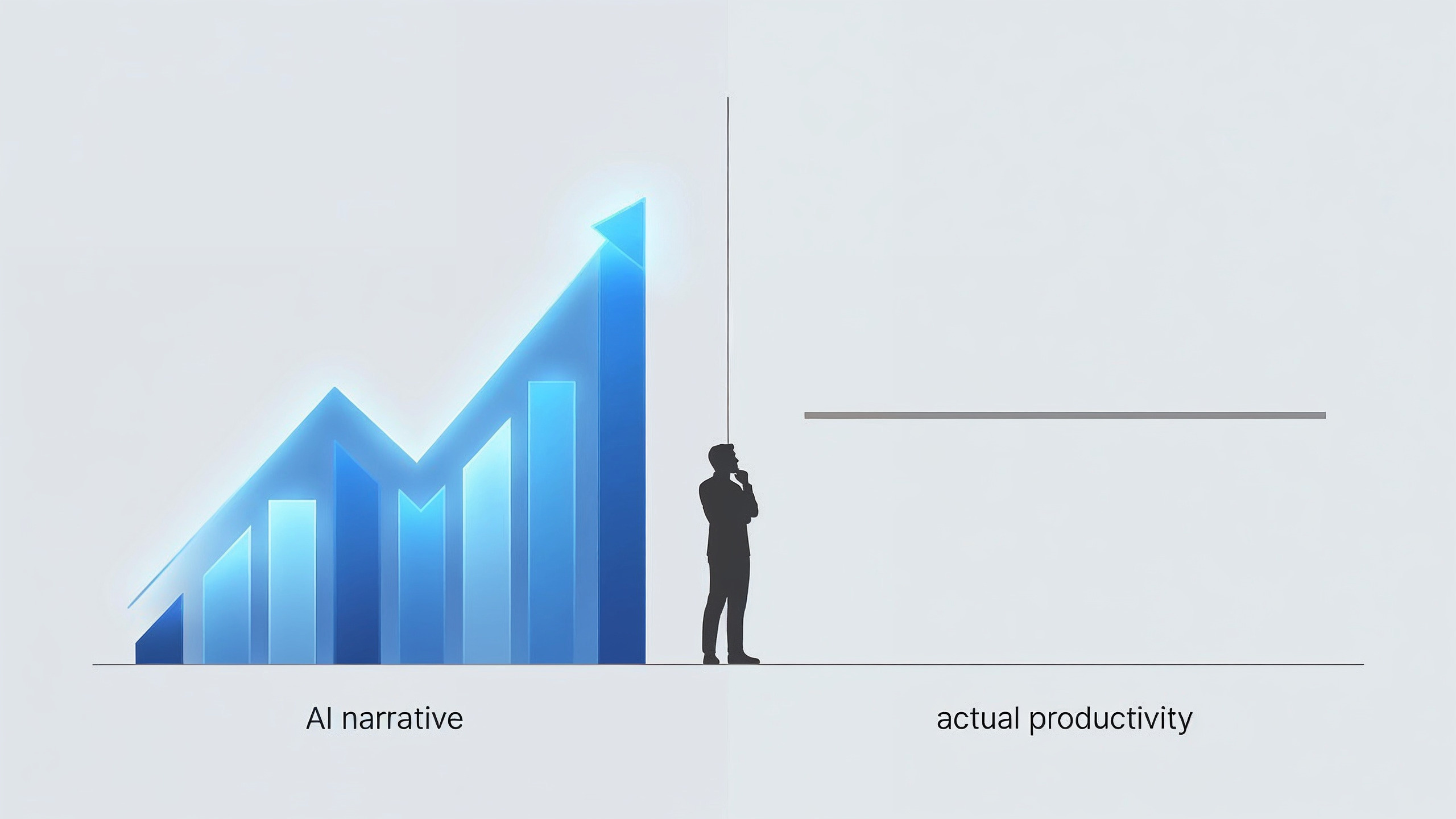
And the people best positioned to know keep saying as much. The economists at Oxford Economics keep pointing at the macro data and finding that firms “don’t appear to be replacing workers with AI on a significant scale” — because, as they put it, “if AI were already replacing labour at scale, productivity growth should be accelerating. Generally, it isn’t.” If a robot army were really swallowing the work, the output-per-worker numbers would be screaming. They’re murmuring.
So no, it’s not a hoax. It’s something slipperier: a true-ish sentence deployed for a misleading purpose. Which is exactly the kind of thing that’s hardest to call out — because the moment you do, someone points at Coinbase and says “but the AI is real,” and they’re not wrong.
The pattern is older than the technology
Here is where things get genuinely clarifying — because if you widen the lens past this one hype cycle, you realize we’ve watched this exact movie before, just with a different monster on the marquee.
Paul Osterman, who has watched this movie before — he’s a labor economist at MIT Sloan — put it about as plainly as an academic ever does: “AI is a perfect excuse to justify big layoffs. It makes it seem as if it’s not our decision, our fault — it’s the technology.” And the part I can’t stop thinking about: “They’ve been saying that for 20 years.” Twenty years. Before it was AI, it was “offshoring.” Before that, “the China shock.” Before that, “automation,” “globalization,” “the new economy.” Every era hands management a faceless, inevitable-sounding force to stand in front of, so that a human decision to spend less on humans can be narrated as something that simply happened.
A management professor at Babson made the same point from a different angle — that companies reach for AI in these announcements because it’s the least bad reason on the menu. Think about the alternatives from a CEO’s chair. Blame tariffs and you sound political. Blame falling sales and you tank your own stock. Blame your own past hiring and you look incompetent. But blame AI? You sound visionary. Your share price might even rise on the news that you’re “AI-native” now. It’s the only explanation that makes cutting your workforce look like leadership.
And what’s the boring truth hiding under the visionary one? Often it’s just money and timing. The reporting on overhiring during the cheap-money years, plus a brutal swing in interest rates, lays it out: companies hired wildly when money was free, then had to pay for it when rates shot past 5%. One prominent venture capitalist estimated large companies are “overstaffed by anywhere from 25% to 75%.” Even the most AI-bullish voice in the industry conceded it — by his own account, nearly every company doing layoffs now blames AI “whether or not it really is about AI.” When the people selling the AI are telling you the AI story is often a story, you should probably listen.
Now imagine the next layoff season
Let me get a little speculative, because the incentives all point one direction and it’s worth picturing where they lead.
It’s the spring of 2028. The cheap-AI narrative has hardened into reflex. A mid-sized company misses its numbers — nothing dramatic, just a soft quarter and an impatient board. The CFO doesn’t write a memo about demand or interest rates. She opens a slide deck titled “Becoming an Intelligence.” The layoff is announced as a “human-in-the-loop transformation.” The stock ticks up three percent on the news, because the market has been trained to reward the word. The cut workers get severance letters congratulating them, in effect, on having been part of something so advanced it no longer needs them.
And here’s the dark joke the incentives already set up: a chunk of those exact jobs quietly come back. Once it turns out the robot couldn’t actually do the thing — once the work the press release said had vanished reappears, undone — the company rehires for it, just with new titles, often as contractors, often for less. The “AI took your job” letter and the “we’re hiring for this role again” posting, six months apart, signed by the same company. If that doesn’t tell you the first letter was a story, I’m not sure what would.
The escalation isn’t sci-fi robots. It’s rhetoric — a vocabulary so good at laundering ordinary cost-cutting into visionary progress that, eventually, no executive ever has to say “we decided to spend less on people” again. The decision vanishes into the technology. That’s the future I’m actually worried about.
What the smart people are saying
What gives me some hope is that this is not a fringe suspicion — careful people across the spectrum are landing in the same place, from very different starting points.
The market-minded macro shop Oxford Economics says the productivity data simply doesn’t show a robot takeover yet. The center-left researchers at Brookings say displacement is real but confined and uneven — not the blanket apocalypse the announcements imply. An MIT labor economist calls it a decades-old excuse. Industry analysts coined “AI washing” to name it. And even the AI industry’s own loudest optimist concedes a lot of companies are blaming AI whether or not it’s true. When the macro hawks, the labor economists, the corporate analysts, and the AI salesmen all land in the same spot — that the attribution is being abused — that’s not a partisan talking point. That’s a consensus hiding in plain sight.
The one thing none of them dispute is that some of it is real — which is precisely what makes the lie so effective. A cover story works best when it’s wrapped around a kernel of truth.
What does this mean for you?
You can’t audit a company’s books from your kitchen. But you can stop letting the word “AI” do to you what it did to my friend — and you can act on both sides of this, because you’re not just a worker. You’re a customer, a voter, and sometimes the person reading the layoff email.
If you’re worried about your own job:
Translate the press release. When a cut is blamed on AI, ask the diagnostic question: can they point at the specific software now doing the specific work? If the “AI-native transformation” has no named tool, no live system, no actual product behind it — you’re looking at AI washing, not AI. The robot in the letter may not exist.
Don’t internalize the cover story. This is the human cost I care about most. If you’re let go under an “AI” banner, do not quietly conclude you’re obsolete. The data says you were very possibly cut for a missed quarter and handed a flattering reason. Update your story before you update your résumé.
Build the things AI is bad at. The honest part of all this is that displacement is real in specific lanes. Most workers are already more worried than hopeful — Pew found 52% worried versus 36% hopeful — and that anxiety is rational fuel if you point it at the right target: judgment, relationships, accountability, the messy human work that doesn’t compress into a prompt. Become the human they have to keep “around the edge.”
If you’re a customer or a citizen:
Refuse to reward the word. Markets bid up “AI-native” because we let them. Treat a company that announces layoffs as “innovation” with the same skepticism you’d treat a restaurant that calls a smaller portion “curated.” Smaller is smaller. Ask what you’re actually getting.
Demand the receipts. “We’re using AI to serve you better” should invite a follow-up, not applause: better how, and who got cut to pay for it? The companies genuinely transforming can answer. The ones washing can’t.
If you’re the one writing the email:
Name the real reason. I know it’s the hard road. But every manager who picks the AI line because it “plays better” is building a world where no decision ever has an author. People can survive a hard truth. What corrodes them is a lie that tells them they’re obsolete when they’re not.
The lesson, as I see it
We are living through a genuine technological shift — that part is not hype, and I’m not here to tell you the machines are harmless. But a real revolution is exactly the kind of cover a tired old maneuver loves to hide behind. The oldest move in management isn’t replacing workers with technology. It’s replacing responsibility with technology — taking a human decision to spend less on humans and dressing it in the inevitable language of the future, so that no one has to own it.
“The AI did it” is becoming the layoff era’s “the computer says no” — a sentence designed to end a conversation right where accountability should begin. And the cruelest part is what it does to the people on the receiving end: it convinces them the problem is them, that they’ve been outpaced, when often they’ve just been outpriced.
My vote? Keep the skepticism aimed in the right direction. Be honest that AI takes some jobs — and be twice as honest that it’s also taking the blame for a lot of jobs it never touched. When the next email lands and it blames the future, do the one thing the cover story is built to stop you from doing. Ask who actually decided. There’s always a name. Make them say it.
The HAIA Foundation exists to keep humans — our judgment, our agency, our dignity — at the center of the AI story, not “around the edge” of it. If you read this far, you’re our kind of skeptic: come think out loud with us at haia.foundation and on our Substack, and forward this to anyone who’s been told, lately, that they’re obsolete.
This article was extremely enlightening. My husband hinted to something like this, but I didn’t really understand what he was talking about. Thank you for writing this!
I really appreciate you for giving attention to this story. I would even go further to claim that the deeper headline is that employers typically do not appreciate employees for who they are; they do not restructure each job around the amazing unexpected gifts of its holder. Family businesses might work that way—you know your daughter will inherit the business, so you shape it to match her passions and abilities—but most businesses today are not family owned. If what stockholders want from employees is something other than what employees offer, then employment is like a bad marriage and it is difficult to build enthusiasm over delaying the inevitable divorce.