
You have probably heard the advice, and maybe passed it on: if federal agents are making an arrest in your town, take out your phone, keep your distance and record. The camera is the witness. The law is with you, too. In the First Circuit, which includes Maine, filming officers at work in public is "a basic, vital, and well-established liberty safeguarded by the First Amendment."
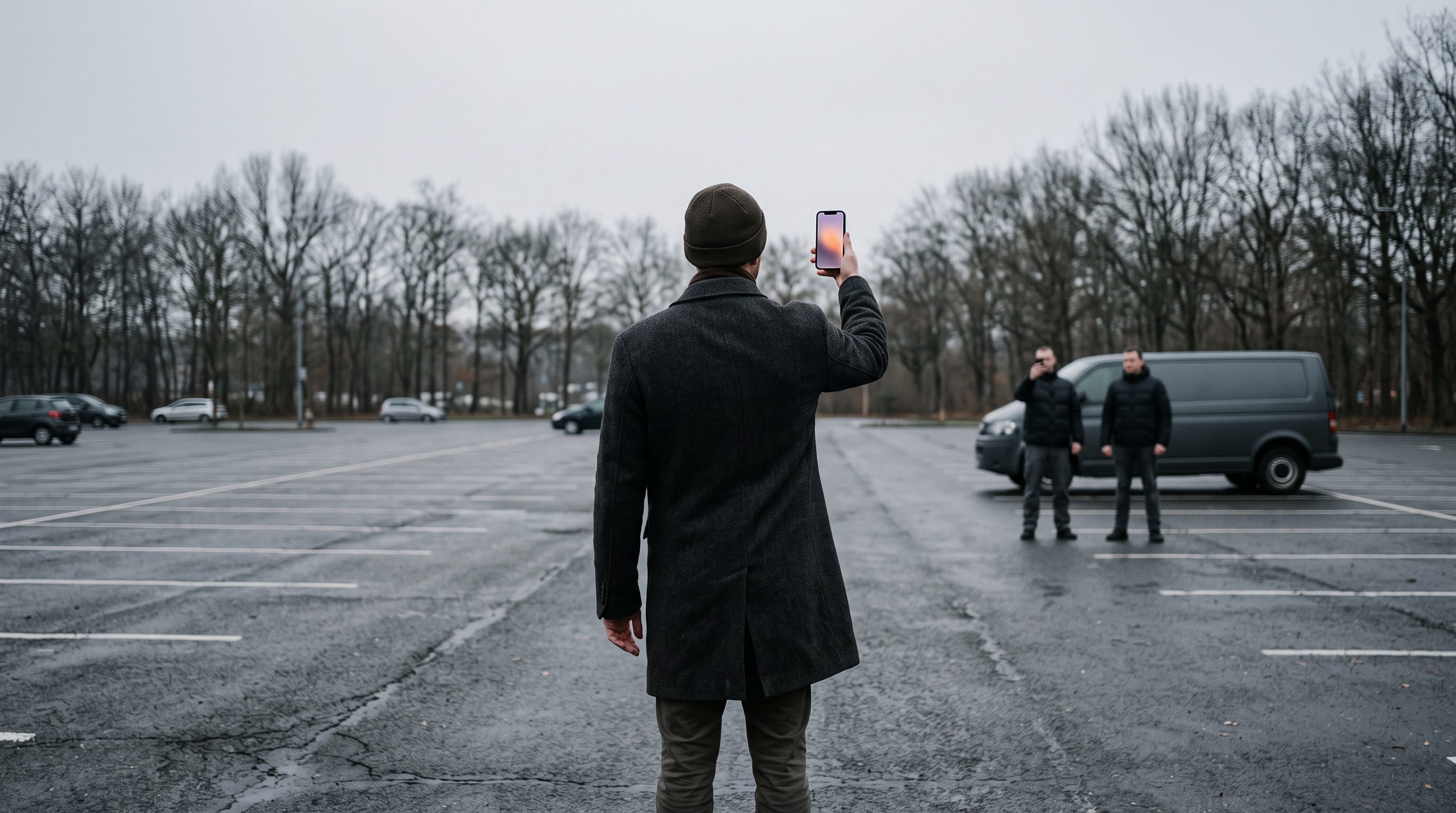
So picture yourself in a store parking lot, phone up, twenty feet from the nearest agent. Now picture him raising his phone back at you.
According to a court filing made public on October 2, 2026, that is how it began for Elinor Hilton, one of four observers suing the federal government in Maine. She "parked her car about 20 feet from one group of agents" and began filming. An agent "immediately held up his phone, ostensibly to record her," and another "approached and filmed Hilton's face as well." The first later testified, the filing says, that he recorded (or pretended to record) observers "almost like a deterrent. If you are going to film us, we are going to film you."
What happened to those faces next is the heart of the observers' motion for a preliminary injunction: their account, contested by the government and, as of October 3, 2026, not ruled on. It is worth knowing before you next raise your phone.
Two observers, two encounters and "a few officers"
What did the government tell the judge in March? In short, that the case was small. The suit, Hilton v. Mullin (Markwayne Mullin is the Homeland Security secretary), then rested on two encounters: Hilton's, and one in which an officer told a second observer, Colleen Fagan—on video—that she was now "considered a domestic terrorist." (He later told his supervisor he was "trying to be funny," the government says, and was given verbal counseling.)
The government's lawyers described "past encounters with a few officers" and called the alleged threats to put observers on a database or watchlist "not only contrary to policy but empty threats." Empty, in their sense, meant not carried out: the officers "did not enter their information into a database or watchlist related to those encounters." A supervisor swore that the agents' team leader had confirmed they "did not place the Plaintiff Elinor Hilton on any list or database." And a Justice Department lawyer told the court, "We don't think what happened here was proper."
On March 23, 2026, Judge John A. Woodcock Jr. denied emergency relief. He saw "a significant difference" between an agency-wide policy and "the actions of a few agents, who are acting contrary to agency policy." But he noted that the government had been "careful not to affirmatively assert that the Government does not have a database that covers protestors and observers," and that discovery might show more.
From a parking lot to a border lookout, according to the filing
So what changed? Discovery. The motion, filed under seal on September 11 and made public in redacted form on October 2, argues that "none of the government's representations hold up."
Soon after the parking-lot encounter, it says, an agent of Homeland Security Investigations—the investigative arm of Immigration and Customs Enforcement—sent "photos of Hilton and others" to an officer of Customs and Border Protection, writing "Officer safety" and "Let me know what you find." That officer "ran a facial recognition search using the Mobile Query application on his phone" and "identified Hilton and others."
Later, the motion says, the HSI agent "created ICM records for two of the other observers and a vehicle he associated with observers, describing each as a 'Threat to Law Enforcement, Professional Protestor.'" Hilton was not one of them: he "admitted that he '[a]bsolutely' would have created an ICM record for Hilton as well but believed he had not been able to identify her."
ICM, short for Investigative Case Management, is HSI's case system. The motion counts records on six observers. The government's number is eight: its motion to dismiss says the agent "documented contemporaneous subject records on 8 individuals he encountered in Maine that he believed posed 'potential threats to law enforcement'" and that he "did not attempt to nominate any individuals to the terrorist watchlist." (Eight "individuals," not necessarily observers. And keep the word "believed" in mind.)
The starkest account concerns Carlyn Williams. On January 20, the motion says, her spouse, Polyxenia Pantos, watched the end of an arrest for five to ten minutes, then drove off in a car Williams owns. The agent traced the car to Williams by its plate, sent her photo to his team ("Was this the protestor.") and heard back from a colleague who had been there: "I don't think those are the same women." He then phoned Williams. In her account, he warned that people "doing things like that might get added to a domestic terrorism watchlist"; he denies mentioning a watchlist and testified, Wired reports, that he warned she would be arrested if she continued.
"Despite learning that Williams had not been on the scene," the motion says, the agent "still created records" about her and her car. One states that "her License Photo matches the video recordings of an aggressive woman interjecting herself into an arrest." The records, it says, flag her for secondary inspection "any time she travels internationally, at least through the end date of January 20, 2027," a date the agent can extend. On March 16, 2026, returning from an anniversary trip to Quebec, Williams and Pantos "were held for about an hour at the Jackman Border Crossing," where officers took their phones; the report from that stop, the motion says, "confirms that officers found no evidence of unlawful conduct." Afterward, "she stopped observing ICE activity entirely."
How does a line in an investigative file meet you at a border booth? ICE's own 2016 privacy assessment describes the route in general terms: ICM can "continually publish and update ICE-created Subject Records to the CBP TECS Platform," where they "serve as 'lookout records'" for screening at the border. In Williams's case, the government's own motion to dismiss says the entry "led to the March 2026 border stop."
As of October 3, 2026, the docket showed the government's opposition filed and the observers' reply due October 16; the parties had proposed a hearing the week of October 19, and the government's motion to dismiss was pending.
Shouldn't agents know who is following them?
The government says yes, and its case deserves a fair hearing.
In its account of the parking lot, a car followed agents carrying a detainee and "frequently ignored stop lights and other traffic laws," and the agent believed Hilton had chased his team. The observers answer that she "arrived on the scene alone in her car—a green Toyota with red racing stripes and bumper stickers." As for Williams, the government says the agent "believed, and believes, that Williams was interfering with an arrest."
More broadly, officers "have legitimate reasons to identify individuals or vehicles encountered during enforcement activity, assess whether they present safety or operational concerns," the government argues. The fear is not abstract. One agent testified, in deposition excerpts reported by the Portland Press Herald: "I heard multiple times that people were going to find me and my family, and we're going to pay for it." DHS counts 647 assaults against ICE from January 20, 2025 to September 20, 2026, against 37 in the same stretch of 2021–2022, and says someone mailed an ICE officer's neighbors in North Carolina a postcard reading "Beware! Your neighbor is an ICE agent," with a photo of his face.
Policy points the same way. DHS's 2019 policy says the department "does not profile, target, or discriminate against any individual for exercising his or her First Amendment rights." The Privacy Act bars agencies from keeping records of how people exercise First Amendment rights, with exceptions that include records "pertinent to and within the scope of an authorized law enforcement activity." That exception is where the two sides collide.
Then there is standing. The government says the case rests on "the actions of a handful of agents who were deployed there for an enhanced operation lasting four days in January 2026." Hilton, it adds, "recently moved out of state." And on September 18, 2026, a federal judge in Minnesota dismissed a similar suit by protesters and observers for lack of standing, because the surge there had ended.
So were the March statements false? The sworn statements about Hilton and Fagan themselves are not contradicted: the motion agrees the agent intended, but failed, to log Hilton. It does dispute sworn assurances about what agents had been told: that agent, it says, "was never instructed not to repeat his threat." Williams and Pantos joined the case on April 27. What the filing adds is everyone those statements left out, the narrowness the judge flagged.
A DHS spokesperson, quoted by Wired, called the case "meritless" and said that "the underlying lawsuit is based on the lie that there is a database of 'domestic terrorists' run by DHS." The denial and the motion can both be true—the filing alleges entries in an existing investigative system, not a standalone list. Todd M. Lyons, then ICE's top official, wrote to a member of Congress on April 21 that DHS keeps no "separate, standalone database" for people who are not arrested, while information collected in such encounters "is maintained consistent with applicable law and DHS and ICE policies and is treated as an official government record."
Australia's privacy commissioner didn't need a plaintiff
Does it always take a lawsuit to learn what police did with a face search? Australia suggests not—with caveats worth keeping.
Between November 2, 2019 and January 22, 2020, Clearview AI gave free trials of its face-search tool to members of a child-exploitation center led by the Australian Federal Police. Seven of them ran searches, on images that included possible persons of interest, victims and members of the public.
The Office of the Australian Information Commissioner, which calls itself "an independent agency within the Attorney-General's portfolio," opened a formal investigation in March 2021, in Commissioner Angelene Falk's words "an investigation commenced on my own initiative." No lawsuit, no complainant. In a determination dated November 26, 2021, she found the AFP had failed to complete a privacy impact assessment before using the tool, or to put systems in place to make sure one was done. She declared that it had thereby "interfered with the privacy of individuals" and "must not repeat or continue" those practices. She also found that the AFP held no logs of who had used the tool or how.

Now the caveats. Journalists, not the regulator, surfaced the trial. The remedy was governance (an independent assessor's review and updated privacy training), not a fine. The AFP kept meeting Clearview's chief executive after the ruling, according to freedom-of-information records reported in 2023. Falk herself allowed that facial recognition and similar technologies "may provide public benefit where they are accompanied by appropriate safeguards." And the uses differ: a child-exploitation unit testing a commercial tool is not an agent photographing protest observers.
What carries over is the design. Australia's regulator could open the file itself, establish what the agency had not even recorded, and publish its declarations. In Maine, the observers conceded in March that they did not yet know "what the Agents did with that information." The account in this motion exists because they sued and obtained discovery—which ran, by the government's count, to "over 20,000 pages of documents" and "over 34 hours" of depositions.
The surge leaves town. The lookout stays.
Let me play this out (my extrapolation, not anything the filing alleges).
The pieces already exist. A face search can run from an officer's phone. An ICM record can, by ICE's own description, travel to the border as a lookout. In the government's own account, the Maine agent logged people he "believed" posed potential threats. And Georgetown Law researchers found in 2022 that ICE had used face recognition to search the driver's-license photos of "around 1 in 3 (32%) of all adults in the U.S."
So imagine the next surge, in the next city. You film from across a lot. Someone films you back, and your picture travels from one phone to another. A match comes back. A label gets typed and rides along to a border booth, where an officer—following policy—sends you to secondary. At no step did anyone have to show that you broke a law. Each person only had to believe something.
Then the surge ends, and the clocks split. The courtroom clock runs on the surge, as Minnesota showed. The lookout runs to its own end date, which in Williams's case, the motion says, is "January 20, 2027," or later if the agent who wrote it decides so.
Two fears, both on the record
Where do the people who think about this for a living come down?
The ACLU's Scarlet Kim read the ICE letter as evidence of the problem: "So their own definition of what potentially violates the law and could trigger surveillance against an individual includes activities that are squarely protected by the First Amendment," she told NPR. Reason, the libertarian magazine, "has argued through both Republican and Democratic administrations that government fears of 'domestic terrorism' are a pretext for increased snooping and harassment."
From the security-minded side, the Manhattan Institute's Christina Buttons, writing in City Journal about Minneapolis, describes ICE-watch networks whose participants "track suspected ICE agents—by car and on foot—and post suspected officers' locations, photos, and license plate numbers." Mathew Silverman, president of the Federal Law Enforcement Officers Association, puts it flatly: "Attacks on federal law enforcement are at an all-time high," including "targeted physical and doxing attacks on officers and their families."
Set Buttons's sentence beside the motion and both describe the same act from opposite ends of the lens. What differs is where the pictures can go. An agent's face can end up in a group chat (or, DHS says, on a postcard to his neighbors). An observer's face or plate, captured by an agent, can end up, the motion says, in a federal file that follows someone to the border.
What does this mean for you?
None of this is legal advice.
Film, and keep your distance. The First Circuit (Maine, Massachusetts, New Hampshire, Puerto Rico and Rhode Island) recognized the right in Glik v. Cunniffe in 2011, while calling it "not unqualified." The ACLU's guide to your right to film ICE in public says you may record "as long as you don't interfere with or obstruct their operations, or break another valid law while you're filming," though on private property, such as a store's lot, "owners can set their own rules about photography and filming." Officers may move you for safety, but under a 2014 First Circuit ruling, an order aimed at the filming itself is allowed only if an officer can reasonably conclude that "the filming itself is interfering, or is about to interfere."
Lock your phone with a passcode, not your face. EFF's Surveillance Self-Defense guide warns that biometric unlock "means an officer could physically force you to unlock your device with your fingerprint or face," and suggests turning it off at protests and anywhere a demand to search your phone is more likely, such as a border crossing.
Obscure faces before you post. The same guide says to obscure the faces of anyone who hasn't consented and to "block out or blur other identifying features such as tattoos or unique clothing."
Pulled into secondary again and again? File a DHS TRIP inquiry. The Traveler Redress Inquiry Program takes inquiries from people who "have been repeatedly referred to additional (secondary) screening." It promises an inquiry, not an outcome; nothing on DHS's page says it can lift a lookout.
Ask for your own records. DHS takes FOIA and Privacy Act requests online only; border records go through CBP's SecureRelease portal. Investigative records sit with ICE, which says it applies exemptions to protect sensitive information, so expect redactions; you have 90 days to appeal an adverse ICE letter.
In Maine, put it on record. The Attorney General's office set up a dedicated address in January 2026 for reports of "intimidating and excessive federal enforcement behavior" (CitizenReporting.OAG@maine.gov; no photos or videos, and what you send may become public). The ACLU of Maine keeps an intake form for observers.
The lesson, as I see it
Agents have real reasons to want to know who is following them, and the doxxing of officers is real. As I argued about plate readers in September, "the controls, not the usefulness, are what collapsed." If the motion's account holds up, the same is true here.
So what would controls look like? A face search that leaves a log someone else can read. A threat record that has to name what a person did, not a label like "Professional Protestor." An end date set by someone other than the agent who wrote the record. And an office with the reach of Australia's commissioner, able to open the file without waiting for four people to sue.
As I wrote in August: "A face recognition result is not an identification." The same discipline belongs on a human match, like the one the motion describes in Williams's record, which a colleague at the scene had already doubted. A match is a lead; treating it as an identity is a choice someone else should be able to review.
My vote? Keep both rights—the observer's to film and the agent's to stay safe—and put what each camera produces under rules a stranger could check. However Judge Woodcock rules, one question will outlast this case: when you raise your phone, who decides what happens to the picture taken of you?
If someone you know keeps a phone ready for the next arrest in your town, send this to them now. The right and the precautions are easier to learn before that moment than during it.