
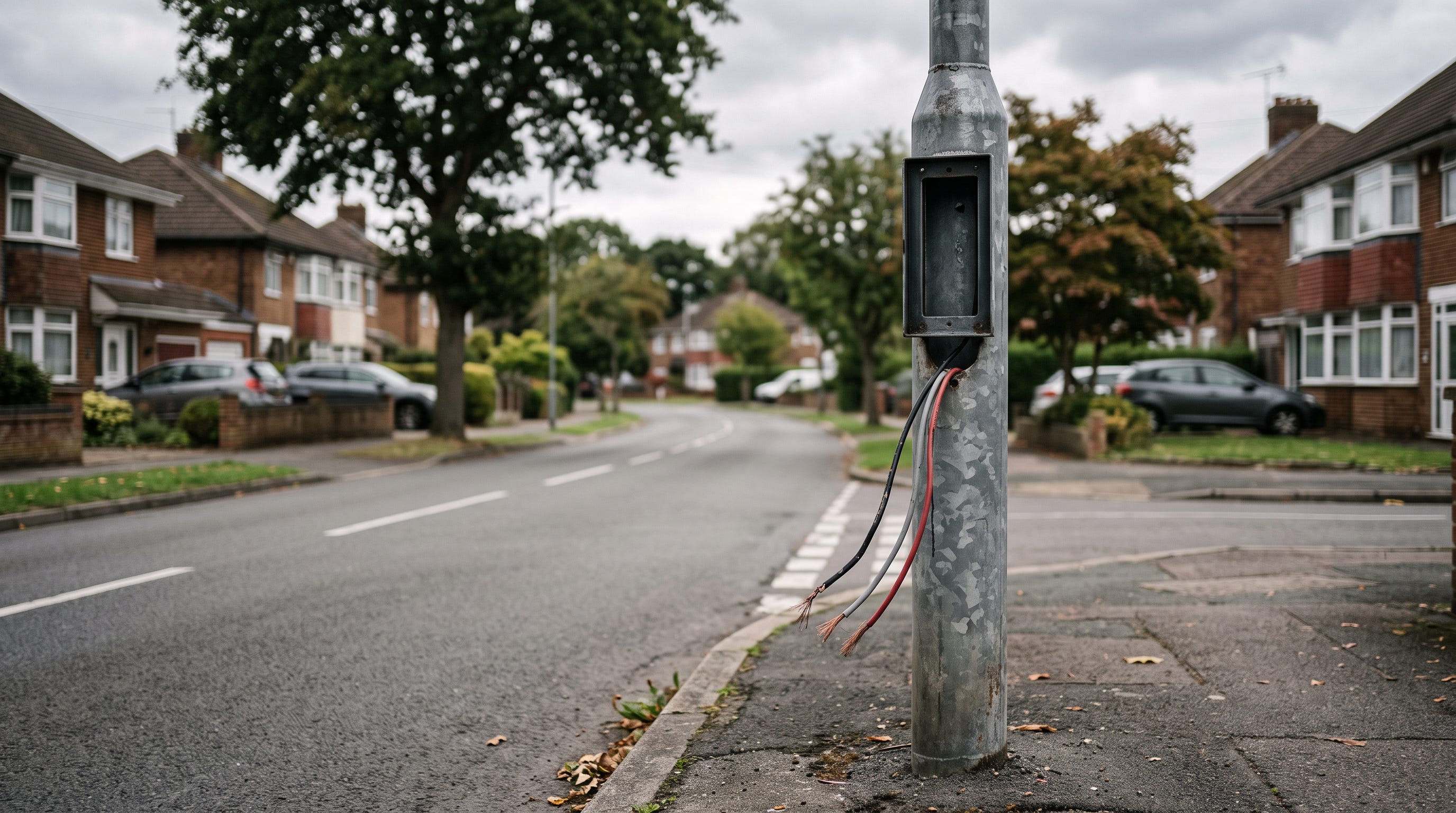
I forwarded that ruling to three people the morning it came down. My message was one word: finally.
I had read a headline and about two paragraphs. What I had in my head was a tidy story in which the Supreme Court had looked at the machinery quietly tracking everyone's movements and said no. It felt like the thing I had been waiting years for somebody to say, and I passed it along with the small satisfaction of a person whose position has just been vindicated by nine strangers in Washington.
Then I read the opinion, and the tidy story fell apart in a way I found genuinely disorienting — not because the decision was bad, but because it was about something else entirely, and because the cameras I thought it had killed were already coming down for reasons that had nothing to do with it.
This piece is about that gap. It matters more than the ruling does.
What the Court actually decided
Chatrie v. United States was decided on June 29, 2026, and it is a real and consequential Fourth Amendment case. It is about geofence warrants: the practice of asking Google for a list of every device inside a drawn boundary at a given time, in this case to identify a bank robber.
The holding is one sentence, and the Court flags it as the holding: "we hold that police officers invade a cell-phone user's reasonable expectation of privacy when they access his Location History. It does not matter if the time period scrutinized was only two hours. Nor does it matter that the materials obtained were handed over by a third-party tech company."
That is a significant win for privacy, decided by a 6–3 vote. Two hours of location history is a search. The third-party doctrine does not launder it. If you have been arguing that handing your data to a company should not strip its constitutional protection, you won something real that day.
Now here is what I did not know when I hit send.
I downloaded the slip opinion — majority, two concurrences, two dissents, syllabus, the whole thing — and searched the text. The phrase "license plate" appears zero times. So does "plate reader." So does "ALPR." So does "automated." The word "camera" appears exactly once, in the statement of facts, describing the surveillance-camera footage that started the investigation — footage that, the Court notes, left the robber "at large," which is why police reached for a geofence warrant in the first place.
The Court did not narrow the law on plate readers. It did not expand it. It did not reserve the question for later. It never raised the subject.
And the question presented explains why: "Whether the execution of a geofence warrant violated the Fourth Amendment." That was the whole grant. Certiorari was limited to Question 1. Cases are not sprawling inquiries into a technology; they are answers to the question somebody paid a filing fee to ask.
The passage that cuts the other way
There is one place where Chatrie touches surveillance on public roads, and it does not do what you would hope.
To explain why an older case — United States v. Knotts, about a tracking beeper — did not control, the Court distinguished it. And the distinguishing feature it chose was that Knotts involved public roads:
"And still another feature of Knotts makes it inapt here: that the surveillance there was confined to public roads. That fact was crucial to the Court's decision: 'A person traveling in an automobile on public thoroughfares has no reasonable expectation of privacy,' Knotts explained, because the car is always 'in plain view.' By contrast, the movements that Location History reveals are not limited to public streets."
Read that as a defense lawyer would. The Court's reason for setting Knotts aside is that Knotts was about public roads and this case was not. The public-road rule is not disturbed; it is the thing being contrasted with. And a fixed camera on a pole photographing a plate on a public street is about as squarely inside "surveillance confined to public roads" as a technology can get.
Justice Barrett, dissenting, described the data at issue as "his public movements." Justice Alito, also dissenting, called the majority "an opinion composed exclusively of dicta" — and predicted the limits would not hold, in the best line of the term: the qualification "might as well be written on the dissolving paper sold in magic shops."
Alito may be right. That is a genuine possibility and I will come back to it. But a dissent's prediction that a holding will expand is not the same as the holding having expanded.
The hostile witness agrees
If you think I am reading this tendentiously, consider who else says so.
Flock Safety is the company that sells most of these cameras. It has every commercial reason to characterize the ruling as narrowly as possible — and also every reason to be careful, because it is saying this to customers and courts. Its own VP of Litigation wrote: "This was not an ALPR case. Chatrie does not mention, much less directly address, automated license plate reader (ALPR) technology."
The company is an interested party and you should read it as one. But it is not wrong about the text, and I could not find a page anywhere that disputed the point on the merits. Truthout, reporting the cancellation wave sympathetically, says the same thing in passing: "the Supreme Court did not mention ALPRs in their decision."
So we have a company defending its product and an anti-surveillance outlet cheering its retreat, agreeing on the one fact that matters. That is usually a sign you can stop arguing.
So why are the cameras coming down?
Because a great many people got angry, in public, at meetings, for reasons that are all on the record — and they started well before June.
NPR reported in February 2026 — four months before the ruling — that "at least 30 localities" had already deactivated cameras or canceled contracts since the start of 2025, "with much of the activity happening in just the last three months." Flagstaff, Cambridge, Eugene, Santa Cruz. The cause it identified was not constitutional doctrine. It was discovery: "many city officials have realized after the fact that they were sharing their data more broadly than they had known, and that federal agencies, including U.S. Border Patrol, had searched their data."
That is the engine. Not a court telling towns they must stop, but towns finding out what their own cameras had been doing.
The specifics are worse than the summary. In May 2025, 404 Media reported that Texas authorities "performed a nationwide search of more than 83,000 automatic license plate reader (ALPR) cameras while looking for a woman who they said had a self-administered abortion." The EFF later obtained the search logs; the stated reason typed into the system by another official on two searches was "had an abortion, search for female."
The ACLU documented the vendor making false statements to city councils about data sharing — in Oshkosh, "the very next morning, the city learned that Flock had lied." Two House members opened a formal investigation in August 2025, demanding "a full accounting of all National Lookup searches involving the terms 'abortion,' 'ICE,' or 'CBP.'" That is ten months before the Supreme Court said anything.
Then look at what individual councils actually said when they voted.
In Pflugerville, Texas, the council declined unanimously to renew an $87,500-a-year lease. The reason came from the police chief, not from privacy activists: "Clarity around how we protect community data, uphold expectations of data preservation and maintain security measures is essential, and currently I do not have that clarity."
In Menasha, Wisconsin, the council voted seven to one to terminate — after a former officer was sentenced to probation and six months in jail for using the cameras to track his ex-girlfriend. The chief's comment is the whole story in one sentence: "While I cannot say I trust the company anymore, the technology has been a great help for law enforcement."
Asheville voted five to two. Harrisonburg went four to nothing, and the city manager said the systems "will go dark on Friday." Lynchburg went six to nothing on September 3. In Winston, Oregon, the contract ended "amid privacy concerns and law enforcement budget cuts" — and the chief said the cameras were "a great tool. We've solved huge cases."
Not one of those councils gave the Supreme Court as its reason. What they gave was: we do not know who is reading our data, our own officer abused it, the vendor lied to us, or we cannot afford it.
The smoking gun
There is one place I found where the ruling was invoked, and it is perfect.
At an August 27 council meeting in Lexington, Kentucky, a member cited the Supreme Court's June decision as requiring a warrant "to collect sprawling digital location history." The reporter corrected her inside the same paragraph: "(The case is Chatrie v. United States, decided June 29; it concerned cellphone location records, not plate readers…)" — and then noted that "several speakers cited it Thursday as if it reached both."
As if it reached both. That is the whole phenomenon in five words, observed live, by a local reporter who had done the reading. A correct instinct, attached to the wrong authority, repeated confidently in a room where a decision was being made.
A word about the numbers, because they do not agree
If you go looking for how many places have pulled the plug, you will find at least five different figures, and they are all "true" in the sense that somebody counted something.
The Institute for Justice, a libertarian public-interest firm, built a database; as of August 28, 2026, it counted 137 local governments since the start of 2025 — and it is admirably explicit about what it excludes: "This list does not include jurisdictions that only paused operations of ALPRs or switched to another provider." Secure Justice, an Oakland anti-surveillance group, has tracked "more than 200 municipal Flock contract terminations" since 2021, including "more than 90 cities and counties" in August 2026 alone. Truthout counted "at least 82 jurisdictions" as of July 10. NPR's February figure was "at least 30 localities." The Washington Examiner counted "approximately 23 city councils" voting to cancel, not renew, reject or deactivate since the start of 2026.
These count different things — governments versus councils versus jurisdictions — over different windows, with different rules about whether a pause or a switch to a rival vendor counts. I am not going to blend them into one number, and I would be suspicious of anyone who does.
I want to flag IJ's exclusion in particular, because it is the honest problem with this whole story: a town that drops Flock and buys the same capability from a competitor shows up in nobody's cancellation count as a town that kept its cameras. The retreat from this vendor is documented. The retreat from this technology is less clear than the headline totals suggest.
The case against everything I have just written
Now let me argue the other side properly, because there are three serious rebuttals and the piece is worthless if it dodges them.
First: the reasoning may extend even though the holding does not. Andrew Ferguson, who writes about this for a living, told The Record that the ruling "certainly strengthens the Fourth Amendment case against the warrantless collection of ALPR data." Note the verb — strengthens the case, not decides it. And Alito's dissolving-paper line is the same prediction from a hostile direction: he expects the "parchment limits" on this holding to "fade away just as quickly as Carpenter's have."
They could both be right. A ruling that says accumulated location data reveals the privacies of life is a tool a good litigator will point at a camera network eventually. My argument is not that Chatrie is irrelevant to plate readers forever. It is that it has not done anything to them yet, and that treating a future argument as a present holding is how you lose in court.
An IJ lawyer put the distinction better than I can, and it is notable that it comes from the movement's own side: the decision "does not give activists the power to take down ALPRs, but it does provide a powerful set of talking points" for confronting city leaders. Talking points are not nothing. They are also not a warrant requirement.
Second: the existing law runs the other way, and recently. Three months before Chatrie, the Fifth Circuit decided United States v. Porter and held that plate readers are not a search at all: "the use of an LPR system did not invade any reasonable expectation of privacy and did not constitute a search, so no warrant was required." Its reasoning was capacity-based — the system "is not capable of tracking the 'whole of [an individual's] physical movements,' much less 'for a very long period,' to the extent that a cell phone can."
In January 2026 a federal judge upheld Norfolk's network, though with a caveat worth keeping: "as the number and capabilities of ALPR cameras expand, the constitutional balancing could conceivably tip the other way." And Congress's own research service confirms the landscape: "No federal appellate court has decided that issue," while noting that courts have "cautioned that the technology could run afoul of the Fourth Amendment moving forward, with one court suggesting 'that day might well be on the horizon.'"
On the horizon. Not here.
Third, and hardest: the cameras solve crimes. This is the part that anti-surveillance writing usually skips, and skipping it is why that writing does not persuade anyone who has worked a case.
A Connecticut chief told a legislative panel: "In the last ten months, we've had three homicides. This LPR has played a critical role in all three of those homicides in solving them." The Arkansas Association of Chiefs of Police went on the record supporting the technology as seven Arkansas cities dropped it: "There's definitely more benefit than there is harm." A retired Arizona chief predicted the cost of removal in plain terms: "you are definitely going to have cases that aren't going to be closed, going to have victims who will never get closure."
Flock says its cameras helped police in "more than 1 million criminal investigations" in 2025 and helped locate nearly 10,000 missing people. That is the company's own number about its own product and should be read accordingly — but even the chiefs who canceled kept saying the tool worked. Menasha's chief lost trust in the vendor, not the technology. Winston's chief called it great while the budget killed it.
So the honest framing is not "surveillance bad, towns wise." It is that a genuinely useful tool was deployed with genuinely inadequate controls, and the controls, not the usefulness, are what collapsed.
Meanwhile, in Germany, the question was actually asked
Here is what makes the American situation strange, and you can only see it from outside.
There exists a constitutional court that has squarely decided the exact question the Supreme Court has never been asked. On December 18, 2018, the Bundesverfassungsgericht ruled on automated plate scanning under the Bayerisches Polizeiaufgabengesetz — the Bavarian police statute whose Article 39 authorizes automated plate recognition — and held the regime partly unconstitutional for violating the right to informational self-determination.
The critical move is one the American debate has never had to confront. The German court held that the interference with the fundamental right happens at capture — for everyone scanned. Not only for the driver whose plate matches a wanted list. Also in the Nichttreffer case: the no-match, where the system photographs your plate, compares it, finds nothing, and discards the record in a fraction of a second. That is still an interference. And in so holding, the court expressly abandoned its own 2008 precedent, BVerfGE 120, 378, which had said the opposite.
It was not a one-off. Companion decisions the same day covered Baden-Württemberg and Hessen, and all three Länder were given until the end of 2019 to rewrite their statutes. A constitutional scholar writing in Verfassungsblog called it a Korrektur — a correction of the court's own case law — noting that the measure now appears "erheblich eingriffsintensiver" than under the earlier decision, while adding the honest hedge that the practical consequences changed rather little.
That hedge matters, and so does this: Germany did not ban plate readers. The ruling required a proper statutory basis, a purpose serving legal interests of considerable weight, and proportionality. Cameras still operate. The contrast is not "Germany protects people and America does not."
The contrast is that Germany's highest court was asked, answered, and set conditions — and America's has not been asked, so the question is being settled instead in city council chambers, one 5–2 vote at a time, by people reading news coverage of a case about something else.
One system produced a rule. The other is producing an outcome. Those are not the same thing, and only one of them survives a change of mood.
Now run it forward
Play the next three years the way it will actually go, which is not dramatically.
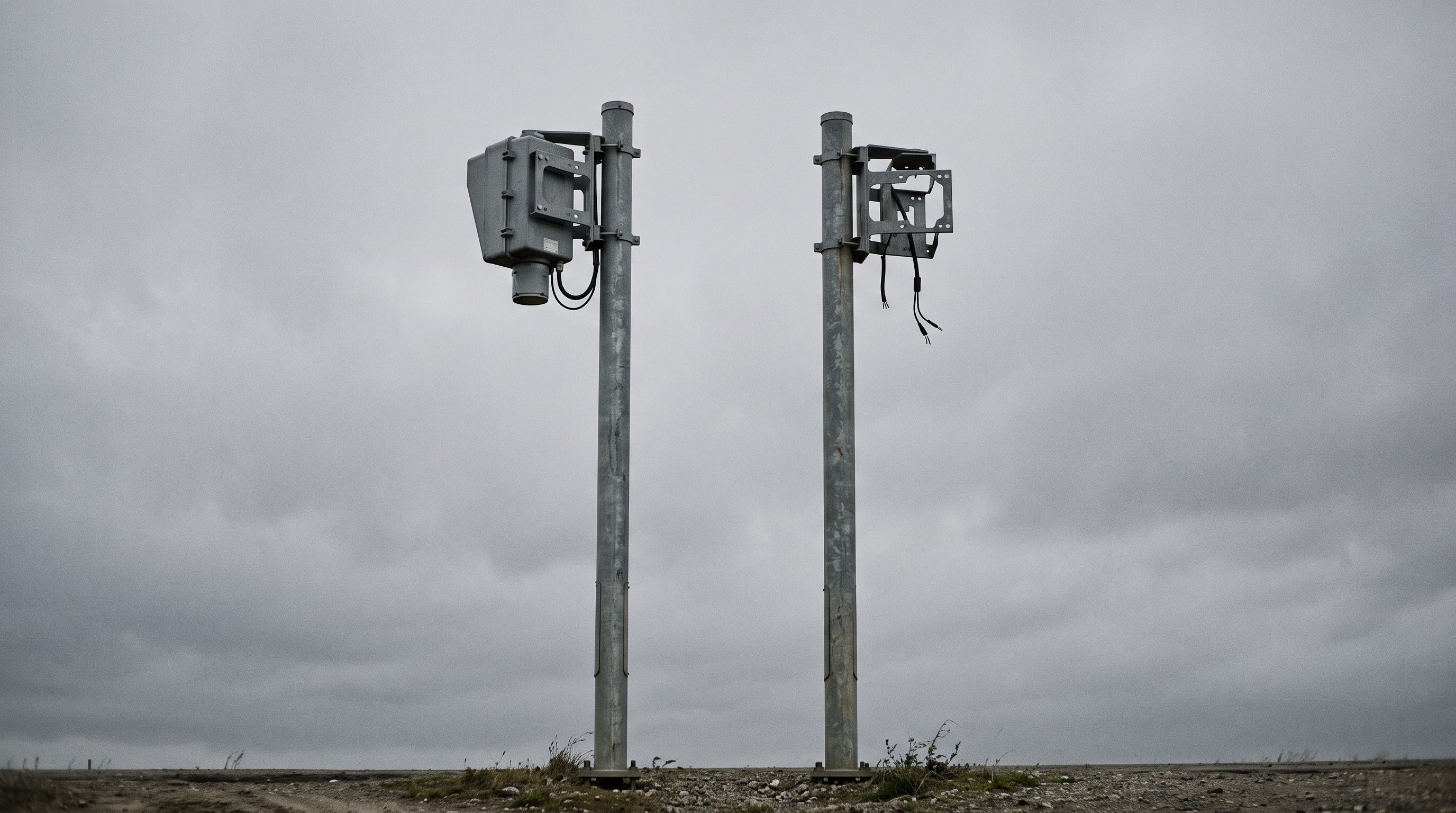
The cancellation wave continues through 2027, because the stories that drove it keep arriving — a sheriff's office searching for someone across a network its own county never authorized, an officer looking up a partner, a state regulator pulling permits, as Florida's transportation department did on August 31, citing "concerning reports of misuse, data privacy concerns, and surveillance schemes."
But the wave is uneven, because it depends entirely on whether a given town has had its scandal yet. Places that have not, keep their cameras. Places that have, remove them — and some of those quietly buy an equivalent system from a competitor with a less notorious name, which is why IJ's careful exclusions are more informative than the totals.
Meanwhile the actual legal question moves at the speed of litigation. The Norfolk plaintiffs said they would appeal. Someone eventually gets a circuit split — Porter says not a search, and some other panel, reading Chatrie's language about the privacies of life, says a dense enough network is different. That is a 2029 or 2030 Supreme Court case at the earliest, and it will be decided on a record about camera density and retention periods that nobody is building carefully right now.
And here is the outcome I would actually bet on, the boring one. By the time a court rules, the technology in question has changed enough that the ruling lands slightly beside it — the way Chatrie landed on Google's Location History just as the interesting data moved to a dozen other places. Councils will still be voting. The cameras will still be going up in some towns and coming down in others. And the constitutional question will still be open, because nobody with standing and money and a clean record has managed to put it in front of the right court at the right time.
That is not a dystopia. It is just what it looks like when a technology outruns the institution that is supposed to rule on it.
What the people who watch this closely are saying
The striking thing about this fight is that the coalition against the cameras does not map onto anything.
On the left, the ACLU and EFF have done the documentary work — the search logs, the false statements, the mission creep that is "already here" rather than hypothetical: "Police often swear that a piece of technology will only be used in a particular set of circumstances or to fight only the most serious crimes only to utilize it to fight petty crimes or watch protests."
On the libertarian right, the Institute for Justice is suing Norfolk over its 176 cameras — a suit in which the federal government has intervened on the side of the cameras. Its attorney frames the objection in terms a conservative can sign: these systems gather data on ordinary people's movements and pool it in a database officers can search on demand, without a warrant and without anyone being suspected of anything.
And writing in a syndicated column, Reason's Jacob Sullum notes the political shape of it: the congressional response "has been dominated by conservative Republicans," including an investigation announced by Senator Josh Hawley, "which confirms that the backlash is not limited to libertarian or left-leaning critics." He also carries IJ's count of "well over 100" abuse incidents with the group's own hedge attached — that this "may be just the tip of the iceberg."
For what the ruling itself did, the most careful reading I found is by Michael Dreeben, a former Deputy Solicitor General who has argued more Fourth Amendment cases than almost anyone alive. His analysis of Chatrie walks through what was held and what was sidestepped — the Court "stopped well short of saying whether any judicial warrant could issue for 'geofence' information." He discusses tower dumps, reverse searches, data brokers. He does not mention plate readers either. When the person best placed to spot the implication does not raise it, that is evidence.
What does this mean for you?
When a court ruling is credited with a result, ask what it actually held. Not what it implies, not what it strengthens — what it held, and on what question. That habit costs you ten minutes and it is the single most useful thing in this piece. Opinions are public and free.
If your town is voting on this, the useful arguments are local, not constitutional. The things that have actually moved councils are: who else can query our data, what happened when our own officer misused it, what did the vendor tell us that turned out to be untrue, and what does it cost. "The Supreme Court says" is the weakest argument in the room, and it is wrong.
Ask the retention and access questions, in that order. How long is a scan of my plate kept if it matches nothing? Who outside this department can search it? Has any federal agency queried it? Those three questions produced most of the cancellations described above.
Notice when a cancellation is a substitution. If your council drops one vendor, ask what replaces it. A contract ending is not the same as a camera coming down, and the counts everyone quotes do not distinguish them unless the counter says so.
Hold both facts at once. These systems have solved homicides and found missing people, and they have been used to hunt a woman who had an abortion. Any argument that requires you to forget one half is an argument you should not trust — including, I would gently suggest, the version of this I forwarded to three people in June.
The credit and the cause
What unsettles me about this story is not that people got a case wrong. It is how well the mistake worked.
The councils are, I think, reaching the right answer. A surveillance network that a stranger in another state can query about your movements, with no warrant and a retention period nobody voted on, is not something a town should buy on a vendor's word. Every place that paused to ask who was reading its data was doing the job.
But one of the reasons now being given is a decision that never mentioned them. I found that happening clearly in one room, in Lexington, where a reporter caught it — which is a thin sample, and I am not going to inflate it into a national pattern. It is enough to worry about, though, because a movement that runs on a misunderstanding has a structural problem: it can be corrected. Somewhere a city attorney is right now reading the actual opinion, telling a council that the case is about cell phones and Google, and being entirely correct. Flock's lawyers have already published that argument for him. When that correction lands, the towns that voted on the strength of the misreading have nothing left to stand on except the reasons they should have led with — the abortion search, the jailed officer, the federal queries, the lie to the council in Oshkosh.
Those reasons are better. They are documented, local, and immune to a lawyer pointing out that the Supreme Court said nothing of the kind.

My vote, and I say this as someone who got it wrong in writing to three people: argue the thing you can prove. The Fourth Amendment question about plate readers is real, live, and genuinely unresolved — no federal appellate court has touched the database issue, one circuit says the cameras are not a search at all, and a judge in Norfolk thinks the balance could tip later. That fight is worth having on its own terms, in front of a court, on a record.
What it does not need is a borrowed victory. The cameras are coming down because people found out what they were doing. That is a better story than the one I forwarded, and it has the advantage of being true.
A ruling you have not read is just a rumor with a citation. HAIA reads them so you do not have to — though honestly, you should. Come along.