
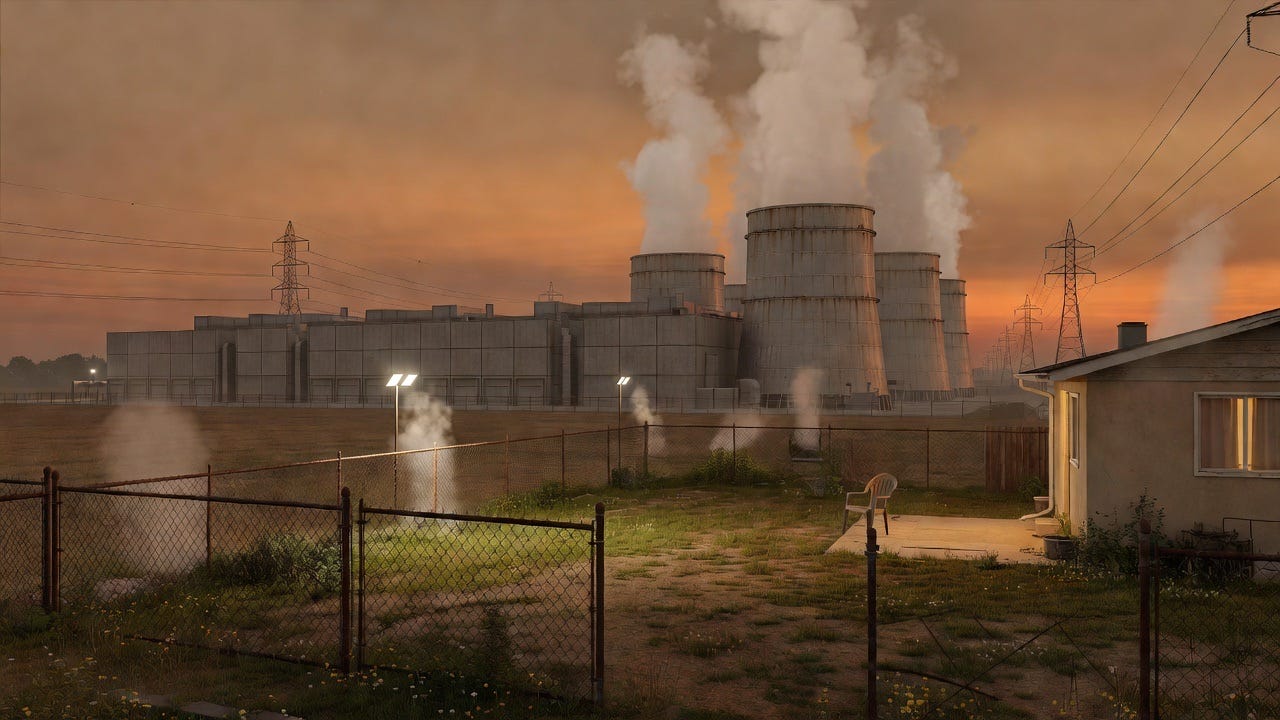
This morning I asked a machine to read a forty-page grid-planning filing, draft two emails, and settle a dinner-table argument about how much water it takes to cool a server. Total effort on my end: maybe ninety seconds and not one calorie of real thought. I have done some version of this every single day for two years — and, if I am honest, I cheered the build-out that makes it possible. More compute, more data centers, more of that frictionless magic. Build, baby, build.
The bill for my convenience, it turns out, does not come to me. It came to a resident of Manassas, Virginia, whose January electricity statement jumped from about a hundred dollars to two hundred and eighty-one. It comes to the county downstream of a cooling plant that drinks millions of gallons a day. Last year, on this very Substack, we traced who pays for the AI boom, and the short answer was: not the people who profit from it. That piece was about the plumbing — rate design, special contracts, the quiet accounting that shifts infrastructure costs onto your monthly bill. This one is about what happened when regular people finally noticed.
Because here is the part I did not see coming. The revolt against the thing I cheered for is now the most bipartisan movement in America.
First, the thing Greg Abbott and AOC suddenly agree on
Hold two images in your head.
Image one: late June, a campaign stop in Bullard, East Texas. Governor Greg Abbott — a Republican who has spent years rolling out the red carpet for anyone who wants to build in his state — calls for banning new data centers in rural Texas. "We must prohibit them from building AI data centers in rural Texas neighborhoods," he told the crowd, and then went further, insisting the state must eliminate the tax break these projects are getting. One conservative account of the speech framed rural anger as the inevitable result of a decade of unwanted build-out — wind, then solar, and now this — "for many people, the last straw."
Image two: Senator Bernie Sanders and Representative Alexandria Ocasio-Cortez, standing up months earlier to announce the AI Data Center Moratorium Act — legislation that would impose an immediate federal moratorium on new AI data centers until national safeguards are in place.
The Sanders–AOC bill has actually been on the table since March. But the timing that made all of this feel like a movement was July. The same week Abbott stood in Bullard, a leading climate group told Congress to protect people, not data centers and to freeze new construction as an emergency measure. Red governor, socialist senator, climate activists — all pointing at the same chain-link fence, for reasons that could not be more different.
What changed between March and July was the weather.
The week grid math became something you could feel
Numbers on a spreadsheet don't start movements. Heat does.
In early July, a punishing heatwave strained the grid across much of the country, and the abstract argument about AI's appetite became suddenly, physically real. PJM Interconnection — the largest power grid operator in the U.S. — forecast demand of over 166,000 megawatts, breaking a summer record the grid had held since 2006. To keep the lights on, the Department of Energy issued an emergency order under the Federal Power Act authorizing operators to fire up backup generators at large facilities — an order that, in its own text, names data centers as the load driving PJM's demand growth faster than anything else on the system. Al Jazeera put the stakes plainly: the summer was testing public support for the rapid expansion of AI data centres.
And the public, it turns out, had already answered. Weeks before the heat arrived, Gallup found that seven in 10 Americans oppose a data center being built in their local area — 48% of them strongly. Sit with that number. It is far more opposition than Americans express toward a nuclear plant next door (53%). We are more comfortable, as a nation, with a reactor down the road than with a windowless building full of servers.
This is no longer a NIMBY footnote. According to Data Center Watch, roughly $130 billion worth of projects were blocked or delayed in the first quarter of 2026 alone — as much disruption in three months as in all of 2025. NBC News, reporting the same data, called it the most in any three-month period since tracking began in 2023, with active opposition groups more than doubling to 833 across 49 states. And on July 18, organizers staged a national day of protest with more than 50 locations on the map — coordinated, notably, by a conservative advocacy group, not a climate one.
Same fence, opposite reasons
Here is where it gets genuinely strange, and worth slowing down for.
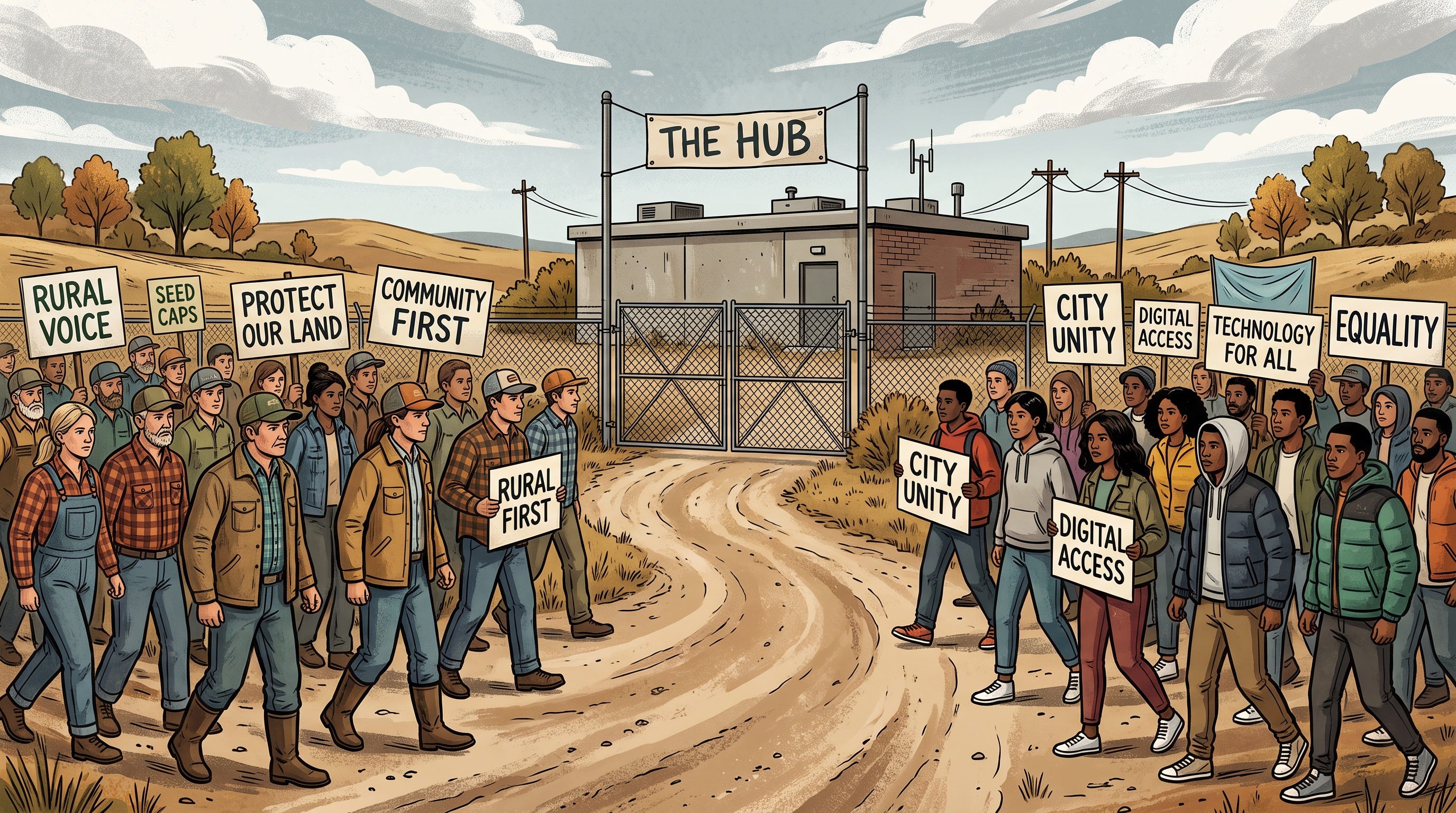
When Abbott and AOC point at the same data center and both say no, they are not agreeing. They are colliding. And the collision is the whole story.
The red-state "no" is about land, sovereignty, and a broken bargain. Rural Texans were promised that hosting infrastructure meant jobs and revenue; instead they got humming megastructures, strained local grids, and tax breaks flowing to the operators rather than to the neighbors. Abbott's pitch isn't environmentalism — it's this was supposed to be our deal, and you broke it.
The blue-state "no" is about bills, water, and equity. When New York paused new large AI data centers, Governor Kathy Hochul defended the move on the ground that the state's grid cannot currently support additional large-scale facilities. Sanders and Ocasio-Cortez frame their moratorium as consumer and climate protection. A completely different vocabulary — but the very same fence.
And — to be fair, because this matters — the convergence isn't total, even inside a single party. When New York hit pause, Senator John Fetterman, a Pennsylvania Democrat, warned that "China wins". The real fault line here doesn't run neatly left to right. It runs between people who feel the cost locally and people who fear the cost geopolitically. Which is exactly why this is so combustible: it refuses to map onto the tribes we already have.
Now run the next five summers forward
So where does this go? Let me get imaginative for a moment, because the trend lines practically draw themselves.
The core problem is a physical trap the industry cannot engineer its way out of quickly. Cooling next-generation AI chips is a no-win choice between water and power: save water, and your electricity demand surges; cut electricity, and your water use climbs. A single large data center can already consume up to five million gallons of water a day — as much as sixteen thousand households. Now multiply that by every county courting a hyperscaler.
Imagine the summer of 2028. Researchers at NC State, Carnegie Mellon, Pitt, and Toronto project that data center demand could push electricity costs up 6% to 29% nationally — and as much as 57% in the hardest-hit regions. The PJM market monitor has already blamed data center demand for $23 billion in customer price increases locked in through at least 2028. Picture a July three summers from now: another record heatwave, another emergency order — and this time the local news isn't covering an abstract debate, it's covering the town that ran its reservoir low keeping the servers cool while residents were asked to cut back. Picture the ballot measures. Picture "no new data centers" as a plank that wins in a red county and a blue city in the same election.
That future isn't science fiction. It's just an extrapolation of a fight that is already fully underway.
The unlikely chorus — and it isn't just activists
If this were only Sanders and the climate left, you could file it under "the usual suspects." It isn't.
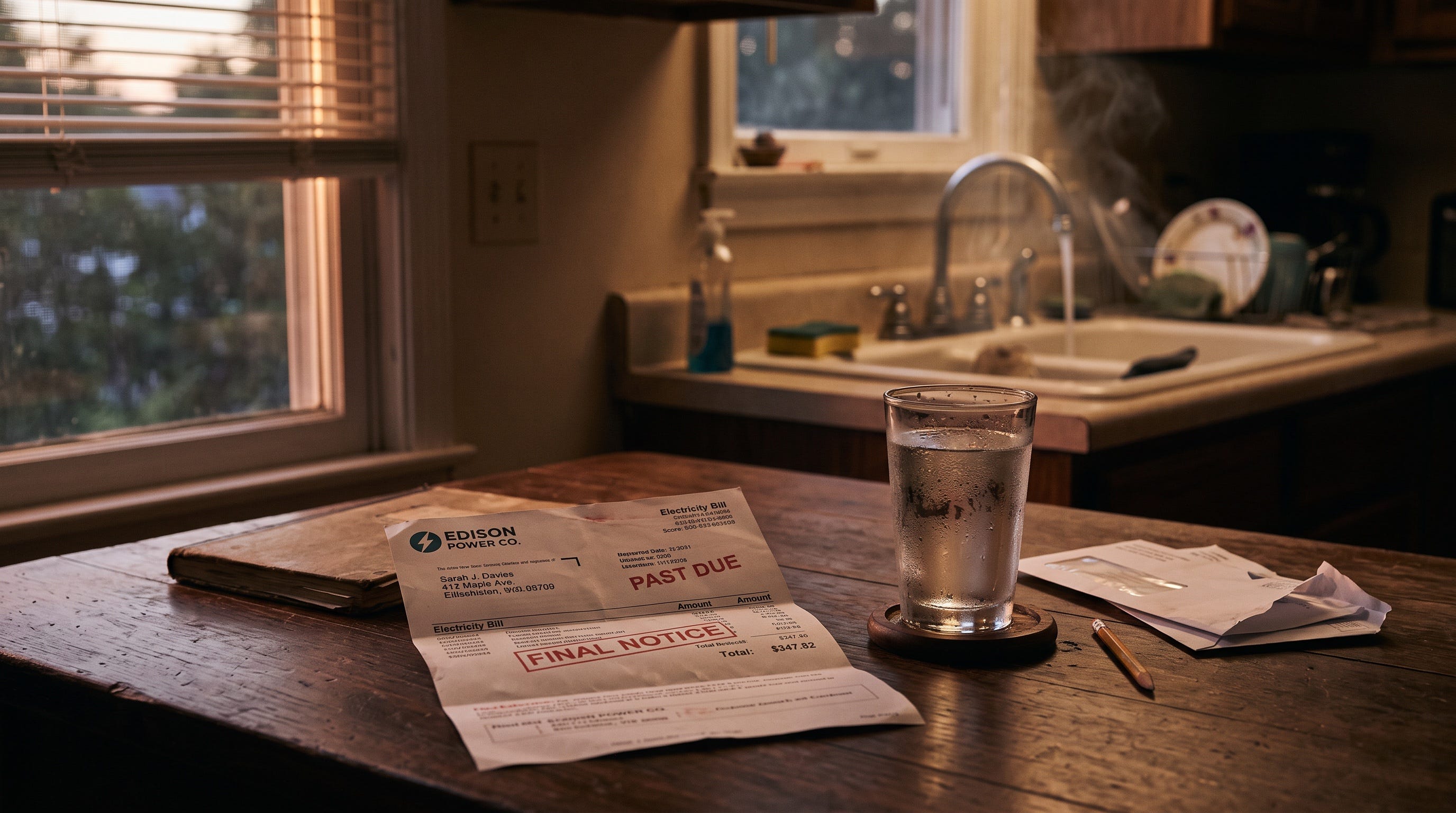
Consumer Reports — hardly a radical outfit — found that 78% of Americans are worried new data centers will drive their bills up. And the alarm on the pro-build side is just as loud, which is what tells you this is real. The Atlantic Council warns that the backlash could cost the U.S. its AI edge — arguing that America might lose the AI race not because its engineers fall behind China's, but because it fails to build the infrastructure AI requires. The Center for Data Innovation calls the Sanders–AOC moratorium a construction freeze that only undermines the American digital economy.
I take that counter-argument seriously, and so should you. There's also an honest complication the anti-build crowd tends to skip: data centers are not the only reason your bill is climbing. Retail prices are up nearly 40% since 2021, and extreme weather, an aging grid, and utility capital spending all share the blame. Pinning the entire increase on AI is too easy. But "not the only cause" is a long way from "not a cause" — and the people whose bills doubled in a single month are not in a mood for nuance.
So what can you actually do about it?
This is the part where most essays wave vaguely at "raising awareness." Let's be concrete instead. If you want a say in whether the grid you depend on gets rebuilt around someone else's chatbot, here is where the leverage actually sits:
Read your utility's rate case. The costs get shifted in dry regulatory proceedings almost nobody attends. Your state's public utility commission holds hearings, and public comment is genuine leverage — this is where "who pays" is literally decided, line by line.
Ask the local siting question, not the national one. Data centers are approved by county commissions and zoning boards, not Congress. When one is proposed near you, the questions that matter are boring and powerful: Who pays for the grid upgrades? What's the water contract? What happens to the tax abatement if the promised jobs never materialize?
Watch the tax abatement. Abbott's sharpest line wasn't about banning anything — it was about ending the tax breaks. Follow whether the incentives your town hands out actually come back as revenue, or just as noise and demand.
Notice your own footprint without flagellating over it. I'm not going to tell you to quit AI; I haven't. But knowing that every query lands on somebody's grid quietly changes how you weigh the trivial uses against the ones that actually matter.
Refuse the false binary. "Build everything" and "build nothing" are both lazy. The real question is where, at whose expense, and with what safeguards — and that's a question you are fully entitled to have an opinion on.
What I think is really going on here
Here's the lesson, as I see it. For two years the AI boom felt like something happening on a screen — weightless, clean, faintly magical. The heatwave was the moment it acquired a body: a footprint, a water bill, a power draw you could measure against a record set in 2006. And the second a technology acquires a body, people start asking who has to live next to it.
That Greg Abbott and AOC arrived at the same fence from opposite ends of the country and opposite ends of the spectrum is not a punchline. It's a signal. When a fight scrambles the usual tribes this completely, it means the thing being fought over — cheap, reliable, un-rationed power — is something almost everyone still assumes is theirs by right. They are about to learn it's up for negotiation. The only real question is whether they're in the room when the deal gets cut.
I cheered the build-out. I still reach for the tools every day. But I've stopped pretending the bill isn't real just because it doesn't have my name on it.
Turns out the fastest way to unite the left and the right was to threaten the air conditioning.