
If you have followed a city council debate over plate-reader cameras, you have probably heard the reassurance: every search leaves a record. The officer gives a reason, the system writes it down, and anyone checking later can see who looked up whom. You may have found that persuasive. It sounds like accountability.
So read one of those records the way a federal judge in Oklahoma did.
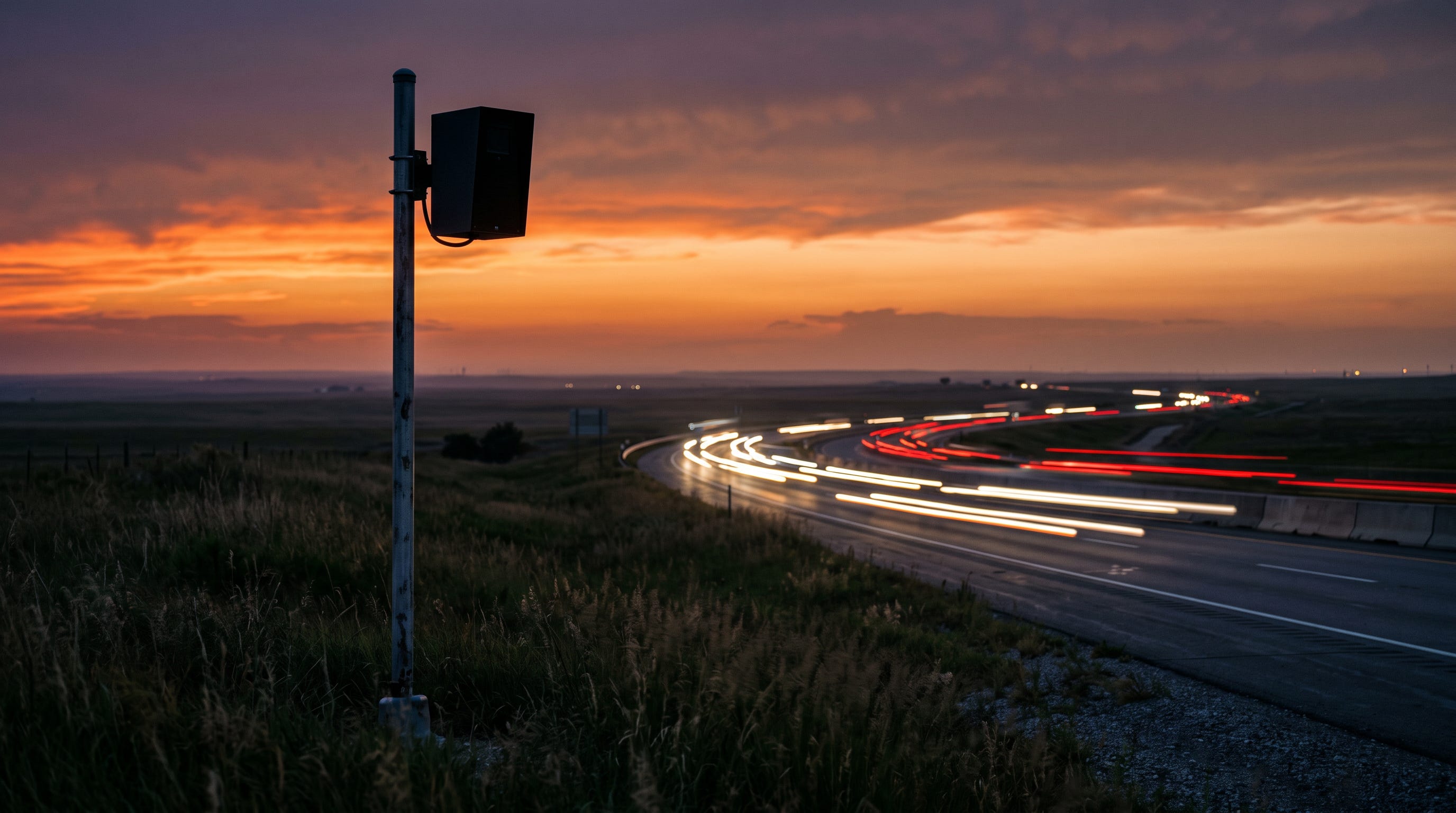
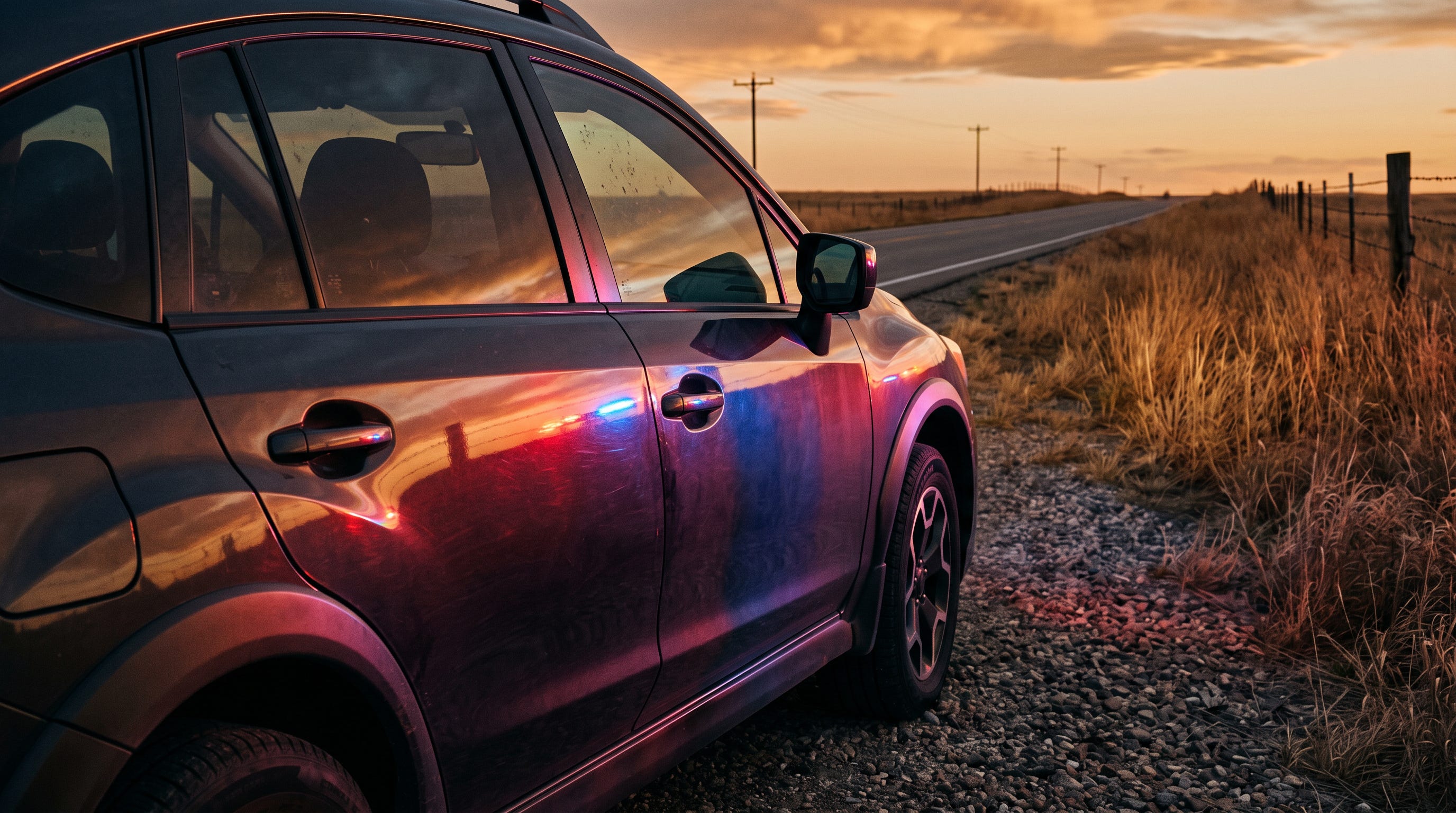
One evening in May, Tulsa County Deputy Sheriff Freddie Alaniz, parked beside the highway, saw a Mazda SUV with a California plate and followed it "for no apparent reason other than the fact that it had a California license plate." He queried the plate in two systems, Flock and Motorola Solutions' VehicleManager, and both offered a field for a reason. In Flock, as a prosecutor later relayed in an email, he "inputted the reason as a traffic violation." In VehicleManager, "He inputted the reason as investigation."
Then comes the sentence the plate-reader ruling turns on: "At the time of those queries, all Alaniz knew was that the vehicle had a California license plate." His own report places the search "As the vehicle passed me" and a lane change "As I continued to drive behind the vehicle." He stopped the driver, Melisa Kyle, for following too closely, a stop the court found lawful. (Hold on to that.)
So the safeguard worked as designed — a reason went in, and the search ran. On Thursday, October 1, 2026, U.S. District Judge Sara E. Hill held that the search violated the Fourth Amendment anyway. Afterward, the sheriff's office told KFOR the deputy was still on duty and faced no discipline "because he followed policies," as the station summarized it.
So what did the judge decide?
I argued in September that the Supreme Court's June decision in Chatrie v. United States "is about geofence warrants" and had "not done anything to them yet," meaning plate readers. A district judge has now put it to work on them.
With no Tenth Circuit or Supreme Court ruling on plate readers, Hill reasoned from Chatrie, which held that accessing a phone's location history is a search, and from Carpenter, an earlier case whose warning Chatrie repeated: society never expected police to "secretly monitor and catalogue every single movement of an individual's car."
What did one query buy? The deputy's search "in just the ALPR system" (the opinion doesn't say which of the two) returned "more than 50 individual records of Kyle's whereabouts across the country for an entire month." How long that data is kept, and by whom, the court couldn't say.
That the movements happened in public, Hill wrote, is "not dispositive." What mattered was the breadth: "This is a type of indiscriminate mass surveillance." And she asked the question this whole debate circles: "why is it the government's business where everyone goes all the time?"
She granted the tools "remarkable benefits that the Court cannot ignore," then held that the query "was a search under the Fourth Amendment" and that, "Based on the information in the record, the only reason Alaniz conducted that search was because he saw her license plate was from California." It had no probable cause and no warrant. Everything "obtained after Alaniz initiated the ALPR search" was suppressed "as fruit of the poisonous tree."
That wasn't the only ground. The deputy kept the stop going after handing back Kyle's license, which the court held he lacked reasonable suspicion to do; on that ground alone, "all evidence recovered as a result of the stop must be suppressed." (One irony: her account of her trip was, the court noted, "bolstered by the results of Alaniz's ALPR search.")
A receipt, not a permission slip
The safeguard is real, and both companies describe it. Flock says "Every search creates a reviewable record, including who ran it, when they ran it, and the offense type." Motorola's VehicleManager brochure, filed by the defense in this case, says of its AI search assistant that "all queries are fully auditable for transparency." Oklahoma City's police chief told his council his department adds "a manual audit for possible improper searches every 30 days."
So what would an auditor have found here? A plate, a deputy, a time and a reason: "traffic violation" in one system, "investigation" in the other. Neither looks wrong on a log. A traffic violation did follow. And "investigation" is about as ordinary as reasons get: in an Electronic Frontier Foundation dataset of 11.4 million Flock searches over six months, more than 14 percent gave just that one word, the ACLU reports.
None of that is a scandal, and that's the point. A log is a receipt — proof that a search happened, and of what the officer said about it. It can't answer the court's question: may police pull a month of anyone's movements, without a warrant, because of where a plate came from? (Kyle's lawyers argued that "compliance with internal policy or state law is not decisive under the Fourth Amendment"; the court didn't need to decide that.)
When California made police disclose AI-written reports, I called the audit trail in that law "a capability the law creates." In Tulsa County, it's a product feature. Oklahoma's only plate-reader statute creates an "Uninsured Vehicle Enforcement Program," and KGOU calls plate-reader use in the state "a legal gray area." (Whether that statute limits a sheriff's searches is disputed, and the court didn't decide it.)

Does this make plate-reader searches unconstitutional?
Not as a rule, and Hill said so herself: "it appears that nearly every court examining the issue to date has determined that ALPR technology use is not a search," including three other federal courts in Oklahoma, one in her own district.
In March, the Fifth Circuit held that using a plate-reader system "did not constitute a search, so no warrant was required." Elijah Porter, the defendant, has asked the Supreme Court to hear what his lawyers call "questions of exceptional importance," and as of October 13, 2026, its order lists show no action. The government, answering only his separate gun-law question, agrees with his fallback request to hold the petition until the Court decides two Second Amendment cases. In January, a federal judge weighing Norfolk, Virginia's cameras wrote that "the answer is: not today." And Chatrie itself distinguished an older case partly because "the surveillance there was confined to public roads," which is where plate readers sit.
404 Media, calling the Tulsa ruling "one of the first times a federal judge has decided Flock searches can be unconstitutional," noted it "will not set a binding precedent." Because the extended stop independently doomed the evidence, an appeal could win on plate readers and still lose. And the government argued no exception to the exclusionary rule, so none was weighed.
Flock, which wasn't a party, says the ruling "goes against the overwhelming weight of authority" and expects it to be "appealed and ultimately overturned." (Motorola hasn't commented publicly that I could find.) The U.S. Attorney's Office, FOX23 reported, is "reviewing the court's decision and evaluating the next steps." As of the docket's latest update, no notice of appeal appears. The ordinary deadline to file one — thirty days, pushed past a weekend — runs to Monday, November 2 unless a court extends it, and Hill has a hearing set that morning, purpose unstated.
The tools do solve cases (Oklahoma City's chief credits them with 1,280 recovered vehicles and help in 60 murder cases), and audits do catch abuse: internal audits were credited in the majority of the alleged misuse cases InvestigateTV reviewed.
So whom did the Fourth Amendment protect here? The sheriff's May account, as KTUL reported it, began with the lane changes: a deputy "observed a vehicle make multiple illegal lane changes," and deputies "reportedly found 91 pounds of methamphetamine." Kyle was federally charged with possessing more than 500 grams of methamphetamine with intent to distribute; the opinion never says what the search found, she is presumed innocent, and her trial date has been struck. Meanwhile, California drivers suing Flock over data sharing heard a federal judge say in September that he was inclined to find they lacked standing: "A violation of the law is not, in itself, an Article III injury, as we all know." He signaled he would likely send the case back to state court. The exclusionary rule protects the person with evidence to suppress; a driver who can't show a personal injury may not get through the federal courthouse door at all.
Switzerland asks a different first question
What happens when a court asks who wrote the rules before it asks what the cameras saw?
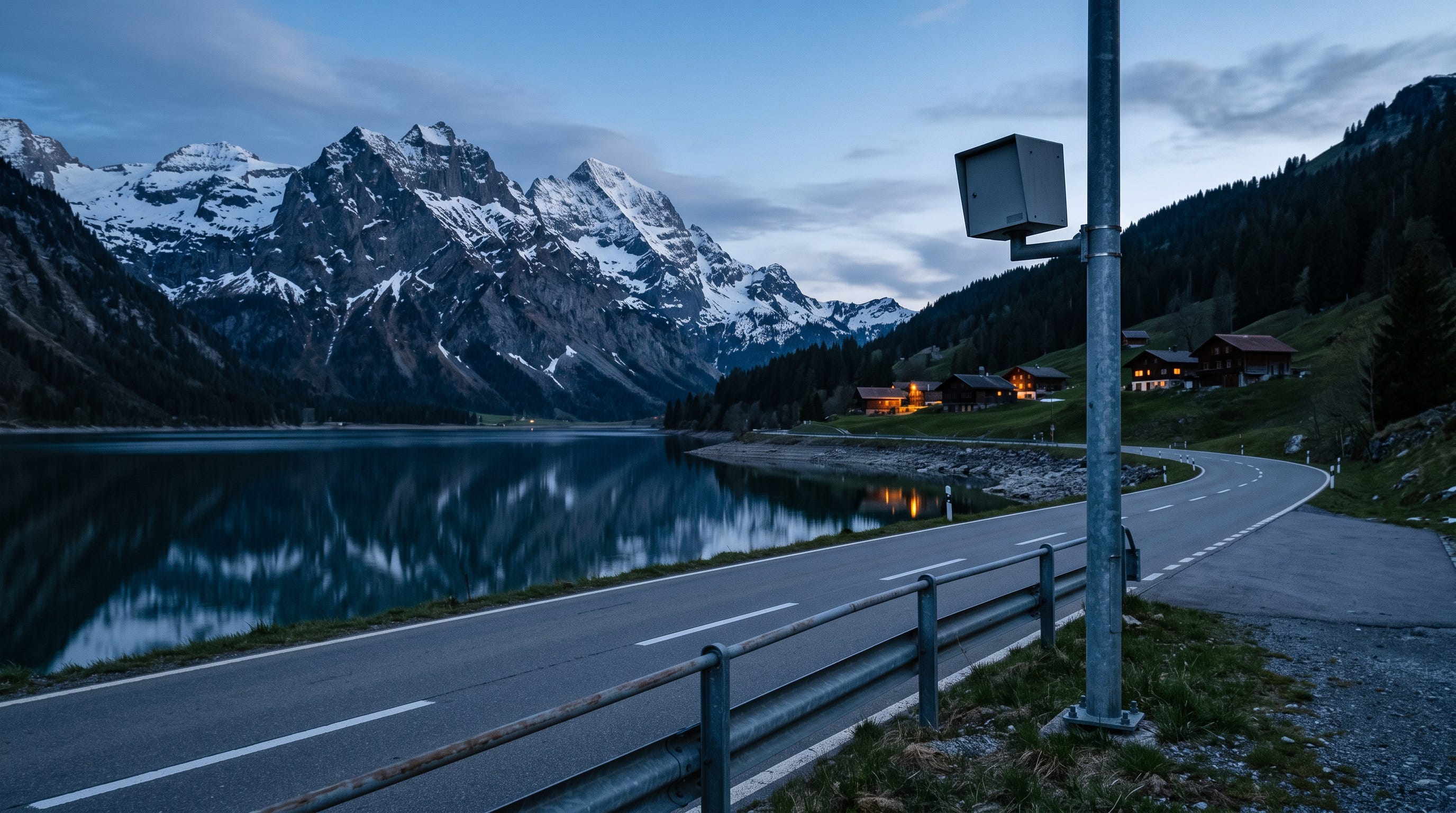
Switzerland's Federal Supreme Court has been answering that since 2019, about cameras that read plates and check them against police search files. In a case from Thurgau, it held that such scanning requires "einer ausreichend detaillierten Regelung in einem Gesetz," a sufficiently detailed rule in a statute. (Translations from the German in this piece are ours.) Thurgau had none, so the recordings were unlawfully collected. Nor did public roads matter: recording the data there "ändert nichts" — changes nothing — about the constitutional protection.
Then the line that matters most for Tulsa County. The police's own technical concept, the "Gesamtkonzept AFV," capped storage at 30 days. The court called that "nicht von Bedeutung, da ihm kein Gesetzescharakter zukommt": irrelevant, because it has no force of law.
Set that beside the Oklahoma record. When the deputy searched, Flock's default retention, absent a state or local rule, was 30 days; in August its chief executive moved the default to "a 7-day retention," adding that "Existing customers will keep their current, democratically approved retention periods." Motorola's brochure tells agencies: "Set retention rules based on what works for you - not us." Settings, not statutes.
The rulings kept coming. In 2022 the court required Solothurn to have an independent body check the system periodically ("periodisch von einer unabhängigen Stelle") and tell the public what it finds. In 2024 it struck Lucerne's version, which let police keep everything, non-hits included, for up to 100 days. And on August 12, 2026, it struck Bern's clause keeping 60 days of data on drivers who matched no search file — "eine geheime anlasslose Massenüberwachung," a secret, suspicionless mass surveillance, without effective protection against abuse — and barred the system until immediate deletion of non-hits is written into law and logging of each specific search order into at least a regulation. Two days later Bern switched the system off, saying its police already met those requirements.
Seven weeks apart, Lausanne and Tulsa reached for the same idea: "anlasslose Massenüberwachung," "indiscriminate mass surveillance."
None of this means Switzerland banned the cameras. The Bern ruling struck parts of the law, not the system, and Bern's security director has asked the court to allow it again for homicides, rapes and kidnappings before the law is fixed. The Swiss remedy is also narrower: unlawfully gathered evidence can still be used where "zur Aufklärung schwerer Straftaten unerlässlich," indispensable to solving serious crimes. Thurgau's case, in one Swiss law firm's English summary, involved "driving without authorization." A 91-pound drug case might have come out differently there. So the useful comparison is who writes the rules, and whether anyone writes them down before the cameras go up.
Now let software fill in the reason
This part is my extrapolation, not a report on any agency's plans.
Hill went there first: it is "no longer difficult to imagine law enforcement using a fleet of drones hovering over an entire city so they don't miss the movement of a single vehicle. This is not hypothetical catastrophizing."
Now give the first look to software. Flock "now alerts law enforcement when suspect vehicles have been identified in multiple states over the past 30 days," a 2025 trade report said (nothing here says Tulsa County uses it). From the plate search, the deputy wrote, the car "appeared to have made a very quick turn around travel to the western part of the country." Picture software flagging that pattern before any deputy sees the car. The log will still want a reason. Whose?
Both vendors also sell search by description. Motorola's brochure: "Simply type a description of the desired vehicle." When a search starts from a description, what does a reason box attach to?
And the rules arrive by blog post. Flock added "a mandatory Offense Type dropdown" in late 2025 and promised case codes by the end of 2026. Switzerland's court set the opposite principle in 2022: new software with functions the law doesn't provide for "dürfen nicht ohne Gesetzesrevision eingesetzt werden," may not be used without amending the law. Here, the next capability can ship in an update. There, it waits for a vote.
The clock may also run faster than I estimated in September, when I called this "a 2029 or 2030 Supreme Court case at the earliest." The Seventh Circuit heard arguments over Illinois's highway cameras on September 29; the Fourth Circuit has Schmidt v. Norfolk tentatively calendared for the week of December 8 (it may move). Imagine the question reaching the justices years early. I won't guess their answer.

An odd coalition, and the people across from it
On the civil-liberties left, the ACLU's Jay Stanley argues that logs depending on officers' self-reporting are "not an adequate check" (though "none of this means that we think companies ought to remove logging"), and the Electronic Frontier Foundation calls the one-click reason dropdown "a loss for transparency" and wants "an ironclad warrant requirement."
The right has landed nearby. The American Enterprise Institute's Jim Harper writes that "Through Flock, Kansas maintains an ongoing search for the location of everyone all the time." Michael Soyfer of the libertarian Institute for Justice, which represents the residents suing Norfolk, told 404 Media the Tulsa opinion recognizes "the sheer breadth of these systems." Sen. Josh Hawley (R-Mo.) has announced a Stop Flock Abuse Act under which "a written approval process must log every authorization for a search." And Oklahoma Republican Rep. Tom Gann has said the data "is being used well beyond what the law allows."
Across from them, the Major County Sheriffs of America say plate-reader use "does not constitute a Fourth Amendment search," the United States and seventeen states back Norfolk in the Fourth Circuit, and Oklahoma City's mayor, David Holt, has said "there is no expectation of privacy in public." Flock, for its part, wrote ahead of a September Senate hearing that the rules "should be set by law." At that hearing, Sen. Dick Durbin (D-Ill.) put the task plainly: "We have got to find a way to balance in America privacy and security."
GW Law's Andrew Ferguson calls the Tulsa case "a direct result of Chatrie." On September 14, UNC's Jeff Welty wrote, "As far as I know, no court has ruled that the use of Flock cameras violates the Fourth Amendment," and predicted "a major legal clash." Seventeen days later, one did. The split, in other words, runs less between left and right than over whether the Constitution has anything to say about a month of your drives.
What does this mean for you?
Find out what your police run, and what they publish. Flock says "More than 1,500 agencies have published a Flock Transparency Portal." Not every agency does: a resident's records request found that Oklahoma City's police do "not publish internal use or transparency reports on Flock."
Ask your council or oversight board five questions.
How long is our data kept? Flock's new default is seven days, but existing customers keep their old periods. Oklahoma City is cutting its own from 30 days to seven, its chief said in August.
Is national sharing on? Oklahoma City is pulling its data from a nationwide sharing platform.
Does every search need a case number, and does anyone approve it first? Flock says it will "require case codes for all law enforcement searches by the end of the year." In July, Oklahoma City's case-number rule was "internal guidance," and "not official policy."
Who outside the department reads the audit log, and does the public see the results? Switzerland's court requires both.
Which state law governs this? NCSL counts "at least 28 states" with statutes on plate-reader use or data retention, and at least 18 that require audits, reporting or oversight. Its table lists Oklahoma: "No statute identified."
If you're stopped and an officer asks to search your car, the ACLU of Texas says "you can refuse," though police with probable cause can search without your consent. Kyle refused. She was held anyway, and a court found that unlawful months later. Don't count on that ending.
Mark Monday, November 2, 2026. It's the government's ordinary deadline to appeal and the day of a hearing in the case. The Fourth Circuit's tentative argument week in Schmidt v. Norfolk starts December 8.
The lesson, as I see it
A reason box records what an officer says about a search. It can't tell anyone whether the search should happen, and in Tulsa County it didn't try: it took "traffic violation" and "investigation," and a month of someone's movements came back. The next search may start with an alert no deputy asked for, and the box will be filled in just the same. Switzerland's court, ruling after ruling, has insisted that the limits have the force of law — before the cameras run, with someone independent reading the logs. Even Flock says the rules belong in law.
My vote? Put the limits where the Swiss put theirs: in a law a legislature passed, with short retention, independent review of the logs, and a judge's signature before anyone opens a month of a stranger's drives. Until then, a reason box is a receipt, not a permission slip.
Someone on your city council votes on these contracts; someone on a police oversight board can ask to see the logs. Bring them the five questions above. They're easier to ask before a renewal vote than after one.