
A friend's mother died in the spring. I found out by message, standing at a bus stop, and I stood there long enough composing a reply that the phone lost patience and offered to help. Three suggestions appeared under the box. The middle one was better than anything I had managed.
I did not use it. I want that on the record, because of what happened in the next ninety seconds: I wrote something clumsier on purpose, read it back, and could not decide whether the clumsier version was the kinder one or whether I was performing effort at a grieving man for my own comfort. Then I sent it. Then his reply arrived, and before I opened it my phone had already told me, in one grey line above the thread, what it said.
I read that line first. I think most people do.
So this is not the loud story — the machine that replaces a friend. It is the quieter one, where a machine stands in the middle of two people who each believe they are talking to the other. Nobody lied. Nobody was fooled, exactly. And something still went missing.

The machine is now at both ends of the wire
Start with what is actually true, because the loose version of this claim is everywhere and it is wrong in an instructive way.
When Google announced that Gmail was entering the Gemini era, it put a summary of what arrives and a draft of what you send in front of essentially everybody. The company's words are "rolling out today for everyone at no cost" — conversation summaries, Help Me Write, Suggested Replies. That is availability, not activation. The post says nothing whatsoever about switching anything on for you, and a couple of the richer features (asking questions of your inbox, Proofread) stay behind a paid Google AI Pro or Ultra tier. Precision matters here; the argument does not need the exaggeration.
The genuinely on-by-default claim belongs to someone else. In January 2025, Apple shipped an update that turned its AI on by default across iPhones, iPads and Macs. And here is the detail I keep turning over: the same update disabled AI summaries for news apps, because those summaries had gained a reputation for twisting news notifications into inaccurate claims. Read that sequence twice. In one release, a company decided the technology was not reliable enough to summarize the news — and reliable enough, without asking, to summarize your friends.
None of this is new. It is newly universal. A peer-reviewed study in Scientific Reports on how AI in communication impacts language and social relationships notes, in passing, that as of 2017 algorithmic responses already made up 12 percent of everything sent through Gmail — roughly 6.7 billion messages a day, written on our behalf. As of 2017. That is not a measurement of today; it is a floor under how long this has quietly been running.
Now hold that next to how we treat AI text everywhere else. Election deepfake disclosure rules are now on the books in 31 states, typically requiring that AI use in political advertising be declared. I support that. But look at the shape of it: the further a message travels from you, the more the law cares whether a machine wrote it. No comparable disclosure duty attaches to the message from the person who knows you best. The most intimate channel we have is the one carrying no label at all.
What actually happens to a message that went through a machine
The obvious guess is that assisted messages make the sender look bad. The research says something stranger and worse.
A preprint from a Carnegie Mellon-led team — not yet peer-reviewed, so weigh it accordingly — finds that AI-assistance labels make messages less diagnostic of the sender's moral character. An AI-assisted apology makes the sender seem less warm. An AI-assisted blame makes them seem less cold. The signal does not invert; it fades. The message stops telling you who this person is.
That is the whole thesis of this essay, measured in a lab. Contact gets cheaper and being known gets rarer, not because anyone is lying, but because the channel has lost resolution.
The Scientific Reports work adds the honest complication: smart replies genuinely help. They make exchanges faster, warmer in language, and leave partners rating each other as closer and more cooperative. The penalty only lands when AI use is suspected. Both things are true at once, which is exactly why this is hard.
And in personal relationships specifically — peer-reviewed, this time — Ohio State's Bingjie Liu found that AI can help write a message to a friend, but don't do it: recipients judged the friend as having put in less effort, reported less satisfaction with the relationship, and felt more uncertain about it. (It is a vignette study; participants judged a fictional friend called Taylor, not a real one.) Keep that result close, because it has a sting in the tail I will come back to.
The first thing we outsourced was the apology
Ask people directly — would it matter if a love letter was written by AI — and the answer is yes, and the penalty is steepest for exactly the messages that hold relationships together: love letters, wedding vows, apologies. Nobody minds much if AI helped you write code or revise for an exam. They mind enormously about the love letter, the wedding vow, the apology. As one participant put it: if they cared this much, they'd have done it themselves.
That is not sentimentality. Effort is information. Sitting with a hard message, drafting it badly, deleting it, and sending the third attempt is how you signal what the relationship costs you — and repair is, I think, the skill that keeps long relationships alive. It is also the most unpleasant thing in your inbox, which is precisely why it is first in the queue to be handed off.
At work, where we have numbers, the dose turns out to be everything: only 40 to 52 percent of employees viewed supervisors as sincere when they judged the AI use heavy, against 83 percent when it was light. Grammar and editing help was broadly fine. That study is about supervisors and employees, not friends and partners, and I am not going to pretend otherwise. But the gradient is suggestive: a spellcheck is not a ghostwriter.
And then there is the sheer volume
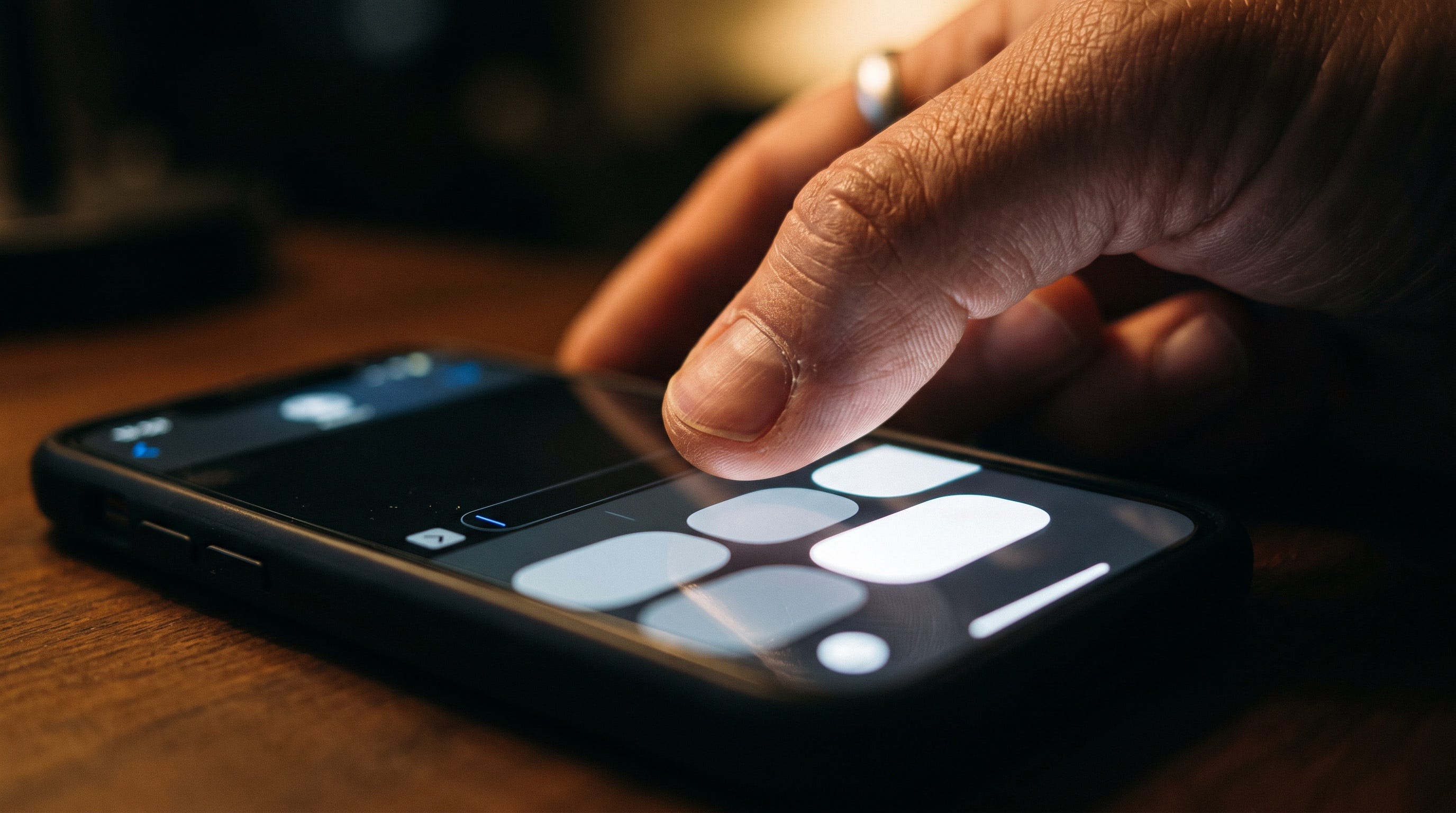
The second mechanism is not what any individual message contains. It is how many of them there now are.
One analysis of over a million posts reports that AI slop writing has taken over a quarter of longform social posts — 41 percent on LinkedIn, and about the same quarter on X. The detector behind those numbers is a tool called Pangram. On the open web, one industry study puts the crossover point at November 2024, when more articles are now created by AI than humans became true.
Now the caveat that nobody selling you those headlines supplies. Every one of those percentages comes out of an AI detector, and detectors are shaky instruments. Peer-reviewed testing published this year found two leading tools neither accurate nor reliable enough to stand alone — 0.69 and 0.61 overall accuracy — performing worst on exactly the hybrid human-plus-AI text that is now normal — and one of the two showed a borderline trend that could disadvantage non-native writers. (That study examined different tools on academic writing, so it does not refute any specific vendor's number. It establishes that the whole class of instrument is soft.) To its credit, the Graphite study publishes its own margins: a 4.2 percent false-positive rate, false negatives measured against a single model, and no measurement at all of AI-written-then-human-edited text, which it concedes may be even more common.
So treat the numbers as direction, not decimal. The direction is enough. When generated text is a substantial and rising share of everything, the cost of producing a message that looks like care collapses toward zero — and anything whose production cost collapses stops functioning as a signal. That is the mechanism. Not deception. Inflation.

So that settles it — AI is corroding human contact. Right?
No. And the strongest objections deserve full weight, not a paragraph of throat-clearing.
First, this alarm is very old and has been wrong before. Vaughan Bell's history of media technology scares runs from the printing press through the telephone, radio and television, and its pattern is brutal for people like me: each generation warns that the new thing is hollowing out real human connection, and each generation's warning looks peculiar to its grandchildren. I should be read with that in hand. So should everyone currently monetizing this anxiety.
Second, assistance is genuine access. A recent preprint on alleviating linguistic and interactional anxiety of non-native speakers found real-time AI support improved speaking self-efficacy, cut interactional anxiety and reduced their workload — with the largest gains for those with below-average language proficiency. If you have ever watched a fluent person's sentences arrive first and win the room, you know what that tool is worth. The same goes for the socially anxious, the disabled, and the person with four hours of unanswered messages and a sick parent.
Third — and this is the finding that stops the whole essay being publishable in 2014 — go back to the Ohio State study. Participants punished a friend who got help from another human writer just as hard as one who used AI. Just as hard. Which means the thing being penalized is not artificiality at all. It is outsourced effort. AI did not create the offense; it made the offense frictionless, free, and available at three in the morning.
And the most interesting recent work — another preprint — moves from content to strategy: people would rather use AI to think through a difficult moment — to cool down, reflect, avoid escalating — than to write the words for them. Some reported better empathy afterwards. Some worried about losing their own voice. That is a mature relationship with a tool, and it is available to anyone who wants it.
The target is not assistance. The target is the default-on, undisclosed, everywhere version.
One country decided disconnection was the state's problem
Japan wrote it down. The Act on the Advancement of Measures to Address Loneliness and Isolation — Act No. 45 of 2023 — was promulgated in June 2023 and has been in force since April 1, 2024. Not a strategy document. A statute, with an official English translation on the government's own law-translation site. Article 3 makes the national government responsible for establishing and implementing measures; Article 4 puts the same duty on every local government. It sits inside a standing Cabinet Office program with a priority plan attached.
The politics ran ahead of the law. Prime Minister Suga appointed a Minister in charge of Loneliness and Isolation in February 2021 — the Japan Times covered it as the moment Japan took steps to tackle loneliness, following the UK's 2018 precedent, against a backdrop of the first year-on-year rise in suicides in eleven years.
Here is why I am not telling you this as a success story. One year in, only 32 of Japan's 1,741 municipalities — 0.6 percent — have set up the regional councils the Act asks for. And the national number has not moved: 39.3 percent reporting some loneliness in both FY2023 and FY2024, with the "always lonely" share flat at 4.3 percent.
That is the useful lesson, and it is a humbling one. A wealthy, competent state appointed a minister for this in 2021 and made it a statutory duty in 2024, and the line on the chart is the same line. Which tells you something about what policy can and cannot reach — and something about anyone (me included) who imagines the fix here is primarily legislative.

Now run it forward
Five years, no new science required — just current features with the friction removed.
Your phone knows your friend's tone, your history together, the anniversary of her father's death. It drafts the check-in, waits for the good hour, and sends it. Her phone summarizes it: warm, no action needed. She taps a suggested reply. Yours summarizes that: positive, doing well. Neither of you has been unkind. Neither of you has lied. And the paragraph she deleted twice before sending — the one where she said she was not, actually, doing well — never made it through the summary, because summarizers optimize for gist, and despair is rarely the gist.
Then the market does what markets do. Somewhere a service offers "verified human-composed" as a premium tier, and the handwritten note becomes a luxury good, which is a polite way of saying sincerity gets priced. If you want to know what that world feels like, notice how you already treat a birthday message that arrives at 00:01. You do not read it as devotion. You read it as a calendar.
What the people who study this are saying
The canon has been here a while. Sherry Turkle has argued since 2011 that we expect more from technology and less from each other. Robert Putnam wants us to stop bowling alone and put it better than I will: we're watching Friends instead of having friends. Jonathan Haidt named the great rewiring of childhood. They were describing the room. What is new is the machine now sitting between two chairs in it.
The measurements are not partisan. The WHO's Commission on Social Connection puts loneliness at one in six people worldwide and roughly 871,000 deaths a year — about a hundred an hour. The US Surgeon General's advisory Our Epidemic of Loneliness and Isolation found that lacking connection raises premature-death risk comparably to smoking fifteen cigarettes a day; Vivek Murthy's own framing is the sentence this whole essay is circling — you can feel lonely with people all around you, because loneliness is about the quality of your connections. From the center-right, Daniel Cox's survey of the state of American friendship found the share of Americans with no close friends went from 3 percent in 1990 to 12 percent. And the time-use record on US trends in social isolation, social engagement, and companionship runs 2003 to 2020 — which is to say the trend predates every product named in this piece. AI did not start this. It arrived, extremely capable, at the worst possible moment.
What does this mean for you?
Set the dose deliberately. Spellcheck and tone-fixes are fine and always were. Full composition of something emotional is a different act. Decide which one you are doing before you tap.
Never outsource repair. The apology, the condolence, the hard conversation. Write those badly and yourself. Badly is the point — clumsy sincerity outperforms fluent delegation every time.
Turn off the summaries for people you love. Check your phone's settings. Read your friends' actual sentences; keep the summarizer for newsletters and receipts. What gets compressed out is exactly what you needed.
Say when you used it. "I used AI to help me phrase this, but I meant every word" costs you nothing and restores the signal the label would otherwise erase.
Spend the effort where it is legible. One unprompted phone call this week beats forty perfectly-timed messages. Effort only counts as care if the other person can see it cost you something.
The lesson, as I see it
We have solved reach completely. Any person you have ever loved is four taps away, at any hour, in any country, for free. That is a genuine miracle and I am not giving it back.
But reach was never the scarce thing. Attention was — the deliberate, costly, slightly awkward act of turning toward one specific person and giving them the part of your day you cannot get back. Every tool in this article makes reach cheaper. Not one of them makes attention cheaper, because attention is not a text-generation problem. And when the cheap thing floods the channel, the expensive thing gets harder to see.
So my vote is not abstinence, and it certainly is not a law — Japan tried the law, seriously, and the number sat still. My vote is friction, chosen on purpose, in the few places it means something. Keep the assistant for the logistics. Write the hard ones yourself, in your own imperfect words, and let them land as evidence that you were there.
You've never been easier to reach. Go and reach someone.
If someone came to mind while you were reading this — that is the whole point of the piece, and forwarding it to them is only the second-best response. Message them first, in your own words, then send this along. The HAIA Foundation writes about keeping human judgment in the loop as machines get better at sounding like us; the rest of it lives here.