

Let me start with a confession, because it makes the rest of this honest.
Last month I handed my week over to an AI agent — not a chatbot that answers questions, but the new breed of software that actually does things: books the restaurant, drafts the reply, compares the flights, fills the form, clicks the buttons. I told it what I wanted and watched it go. And reader, it was wonderful. Forty minutes of admin compressed into a sentence. The little dependency that grew over those seven days is the reason I’m writing this.
Because here is the uncomfortable question I couldn’t shake: when the boring stuff gets done for me, instantly, on demand — what happens to the part of me that used to do it?
This isn’t a “technology is evil” essay. (I’m typing it on a machine that would have seemed like sorcery to my grandmother, and I have no intention of giving that up.) It’s an attempt to look honestly at a trade we’re all making, mostly without noticing — and to separate what the science actually shows from what the headlines want you to believe. So let’s do the unglamorous thing and start with your brain chemistry.
First, let’s clear up the dopamine myth
You’ve heard that dopamine is the “pleasure chemical.” It isn’t — or at least, that’s so incomplete it’s basically wrong.
Dopamine is closer to a motivation and prediction signal. The neuroscientist Wolfram Schultz spent decades showing that dopamine neurons fire hardest not when you get a reward, but when you get one that’s better than you expected. Get exactly what you predicted? The signal stays flat. Expected a reward and got nothing? It dips. The chemical isn’t tracking pleasure — it’s tracking surprise, anticipation, the gap between what you hoped for and what arrived.
This matters more than it sounds. The researcher Kent Berridge at the University of Michigan spent years teasing apart two things we usually lump together: wanting and liking. They’re separate systems in the brain. And here’s the catch — dopamine drives the wanting, which can grow and grow even when the liking fades. (If you’ve ever compulsively refreshed an app that didn’t actually make you happy, you’ve felt this firsthand. The wanting outran the liking.)
Now hold that thought, because it’s the hinge of the whole argument.
So what does this have to do with an AI doing my taxes?
Everything, potentially. Let me explain the bridge.
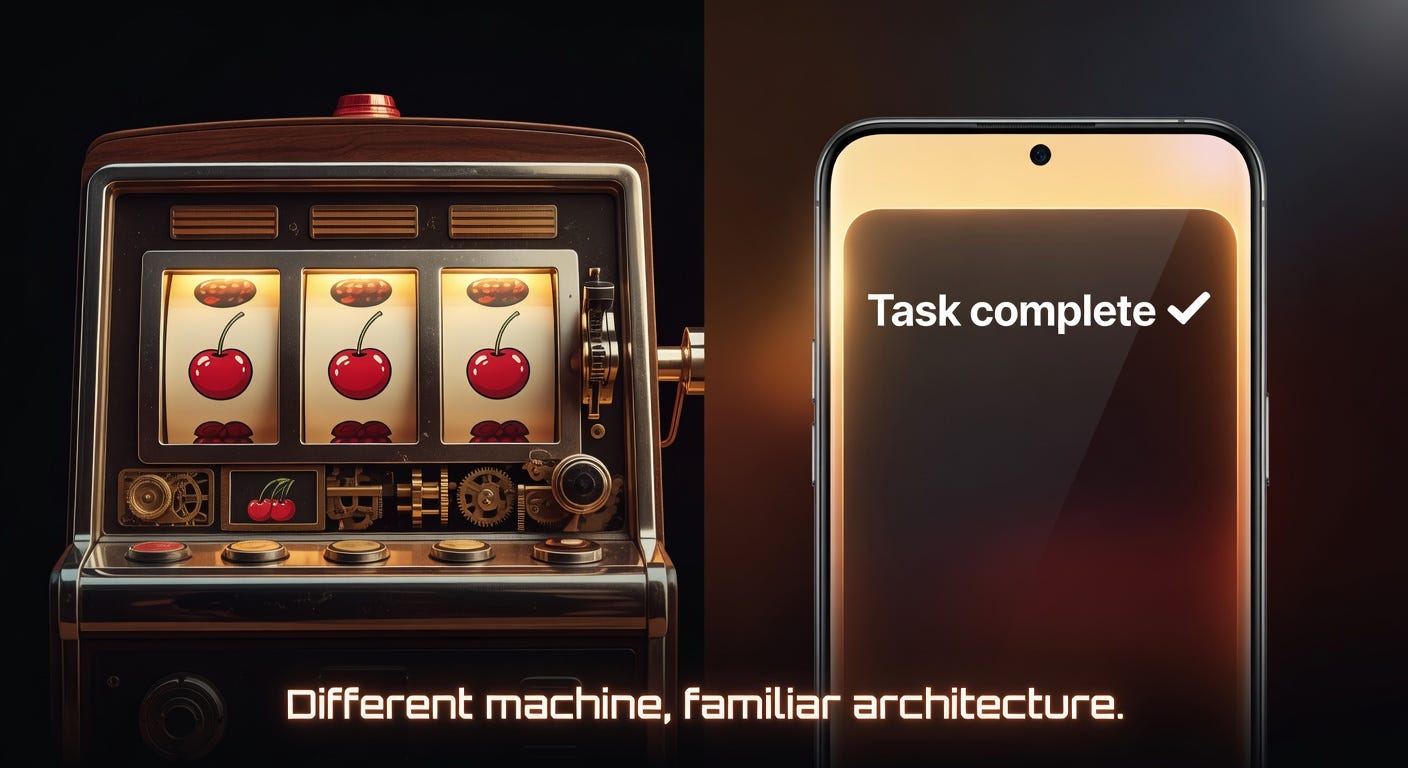
There’s an old, well-replicated idea in psychology — B.F. Skinner’s variable-ratio reinforcement. In plain terms: a reward that arrives unpredictably, after a varying amount of effort, is the single most addictive pattern there is. It’s why slot machines are built the way they are. It’s why the pull-to-refresh gesture on your phone feels the way it does — Tristan Harris, the former Google design ethicist who now runs the Center for Humane Technology, has compared the smartphone to a slot machine you carry in your pocket.
Agentic AI keeps that exact structure — and shrinks the time between the pull and the payout to almost nothing.
Think about the loop. You ask. It works. Something appears: a booking, a draft, a finished task. Sometimes it nails it brilliantly (jackpot). Sometimes it fumbles and you nudge it again (near miss — which, perversely, the brain finds more compelling, not less). The effort on your end has collapsed to a sentence, but the little hit of completion still lands. Stanford psychiatrist Anna Lembke, author of Dopamine Nation, has called the smartphone “the modern-day hypodermic needle.” Agentic AI doesn’t change the needle. It just makes it faster and removes the last bit of friction — the doing.
To be clear, I’m not saying your AI assistant is a slot machine. You usually do get something back, which a slot machine can’t promise. But the shape of the reward — frequent, low-effort, slightly unpredictable — is uncomfortably familiar. And shape is what the brain learns from.
“Fine,” you might say, “but I’m just saving time. Where’s the harm?”
Here’s where things get interesting — and where I want to be careful, because this is exactly the spot where alarmist writing usually overreaches.
The harm isn’t the dopamine, really. It’s what happens to a skill you stop using.
Consider the most boring, best-documented example we have: GPS. The neuroscientist Eleanor Maguire famously studied London taxi drivers, who must memorize the city’s brutal tangle of streets — “the Knowledge,” they call it. She found their posterior hippocampus, the brain region tied to spatial memory, was measurably enlarged. Use the function, grow the muscle.
Now run it backward. A 2020 study found that habitual GPS users had worse spatial memory — and declined faster over three years — than people who navigated for themselves. Outsource the function long enough, and the wetware quietly downsizes. Not because GPS is evil. Because brains are economists; they stop paying for what they no longer use.
This phenomenon has a name in the research: cognitive offloading — handing your thinking and remembering to an external tool. A 2011 study in Science gave us the famous “Google effect”: when we know information is searchable, we remember where to find it instead of the thing itself. (Honestly? Not always a bad trade. More on that in a second — I promised you balance and I mean it.)
But the newest research is what made me sit up. In 2025, a team at the MIT Media Lab wired people up to EEG headsets and had them write essays — some using ChatGPT, some using only their own heads. The brain-only writers showed the strongest, most connected neural activity. The AI users showed the weakest. And when the AI group was later asked to write unaided, they underperformed. The researchers gave it a memorable name: cognitive debt. You borrow ease now; you pay in capability later. Separately, a 2025 study of 666 people found that heavier AI-tool users scored lower on critical thinking — with cognitive offloading as the mechanism in between.
Now the part the headlines skip
I told you I’d be honest, so here’s the other side, and it genuinely matters.
These studies are correlational and short-term. They show a direction, not a destiny. Nobody has proven that using AI causes lasting cognitive decline, and anyone who tells you otherwise is selling something. The MIT study has been criticized for its small sample. The critical-thinking paper needed a published correction. Take the trend seriously; don’t treat any single study as gospel.
And cognitive offloading isn’t always a loss. It can free your working memory for higher-order thinking — which is the entire reason we invented writing, calculators, and notebooks. Speaking of which: this anxiety is ancient. Around 370 BCE, in Phaedrus, Plato had Socrates grumble that the new technology of writing would “create forgetfulness in the learners’ souls.” Writing turned out fine. Civilization-definingly fine, actually.
So Socrates was wrong about the conclusion. But — and this is the thing — he was right about the mechanism. Writing did change how we remember. We just decided the trade was worth it. The real question isn’t whether agentic AI changes us. Tools always have. The question is whether we’re choosing the trade consciously — or whether it’s being chosen for us by interfaces engineered to keep us coming back.
It’s also worth a reality check on the technology itself. Despite the hype, today’s agents are brittle. A late-2025 benchmark set AI agents loose on 240 real freelance jobs; the best one completed just 2.5% of them. Even Cal Newport, no cheerleader for Big Tech, pointed out that current agents will happily spend fourteen minutes failing to use a drop-down menu. So the dependency I’m worried about is partly a future risk — one that gets sharper precisely as these tools get better. Which they will.
Just imagine where this goes
Let me get a little speculative — grounded, but speculative — because I think we should look up the road before we’re standing on it.
Just imagine an assistant that doesn’t wait to be asked. It notices your calendar, your habits, your moods, and acts preemptively — reschedules the meeting before you’ve registered the conflict, orders the thing before you knew you needed it, drafts the apology before you realized you’d been short with someone.
Just imagine a generation that grows up never having booked anything, navigated anywhere unaided, or sat with the productive friction of writing a hard email from scratch. Not because they can’t — because they never had to, and the muscle never came in.
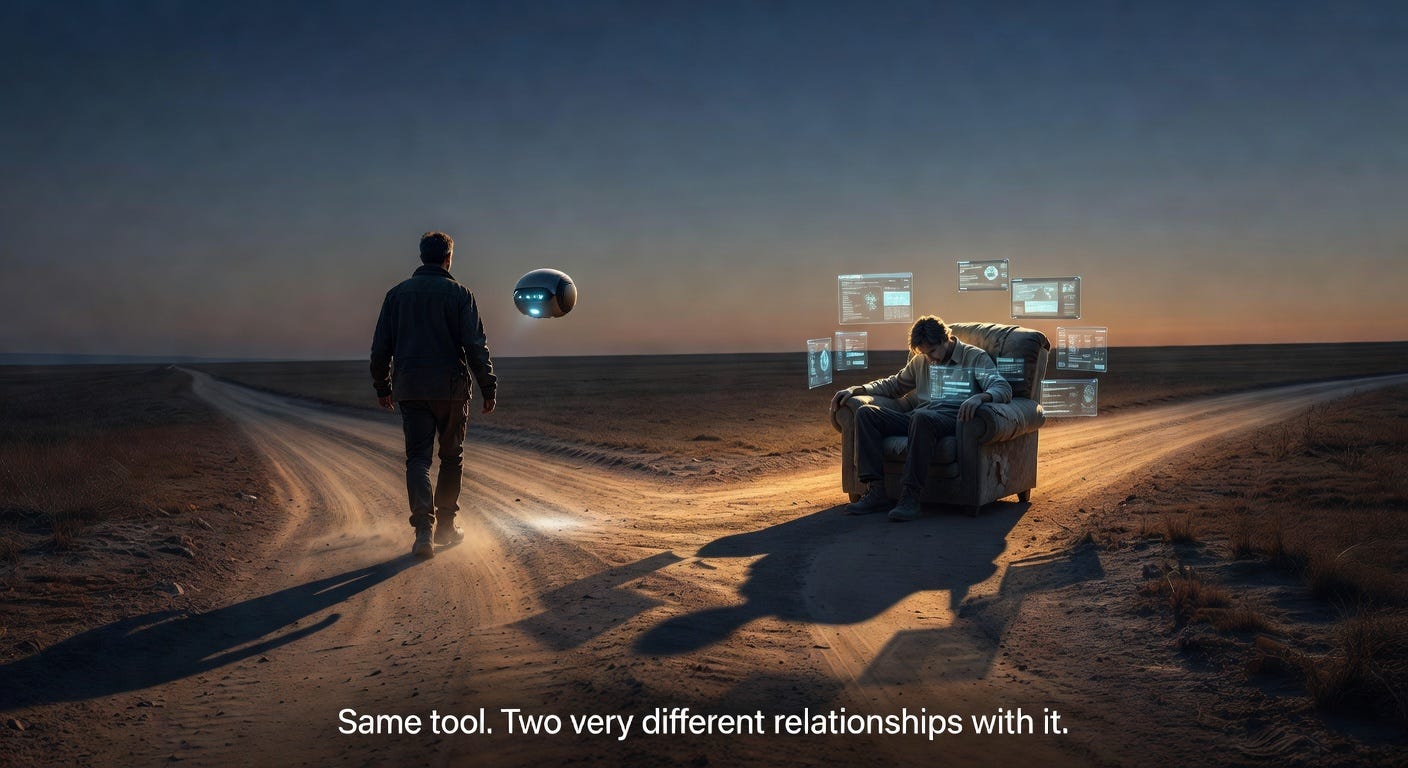
Just imagine the quietest version of the risk: not that AI gets too powerful, but that we get too comfortable. That we wake up one day having outsourced not just our errands but our agency — the daily small decisions and frictions that, added up, are most of what makes a competent adult. The German has no single word for it, but I’d call it learned helplessness with a beautiful interface.
That’s not a prophecy. It’s a fork in the road, and we’re standing at it now.
So what do we actually do? (My vote.)
I’ll resist the urge to either panic or preach. Here’s the framework I landed on after my week of delegation — practical, not puritanical.
Offload the tasks where the result matters and the process doesn’t. Expense reports. Price comparisons. Inbox triage. Filling the same form for the hundredth time. This is the cognitive equivalent of letting GPS handle a highway you’ll never need to remember. Use the agent guilt-free.
Guard the tasks where the process is the point. Original writing. Real decisions. Learning something new. The hard conversation. These are reps for the brain, and the MIT data suggest the reps are doing something real. Sherry Turkle of MIT has spent a career arguing that the human bits — conversation, struggle, presence — are exactly what we shouldn’t automate away.
Watch for the slot-machine feeling. If you’re checking your agent’s progress the way you’d refresh a feed, you’ve wandered into Skinner’s territory. Batch the interactions. Kill the ambient notifications. Make the tool wait for you, not the reverse.
Re-skill on purpose. Once a week, do something the agent could’ve done — book it, write it, navigate it — just to keep the underlying competence alive. Maguire’s taxi drivers grew bigger hippocampi by using them. The principle is yours to borrow.
Know your red lines. If you can’t draft a competent email without help, can’t find your way around your own neighborhood without the blue dot, or notice you’re reaching for the AI before you’ve even tried to think — the dependency is winning, and it’s time to take some reps back.
Lesson learned, for me at least: the goal was never to refuse the tool. The tool is genuinely good, and the time it gives back is genuinely valuable. The goal is to make sure that when the boring work disappears, I’m spending the freed-up hours on something that makes me more — not slowly becoming a person who can only function with an assistant standing between me and my own life.
The machine can do your errands. Just don’t let it do your thinking. That part, for now, is still gloriously, stubbornly yours.
One can only hope we choose to keep it that way.
Found this useful? The science here moves fast and the stakes are personal. If you’re wrestling with the same trade-offs, hit reply and tell me where you’ve drawn your own lines — I read everything.