
Let me start with a confession. The other day I tried to recall a phone number I have dialed for fifteen years — and I couldn’t. Not the whole thing. I got the area code, paused, and reached for my phone before my brain had even finished being embarrassed. The number lives in my contacts now, so my head decided it didn’t need to live there too.
That small failure is the whole story of this article in miniature. Your brain is an efficiency machine. It does not store what it believes it can look up. And we have just handed it the most capable “look-it-up” partner ever invented — one that doesn’t merely retrieve answers like a search engine, but thinks on our behalf. Writes the email. Drafts the argument. Solves the problem. Plans the trip.
So the question worth asking — calmly, without the doom or the hype — is this: if the brain strengthens what it uses and prunes what it doesn’t, what exactly are we training it to forget? And, just as importantly, what might it be free to become instead?
First, the part nobody disputes
Before we argue about AI, we need one piece of settled science on the table, because everything else hangs on it.
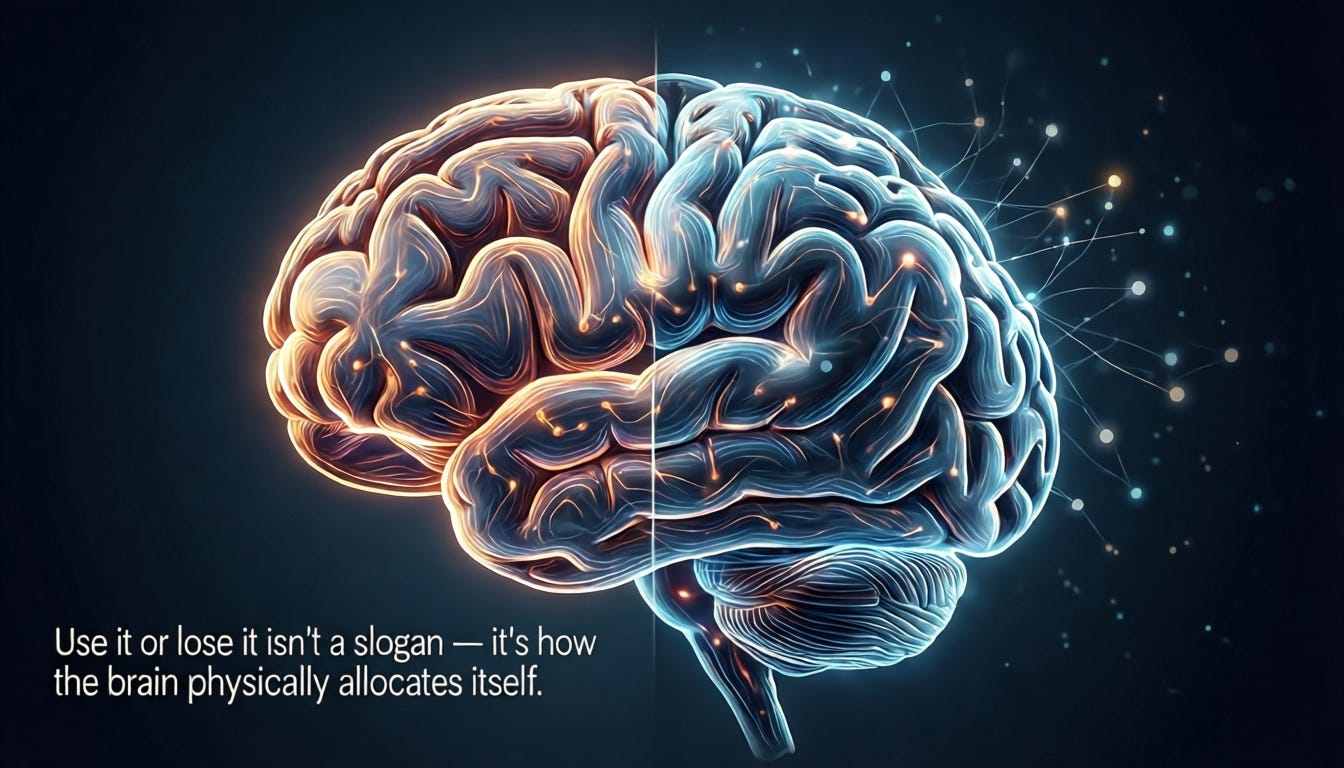
Your brain is plastic. Not plastic like a water bottle — plastic like clay. It physically reshapes itself based on what you do. The pathways you fire repeatedly get thicker, faster, more myelinated. The pathways you neglect get quietly dismantled and recycled in a housekeeping process neuroscientists call synaptic pruning. The shorthand — “neurons that fire together wire together” — is over seventy years old and still holds.
This is not a bug. It is the single most powerful feature of being human. It is how you learned to read, to drive, to recognize your mother’s face. But here is the catch that matters for us: plasticity is morally neutral. The brain doesn’t know whether the skill it’s pruning is one you wanted to keep. It just notices you stopped using it, and reclaims the real estate.
The most famous illustration comes from London cab drivers. To earn their license, they must master “The Knowledge” — a fearsome mental map of 25,000 streets. Neuroscientist Eleanor Maguire (who, sadly, passed away in early 2025) scanned their brains and found something startling: the posterior hippocampus, the brain’s spatial-mapping center, was physically enlarged compared to the rest of us. They had grown a bigger map-making machine by using it.
So far, so inspiring. Here is where things get interesting — and where the warning lives.
That same growth came at a price. Those drivers were measurably worse at certain other visual-memory tasks. The brain reallocates; it does not infinitely expand. And the inverse holds too: a 2020 study found that people who habitually rely on GPS have weaker spatial memory — and the more they lean on turn-by-turn directions, the worse their natural navigation gets over time.
Read that again, because GPS is the dress rehearsal for everything AI is about to do. We outsourced navigation to a machine, and the navigation muscle softened. Now we are outsourcing thinking itself.
What the newest research is finding (and what it isn’t)
Here is where I have to be scrupulously fair, because this topic attracts terrible journalism in both directions — breathless “AI is making us stupid” headlines on one side, dismissive “every generation panics about new tech” shrugs on the other. The truth is more interesting than either.
In 2025, a team at the MIT Media Lab led by researcher Nataliya Kosmyna wired up 54 people with EEG sensors and had them write essays — some using ChatGPT, some using Google, some using nothing but their own minds. The ChatGPT group showed the weakest neural connectivity of the three, the poorest memory of what they had just “written,” and a striking inability to fully re-engage their own brain networks when later asked to write unaided. The researchers gave this lingering effect a memorable name: “cognitive debt.”
It’s a chilling result. It is also — and I want to be honest here — a small, preliminary, not-yet-peer-reviewed result. Fifty-four people. One task. Kosmyna herself has publicly pleaded with journalists not to run “AI rots your brain” headlines, because that is not what a study this size can prove. (To be clear: I’m citing it precisely because it’s suggestive, not because it’s the final word.)
But it doesn’t stand alone. Researchers at Microsoft and Carnegie Mellon surveyed 319 working professionals and found a quietly damning pattern: the more people trusted the AI, the less critical thinking they did. Confidence in the machine, it turns out, is inversely proportional to scrutiny of the machine. And a separate 2025 study of 666 people found a significant negative correlation between heavy AI use and critical-thinking scores — strongest, worryingly, among the youngest users.
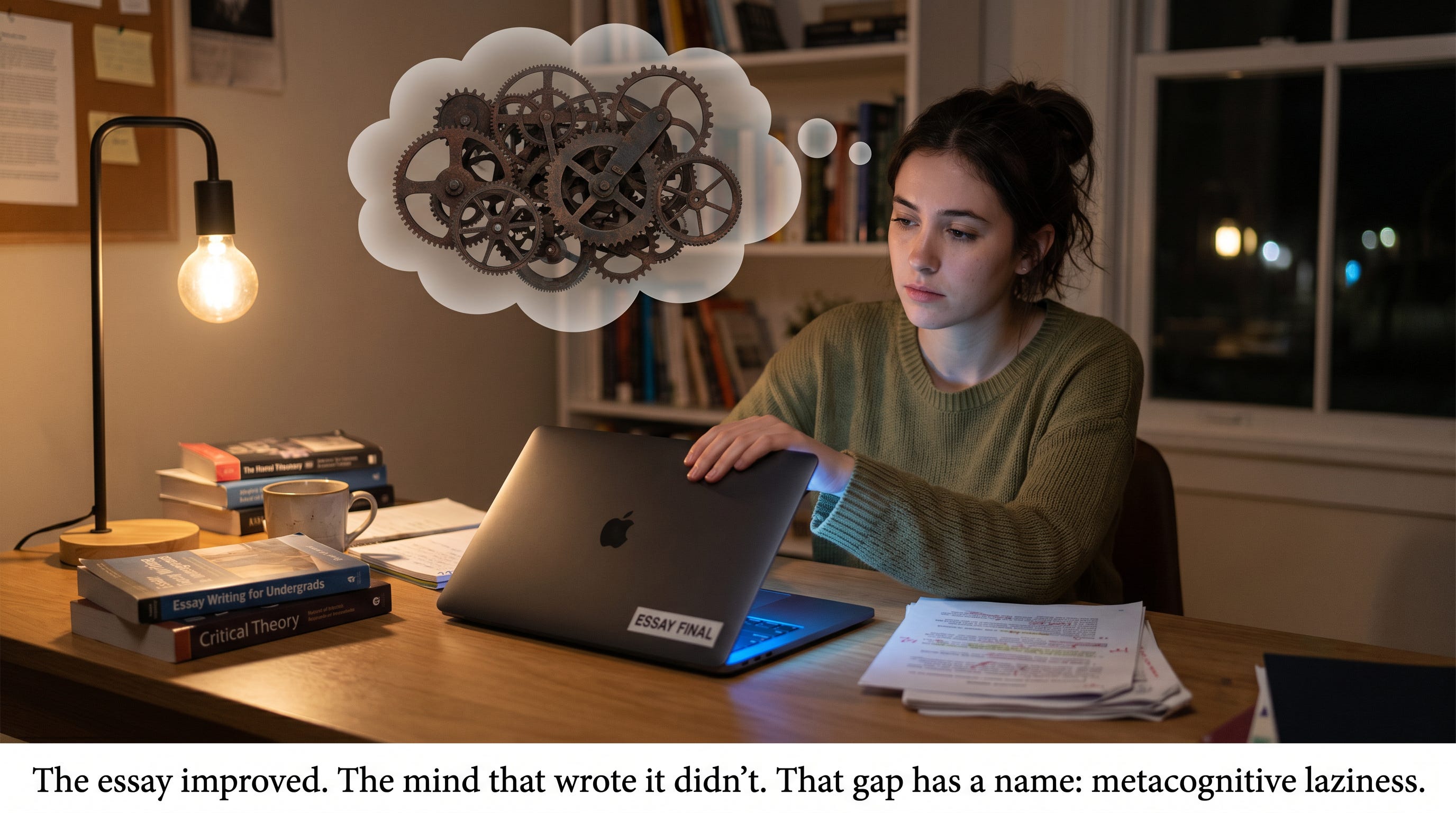
What’s the common thread? A concept educational psychologists have started calling “metacognitive laziness.” In one controlled experiment, students who used ChatGPT produced the best essays — but showed no improvement in actual knowledge or in their ability to transfer what they’d learned to a new problem. They got a better product and an unchanged brain. They had offloaded the thinking, not just the typing.
So that’s settled — AI is bad for us. Right?
Not so fast. This is exactly the moment where lazy thinking (the human kind) would have us close the laptop and declare victory for the doomers. But the evidence has a plot twist, and intellectual honesty demands we sit with it.
The single largest study on technology and the brain points the opposite direction. In 2025, researchers Jared Benge and Michael Scullin pooled 57 studies covering over 411,000 adults and found that greater use of digital technology was associated with a 58% reduction in the odds of cognitive decline. Let me say that plainly: the generation that was supposed to be getting “digital dementia” is, on average, aging more sharply, not less. The “digital dementia” scare, it turns out, has remarkably little evidence behind it.
How can both things be true? How can technology dull us in a lab and protect us across a lifetime?
Here is my read — and I’ll flag clearly that this is interpretation, not proven fact. It comes down to engagement versus surrender. Learning a new app in your sixties is a challenge — it makes the brain work, and challenge is exactly what builds cognitive reserve. Asking ChatGPT to write your college essay is a shortcut — it removes the challenge entirely. Same technology, opposite cognitive effect, depending entirely on whether you’re wrestling with it or outsourcing to it.
This distinction is everything. And it reframes the whole debate away from a useless question (”Is AI good or bad for the brain?”) toward the only one that matters: Are you using AI in a way that makes your brain work, or in a way that lets it nap?
The optimistic case, taken seriously
There’s a school of thought that says I’ve framed this wrong from the start. Philosophers Andy Clark and David Chalmers argued back in 1998 — long before any of this — that the mind doesn’t stop at the skull. Their “extended mind” thesis holds that a notebook, a smartphone, and now an AI are genuinely part of your cognitive system, the same way a blind person’s cane becomes an extension of their sense of touch. From this view, fretting about “offloading” memory to AI makes about as much sense as fretting that we offloaded memory to writing three thousand years ago. (Socrates, for the record, worried about exactly that. He thought writing would destroy memory. He was both right and gloriously beside the point.)
And the upside isn’t theoretical. In a remarkable randomized trial in Nigeria, students who got just six weeks of after-school AI tutoring made learning gains equivalent to roughly two years of normal schooling — outperforming about 80% of all the educational interventions researchers have ever tested. The biggest beneficiaries were girls who had started out furthest behind. As Wharton professor Ethan Mollick argues in his book Co-Intelligence, this is the long-promised dream of personalized one-on-one tutoring, finally cheap enough to give everyone.
Notice the pattern, though. The Nigerian students gained because the AI made them engage more — it gave a struggling kid a patient tutor who’d explain things five different ways. The professionals in the Microsoft study lost ground because the AI let them engage less. The tool was the same. The relationship to it was opposite.
Just imagine — the next ten years
Let me get speculative, because the trajectory of this technology demands it.
Just imagine a child born this year who never experiences the productive frustration of a blank page, because a writing assistant has always been there to finish her sentences. Does she grow up to be a fluent collaborator with machines — or someone who has never once heard her own unaided voice?
Just imagine a surgeon whose AI co-pilot catches every error for a decade, until the day the system goes down mid-operation and a skill that was never allowed to fully form is suddenly, desperately needed.
Just imagine the opposite, brighter world: where AI handles the drudgery — the formatting, the scheduling, the first rough draft — and frees millions of people to do the kind of deep, creative, synthetic thinking that most of us never had time for. Where offloading the trivial expands the space for the profound.
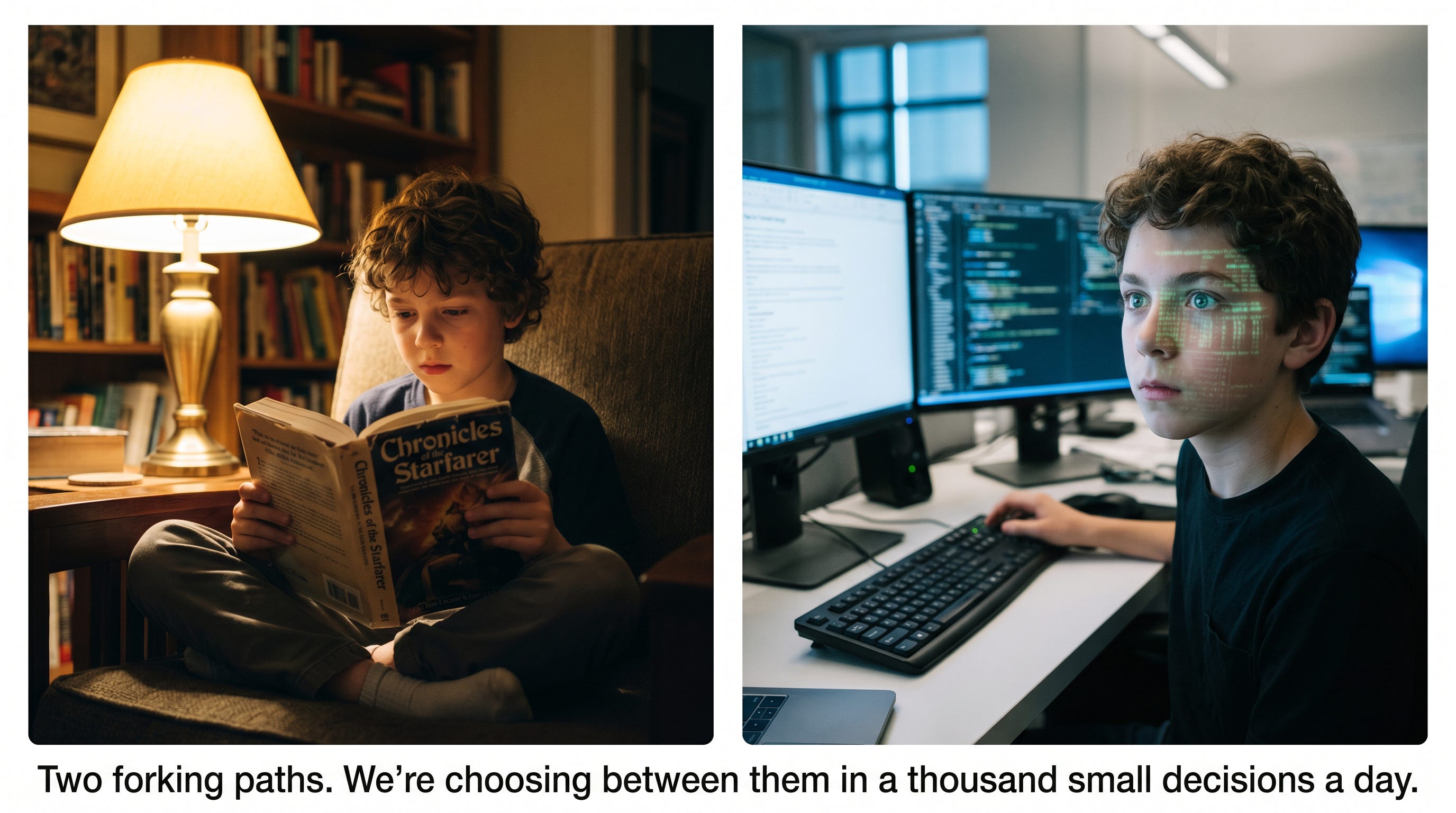
These futures are not science fiction. They are forking paths from the choices we’re making right now, today, every time we decide whether to think a thought ourselves or ask a machine to think it for us.
And the further horizon gets stranger still. Brain-computer interfaces have already left the lab — companies like Neuralink and Synchron now have working implants in human patients, mostly people with paralysis regaining the ability to control devices with thought alone. The near-term promise is medical and genuinely wonderful: restoring movement, speech, sight. But the further-out promise — direct cognitive augmentation for healthy people, memory you can upgrade like phone storage — raises a question we are nowhere near ready to answer. If you can download a skill, will anyone bother to learn one? And who owns the contents of an augmented mind?
What does this mean for you?
I promised practical, not just provocative. So here is what the research actually supports — things you can do this week, not someday.
1. Apply the “GPS rule” to AI. Use it freely when the task is just a means to an end — booking a flight, summarizing a document you were only going to skim anyway. But turn it off when the cognitive work is the point: your first draft, learning a genuinely new subject, finding your way around an unfamiliar city. The test is brutally simple. If you can’t put what you just produced into your own words, you didn’t offload the typing — you offloaded the thinking.
2. Keep one deep practice the machine can’t touch. Maryanne Wolf, the cognitive neuroscientist who literally wrote the book on the reading brain (Reader, Come Home), warns that our capacity for deep reading — the slow, immersive, reflective kind — is eroding even in expert readers like herself. Her prescription, and mine: read something long and demanding, on paper, every day. Twenty minutes. The circuit needs the exercise or it fades, exactly like the cabbies’ hippocampi in reverse.
3. Trust less, verify more. Remember the Microsoft finding — the people most confident in the AI did the least thinking. So flip it deliberately. Before you accept anything an AI tells you for something that matters, argue with it. Make it defend itself. Catch it being wrong (it will be). The friction is not a bug in your process; it’s the entire point.
4. For parents and teachers — front-load the struggle. The clearest finding in all this research is that students who reach for AI first get better grades and learn nothing. So flip the order: let kids draft, reason, and fail on their own first. Bring the AI in afterward, for feedback and revision. Struggle first, scaffold second. That sequence is the difference between a tool that teaches and a tool that replaces.
Lesson learned
We did not get a vote on whether AI would arrive, and we will not get a vote on whether it rewires us. It will. Everything does — every book you’ve read, every language you’ve spoken, every habit you’ve kept has already physically reshaped the organ between your ears. That ship sailed when our ancestors invented writing, and panicking about it now is roughly as useful as panicking about gravity.
But which parts get stronger and which parts quietly fade — that part, remarkably, is still up to us. The brain is not a victim of AI. It is a partner, an apprentice, or a casualty, depending entirely on how we choose to use the thing. The machine can be a crutch that lets a muscle wither, or a weight that makes it grow. The technology won’t decide which. You will, in a hundred unremarkable moments a day.
So the next time you reach for the AI before you’ve even tried to think the thought yourself — pause. Just for a second. Ask whether this is a task you want to get done, or a muscle you want to keep.
Sometimes the answer is “just get it done,” and that’s perfectly fine. That’s what the tool is for.
But sometimes the thinking is the point. And on those occasions, the most radical, future-proof, and quietly rebellious thing you can do — is to do it yourself.
My vote? Keep the muscle.
The HAIA Foundation explores how humanity and artificial intelligence can flourish together. If this resonated, share it with someone who reaches for the AI a little too quickly — and then, naturally, talk it through in your own words.