
Most US employers now track their workers’ screens, and a majority let an AI score that activity in real time — flagging your quietest, hardest thinking as “idle.” Here’s how monitoring quietly became the default, why it makes people perform busyness instead of doing good work, and what you can actually do about it.
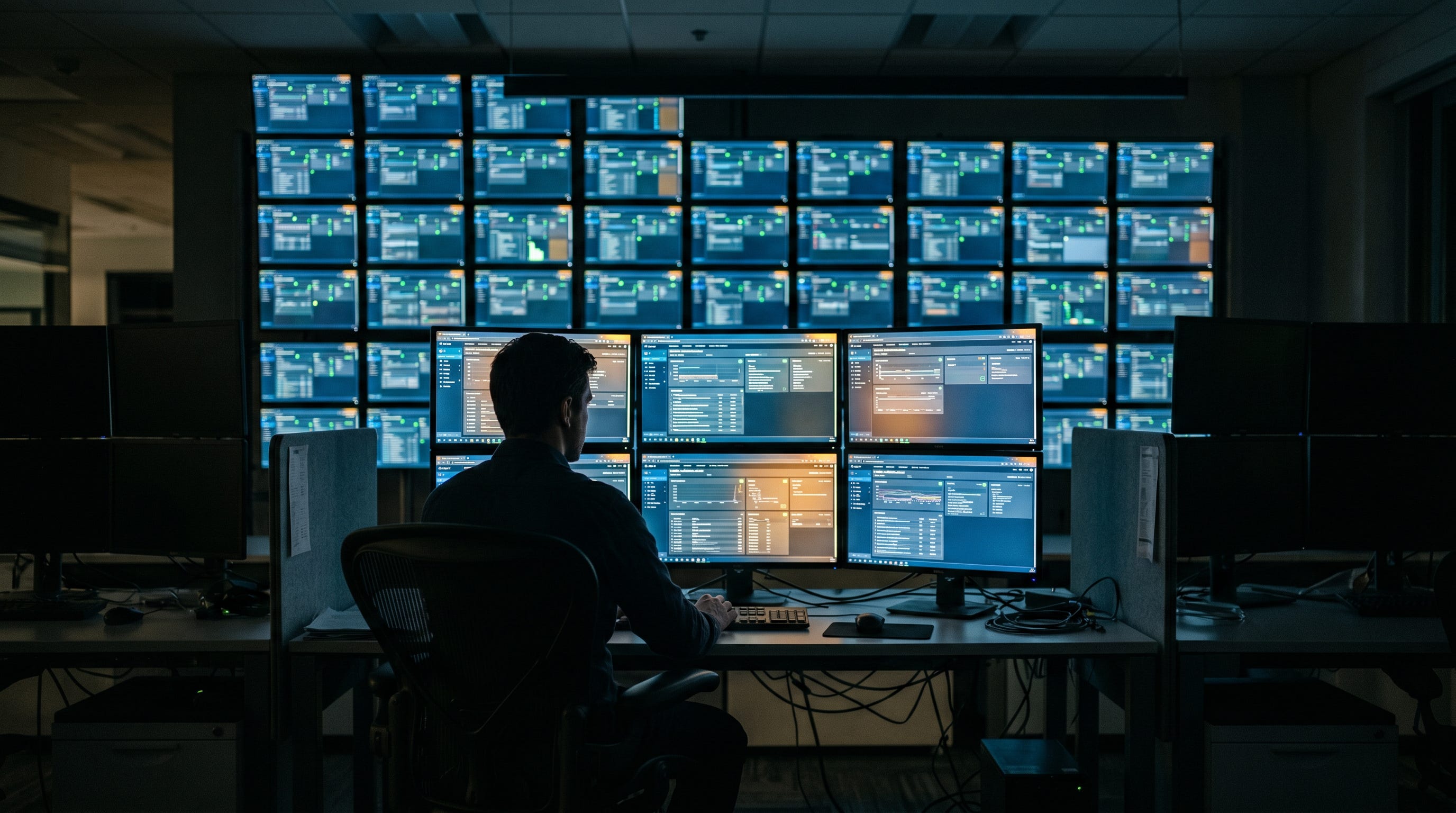
I want to admit something before I judge anyone, because for a stretch of last year I was the watcher, not the watched. I managed a small remote team, and our project tool had a little colored dot next to each person‘s name: green for active, yellow for away, grey for offline. I told myself I never looked. Reader, I looked. When someone‘s dot went grey at 2 p.m. on a Tuesday, a small ungenerous voice in my head asked: where are they? I never said a word about it — but the dot had quietly rewired how I read my own colleagues. I was trusting a pixel over the people I‘d hired.
That little dot is the whole story in miniature. Multiply it by screenshots every ten minutes, keystroke logs, mouse-movement heatmaps, and an AI quietly assigning each person a productivity grade, and you have the modern workplace — not in some dystopian future, but right now, on the laptop in front of you. The unsettling part isn‘t that the technology exists. It‘s that it became the default while almost nobody voted on it.
First, the part that’s no longer up for debate
Let me lay down the facts, because the scale is genuinely larger than most people assume.
Employee monitoring isn‘t a fringe practice anymore — it‘s the baseline. In a survey of 1,500 US employers and 1,500 employees, 74% of US employers track screens using online tracking tools, and — this is the part that matters most for our story — 61% of companies are now using AI-powered analytics to measure productivity. A separate industry aggregator puts the figure even higher, reporting that 78% of companies now use employee monitoring software — screenshots, mouse and keyboard tracking, website logs. (A quick honesty note, because you should always know where a number comes from: those two figures measure slightly different things and shouldn‘t be blended. The point isn‘t the decimal place. The point is that “most employers“ is no longer a stretch — it‘s arithmetic.)
Here‘s the leap that turns ordinary monitoring into something new. Older surveillance just logged what you did — a timestamp, a screenshot, a record someone might review later. The AI layer doesn‘t wait. It gives employees a score on their work in real time, tallying hours online, emails sent, and activity, and — crucially — workers are “logged out or flagged for being idle too long.“ Read that twice. An algorithm now decides, second by second, whether you are working or idle, and acts on the answer without a human in the loop.
That word — idle — is where the trouble hides, and I‘ll come back to it, because the machine‘s definition of idle and a human‘s definition of thinking are not the same thing.
And lest you imagine this is confined to call centers and warehouses, the white-collar core has already arrived. Per recent reporting, almost every Fortune 500 is tracking AI usage, turning work into a contest to prove employee productivity, with internal systems sorting people onto leaderboards. At Meta, internal systems are reportedly being tested to capture mouse movements, clicks, and keystrokes. The market behind all this is booming: one widely-cited estimate puts the bossware market near $4.5 billion by 2026 (other analysts peg it far lower on narrower definitions, so hold that figure loosely — but the direction of travel is not in doubt).
So far, so well-documented. Now for the harder question: is any of this actually a problem?
So that’s just good management. Right?
Let me make the employer‘s case as strongly as I can, because it is not a strawman, and the people making it are not villains.
A monitored workforce, the argument goes, is a more honest and more secure one. The employment-law firm Fisher Phillips lays out the legitimate reasons to monitor: protecting sensitive business data from being lost or stolen, and the plain behavioral nudge that when employees know they‘re being watched, they may be “more mindful about how they spend time ‘at work‘” and less inclined to engage in conduct that violates an employer’s workplace policies. If you‘re paying someone, isn‘t it reasonable to know they‘re doing the job? Hard to argue with in the abstract.
Then there‘s the policy worry, which I take seriously even though I land elsewhere. The free-market Information Technology and Innovation Foundation cautions that throwing the regulatory book at workplace AI risks freezing productivity-boosting technology in place. A framework that spends all its energy restricting employers, ITIF argues, while underinvesting in retraining and worker mobility, would misdiagnose the problem — protecting yesterday‘s jobs at the expense of tomorrow‘s workers. There‘s a real point buried in there: ban the tools and you may simply slow the economy without making anyone‘s work life better.
So that‘s settled, then — monitoring is just modern management, and the critics are Luddites. Right?
Here‘s where the steelman quietly tips over. The pitch is efficiency. But the evidence keeps suggesting that watching people does not, in fact, make them work better — it makes them work more anxiously, which is not the same thing. Even firmly pro-business voices concede the catch: in one risk analysis aimed at employers themselves, the warning is blunt — surveillance destroys trust faster than any missed deadline, and exposes the company to its own legal risks. When the people selling you on monitoring are warning you about it, pay attention.
And the academic record is harder still on the efficiency claim. A large prevalence study from the Washington Center for Equitable Growth found that more than two-thirds of workers are monitored electronically — and that the intensity of monitoring tracked with harm, not flourishing. Among workers whose productivity was watched “all the time,“ 46% agreed they worked too fast, compared with just 15% of the unmonitored, and reported injuries climbed alongside. Faster, yes. Better, no. Safe, definitely not.
The bee that was watched, and the bee that didn’t work any harder

There‘s a parable that captures this better than any chart, and it comes from an unexpected place — a federal regulator quoting Dr. Seuss. In a 2024 speech on automated management, an FTC commissioner warned about the people of a town who were sure that “a bee that is watched will work harder.“ So they assigned a watcher to one bee. And then a watcher to watch the watcher. And so on, up an absurd chain of supervision. The punchline, in the regulator‘s own words: “he watched and he watched. But, in spite of his watch, that bee didn’t work any harder.“
That‘s the whole trap in one image. Watching a worker doesn‘t conjure productivity out of thin air — it just produces the appearance of productivity, performed for the watcher. And here is where that innocent word idle comes back to bite. The most valuable knowledge work — reading carefully, thinking through a hard problem, staring at a wall while the solution assembles itself — generates almost no keystrokes and no mouse movement. To the algorithm, deep focus is indistinguishable from doing nothing. So the rational worker learns to avoid looking idle: jiggling the mouse, padding the email count, keeping the status dot defiantly green. Researchers studying this found that workers respond with tactics of everyday resistance — commiserating with each other and employing technological hacks — precisely because they face a lack of transparency and control over systems that judge them.
Think about what we‘ve built here. A system that penalizes the quiet, concentrated thinking that produces the best work, and rewards the twitchy, visible busyness that produces the worst. We are, at scale, optimizing for the wrong bee.
What Germany figured out: nobody installs the watcher without the workers’ say-so

Here is where my comparative streak kicks in, because I‘ve watched how differently this plays out across borders — and the most interesting counter-model isn‘t a privacy law at all. It‘s a labor structure.
In Germany, you generally cannot just roll out surveillance software the way a US employer can. Under the country‘s long-standing system of co-determination — Mitbestimmung — workers elect a body called a works council, and that council has a genuine, legally binding voice in decisions about working conditions. Crucially, the introduction of technical systems “designed to monitor the conduct or performance“ of employees is one of the matters where the works council has a co-determination right: management cannot install the monitoring tool unilaterally. It has to negotiate, and the workers can say no. Not “file a complaint after the fact“ — say no before the camera is bolted to the wall.
Sit with the difference for a second. In the American default, monitoring arrives as a fait accompli: you find out you‘re being scored when the score shows up in your review. In the German model, the people being watched have a seat at the table where the decision to watch is made. Same technology, radically different power arrangement. The tool isn‘t the destiny; the governance is.
And this isn‘t some exotic European-only idea with no American echo. Several US states have begun building thinner versions of the same instinct — laws requiring employers to notify workers before electronically monitoring them. New York, Connecticut, and Delaware all have notice requirements on the books. Notice is a long way from a veto, and I won‘t pretend otherwise — being told you‘re being watched is not the same as getting to object. But it‘s the same underlying principle poking through: that the watched should at least be participants in their own watching, not just its subjects. The question worth asking isn‘t whether America will regulate this. It‘s whether we‘ll settle for “we told you“ when other countries built “you get a say.“
Now play it forward ten years
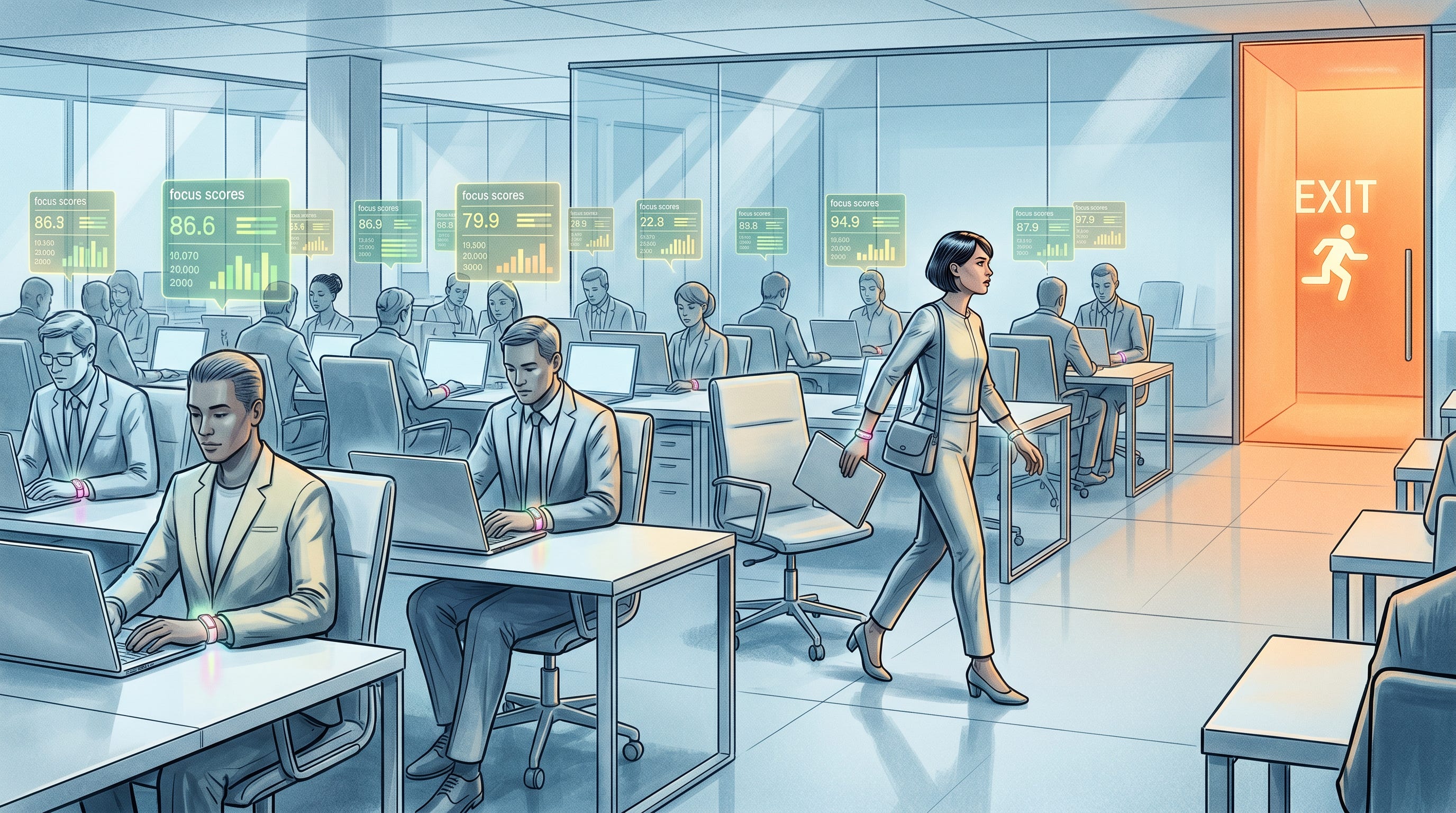
Let me extrapolate — not in a tinfoil-hat register, but in the boring, plausible way these things actually unfold.
It‘s 2036. The monitoring didn‘t get more obvious; it got more intimate. The screenshots and keystroke logs of today look quaint, because the new systems don‘t measure your output — they infer your state. Your wellness wristband (offered, of course, as a perk) feeds the same dashboard that holds your productivity score, and the model has learned to read the gap between them. It knows your focus dips at 3 p.m., that your “deep work“ blocks correlate with answering fewer messages, that your engagement drops the week before you eventually quit — sometimes before you‘ve consciously decided to. Your annual review writes itself from a year of telemetry you never saw.
Now imagine the quiet feedback loop that follows. The algorithm flags you as a “retention risk“ in month nine, based on patterns it won‘t disclose. Your manager — who trusts the dashboard the way I once trusted that little green dot — starts treating you like someone halfway out the door. Which, naturally, nudges you toward the door. The prediction becomes the cause. And the most chilling part isn‘t the watching; it‘s the performing. A whole workforce that has learned to generate the telemetry the machine rewards — the optimal cadence of keystrokes, the meetings that read as “collaboration,“ the carefully-timed Slack messages — while the actual thinking, the part that can‘t be measured, quietly atrophies because nothing in the system can see it, and so nothing in the system values it.
That‘s not a far-fetched future. Every component of it ships today. The only question is whether anyone gets a vote before the rest is assembled.
What the smart people are saying
Here‘s a question where you might expect the usual team jerseys — privacy advocates on one side, industry on the other — and on the should we worry axis, the agreement is more striking than the disagreement.
Start with the group that named the thing. The Electronic Frontier Foundation coined the term “bossware,“ and its objection is precise: these tools log every click and keystroke and deploy spying features that go far beyond what is necessary and proportionate to manage a workforce. Note the phrasing — not “monitoring is always evil,“ but disproportionate. That‘s a standard, not a tantrum.
The ACLU warns from the civil-liberties tradition that new technologies give employers “unprecedented“ power to watch, and that electronic surveillance often crosses the line where it becomes a tool for spying on employees rather than managing them. And the AI Now Institute makes the structural argument: algorithmic management is, at bottom, about control — it widens the gap between employer and worker, and the fix is to rebalance the power discrepancy between workers and employers through real curbs and worker-data rights.
But this is not only a left-coded concern, and that‘s what should make you sit up. The federal labor regulator itself has weighed in: the General Counsel of the National Labor Relations Board issued a memo urging the Board to protect employees from intrusive or abusive electronic monitoring and automated management practices that chill workers‘ rights to organize. When a Dr. Seuss–quoting FTC commissioner, a civil-liberties coalition, a labor regulator, and even the employer-side risk analysts all land on this is going too far — the question stops being partisan and starts being structural. Even ITIF, the dissenting free-market voice, isn‘t arguing the surveillance is good — only that bans are the wrong tool. Notice what nobody is defending: the idea that scoring humans like vending machines makes them work better.
What does this mean for you?
You‘re probably not going to overhaul your company‘s HR stack this week. But this is closer to your desk than it feels, and there are concrete things within reach — whether you‘re the watched or, like I was, the one holding the dashboard.
Find out what’s actually running. Ask — plainly, in writing — what monitoring software your employer uses and what it records. In a growing number of states (New York, Connecticut, Delaware among them) they owe you notice anyway. You can’t push back on a system you can’t name.
Refuse to perform for the algorithm. The mouse-jiggler and the padded inbox are rational responses to a dumb metric, but they corrode the actual work — and your own sense of it. As far as your situation allows, do the deep, quiet, idle-looking work that’s worth doing, and make the case for it to a human, out loud. Don’t let a pixel be your performance review.
If your workplace has any collective voice — use it on this. A union, a works council, an employee committee, even an informal group of colleagues raising it together: the German lesson is that the watched having a say changes everything. Monitoring negotiated is a different animal from monitoring imposed.
If you manage people, watch the watcher in yourself. I speak from the dot. The tools make distrust frictionless; resist the friction. Judge output and outcomes, not green status lights. The best thing I ever did for my team was to stop looking at the dot — and tell them I’d stopped.
Treat “it’s just for productivity” as a claim to test, not a fact to accept. The evidence that surveillance raises output is thin; the evidence that it raises anxiety, turnover, and injury is not. When someone pitches monitoring as efficiency, ask for the efficiency data. It’s usually missing.
The watcher always loses, eventually
Here‘s the lesson I keep landing on, and it‘s older than any of this software. You cannot surveil your way to trust, and you cannot score your way to good work. The bee that is watched, as the man in the parable discovered, does not work any harder — it just learns to look busy while the watcher‘s certainty curdles into the very thing he feared. Monitoring promises control and delivers theater: a workforce performing productivity for a machine, and quietly updating their resumes while they do it. In one survey, 42% of monitored workers said they plan to quit within a year — a number to hold loosely, but a direction that every honest study points the same way.
The good news is that none of this is technologically inevitable; it‘s a choice, and choices can be made differently. Germany shows that the same tools can sit inside a structure where the watched get a vote. A handful of US states are inching toward at least telling people the truth. The fix isn‘t to smash the machines — it‘s to refuse the premise that a green dot knows more about your work than you do. Your most valuable hours at work will always be the ones that look, to a watching algorithm, like nothing at all. Protect them. They‘re where the actual work lives.
The HAIA Foundation watches the systems that watch us, so the rules for living with intelligent machines get written with humans at the table — not just under the lens. If your screen is being scored, forward this to whoever’s holding the dashboard.
Sorry to bring an unusual perspective, but this article reminds me of designing the NUI interface (https://www.democracylab.org/projects/1356). Imagine that each time you do anything genuinely new you are given an option to take credit for your innovation. Would exercising that option hurt other people who have less evidence of innovation? I would like to separate the problem of hurting those with lower measures from the problem of making sure the credit we give is for achievements in which we actually take pride (not for keeping a keyboard busy at the appointed hour). Both problems may be real, but may deserve very different solutions.