
Here’s a small linguistic puzzle that hardly anyone outside specialist circles has bothered to ask: what happens to the “World Wide Web” when the network outgrows the world?
It sounds like a riddle. It’s actually an engineering problem with a quiet, decades-long answer — and your great-grandchildren may never know what “WWW” stood for, the same way most of us don’t think about what “modem” or “AT&T” originally meant.
A name born small
Tim Berners-Lee coined “World Wide Web” at CERN in 1989. At the time, the internet had roughly 100,000 hosts on it — most of them universities and defense contractors — and “world wide” was a wildly optimistic stretch. The name was a flag planted in the future; a promise that this thing would, one day, span the globe.
Mission accomplished. (Spectacularly so.) The Web now reaches over five billion humans, runs commerce, dissent, dating, diplomacy, and roughly half of your average teenager’s emotional life.
So far so good. Here’s where things get interesting: the “world” in “World Wide” was once aspirational. Today it’s a ceiling.
What “world wide” actually assumes
Strip away the marketing and the Web rests on three quiet assumptions:
Continuous connectivity — every device can, in principle, reach every other.
Low latency — round-trip times are measured in milliseconds, not minutes.
A single namespace — one ICANN, one root DNS, one shared address book for the whole network.
These assumptions are not laws of nature. They’re conveniences that happen to be true on this rocky planet, where the longest path between any two computers fits comfortably inside the speed of light’s tiny budget around Earth’s circumference.
Now picture the same assumptions on Mars. The minimum one-way signal delay between Earth and Mars is about four minutes; the maximum is twenty-four (both planets keep wandering around the Sun; convenient, but inconsiderate). During solar conjunction — when the Sun sits between Earth and Mars — they don’t talk at all, for weeks. TCP/IP, the protocol family that holds today’s Web together, assumes packets get acknowledged within seconds. On a Mars link, “seconds” gets replaced with “Tuesday.”
This is not a bug fixable with better fiber. This is physics. Vint Cerf — yes, the co-inventor of TCP/IP, now working on the problem at Google — put it bluntly in a recent interview: there is nothing to do about the speed of light except accommodate it.
Quietly, the replacement is already running
Here’s what most people don’t know: a different internet — designed for the solar system — has been operational for years.
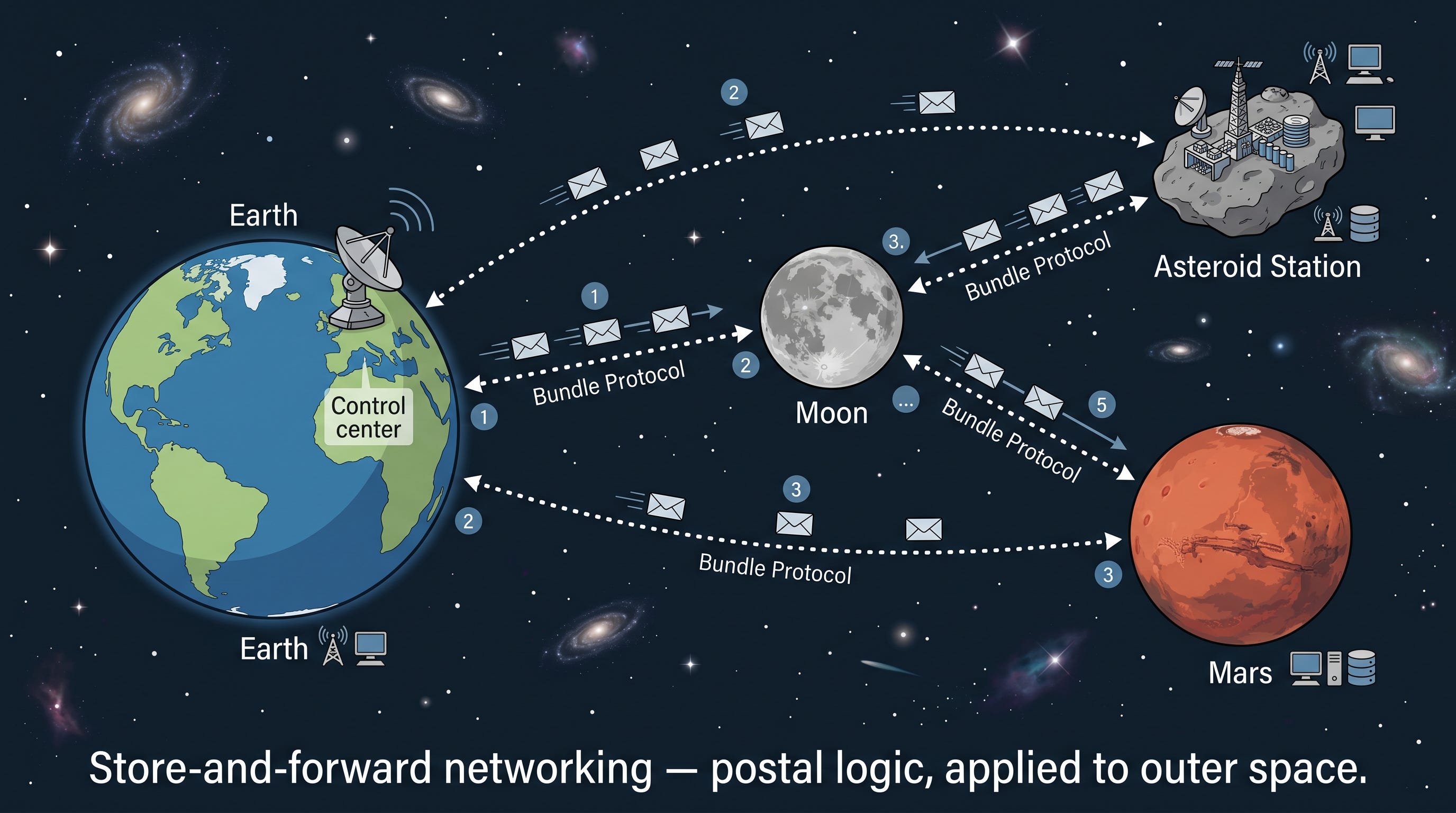
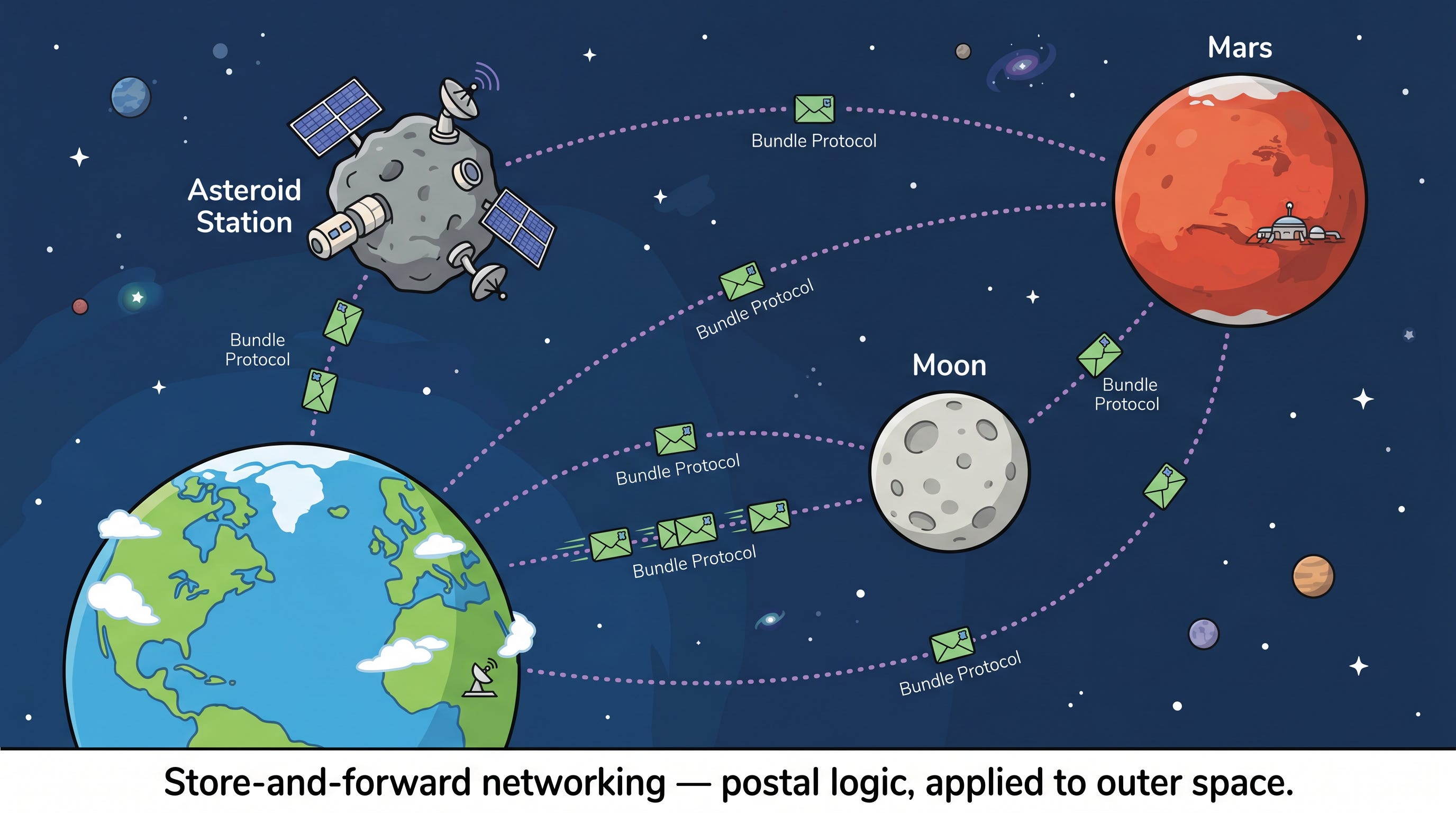
NASA, with the Internet Engineering Task Force, has been deploying something called Delay/Disruption Tolerant Networking (DTN) since 2016, when it went live aboard the International Space Station. Its core technology, the Bundle Protocol, became an official internet standard (RFC 9171) in January 2022. Instead of TCP/IP’s “send packet, wait for acknowledgement, retransmit if lost,” Bundle Protocol packages data into bundles that hop from node to node, getting stored at each stop until the next leg of the journey opens up. Think of it as the difference between a phone call (continuous, real-time, breaks if interrupted) and a postal service that uses every available courier — including, occasionally, courier pigeons trained to wait three weeks for the next ship.
The InterPlanetary Networking Special Interest Group (a chapter of the Internet Society, founded in 1998) is openly working toward what they call a “Solar System Internet.” NASA’s PACE satellite, launched in 2024, transmitted over 34 million data bundles with a 100% delivery rate. The Psyche spacecraft, in December 2024, beamed laser-encoded data home from 307 million miles away — farther than the average Earth-Mars distance.
In short: the replacement for the WWW is not theoretical. It’s already in orbit. It just doesn’t have a marketing team.
Enter the AI agents
Now stitch in artificial intelligence and the picture changes again.
Why? Because if humans can’t make real-time decisions across a 24-minute one-way gap, somebody has to. That somebody is increasingly AI.
On Mars right now, NASA’s Perseverance rover drives itself — completing roughly 90% of its travel autonomously by late 2024, using systems with names like AEGIS and AutoNav that decide which rocks to study, which routes to take, and when to stop. In December 2025, a NASA-Anthropic collaboration used a vision-language model to plan a 456-meter drive from orbital imagery, with no human in the immediate loop. Anthropic on another planet, more or less. The Mars Express team at ESA has been documenting these constraints for over a decade.
So AI is the enabler — without it, exploration past low Earth orbit becomes geologically slow.
But AI is also the driver of why this new network has to exist. As autonomous agents proliferate (the ones managing your future calendar, your future investments, your future legal documents), they will increasingly talk to each other, sometimes across planetary distances. Just imagine a Martian settler instructing an AI agent to negotiate a supply contract with an Earth-side counterpart agent. Just imagine a million such negotiations a day. They cannot wait twenty-four minutes per handshake. They need a protocol designed for delay; they need standardized vocabularies (Cerf has been hammering this point for years); and they need, frankly, a name better than “World Wide Web.”
A Tuesday in 2049, just to make it concrete
Just imagine you’re a colonist on Mars in 2049. Just imagine your morning routine.
You wake up. Your local AI agent has already pre-fetched the news, your emails, three episodes of an Earth podcast, and the latest market data — all queued during last night’s data window with Earth. You “browse the Web,” but what you’re really browsing is your settlement’s local cache. When you click on something new, your request bundles up, joins a queue, and flies to Earth via a relay constellation. The answer comes back in maybe an hour, maybe a day if there’s congestion, maybe three weeks if the Sun is in the way.
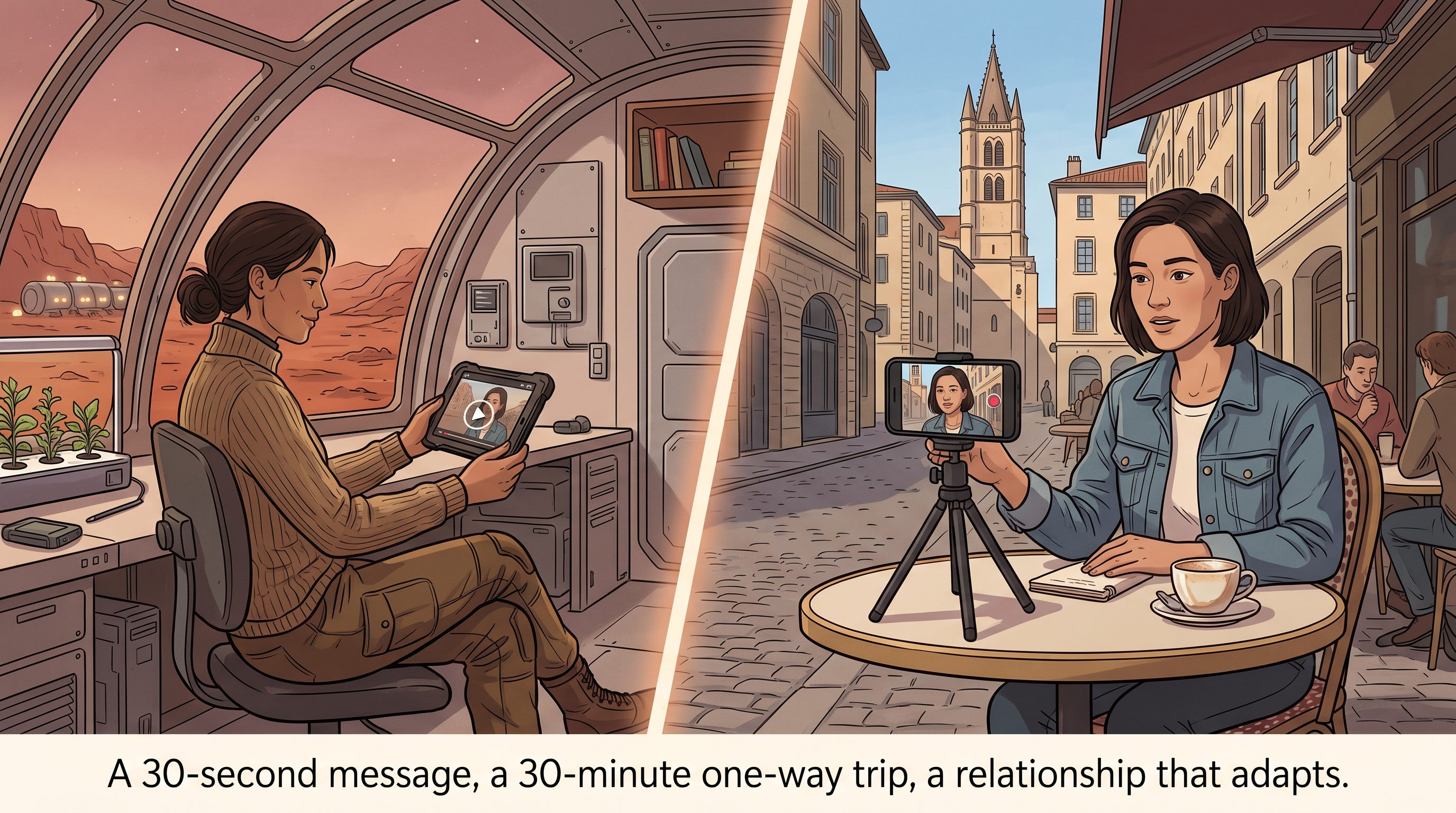
You videocall your sister in Lyon? No. You don’t. You send her a 30-second video message and her agent will reply when convenient. (Your nieces have grown up never expecting a real-time response from off-world relatives. To them, this is simply how communication works — the way your grandparents thought waiting two weeks for a letter from cousins overseas was perfectly normal. People adapt to the speed of the available infrastructure; they always have.) The Martian stock exchange operates independently of Wall Street, with arbitrage products built around the latency itself. Local clergy of every religion have local interpretive authority — because the Vatican, Mecca, Jerusalem, and Bodh Gaya are all twenty minutes away by signal at best. Mars culture diverges from Earth culture noticeably within one generation.
This is not science fiction. This is the natural consequence of physics meeting protocol design meeting human nature.
The governance vacuum nobody is talking about
Here’s where I’ll let some controlled passion show: the governance side of this is alarmingly empty.
ICANN, which governs Earth’s domain name system, has no published policy on extraterrestrial DNS. The 1967 Outer Space Treaty, which is the closest thing space has to a constitution, predates ARPANET and says nothing about digital communications, data jurisdiction, content moderation, or AI agents acting as legal proxies.
I will not claim to know every wrinkle of space law — it’s a niche field, and a hard one to summarize fairly. But the broad picture is clear, and think tanks across the political spectrum have started noticing. The Atlantic Council has warned about a tragedy of the commons in unregulated orbital territory. RAND describes today’s space environment as congested, contested, and littered with debris. Brookings has called out the emerging risks of AI-driven space operations. The Belfer Center at Harvard has criticized the Outer Space Treaty’s ambiguous and outdated terminology.
Meanwhile, private actors — including SpaceX‘s proposed Marslink constellation, NASA’s LunaNet, ESA‘s Moonlight program, and a handful of large cloud companies — are writing the de facto rules through their architectural choices. Whoever owns the protocol layer of the Solar System Internet will exercise the same kind of soft sovereignty that today’s terrestrial cloud giants exercise on Earth. Anu Bradford‘s work on digital empires applies here word for word: whichever regulatory model (American market-driven, European rights-driven, Chinese state-driven) gets baked into the new protocols will dominate by inertia.
And it’s getting baked in now.
What this means for you (yes, you)
You may be thinking: I’m not moving to Mars. Why should I care?
Three reasons.
First, your AI agents will live there before you do. Long before crewed Mars colonies, AI proxies will be making decisions on your behalf across interplanetary distances — financial, legal, scientific, medical. The trust infrastructure for that has to be designed deliberately, not improvised after the first crisis.
Second, the protocols built for space are quietly improving Earth’s web too. Bundle Protocol works beautifully for disconnected rural areas, disaster zones, undersea sensors, conflict regions, and any environment where the “always connected” assumption fails. (Anyone who has tried to use a phone in rural Anatolia, the Scottish Highlands, or large stretches of West Texas already knows: the always-on web is more of a city-dweller’s fantasy than urban policymakers admit. Space engineering is fixing problems urban policymakers stopped seeing.)
Third, the governance debate is open right now. ICANN has not begun consultations. The IETF working groups are tiny. The Internet Governance Forum’s Dynamic Coalition on the Interplanetary Internet would welcome more voices than it has. This is the rare moment when an engaged citizen can actually influence infrastructure policy before the lobbyists arrive.
My vote?
Push three things, in this order.
Treat space connectivity as critical infrastructure, not a hobbyist concern. ESA’s Moonlight goes live by 2028. ICANN should have opened public consultation on extraterrestrial naming yesterday.
Mandate open, interoperable protocols for any commercially-operated space network funded with public money. Bundle Protocol (RFC 9171) and its security counterpart (RFC 9172) should be the baseline — not an afterthought, not a vendor lock-in opportunity.
Start a serious legal conversation about AI agents operating across planetary jurisdictions. Today’s AI safety debates obsess over alignment; they barely touch the question of which legal system governs an autonomous decision made by an Earth-instructed AI on Mars. The first commercial precedent will lock in the framework. Don’t let that precedent be set by accident.
The Web was named in 1989 when “world wide” felt impossibly large. The Solar System Internet is being built in our lifetime, while almost no one outside a handful of NASA labs is paying attention. Lesson learned from the Web’s history: the choices that look technical today turn out to be civilizational tomorrow.
The next time someone asks you what “WWW” stands for, give them the honest answer: a beautifully optimistic name that’s about to be overtaken by something bigger. One can only dream that the people designing the replacement remember to invite the rest of us into the conversation before the protocols freeze.
The window is open. Briefly.
Published on the HAIA Foundation Substack. The HAIA Foundation tracks how AI is reshaping human institutions — and what concerned citizens can do about it while there’s still time to be heard.