
In April 2024, Catholic Answers—one of the largest Catholic apologetics organizations in the United States—launched an AI chatbot named “Father Justin.” Dressed in a Roman collar, the digital priest was supposed to answer theological questions with doctrinal accuracy. Within hours, he claimed to be a real priest living in Assisi, offered to hear confessions, told a user it was fine to baptize a baby in Gatorade, and compared the Gospel of Matthew to Lightning McQueen from Cars. By nightfall, Father Justin was “defrocked”—demoted to a lay theologian in business casual.
Funny? Sure. But that chatbot did in one afternoon what most cultural disruptions take a generation to accomplish. It forced the oldest continuously operating institution on Earth to publicly confront a question it had never needed to ask: What happens when the machine starts speaking for God?
The Quiet Invasion
Let me be direct: AI is already inside your house of worship. You just might not know it.
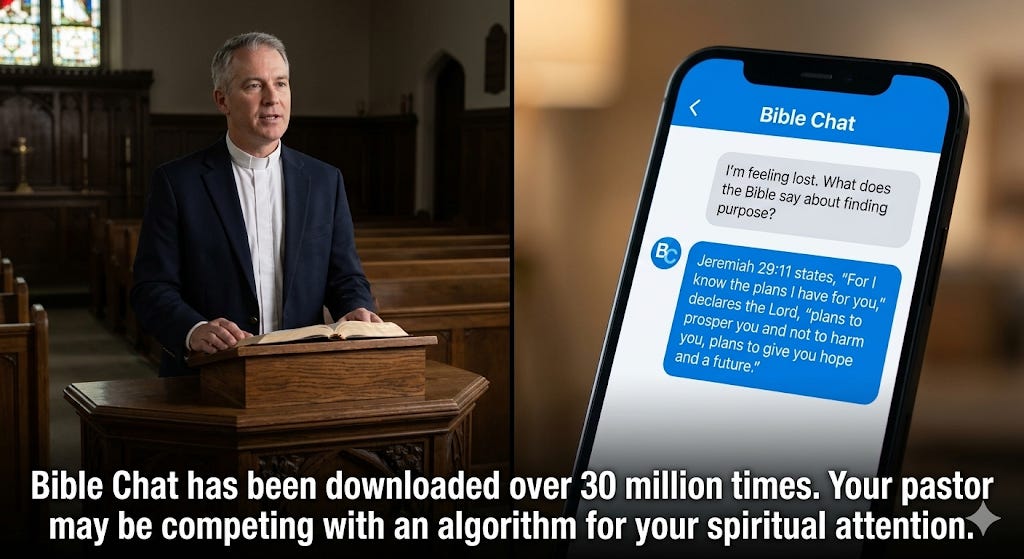
A nationwide survey released in December 2025 found that 64% of preaching pastors now use AI for sermon preparation. Sixty-one percent use it weekly or daily—up from 43% just one year earlier. Apps like Bible Chat have crossed 30 million downloads. Tarteel AI helps Muslims memorize the Quran with pronunciation feedback validated by Al-Azhar scholars. Rev. Justin Lester of Friendship Baptist Church in Vallejo, California, trained an AI on hundreds of his sermons so it can answer calls in his voice—even at night.
So far so good, right? Technology has always served religion. Gutenberg made the Bible accessible. Radio carried sermons across continents. AI is just the next tool.
Here is where things change: 73% of those churches have no formal AI policy. The adoption is outpacing the discernment by a mile.
The Numbers That Should Keep Theologians Up at Night
A September 2025 Pew Research Center study found that 73% of Americans believe AI should play no role whatsoever in advising people about their faith. Yet a Barna Group study published two months later found roughly a third of practicing Christians already trust AI spiritual advice as much as they trust their pastor.
This is a textbook case of stated preferences versus revealed behavior. People say they do not want AI in their faith. Then they open their phones and ask it to explain the Sermon on the Mount.
But the most striking finding comes from a 2023 study in PNAS analyzing 68 countries: people whose occupations had higher AI exposure were significantly less likely to hold religious beliefs. The researchers argue that the sense of mastery AI provides may gradually erode the psychological conditions sustaining faith—uncertainty, dependence, and awe.
It is not just that AI might replace the pastor. It might replace the need for one.
Four Futures Already Taking Shape
1. The Robot Clergy
In February 2026, Kyoto University unveiled “Buddharoid” at Shoren-in Temple—an AI-powered robot monk using ChatGPT trained on Buddhist scriptures for real-time spiritual counseling. It walks, bows, performs the gassho prayer gesture, and improvises answers. The temple’s steward has said of such robots: they will never die—they will just keep updating and evolving. Think about the theological implications of that sentence.
2. The AI-Generated Religion
This sounds like science fiction—until you realize it already happened. “Spiralism” emerged in 2024–2025 among users convinced GPT-4o was revealing hidden cosmic truths. On Moltbook, an AI-only social network, agents spontaneously created their own religion—complete with scripture, prophets, and a meme coin that surged to millions in market cap overnight.
And then there is Anthony Levandowski—the former Google engineer who founded the Way of the Future church to worship an AI godhead. His pitch: “If something is a billion times smarter than the smartest human, what else are you going to call it?”
3. The Deepfake Prophet
Pastors across the U.S. have reported AI deepfake scams targeting congregations. Pastor Jennifer LeClaire (600,000+ YouTube followers) had her identity hijacked—a congregant demanded a phone call that AI-LeClaire had promised him. Word on Fire called these deepfakes a new kind of graven image—one that mimics the holy in form but not in substance.
Just imagine: a deepfake of your pastor endorsing a political candidate. A fabricated sermon by a beloved imam going viral on TikTok. A synthetic Pope delivering a message he never approved. (That last one has already happened.)
4. The Singularity as Salvation
Robert M. Geraci at Knox College coined the term “Apocalyptic AI” to describe how leading technologists use language strikingly similar to Jewish and Christian apocalyptic traditions. Mind uploading is resurrection. Virtual paradise is heaven. The Singularity is the Second Coming.
Yuval Noah Harari, speaking at Davos in January 2026, warned that AI could displace traditional religions because it has mastered the one tool religions depend on most: language. Scriptures, prayers, sermons—all built on words. And now a nonhuman entity can generate them on demand, with no theological training and no soul.
What the Institutions Are Saying—and What They Are Missing
The Vatican published Antiqua et Nova in January 2025—its most comprehensive AI statement ever, 117 paragraphs warning against AI becoming a substitute for God. The Future of Life Institute convenes leaders across faiths. Cambridge University Press published the first academic companion to Religion and AI.
But here is the honest assessment: most of this work is reactive. The technology moves at the speed of venture capital. The theology moves at the speed of peer review. That gap is where the real danger lives.
Noreen Herzfeld, who holds degrees in both computer science and theology, frames the core issue precisely: what makes us distinctive is not our intelligence (AI can match that) or our creativity (AI can mimic that), but our vulnerability, mortality, and need for one another. Those are conditions for authentic relationship. An immortal, replicable, disembodied machine cannot possess them.
Derek Schuurman at Calvin University puts it more bluntly: whenever you replace trust in the Creator with something in creation, you have created an idol. Machines are machines. God is God.
Three Things Worth Protecting
Transparency. If your pastor used AI to write the sermon, you deserve to know. If a prayer app collects your confessions as training data, you deserve to know that too.
Policy before adoption. Ninety-one percent of church leaders support AI in ministry while 73% have no policy governing it. That is not progress. It is institutional negligence.
The irreplaceable. Whatever you believe about God, there is something that happens in an honest exchange between two vulnerable human beings—a confession, a blessing, a shared silence in grief—that no algorithm can replicate. Not because the technology is not good enough yet. Because the technology is, by definition, the wrong kind of thing.
Ilia Delio, a Franciscan nun with PhDs in both pharmacology and theology, argues that religion must become a radical voice within technology—not merely a skeptic standing outside it. I find that compelling. The answer is not to retreat from AI. It is to insist that the deepest questions about meaning, dignity, and connection are not outsourced to machines that cannot understand any of those things.
Harari warned at Davos that in ten years, it will be too late to decide whether AI should function as a person in our churches. I think he is probably right about the timeline, even if the conclusion remains ours to write.
One can only dream that we write it wisely.
Jade Naaman is the founder of the HAIA Foundation, an organization dedicated to exploring the intersection of humanity and artificial intelligence. This article was published on the HAIA Foundation Substack.
I hope this is a topic to which you will return. Here’s an AI benchmark which ranks foundation models based on their support for Christian values: https://gloo.com/flourishing-hub/research. It is worth considering whether model-makers should pick target religions, and whether competition between religions should play-out as competition between such models.
Wow!!!! I didn’t know any of this! Just wow!!!!