
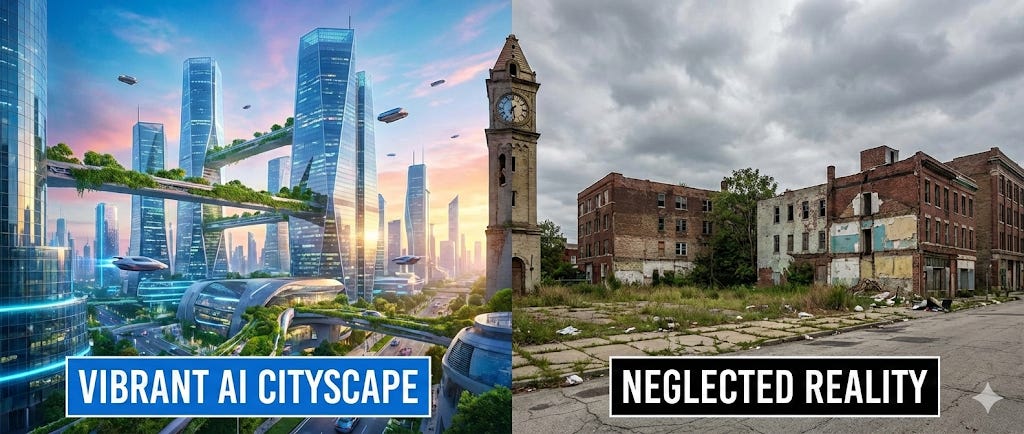
Here is a thought experiment. You are a Hollywood producer. You need a sweeping shot of a medieval coastal city — cobblestone streets, terracotta rooftops, the sea glittering behind ancient fortifications. You have two options.
Option A: Fly a crew to Dubrovnik, Croatia. Negotiate permits. Book hotels. Shut down streets. Pay for catering, insurance, weather contingencies. Budget: north of $500,000 for a few days on location. But here is the upside — your shoot puts money into the local economy, your location scouts pressure the city to keep its facades clean, and when the show airs, millions of tourists follow. Dubrovnik gained an estimated €126 million and 244,000 additional visitors between 2012 and 2015 because of Game of Thrones. Klis Fortress — used as the city of Meereen — went from under 10,000 annual visitors to over 100,000.
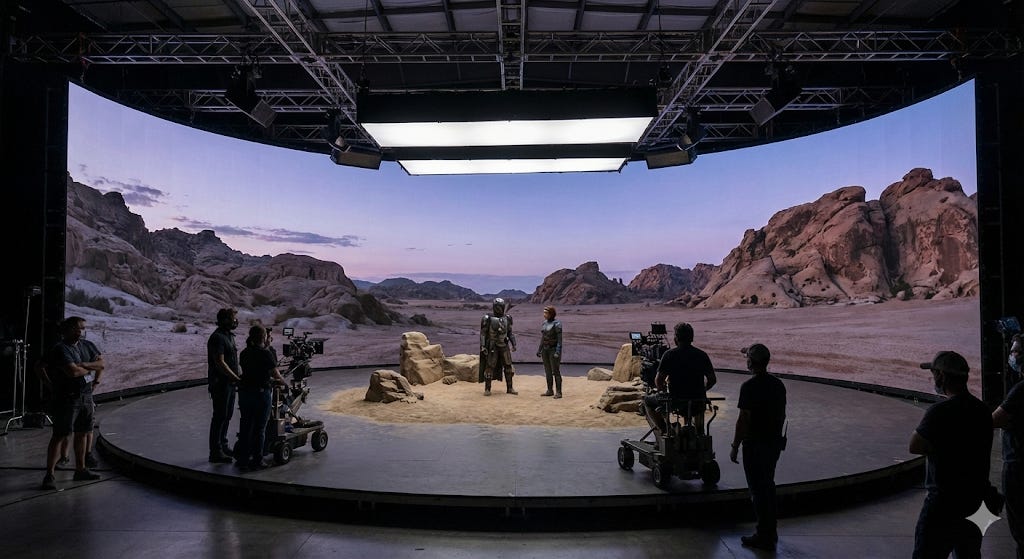
Option B: Shoot the whole thing inside an LED volume stage — a wraparound screen that projects photorealistic environments generated in real time. No flights. No permits. No weather delays. And the “location” can be anything: Dubrovnik at sunrise, then the Sahara at noon, then the Himalayas by afternoon. All in a single studio, in a single day.
Which would you choose?
If you answered B, you are not alone. The entertainment industry already has. And that decision — multiplied across every industry that once relied on the physical world to look good — is quietly reshaping something far bigger than how movies get made.
It is reshaping whether anyone has a reason to keep the real world beautiful at all.
The Great Decoupling
Let me be clear about what is happening. This is not some distant, speculative concern. The decoupling of content from physical reality is already well underway — and the numbers are staggering.
In 2019, there were roughly 3 LED virtual production stages worldwide. By 2023, there were about 300. The virtual production market hit an estimated $2.5–3.7 billion in 2024 and is projected to reach anywhere from $6.6 to $15.8 billion by the early 2030s. The world’s largest LED volume — unveiled in Deqing, China in 2025 — features a 164-foot diameter screen where entire scene changes happen in minutes. One moment you are in Renaissance Florence. The next, a Japanese temple garden. The next, Mars.
So far so good — for the studios. But here is where things get uncomfortable. Film tourism is a $66–70 billion global market. New Zealand’s economy receives an estimated NZ$630 million annually from Lord of the Rings-influenced visitors. Tourist arrivals grew 40% in the years following the trilogy. Hobbiton Movie Set alone went from 150,000 visitors in 2012 to 650,000 by 2019.
When productions no longer need real locations, those revenue streams dry up. And with them, the economic incentive for communities to preserve and beautify themselves for the camera vanishes. Why repaint that historic façade when no production scout is coming to evaluate it?
Tyler Perry — who had planned an $800 million expansion of his Atlanta studio — halted everything after seeing what AI video generation tools could do. That is not a filmmaker who stopped caring about physical spaces. That is $800 million in physical infrastructure that will simply never be built.
It Is Not Just Hollywood
Here is the thing most people miss: the same logic applies across virtually every industry that once had a financial reason to make the physical world look good.
Fashion and advertising. Zalando reported that 70% of its editorial campaign images in Q4 2024 were AI-crafted — cutting production costs by up to 90%. H&M created AI “digital twins” of 30 real models. Mango launched a fully AI-generated campaign. Guess debuted an AI model in Vogue. A fully AI-generated television ad aired during the 2025 NBA Finals — created by one person, using a text-to-video tool, in under 48 hours, for about $2,000. Each of those campaigns represents a photoshoot that did not happen: a studio not rented, a location not booked, a hair-and-makeup crew not hired, a neighborhood that lost its reason to serve as a backdrop.
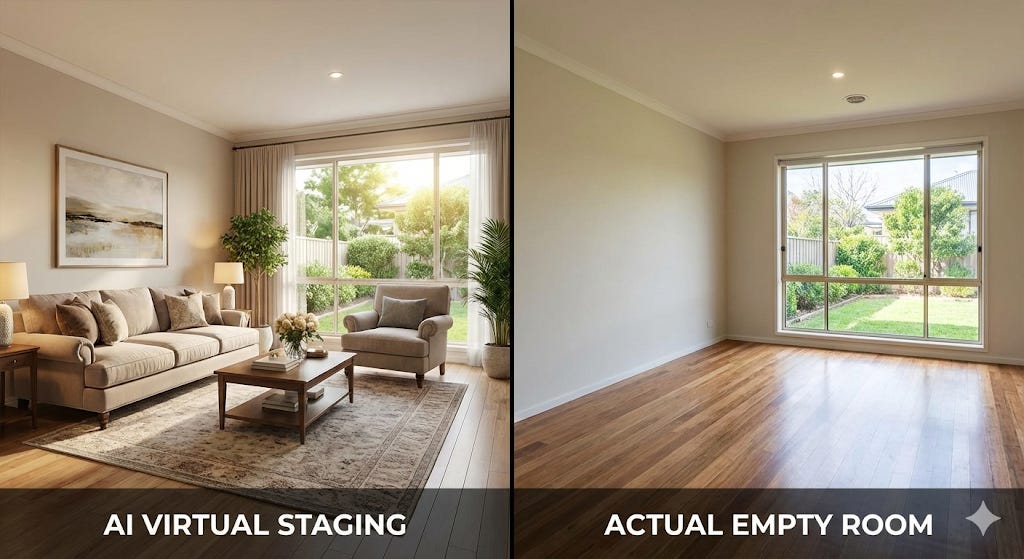
Real estate. The virtual staging market is projected to grow from $0.35 billion to nearly $6 billion by 2033. Traditional staging runs $2,000–$5,000 per property. AI staging? As low as $1 per image. The result: buyers show up to empty rooms that looked like magazine spreads online. The gap between the digital promise and the physical reality widens — and crucially, nobody invests in closing it.
Tourism. This one borders on absurdist comedy. AI-generated content sent groups of tourists to non-existent “Weldborough Hot Springs” in Tasmania — over 24 visitors arrived at a remote village expecting hot springs that had never existed. Others paid €140 for trips to a hallucinated “Sacred Canyon” in Peru. When AI can fabricate destinations more appealing than real ones, what is the incentive for a real destination to invest in being beautiful?
The Deeper Pattern: Who Pays for Beauty?
Now, someone might push back and say: people still want beautiful places. They still crave authentic experiences. And that is true — demonstrably so. The World Economic Forum reported in early 2026 that consumer spending on live experiences has increased 70% since 1987 relative to total spending. Icelandair launched a global “This is not AI” counter-campaign after research showed only 19% of travelers would book trips based on AI-generated imagery. The desire for authenticity is real and growing.
But here is the distinction that matters — and it is one I think most commentary on this topic misses entirely.
The question is not whether people will stop caring about physical beauty. They probably will not. The question is whether the institutions that fund physical beauty will stop having a reason to pay for it.
Think about it. Studios that book locations. Brands that rent spaces for photoshoots. Tourism boards that invest in destination upkeep. Municipalities that commission public art. Developers who stage properties. Advertisers who hire location scouts. These are the entities whose spending — year after year, project after project — actually keeps the physical world looking presentable. And when AI offers them a 90% cost reduction, the rational economic choice is obvious.
The French philosopher Jean Baudrillard warned decades ago about a society where representations replace reality — where the copy needs no original. The German-Korean philosopher Byung-Chul Han argues that digital culture has already reduced beauty to something “smooth and pleasing,” stripped of the depth that comes from imperfection and physical presence. And technology critic L.M. Sacasas puts it this way: AI imagery offers us an infinite smooth surface to skim across — in exchange for the occasional experiences of depth that actually renew us.
What I would add to their insights is the economic mechanism. It is not just a philosophical shift. It is a funding shift.
Just Imagine What Comes Next
The displacement I have described so far is, believe it or not, just the beginning. Because the tools are about to get dramatically better.
Text-to-video models can already produce photorealistic footage from a written prompt. One prominent tool’s internal team describes their ambition as building a “world model” — a system that does not just generate images but simulates entire environments with consistent physics and lighting. Major entertainment companies have invested billions in these capabilities. The metaverse tourism market is projected to reach $45 billion by 2034.
Just imagine a near-future where a real estate developer can sell condos using AI-generated walkthroughs of neighborhoods that look nothing like the actual street outside. Where a city’s tourism board generates promotional content of beaches and plazas that exist only as pixels — and nobody complains because, well, the pixels look better anyway. Where a child grows up seeing more AI-generated landscapes than real trees — and the research already tells us that every additional 10 minutes of daily screen time is associated with 1 minute less outdoor play. Where public art commissions go to AI prompt engineers instead of sculptors — as already happened at San Francisco International Airport, sparking public outrage.
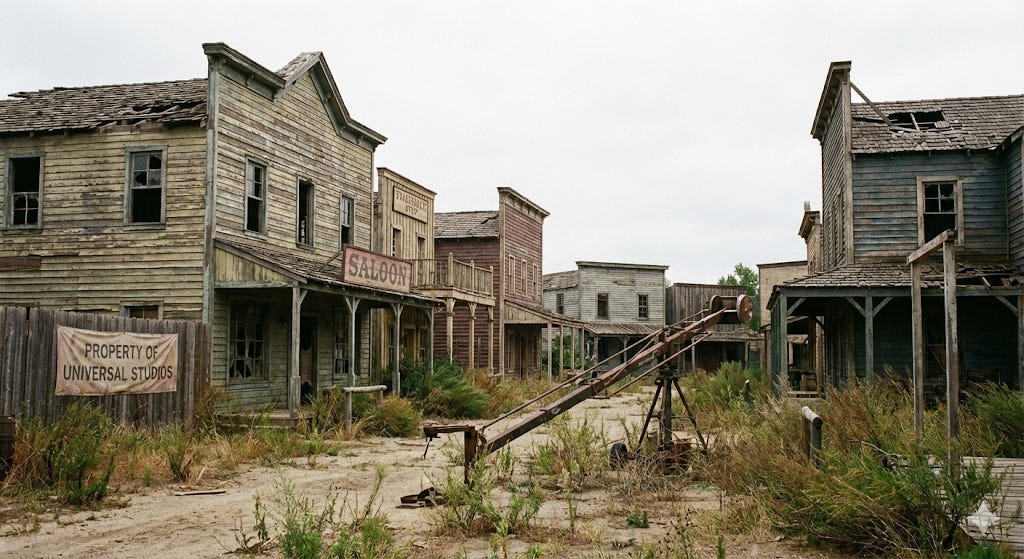
Just imagine a world where the physical environment continues to deteriorate — U.S. infrastructure already earns a grade of C with a $3.6 trillion investment gap, public arts funding has declined 35% in real terms over two decades — but nobody particularly notices because our screens show us something prettier.
Richard Louv coined the term “nature deficit disorder” back in 2005 to describe what happens when humans — especially children — lose contact with the natural world. Since then, nearly 1,000 studies have confirmed the pattern. What do we call the condition when humans lose contact not just with nature, but with the expectation that any physical space should be worth looking at?
Science fiction writers have been mapping this territory for years. Ready Player One depicts a grey, decaying physical world where people escape into a dazzling virtual one — and makes the feedback loop explicit: by escaping into virtual worlds, the population spends less time and energy improving conditions in the physical one. WALL-E shows humans so absorbed in their screens that one character exclaims, “I didn’t know we had a pool!” Snow Crash depicts a collapsed nation-state where people flee into a Metaverse because everyday physical life has become unbearable.
The writer Max K Hayward put the mechanism most bluntly: “Once private corporations start to sell virtual reality it will be in their interests for the physical world to become less alluring, increasing the comparative appeal of their products.”
We do not even need the conspiracy. We just need the economics.
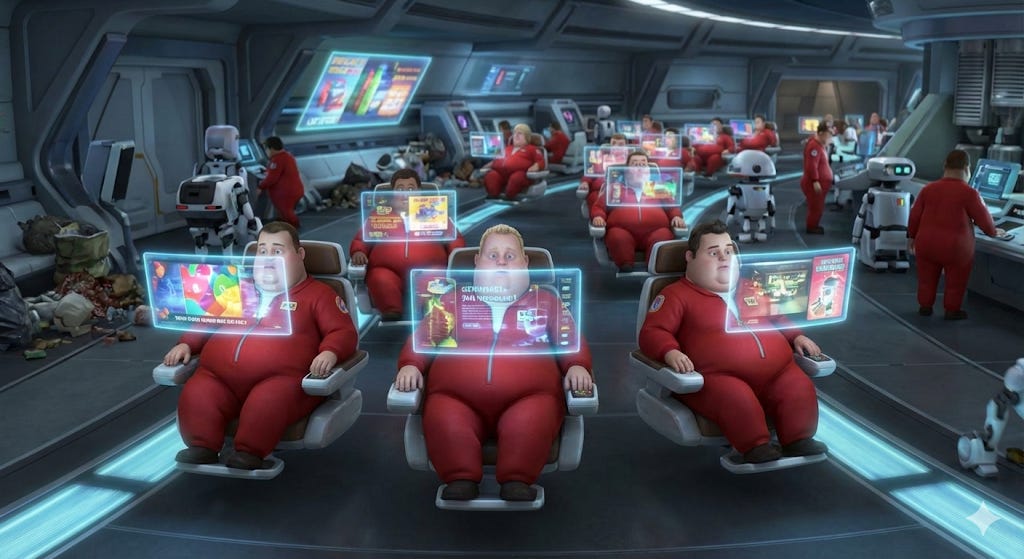
So What Do We Do?
I will not pretend there are easy answers here, but I think the conversation has to start with a few honest acknowledgments.
First, AI can be used to improve physical spaces — and in some cases, already is. AI-assisted urban planning tools are helping cities optimize for walkability, green space, and natural light. The technology is not inherently destructive. What matters is whether the incentive structures push toward using AI to enhance the real world or to replace the need for it.
Second, the backlash against AI-generated content is real — but it may not be enough on its own. 86% of brands were open to AI creators in late 2024; by mid-2025, that dropped to 60%. Consumer distrust is growing. But cost savings of 90% have a way of overriding consumer sentiment, especially when consumers cannot easily tell what is AI-generated and what is not.
Third — and this is the hard one — we may need to start thinking about physical-world beauty the way we think about the environment: as a shared resource that requires deliberate protection. Tax incentives for on-location production. Public art mandates that specify human creation. Zoning codes that account for the aesthetic gap between AI-rendered marketing materials and actual built reality. Disclosure requirements for AI-generated tourism and real estate imagery — because if a buyer or visitor has been sold a fiction, they have a right to know.
Neuroscientist Erik Hoel warned that behind the aesthetic of an AI-driven civilization “there will be a vast emptiness.” The philosopher Han says digital beauty is “pleasure without any negativity — namely, the Like.” And the RAND Corporation has spent years documenting how simulated information displaces real facts. What we are now watching is the aesthetic equivalent: simulated beauty displacing real beauty — not because anyone decided the real world does not matter, but because the economics quietly stopped requiring that it does.
The physical world will not disappear, of course. But it may, gradually and then suddenly, stop being maintained — not out of malice, but out of indifference. Not because we chose ugliness, but because beauty moved to a screen where it was cheaper to produce and easier to control.
And one day, someone will walk outside, look around at the cracked pavement and faded walls, and wonder: when exactly did we stop bothering?
One can only hope we ask that question before it is too late to reverse the answer.
This article was published by the HAIA Foundation. For more, visit our Substack.