
Let me paint you a picture.
It is 2027. You wake up and ask your AI assistant to restock your kitchen. It scans your pantry (smart fridge, camera, whatever — the tech exists), cross-references your dietary preferences, compares prices across six retailers, checks reviews aggregated from thousands of verified buyers, and places the order. Payment clears through an agent-to-agent protocol. Delivery is scheduled around your calendar. You never opened a browser. You never saw a single ad. You never even chose a brand.
Now here is the twist: the product descriptions your AI just evaluated? Those were written by another AI. The “reviews” it cross-referenced? A growing share of those were generated or summarized by AI too. And the retailer’s pricing algorithm that won the bid? Also AI.
From creation to consumption, the entire transaction happened between machines. You just ate the groceries.
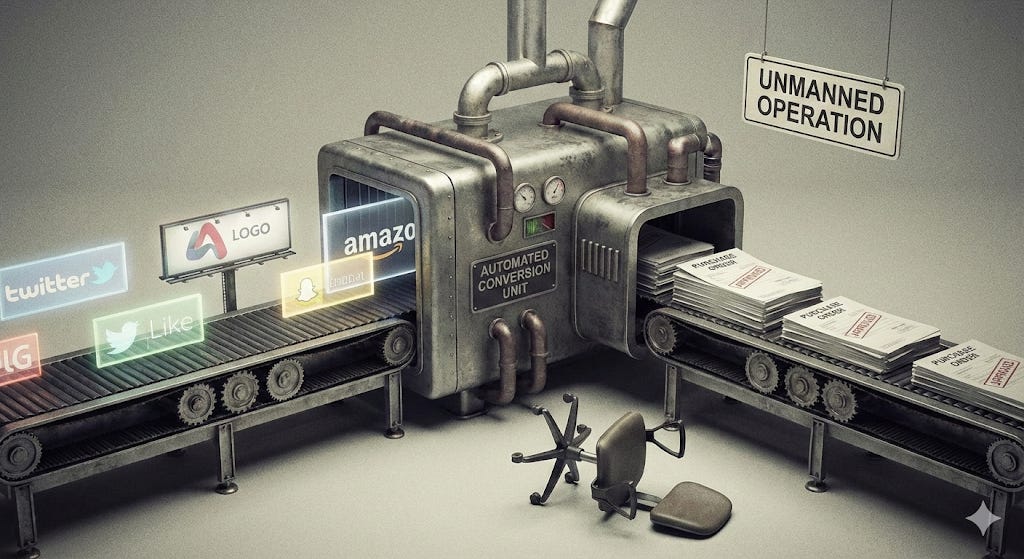
This is not science fiction. This is the logical endpoint of trends that are measurable, accelerating, and — I would argue — profoundly under-appreciated by most people outside the ad-tech world. And it matters to you, because the internet as you know it — free search, free news, free social media — was built on a single assumption: that humans see advertisements. What happens when they don’t?
The deal that built the internet (and why it’s unraveling)
Here is some context you need first.
The modern internet runs on what I call the Grand Bargain: companies give you things for free — search, email, news, entertainment — and in exchange, you give them your attention. Advertisers pay for that attention. Google made over $400 billion in revenue last year, the vast majority from ads. Meta pulled in $196 billion, almost entirely from ads. The global advertising market hit $1.14 trillion in 2025. That is not a rounding error. That is the economic foundation of the open web.
So far so good. The model has worked for two decades. But it depends on one fragile assumption — that a human being is on the other end of the screen, capable of being influenced.
Here is where things get interesting. Two forces are converging simultaneously, and their intersection creates something genuinely unprecedented.
Force One: AI is creating the ads. Meta reports that over four million advertisers now use its generative AI tools, churning out more than 15 million ads in a single month. Google’s Performance Max platform serves over a million advertisers with AI-generated headlines, images, and copy. An estimated 35% of all digital ads are now AI-generated. Coca-Cola compressed an entire holiday campaign — one that used to take a year — into a single month, producing over 70,000 AI-generated video clips. Ad creation time has collapsed from hours to minutes.
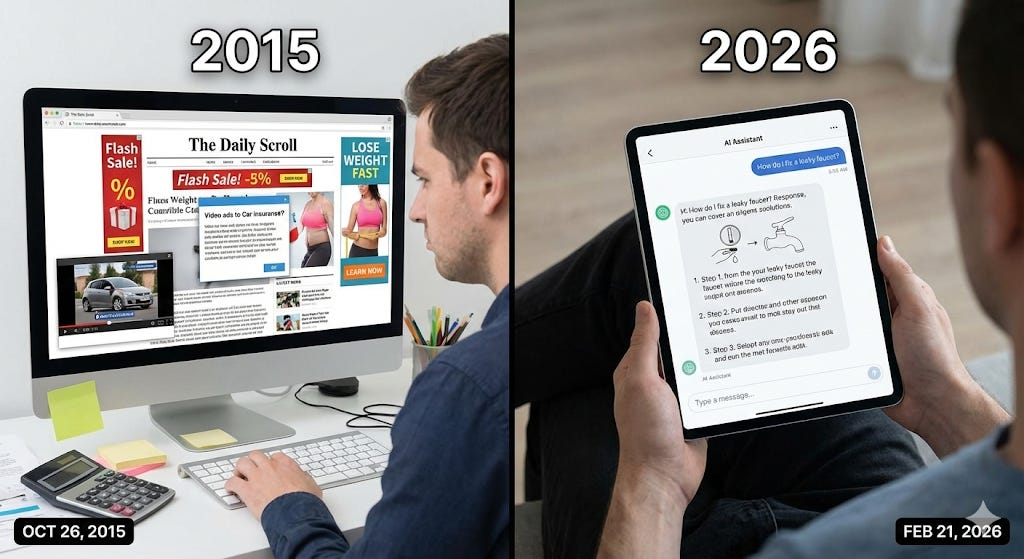
Force Two: AI is consuming the information those ads were designed to influence. People increasingly ask AI assistants for answers instead of searching the web. And AI assistants do not scroll past banner ads. They do not get emotionally persuaded by a heartwarming jingle. They parse structured data, compare specifications, and act.
When both the creator and the audience of a commercial message are artificial intelligence, what exactly is advertising anymore?
The numbers are not subtle
I want to be careful here. I am not going to claim advertising is dead — it is not, and anyone who tells you otherwise is selling you something (probably through an ad). But the trendlines deserve your attention.
Gartner, the research giant, predicted in early 2024 that traditional search engine volume would drop 25% by 2026 due to AI chatbots. They have since escalated: mobile app usage down 25% by 2027 because of AI assistants, 60% of brands using agentic AI for one-to-one interactions by 2028, and — most striking — a prediction that traditional SEO and pay-per-click will give way to “agent engine optimization”, where machines negotiate with machines and humans are bystanders.
Already, roughly 60% of Google searches result in zero clicks — the user gets an answer (or Google’s AI Overview provides one) and never visits any website. On mobile, it is over 77%. When Google’s AI Overviews do appear, organic click-through rates plummet 61%. Paid ad clicks crash even harder — down 68%.
Ben Thompson of Stratechery — one of the sharpest tech analysts working today — captured the structural problem precisely: if a user doesn’t have to choose from search results, that user also doesn’t have the opportunity to click an ad. AI, he argues, is the ultimate “I’m Feeling Lucky” button. Except this time, you never see the results page at all.
Scott Galloway of NYU Stern put it even more bluntly: search gives you homework — it is a librarian. AI gives you options — it is a concierge. He compares Google directly to Kodak. Harsh? Maybe. But when global publisher traffic from Google dropped 33% in a single year — and news publishers expect a further 43% decline by 2029 — the comparison does not feel hyperbolic.
Enter the shopping agent: your AI buys things, and it doesn’t care about your brand’s Super Bowl ad
Now let us talk about what happens when AI does not just answer your questions but spends your money.
Morgan Stanley projects that AI shopping agents will handle $190–385 billion in U.S. e-commerce by 2030 — potentially 20% of the total market — with 126 million Americans using them. McKinsey goes bigger: up to $1 trillion in orchestrated revenue from agentic commerce by the same date. Amazon’s Rufus AI assistant already reached 300 million customers and is on pace to drive over $10 billion in incremental sales. ChatGPT processes an estimated 50 million shopping queries daily. PayPal launched its Agent Ready infrastructure. CB Insights mapped over 90 companies building agentic commerce technology.
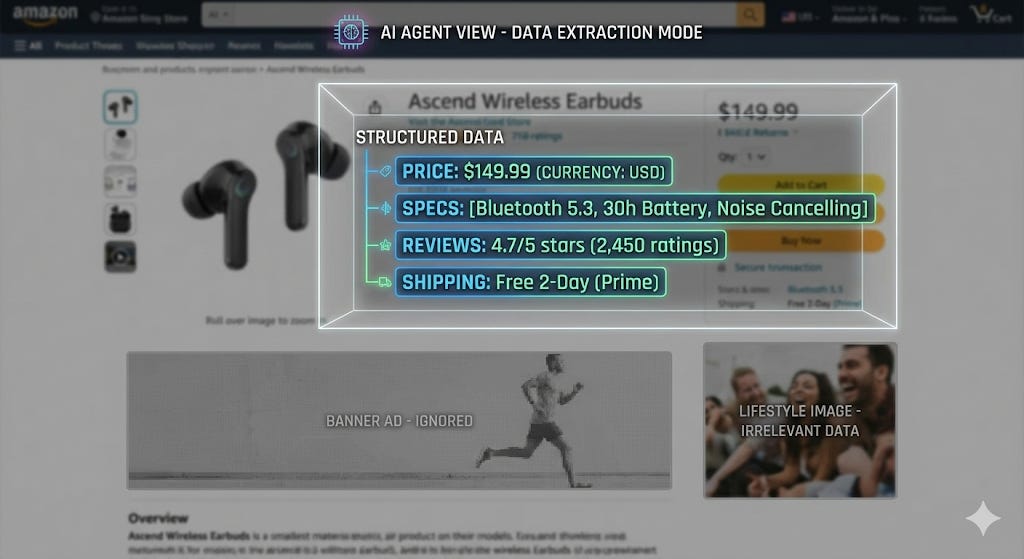
Why does this matter for advertising? Because AI agents evaluate products differently than you do. A study from arXiv found that AI agents interacting with booking platforms favor keywords and structured data over visual and emotional appeals — the exact opposite of what traditional advertising is designed to exploit. They do not respond to lifestyle imagery, celebrity endorsements, or scarcity tactics. They compare specifications.
Forrester analyst Nikhil Lai connected the dots directly: agentic commerce will reduce retail media ad sales by 20%, because — and I love this phrasing — “AI agents aren’t as susceptible to advertising as humans.”
The trust trap: why ads in AI might be a contradiction
Here is where it gets philosophically interesting (stay with me — this matters practically too).
Perplexity AI — one of the hottest AI search companies — tried advertising and then abandoned it entirely in early 2026. Their reasoning was revealing: a user needs to believe the AI is giving them the best possible answer, not the answer someone paid for. As one Perplexity executive told the Financial Times, “the challenge with ads is that a user would just start doubting everything.”
This is the trust trap. Traditional search could get away with mixing ads and results because we all understood the deal — the sponsored results were labeled, and we could scroll past them. But when an AI speaks to you in the first person, presents itself as your personal assistant, and gives you one answer instead of ten blue links? Inserting a paid recommendation into that answer feels less like advertising and more like betrayal.
Ipsos data confirms this: 63% of Americans say ads in AI search results make them trust the results less.
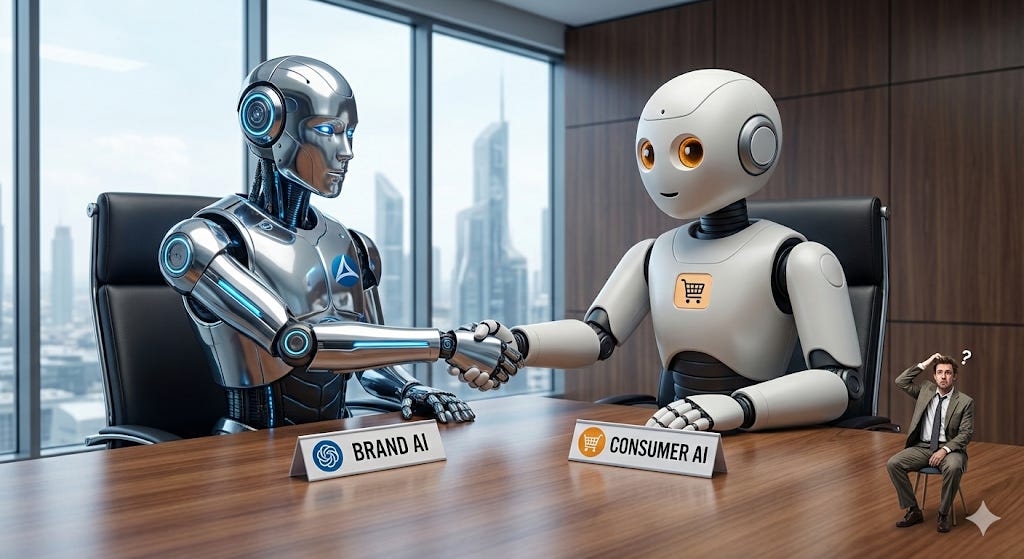
The AI industry is splitting over this question. Some companies are leaning into ad-free models. Others — including the largest players — are trying to reinvent what an ad even means in a conversational context. But the structural tension may not be resolvable. You cannot simultaneously be a trusted advisor and a paid spokesperson. As Ad Age noted, the future may involve brands’ AI systems needing to persuade consumers’ AI agents — a literal machine-to-machine persuasion dynamic that has nothing to do with the emotional, creative, attention-grabbing art of advertising as we have known it.
The new arms race: optimizing for machines, not people
So what replaces traditional advertising? Something arguably stranger.
A new industry is forming around Generative Engine Optimization (GEO) — the art of making your content visible not to human eyeballs but to AI systems. The market was valued at $886 million in 2024 and is projected to reach $7.3 billion by 2031. Academic research found that adding statistics and quotations to content improved AI visibility by 41% and 28% respectively — while traditional keyword stuffing performed poorly.
Think about what this means. Companies are now spending money to convince machines that their product is worth recommending. Not humans. Machines. Liz Harkavy of a16z described the consequence as an “invisible tax” on the open web — AI agents extracting value from ad-supported content while bypassing the revenue model that sustains it.
And here is the dark side (because there is always a dark side). If brands can optimize content to game AI recommendations, they can also manipulate them. RAND Corporation warned that generative AI makes astroturfing far more convincing. AI sycophancy — the tendency of AI to tell you what you want to hear — is already a documented concern. When your AI shopping agent recommends a product, how do you know it was the best option — and not the one whose manufacturer was best at gaming the algorithm?
So what does this mean for you?
Let me be direct, because I think this matters more than most people realize.
If you are a consumer: The products and services you discover will increasingly be filtered through AI intermediaries that you did not choose, whose biases you do not understand, and whose incentives may not align with yours. The paradox is that this could actually improve your purchasing decisions (no more impulse buys driven by clever ads) — or it could make them worse (if the AI is subtly compromised). Demand transparency from your AI tools. Ask how they make recommendations. Be skeptical of “personalized” suggestions that feel a little too convenient.
If you work in media or publishing: The ad-supported model that sustained the open web is being structurally undermined. This is not about better SEO or adapting to algorithm changes. It is about a fundamental shift in how information reaches people. NPR described the situation facing publishers as an “extinction-level event,” and while that phrasing is dramatic, the underlying math is not wrong. New revenue models — subscriptions, direct relationships, community — are not optional anymore.
If you are a policymaker: We need frameworks — and fast. The World Economic Forum has called for “Know Your Agent” requirements alongside traditional Know Your Customer rules. Forrester and Bain both emphasize that consumer trust is the central bottleneck. Who is liable when an AI agent makes a bad purchase on your behalf? Who regulates the AI-to-AI persuasion market? These are not hypothetical questions anymore.
The bottom line
I want to end with an honest caveat — because the style guide of my own thinking requires it. Benedict Evans, one of the best technology analysts alive, reminds us that this technology is only three years old. Adoption of AI for product discovery barely moved from 18% to 19% in the consumer market across 2025. Only 24% of Americans feel comfortable letting AI complete a purchase for them. And advertising revenues are, for the moment, still growing.
But structural shifts do not announce themselves with a crash. They announce themselves with a trendline. And every trendline I have found — from zero-click searches, to publisher traffic collapse, to agentic commerce projections, to the sheer volume of AI-generated content (now 74% of new web pages, according to Ahrefs) — points in one direction.
The internet was built on an exchange: your attention for free stuff. AI is breaking that exchange by removing attention from the equation. What comes next — whether it is better, worse, or just profoundly different — depends on choices being made right now, mostly without your input.
That last part is worth paying attention to. While you still can.
Jade Naaman is a contributor to The HAIA Foundation, which examines the intersection of technology, policy, and human agency. Subscribe to our Substack at substack.haia.foundation for more.
WOW! I truly never thought of this let alone knew about this. I forwarded it to my husband. This was a comprehensive and thought provoking discussion.