
This isn’t science fiction. Over six decades of documented experiments, military programs, and corporate R&D have built a clear technological trajectory toward animals augmented with artificial intelligence. The convergence of brain-computer interfaces, neuromorphic AI chips, CRISPR gene editing, and optogenetics creates a credible pathway to cognitively enhanced animals — one that virtually no major AI safety organization has seriously addressed.
Here is why that should concern you.
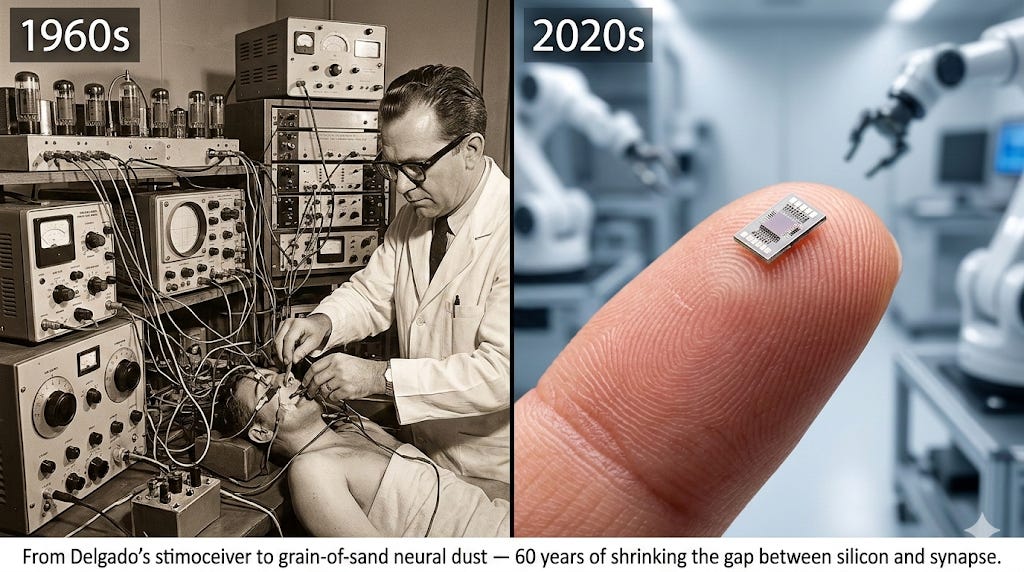
José Delgado Walked Into the Bullring With Only a Radio Transmitter
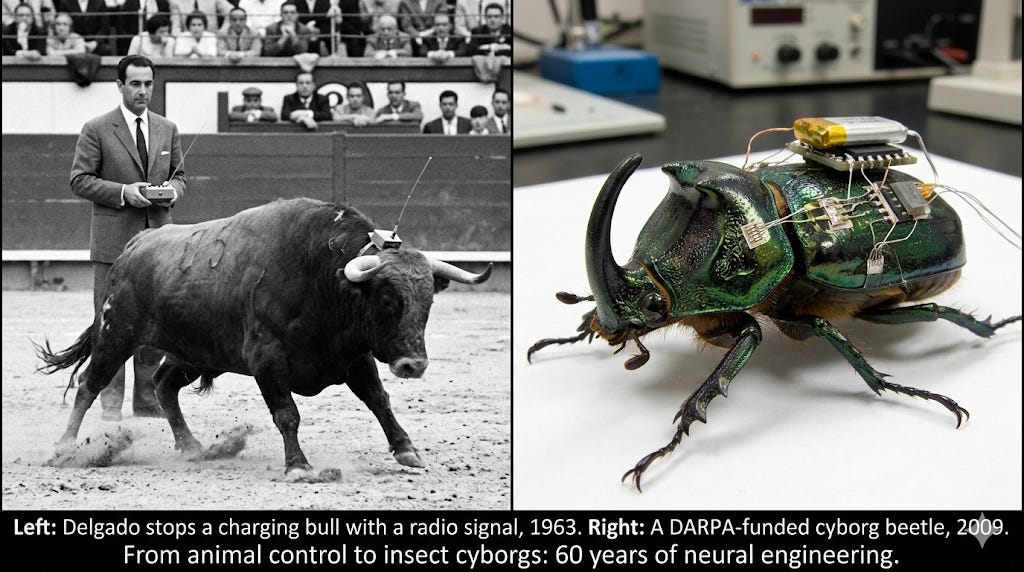
The story of computer-controlled animals begins in 1963 in a dusty bullring outside Córdoba, Spain. José Manuel Rodríguez Delgado, a Yale University professor of physiology, faced a charging 550-pound fighting bull armed with nothing but a red cape and a small handheld device. When the bull charged, Delgado pressed a button. The bull skidded to a halt. Delgado had implanted his invention — the “stimoceiver,” a wireless bidirectional device the size of a half-dollar coin — into the bull’s caudate nucleus. The New York Times ran the story on its front page in 1965. Delgado went on to publish Physical Control of the Mind: Toward a Psychocivilized Society in 1969 — a book whose title alone signals how far ahead he was thinking.
The military took notice. In the 1960s, the CIA spent an estimated $10–20 million on Project Acoustic Kitty, surgically implanting a cat with a microphone in its ear canal, a radio transmitter at the base of its skull, and an antenna woven into its fur — all to eavesdrop on Soviet officials. The program was canceled when cats proved, well, uncontrollable (anyone who has owned a cat is nodding right now). Around the same time, the U.S. Navy Marine Mammal Program — established in 1960 and still operational today with approximately 70 dolphins and 30 sea lions at Naval Information Warfare Center Pacific in San Diego — began training dolphins and sea lions for mine detection and harbor defense. Navy dolphins were deployed in Vietnam (1970–71), the Persian Gulf (1987–88), and Iraq (2003), where nine dolphins helped identify and disable over 100 anti-ship mines — the first marine animals to clear mines in a combat zone.
So far so good — or rather, so far so alarming. But here is where things accelerate.
By 2002, the technology had progressed dramatically. Sanjiv Talwar and John Chapin at SUNY Downstate Medical Center, funded by DARPA, published a landmark paper in Nature demonstrating remote-controlled rats. Electrodes implanted in the rats’ medial forebrain bundle (that is the reward center) and somatosensory cortex (the whisker areas) allowed researchers to steer them through complex 3D environments — climbing ladders, navigating debris, entering brightly lit areas rats normally avoid — with over 90% turn accuracy. The rats wore electronic backpacks containing microprocessors and radio receivers. The media called them “robo-rats.” The scientists called it a breakthrough.
DARPA doubled down with the Hybrid Insect Micro-Electro-Mechanical Systems (HI-MEMS) program in 2006. The program’s innovation was radical: inserting MEMS chips into insect pupae during metamorphosis so that living tissue would grow around the electronics, creating true cyborg organisms. Michel Maharbiz at UC Berkeley achieved the program’s signature success in 2009 — the first wirelessly controlled flying cyborg beetle, with electrodes connected to optic lobes and flight muscles. The beetle flew on command, turned on command, and landed on command. Five institutions were funded (Michigan, MIT, Boyce Thompson Institute, UC Berkeley, Cornell) before the program concluded in 2012.
Let me pause here and state the obvious: we were remotely controlling the flight of living insects over fifteen years ago. What do you suppose has happened since?
Neuralink’s Monkeys Play Pong While 1,500 Animals Die in Testing
The current generation of animal brain-computer interfaces (BCIs) is led by Neuralink, which in April 2021 released video of a nine-year-old macaque named Pager playing “MindPong” using two N1 Link chips implanted in his motor cortex — each with approximately 1,024 electrode threads recording from over 2,000 electrodes. Pager controlled the Pong paddle purely through neural activity transmitted wirelessly via Bluetooth. A genuine advance in wireless BCI capability, though the underlying brain-cursor control had been demonstrated in monkeys by Miguel Nicolelis at Duke University as early as 2000, and by Andrew Schwartz at the University of Pittsburgh in 2008, when a monkey fed itself marshmallows using a brain-controlled robotic arm (published in Nature).
Neuralink’s animal work has been plagued by controversy. Reuters reported the company experimented on and killed approximately 1,500 animals between 2018 and 2022, including monkeys, pigs, and sheep. The Physicians Committee for Responsible Medicine obtained records showing that researchers at UC Davis (contracted by Neuralink for $1.4 million) drilled open monkey skulls and used an unapproved adhesive called BioGlue that allegedly destroyed portions of their brains. The USDA opened a federal probe in December 2022.
But Neuralink is far from alone in this space. Synchron developed the Stentrode — a BCI implanted through blood vessels without open brain surgery — and has implanted over 10 human patients. Blackrock Neurotech manufactures the Utah Array electrode used across the BCI field and has implanted more than 30 human patients. Paradromics is developing a fully wireless, dime-sized implant with 421 microelectrodes. Precision Neuroscience (founded by former Neuralink co-founder Benjamin Rapoport) raised $155 million in a December 2024 Series C. The BCI industry is projected to reach $6.2 billion by 2030.
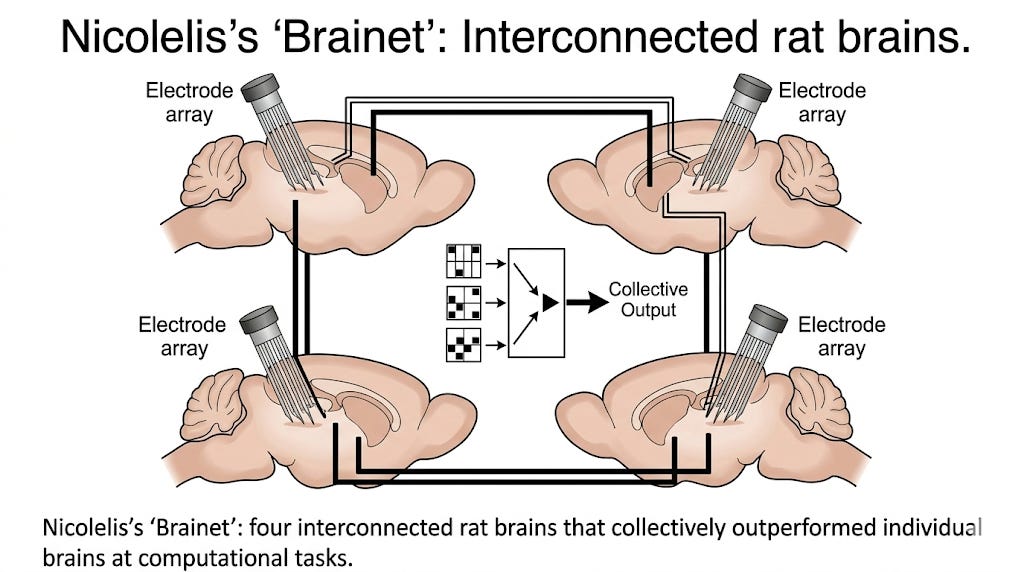
The most striking recent advances, though, are in networking brains together. Nicolelis’s lab at Duke published the first brain-to-brain interface between two rats in 2013 in Scientific Reports — one rat in Durham, North Carolina, transmitted cortical activity via the internet to a decoder rat in Natal, Brazil, which chose correct responses 60–70% of the time. By 2015, Nicolelis demonstrated “Brainets” — four rat brains interconnected via multi-electrode arrays that collectively solved computational problems. The networked brains outperformed individual brains. The architecture mimicked hidden layers of artificial neural networks.
Read that again: researchers built a biological neural network out of living rat brains — and it worked better than any single brain.
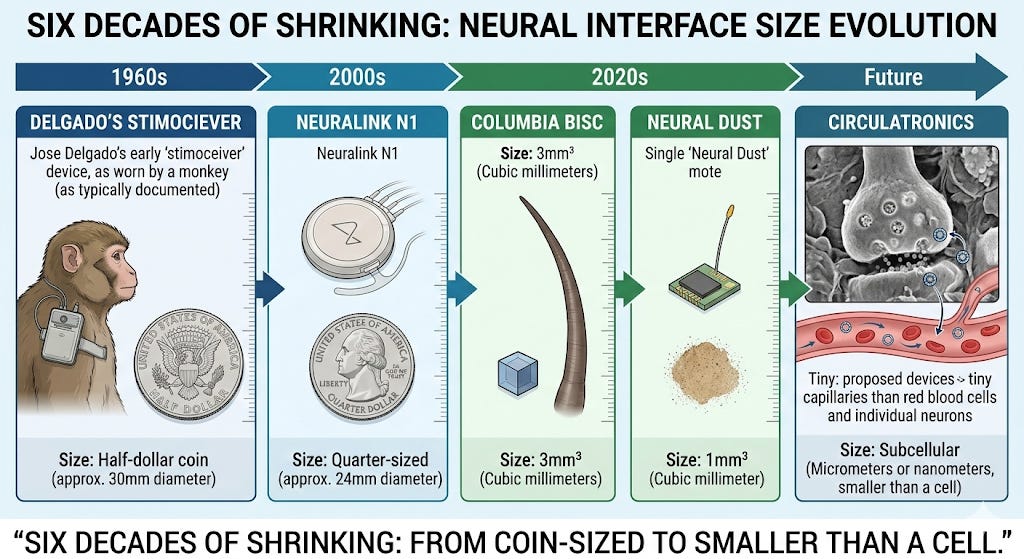
AI Chips Are Shrinking Toward the Size of Biological Neurons
Here is where things get interesting — and frankly, where the future scenarios start writing themselves. The hardware side of the equation is advancing just as rapidly as the biology.
Neuromorphic chips — processors that mimic the brain’s spiking neural architecture — now operate at power levels approaching what wireless energy harvesting can deliver inside a living body. BrainChip’s Akida processor runs at 0.3 milliwatts per inference for keyword spotting. Innatera Nanosystems unveiled the Spiking Neural Processor T1 at CES 2025 — the first commercial neuromorphic chip operating at sub-milliwatt power with sub-millisecond latency. Intel’s Loihi 2 packs 1 million neurons and 120 million synapses on a single chip at roughly 1 watt, with benchmarks showing 75x lower latency and 1,000x higher energy efficiency than conventional processors. Intel’s Hala Point system (April 2024), deployed at Sandia National Laboratories, scales to 1.15 billion neurons.
Why does this matter for animals? Because these chips’ spiking neural network architecture is biologically compatible by design — they communicate via discrete electrical spikes, the same mechanism biological neurons use. This creates a theoretical pathway for direct integration between silicon and living tissue.
On the implant side, the miniaturization trajectory is staggering. Neuralink’s coin-sized device gives way to Columbia University’s BISC platform (published December 2025 in Nature Electronics): a single CMOS chip thinned to 50 micrometers providing 65,536 electrodes in roughly 3 cubic millimeters — about 1/1000th the size of conventional devices. Neural Dust, developed by Maharbiz and Jose Carmena at UC Berkeley (published in Neuron, 2016), demonstrated ultrasound-powered, batteryless wireless sensors shrunk to approximately 1 cubic millimeter — the size of a grain of sand. Brown University’s Neurograins are even smaller: autonomous silicon microchips at 0.5 × 0.5 millimeters, RF-powered and batteryless.
Perhaps the most dramatic advance arrived in 2025. Researchers published in Nature Biotechnology a system called Circulatronics: subcellular-sized, wireless, photovoltaic electronic devices attached to immune cells via click chemistry. Delivered intravenously — through a simple injection — they traffic autonomously through the bloodstream to brain inflammation sites and self-implant without surgery. Electronics that navigate to and park themselves at target locations in the brain without a single incision.
To be clear about what this means: we now have electronic devices small enough to be injected into a bloodstream and smart enough to find their own way to the brain.
33 Strains of Genius Mice and Human Neurons Growing in Rat Brains
The genetic engineering dimension makes the picture considerably more alarming. In 1999, Joe Z. Tsien at Princeton created the “Doogie” mouse by overexpressing the NR2B subunit of the NMDA receptor, producing mice with dramatically enhanced learning, memory, and pattern recognition. The paper, published in Nature, made the cover of TIME magazine. By 2009, researchers had created at least 33 mutant mouse strains with enhanced cognitive abilities. Nearly all worked through enhanced long-term potentiation (LTP) — the mechanism underlying memory formation.
CRISPR has since supercharged this field. In 2016, Miou Zhou and Alcino Silva found that deleting the CCR5 gene in mice significantly improved their memory — a finding that became explosive when it emerged that He Jiankui’s CRISPR-edited human twins, Lulu and Nana, carried CCR5 deletions, meaning their cognition may have been inadvertently enhanced. Multiple CRISPR delivery methods to adult animal brains now exist: nanoparticle-based CRISPR-Gold (UC Berkeley, 2019), amphiphilic nanocomplexes (Nature Neuroscience, 2019), and even nasal spray delivery (Guilherme Baldo, Federal University of Rio Grande do Sul, 2022).
Optogenetics adds another layer of precision control. Pioneered by Karl Deisseroth at Stanford in 2005, optogenetics uses light-sensitive proteins inserted into neurons to control their firing with millisecond precision. In 2013, Steve Ramirez and Xu Liu in Nobel laureate Susumu Tonegawa’s lab at MIT implanted a completely false memory in mice — the animals froze in fear in a context where they had never been shocked, because researchers reactivated hippocampal neurons from a different context during fear conditioning. Published in Science, this demonstrated that memories could be artificially written into a brain. Korean researchers at KAIST later used optogenetics to create cyborg mice navigable by remote control through complex mazes.
And then there is the chimera research — perhaps the most unsettling of all.
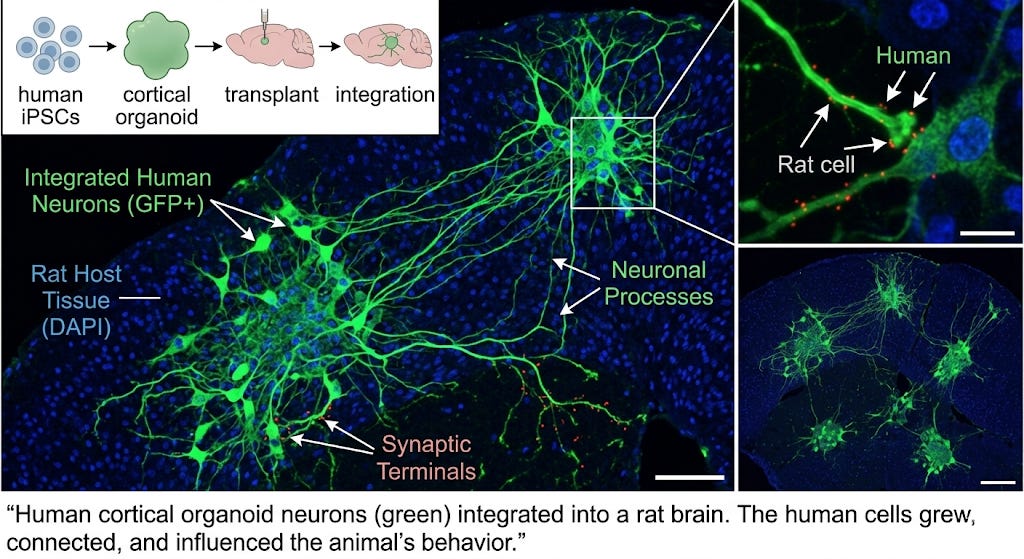
In October 2022, Sergiu Pașca at Stanford published in Nature the transplantation of human cortical organoids (essentially miniature lab-grown human brain structures) into neonatal rat brains. Approximately 80% of implants took. After six months, about one-third of the transplanted brain hemisphere consisted of human cells. The human neurons received thalamocortical inputs, responded to whisker stimulation, and — here is the part that should make you sit up — optogenetic activation of the human neurons drove reward-seeking behavior in the rats. Human brain cells, growing inside a rat, influencing the rat’s behavior.
Separately, Steven Goldman’s lab demonstrated that mice transplanted with human glial progenitor cells developed human astrocytes and showed significantly improved learning and memory — each human astrocyte encompasses approximately 2 million synapses compared to 100,000 in rodent astrocytes. That is a twenty-fold increase in synaptic processing power, just from swapping one cell type.
The Ethics Gap Nobody Is Filling
Despite this convergence of technologies, none of the major AI safety organizations have published dedicated work on AI-enhanced animals. The Future of Life Institute, Center for AI Safety, and the now-closed Future of Humanity Institute at Oxford all focus exclusively on risks to humans from AI. This represents a significant blind spot — one that becomes more glaring the closer you look at what the science already makes possible.
The most serious ethical discourse comes instead from bioethicists. Sarah Chan at the University of Edinburgh published the seminal paper “Should We Enhance Animals?” in the Journal of Medical Ethics (2009), arguing provocatively that if human enhancement can be considered a moral obligation, so too can animal enhancement. Julian Savulescu at Oxford’s Uehiro Centre for Practical Ethics co-edited Rethinking Moral Status (Oxford University Press), which includes chapters on chimeras, “superchimps,” and the moral status of brain organoids — directly addressing what happens when enhancement blurs species boundaries. Thomas Douglas (also Oxford) asks the pointed question: should we cognitively alter animals in ways that might change their moral status?
The transhumanist camp has been the most vocal. George Dvorsky, director of the Rights of Non-Human Persons program at the Institute for Ethics and Emerging Technologies (co-founded by Nick Bostrom and James Hughes in 2004), published “All Together Now: Developmental and Ethical Considerations for Biologically Uplifting Nonhuman Animals” in 2006, using Rawlsian frameworks to argue uplift is a moral obligation. Science fiction author David Brin — whose Uplift series imagines humans sharing Earth with enhanced chimpanzees and dolphins — envisions “dolphin philosophers, bonobo therapists, raven playwrights and poets.”
Critics push back hard. Paul Graham Raven (University of Sheffield) calls uplift “a kind of benevolent colonialism” reflecting hubris in assuming other animals would benefit from human-like minds. Forbes contributor Alex Knapp noted the cruel irony that developing uplift technology will likely require extensive invasive animal research that causes huge suffering to the animals it purports to help.
The military dimension is perhaps the most sobering. A 2020 U.S. Army study — Cyborg Soldier 2050 — forecasts augmented beings entering the general population by mid-century and warns of losing technological dominance to adversaries pursuing human-machine enhancement programs. The 2024 RAND Corporation report explores BCIs, CRISPR, and the “Internet of Bodies” as future warfighting technologies. If nations are racing to augment their soldiers, why would we assume they would not augment animals for military applications too — especially given that DARPA has already spent decades doing exactly that?
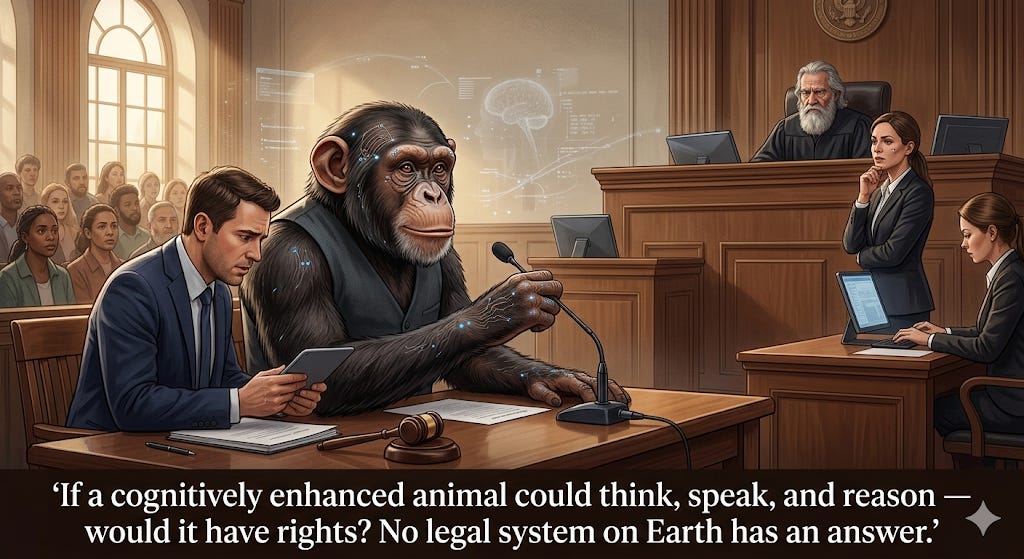
Legal frameworks remain wholly inadequate. Steven Wise’s Nonhuman Rights Project has filed habeas corpus petitions for chimpanzees and elephants in U.S. courts, and all have been rejected — though Argentina recognized an orangutan named Sandra as a “non-human person” in 2014. If an animal were cognitively enhanced to human-level intelligence, no existing legal framework in any jurisdiction would know what to do with it. Not one.
The Biological Computer Already Exists
The final piece of the puzzle arrived in October 2022 when Brett Kagan at Cortical Labs in Melbourne published in Neuron that approximately 800,000 mouse and human neurons grown on high-density multi-electrode arrays learned to play Pong within five minutes. The system, called DishBrain, demonstrated that living neurons on silicon could perform goal-directed behavior — the most direct proof-of-concept for hybrid biological-AI systems. In March 2025, Cortical Labs launched the CL1, the first commercial “Synthetic Biological Intelligence” system, priced at $35,000. The Australian Office of National Intelligence awarded the project a $600,000 grant for DishBrain-based AI with continual learning capabilities.
Thomas Hartung at Johns Hopkins coined the term “Organoid Intelligence” in a 2023 Frontiers in Science paper, and his team published the Baltimore Declaration establishing an ethical framework for the field. By August 2025, Johns Hopkins demonstrated that brain organoids show synaptic plasticity and expression of immediate early genes associated with memory formation. A separate team at Indiana University connected brain organoid tissue to silicon chips and achieved 78% speech recognition accuracy (published in Nature Electronics, December 2023). The NSF launched a dedicated “Biocomputing through EnGINeering Organoid Intelligence” funding program in 2024.
Stanford’s Wu Tsai Neurosciences Institute now funds “synthetic neuroscience” — programmable molecular circuits within brain cells, genetically encoded voltage integrators, and synthetic neural interfaces. Science Corporation is developing biohybrid neural probes using stem cell-derived neurons embedded in electronics that grow their axons and dendrites directly into the brain, joining existing neural circuits. A 2025 review in npj Biomedical Innovations describes this convergence as approaching a “biotechnological singularity.”
Living neurons on chips. Chips inside living brains. Human brain cells inside animal brains. AI processors that speak the language of neurons. Each technology exists today. They just have not been combined — yet.
What Could This Actually Look Like?
Let me get creative for a moment — not to be alarmist, but to be honest about where these trendlines point.
Scenario 1: The Enhanced Guard Dog. Imagine a large breed — a German Shepherd or Belgian Malinois — with a neuromorphic AI chip implanted in its prefrontal cortex, interfacing with its natural neural architecture. The chip provides real-time pattern recognition, threat assessment, and even basic decision-making augmentation. The dog can process surveillance camera feeds directly, identify specific individuals from a database, and make tactical decisions about pursuit paths. Its natural senses — smell 10,000 times more sensitive than a human’s, hearing that detects frequencies we cannot — are now paired with computational analysis. This is not a robot dog. This is a biological organism with AI-level pattern recognition layered onto predatory instincts refined by millions of years of evolution.
Scenario 2: The Networked Primate Team. Take Nicolelis’s Brainet concept and scale it to chimpanzees — who already share 98.7% of our DNA and can learn sign language. Give them CRISPR-enhanced memory (the NR2B overexpression that worked in mice), implant neuromorphic chips providing linguistic processing capabilities, and network three or four of them via brain-to-brain interfaces. What you get is not a single enhanced animal — it is a collective intelligence, with each member contributing its individual perceptual strengths to a shared computational substrate. A chimpanzee with a 600-pound grip strength, enhanced cognition, and access to the processing power of multiple networked brains.
Scenario 3: The Autonomous Swarm. DARPA already built cyborg beetles. Now give them neuromorphic AI chips running edge intelligence — target identification, navigation, communication — at sub-milliwatt power levels the insects’ own metabolic processes can supplement. Deploy thousands. Each insect makes independent decisions, shares information with the swarm, and adapts to countermeasures in real time. Not drones that can be jammed or hacked through their radio frequencies — living organisms with electronics grown into their bodies during metamorphosis, making them virtually undetectable.
Scenario 4: The Chimeric Breakthrough. A primate with transplanted human cortical organoids (Pașca has already done this in rats) combined with CRISPR cognitive enhancements and a neuromorphic BCI providing access to large language model reasoning. The human neurons provide the biological substrate for abstract thought. The genetic modifications enhance memory and learning speed. The AI chip provides linguistic processing and access to vast knowledge databases. The result is an entity with physical capabilities far exceeding any human — stronger, faster, with superior senses — and cognitive abilities approaching or exceeding human level.
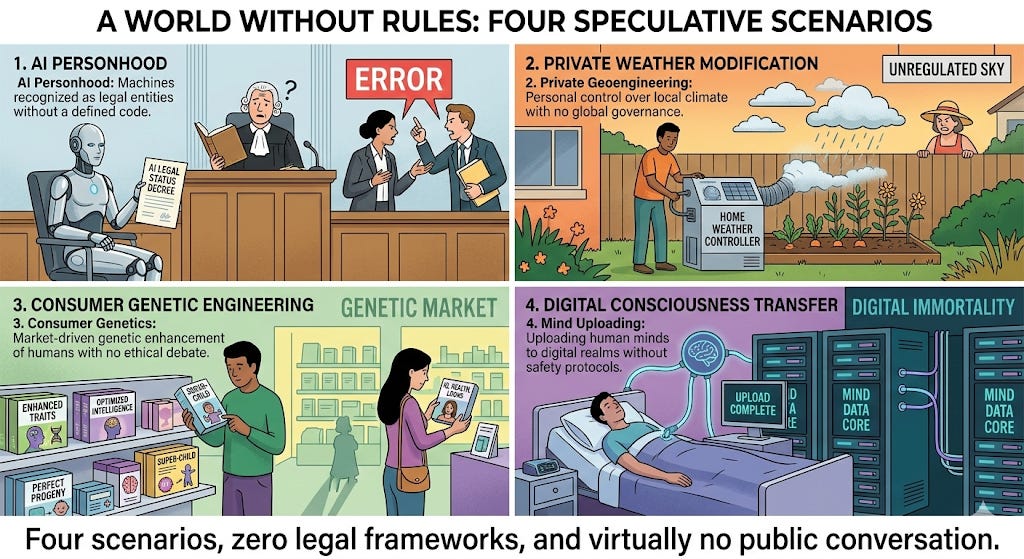
Are these scenarios speculative? Yes. Are they physically impossible given current technology? No. And that distinction is what should keep you up at night.
The Warning Nobody Is Issuing
The technological ingredients for AI-enhanced animals are not speculative — they exist today in separate laboratories around the world. We can remotely control insects and rodents via brain implants. We can genetically engineer mice with enhanced memory and cognition using at least 33 proven approaches. We can grow human neurons inside animal brains that integrate into functional circuits and drive behavior. We can implant false memories with optogenetics. We can build neuromorphic AI chips that operate at biological power levels. We can create grain-of-sand-sized wireless neural interfaces. We can grow living neurons on silicon that learn to play games within minutes. And as of 2025, we can deliver electronic devices to the brain through the bloodstream without surgery.
What we cannot do — and what no institution is seriously preparing for — is answer the question of what happens when these technologies converge inside a single organism.
The major AI safety organizations remain focused on silicon-based superintelligence while ignoring the biological pathway. The ethicists working on animal enhancement are a small community, mostly in Oxford and a handful of universities, largely disconnected from the AI hardware engineers building ever-smaller neuromorphic chips. The military has historically been the most aggressive funder of animal augmentation — DARPA’s robo-rats, HI-MEMS cyborg insects, the Navy’s dolphin program — and defense research operates with minimal public oversight.
Nick Bostrom once observed that if moral status tracks cognitive capacity, then beings with superior cognitive abilities to ours would possess higher moral status than humans. The path from Delgado’s bull in 1963 to self-implanting electronics in 2025 took just 62 years. The question is not whether AI-enhanced animals are possible. It is whether anyone will be paying attention when the pieces come together.
One can only dream that this conversation begins before the technology forces it upon us.
This article was published by the HAIA Foundation. For more on how AI intersects with human and animal futures, visit substack.haia.foundation.