
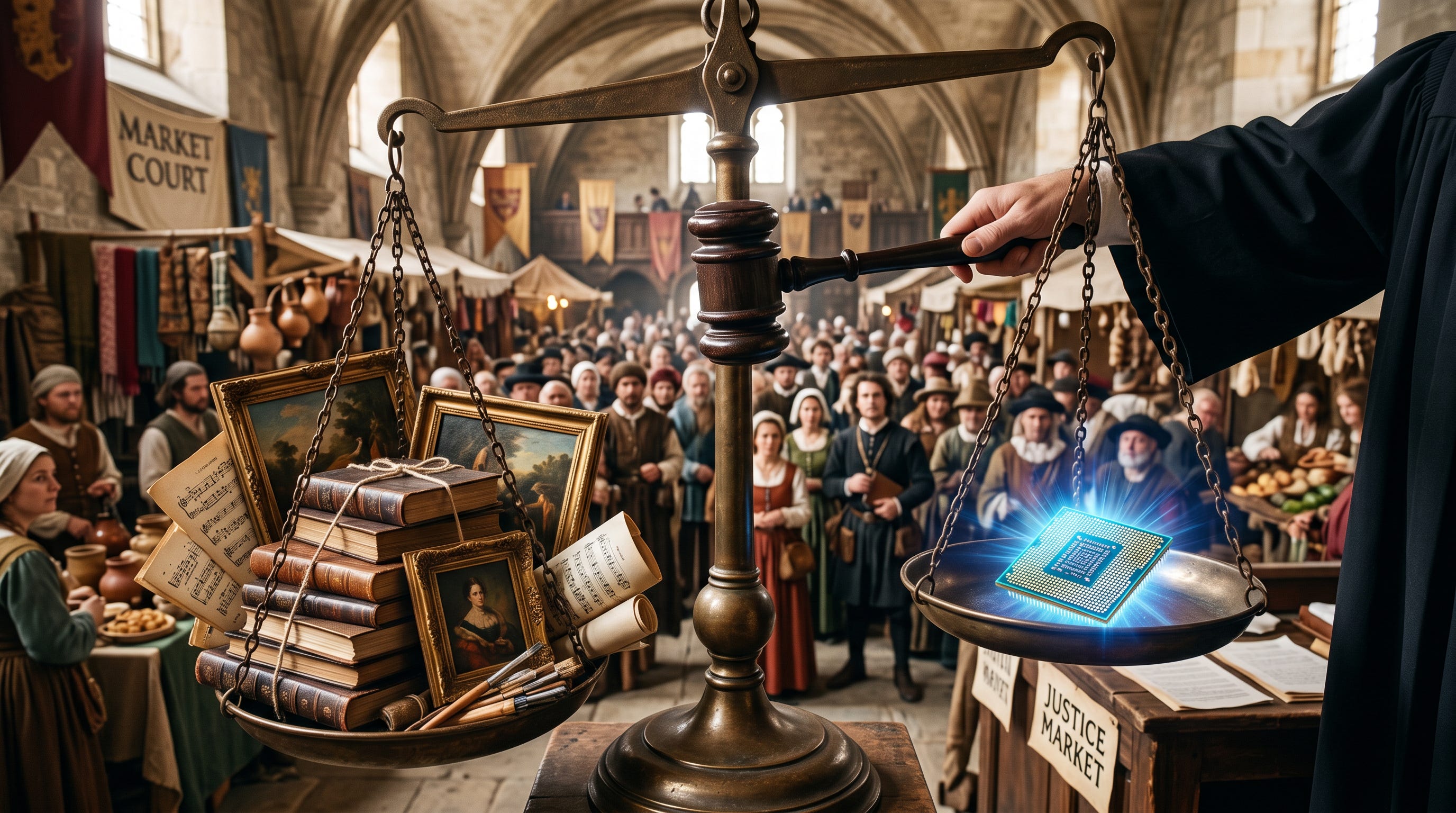
I should tell you something before we go any further, because it changes how you‘ll read the rest of this. The essay you are looking at right now — these words, this argument, the particular way I‘m trying to make a dry legal story feel like it has a pulse — is exactly the kind of thing that gets fed into a machine. It will be scraped, almost certainly, the way nearly everything published on the open internet now gets scraped. Some future model will read it, learn a little something about how to sound like a person reasoning in public, and forget where it came from. I don‘t say that to complain. I say it because I have skin in the question I‘m about to ask you to care about, and I‘d rather admit that up front than pretend to a neutrality I don‘t have.
So here is the question, and it is not the one we usually argue about. We love to argue about theft — did the AI companies steal? It feels good to argue about theft. It is a moral word, a clean word, a word that sorts the world into villains and victims. But the courts have stopped asking it. They‘ve replaced it with something far less satisfying and far more consequential: not did they take it, but what does it cost. And the early answers are landing in actual dollars.
First, the number that started the clock
Let‘s establish what is actually true, because the facts here are more interesting than the slogans.
In September 2025, the AI company Anthropic agreed to settle a class action brought by authors who said it had trained its Claude models on their books without permission. The settlement is enormous — and the per-book math is where it gets vivid. NPR reported it as the largest publicly reported copyright recovery in history, with Anthropic agreeing to compensate authors around $3,000 for each of the estimated 500,000 books covered by the deal. Do the division on the full $1.5 billion across the works actually in the class and you land a hair above three thousand — call it roughly $3,100 a book once the arithmetic settles. (I want to be precise here, because precision is the whole point of this piece: $3,000 is the figure the parties and the reporting use; the slightly higher number is just what you get when you run the long division yourself. Don‘t let anyone tell you a court “ruled“ that a book is worth $3,113. No court did.)
Here is the part I found genuinely surprising. You might assume a number plucked from an AI mega-lawsuit would be exotic — some unprecedented figure invented for an unprecedented harm. It isn‘t. The legal-industry analysis at Copyright Lately points out that the settlement breaks down to $3,000 per work — and that this is, of all things, a number that’s surprisingly ordinary in copyright litigation. When researchers looked at what courts actually award in run-of-the-mill copyright cases, $3,000 turned out to be the second-most-common figure, right behind the $750 statutory minimum. The trade lawyers at Norton Rose Fulbright confirm the same math: class members are estimated to receive approximately US$3,000 per work before fees and costs.
Sit with that. The reckoning so many people imagined — the great moral accounting where the machines finally answer for what they took — arrived, and it looked like a spreadsheet. Three thousand dollars, a line item, a number a court has seen a thousand times before. Your life‘s work, priced like a used appliance.
One important caveat I won‘t bury: this settlement is not finished. It‘s been preliminarily approved, with final approval and the actual payouts still pending. So no, authors haven‘t been paid yet, and you should be suspicious of anyone who tells you they have. But the benchmark is set. Once one number exists in the world, every future negotiation starts from it.
The line everyone forgets: training was the legal part
Before we go further, I have to clear up the thing that almost everyone — including people who should know better — gets wrong.
The Anthropic case did not establish that “AI training is theft.“ It established something far more uncomfortable and specific. When Judge William Alsup ruled on it in June 2025, he actually split the question in two. Training the models on books, he found, was exceedingly transformative — that is, fair use, legal, fine. What was not fine was how Anthropic got the books in the first place: by downloading pirated copies to build a digital central library of works it never paid for. NPR‘s reporting captured the judge‘s own framing — the case would proceed to a trial on the pirated copies and the resulting damages — before the parties settled to avoid exactly that.
So the lesson the law actually delivered is subtle, and it matters enormously: learning from a book may be allowed; stealing the book to learn from it is not. The billion-and-a-half dollars wasn‘t a fine for training. It was a fine for piracy. Even the Authors Guild, no friend of the AI labs, called it a mixed decision — a loss on the training question, a win on the piracy one. Hold onto that distinction. It‘s the hinge the entire future swings on.
So the artists won. Right?
Here is where I have to argue against my own instincts, because the strongest counter-case is genuinely strong and the people making it are not shills.
Imagine you got everything the angriest creator wants: a rule that says no model may train on a copyrighted work without a paid license. Sounds like justice. Now ask who can actually afford that world. A trillion-dollar company can cut licensing checks to every publisher and record label on Earth and barely notice. A university lab, a nonprofit, a startup, a researcher in a country with no spare millions — cannot. The Electronic Frontier Foundation has made this argument with real force: imposing heavy new licensing requirements would lock in the market advantages enjoyed by Big Tech and Big Media, pulling the ladder up behind the incumbents. Their bumper-sticker version is hard to dismiss: you shouldn‘t need a permission slip to read a webpage, whether you do it with your own eyes or with software. When two courts ruled on generative AI and fair use in 2025, the EFF cheered the one that treated training as transformative — and when the U.S. Copyright Office issued a draft report leaning the other way, the EFF argued the draft report errs on fair use.
I take this seriously. There‘s a real danger that in our hurry to protect the individual artist, we write a rule that protects only the three companies big enough to pay — and quietly strangles everyone trying to build a more open, less centralized version of this technology.
But — and here‘s where I land — “you can‘t read a webpage without permission“ quietly smuggles in a sleight of hand. There‘s a difference between a human reading your work and a machine ingesting half a million books to manufacture a product that may then compete with the very people it learned from. The EFF is right that copyright maximalism would entrench the giants. The creators are right that “transformative“ can become a magic word that means “we took it and you can‘t stop us.“ Both can be true. Which is exactly why the courts are no longer asking whether — they‘re asking how much, and under what license. The fight has moved from the moral register to the market register. As the tech lawyer Cecilia Ziniti put it, the settlement may mark the beginning of a move toward a legitimate, market-based licensing scheme for training data. Price, not principle.
The same question, answered three different ways around the world
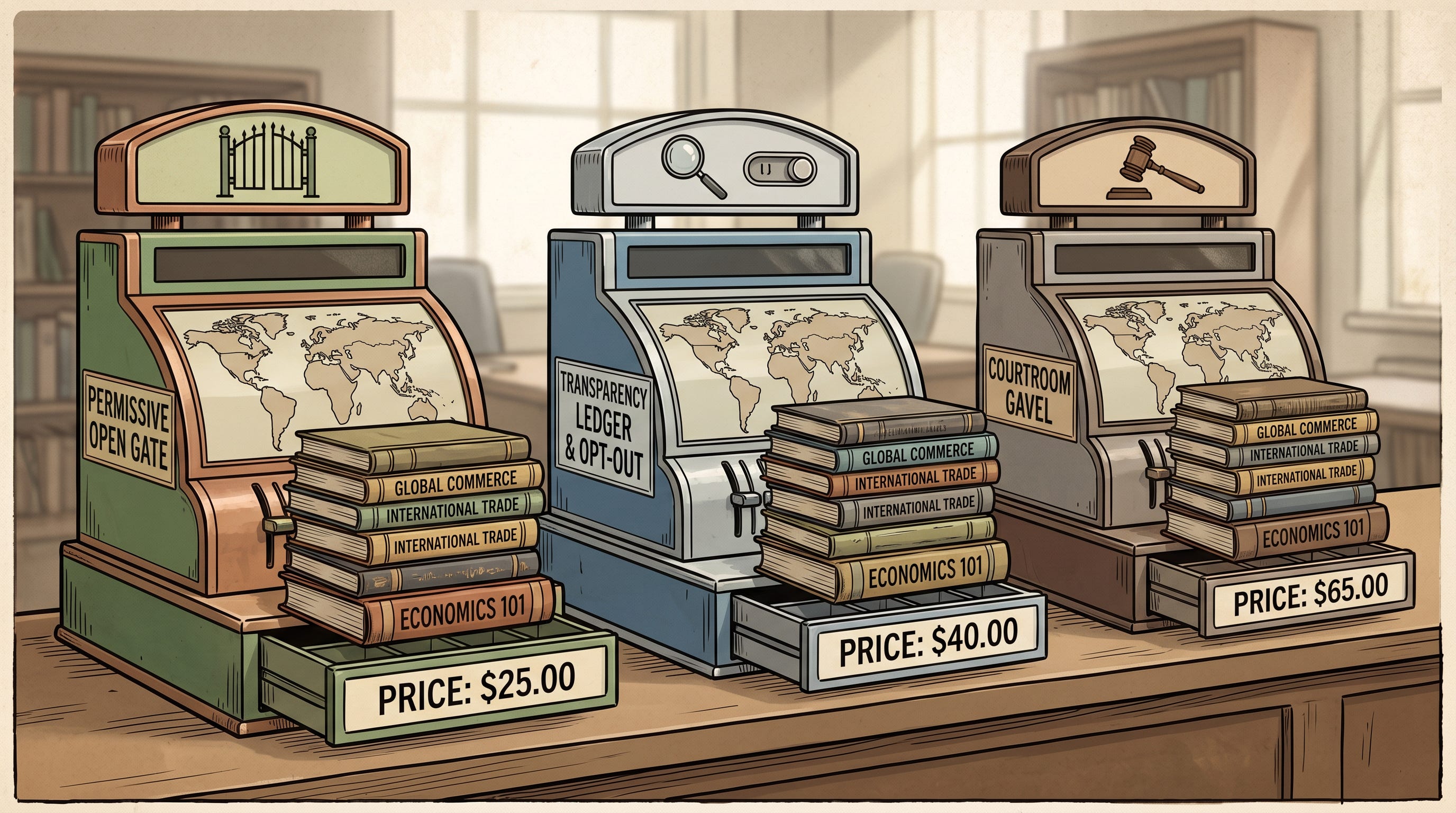
If you want to see how unsettled all of this really is, stop looking at one courtroom and look at a map. Three of the world‘s major economies have looked at the identical question — can an AI train on copyrighted work, and who decides? — and arrived at three genuinely different answers.
Start with Japan, the most permissive. Under Article 30-4 of its Copyright Act, Japan broadly permits the unlicensed use of copyrighted data for data analysis — which includes training AI. But don‘t mistake this for a free-for-all (the headline writers do, and they‘re wrong). The exception holds only as long as the use is for “non-enjoyment“ — analysis, not expressive consumption. The moment a user starts deriving real expressive benefit from the protected content, the carve-out evaporates. Japan is the friendliest jurisdiction to AI training on Earth, and even Japan put a condition on it. Policy analysts surveying the region‘s solutions from Asia treat it as the high-water mark of permissiveness.
Now cross to the European Union, which chose a different lever entirely: not permission, but daylight. Under the AI Act, general-purpose AI providers must publish a “sufficiently detailed summary” of the content used for the training of their models, on a template the EU itself provides, and must explain how they respected opt-outs under the EU Copyright Directive’s text and data mining exception. When the European Commission released its mandatory template for public disclosure of AI training data, it effectively told the labs: you may train, but you must show your work, and creators may opt out in advance. (Whether that opt-out is actually exercisable — whether there‘s any machine-readable way for a novelist in Lisbon to wave off the scrapers — is a real and unsolved problem. Transparency is not the same as enforcement.)
And then there‘s Britain, the cautionary tale of the three — the country that tried to write a rule and gave up. The UK government spent a year floating a broad text-and-data-mining exception with an opt-out, the EU model with British characteristics. Then, in its March 2026 report, it killed its own plan. The lawyers at Reed Smith summarized it bluntly: the opt-out is dead, with the previously ‘preferred option’ of a TDM opt-out exception formally abandoned — and nothing endorsed to replace it. As Hogan Lovells put it, the UK government backs away from exceptions for AI training and now proposes maintaining the status quo: wait and see.
Permission, with a condition. Transparency, with an opt-out. Or a shrug and a courtroom. Three rich democracies, the same question, three different prices — and the United States, notably, has chosen the most expensive and least predictable path of all: deciding it one lawsuit at a time.
Now imagine the next five years
Play it forward — not into science fiction, but into the boring, plausible machinery of how these things actually settle.
The American courts are about to deliver a cluster of answers all at once. On June 11, 2026, the Third Circuit heard oral argument in Thomson Reuters v. ROSS Intelligence — the first appeal of a decision on whether the use of copyrighted works to train an AI model is a fair use, turning on Westlaw‘s legal headnotes. It is, in the words of one trade outlet, the first AI training dispute to be heard before a US court of appeal. (No ruling yet — appellate courts take months — and a word of caution: ROSS was a non-generative legal-search tool, so its eventual outcome won‘t cleanly settle the chatbot question.) Meanwhile the visual artists get their day too: Andersen v. Stability AI — a group of visual artists including Sarah Andersen versus the makers of the major image generators, over the LAION data set of 5 billion images scraped from the internet — is set to begin on September 8, 2026. And the musicians are right behind them: in the AI-music cases, discovery‘s audio-fingerprinting reportedly turned up millions of recordings owned by Universal and Sony in the training data, with a pivotal summary-judgment hearing scheduled for July 2026 before Chief Judge Saylor in Massachusetts.
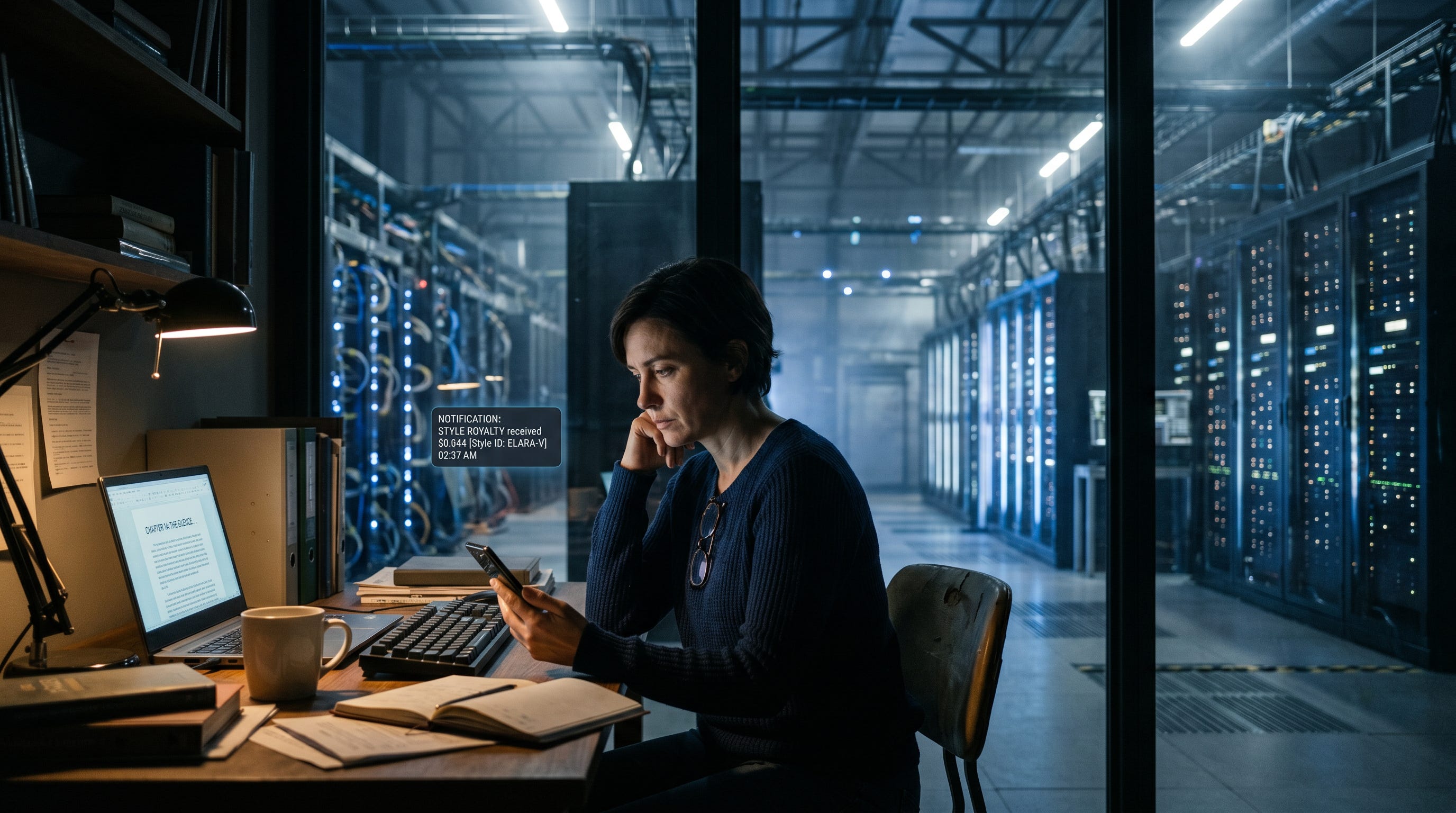
So imagine it‘s late 2027, and the dust has settled. The most likely outcome is not a grand vindication of either side. It‘s plumbing. Licensing markets spring up — a clearinghouse where publishers, labels, and stock-image houses sell training rights in bulk, the way radio stations have paid for music for a century. Your work gets a price tag attached at the source, negotiated by an intermediary you‘ve never met, denominated in fractions of a cent. The novelist gets a check for $11.40 a quarter. The session musician gets a notification: your style was referenced — $0.004. The painting you posted in 2019 generated, across nine million model outputs, the grand sum of a dollar twenty.
Is that justice? I honestly don‘t know. It‘s certainly not theft anymore — it‘s a market, with all the cold efficiency that word implies. The thing we called a moral violation will have been converted, quietly and completely, into a transaction. And the uncomfortable truth is that a transaction is probably better than the alternative the artists feared most: a world where the work was taken and nothing came back at all.
What the smart people are saying
This is one of those rare questions where the serious voices don‘t line up into two tidy camps — they spread across a spectrum, and the most useful thing you can do is listen to all of them at once.
On one flank, the civil-liberties tradition: the EFF insisting that expanding copyright hurts everyone and entrenches the incumbents, that the open internet was built on the freedom to learn from what you can see. On the other, the creators‘ institutions: the Authors Guild treating the piracy ruling as a hard-won win, and the U.S. Copyright Office‘s 2025 draft report leaning toward compensation — influential, though it‘s worth remembering the Office issues guidance, not binding law. And then, in the genuinely difficult middle, the scholars. The most clarifying voice I‘ve found is Pamela Samuelson of UC Berkeley Law, who grants that courts have largely treated training as a transformative market, and something that the authors didn’t have any right to control — while warning that the newer, slipperier theory of market dilution (the idea that a flood of AI-generated mushroom-foraging books makes nobody want to buy the real expert‘s mushroom book anymore) is real-sounding but legally unsettled and short on hard evidence. She‘s also the one who keeps reminding everyone that this isn‘t only an American argument — that the EU, too, built a text-and-data-mining exception into its law.
Notice what unites this whole spectrum. None of them is naïve about the stakes. What they share is a recognition that “theft“ was always too blunt a word for what‘s happening — and that the real fight, the one that will actually determine whether you ever see a cent, is the technical, unglamorous fight over licensing, transparency, and price.
What does this mean for you?
Maybe you‘re thinking: I‘m not a bestselling novelist, I‘m not suing anyone, why should I care? Because the price being set right now is the price of anything anyone makes and posts — including you. A few concrete things to do about it.
Assume your public work is training data, and decide how you feel about that on purpose. Every blog post, photo, song demo, and design you put on the open web is, functionally, in the pool. You can’t realistically stop it today, but you can stop being surprised by it — and you can choose where to publish accordingly.
Read the terms before you upload. The platforms you post to (for art, writing, music, code) increasingly grant themselves the right to license your work for AI training. That clause is the real transfer of value, and it’s usually three taps deep in a settings menu. Find it. Toggle what you can.
Where an opt-out exists, exercise it — and where it doesn’t, ask why. The EU built one into law; some platforms now offer a “do not train” switch. They’re imperfect and easy to miss, but a right nobody uses is a right that quietly disappears.
Watch the price, not just the principle. The next time a headline says a court “ruled on AI and art,” ask the colder question the courts are actually asking: what’s the number, and who collects it? That’s where your interests live now.
Keep your receipts. Timestamps, originals, records of authorship. In a world settling toward per-work licensing, the people who can prove they made a thing are the only ones positioned to ever get paid for it.
The lesson, as I see it
I opened by admitting that this very essay is destined for some model‘s training set, and I meant it as more than a confession — I meant it as the whole point. We have spent three years asking a question that felt righteous and turned out to be the wrong one. Did they steal it is a question for a courtroom drama. What is it worth, and who decides is a question for the actual world we‘re about to live in — and while we were busy being outraged, that question got answered in spreadsheets and settlement schedules, in Tokyo and Brussels and a federal courthouse in Massachusetts.
The number, for now, is about three thousand dollars a book. It will change. It will fracture into a thousand smaller numbers — per image, per song, per sentence — as the licensing machinery grinds into place. But here‘s the thing I keep coming back to, the reason I can‘t quite mourn the shift from theft to price: a price, at least, can be argued. A price can be raised. A price means the people who make the things the machines learn from are finally, grudgingly, in the room where the value gets divided. That‘s not the victory anyone marched for. It might be the one that actually pays.
So the next time someone tells you the robots stole your favorite author‘s words, you can tell them the truth, which is stranger and more important: the robots didn‘t steal them. They put them up for sale. The only question left is who sets the price — and whether you‘re paying attention while they do.
The HAIA Foundation exists to keep ordinary people in the room when the rules for living alongside intelligent machines get written — including the rule that decides what your work is worth. If this gave you a sharper way to see the fight, pass it to one person who still thinks it’s only the famous artists who have something at stake.