
For about two years I carried a prop into arguments, and the prop did most of my arguing for me.
It was a plastic water bottle. Half a liter, the kind you buy on a station platform without looking at it. I would set it on the table when the conversation turned to AI and say: that is one prompt. One question to a chatbot, one bottle. People put their phones down.
Then someone at one of those tables did the arithmetic out loud, and I learned I had been handing out a figure inflated by 50 to 250 times. The water consumed inside the data center for a single prompt is closer to half a milliliter — a raindrop — and American AI as a whole accounts for something like 0.04% of the country's freshwater. Two orders of magnitude, in public, with a visual aid.
What bothers me is not the embarrassment. It is that even if the bottle had been right, it would still have been the least useful fact in the room. I had reached for a national average to describe a resource with almost nothing national about it. Water does not flow to wherever the price is best. It sits in a particular aquifer, under a particular county, and it is either there in August or it is not.
So here is the number I should have been carrying. Of 809 data centers planned across the United States, 517 are in locations that have been in drought conditions throughout the past year — about two-thirds — according to an analysis the Guardian published in June, built on data from Cleanview and the federal government.
That is the whole argument, so let me state its shape up front. The national total is arguable, and I will concede it below in the strongest version I can find. The map is not. A defensible average has been doing an enormous amount of work hiding an indefensible map.

Two-thirds of the pins, and what "in drought" actually means
Start with the vocabulary, because that is where most of the shouting comes from.
"In drought" is not a mood, it is a classification. The federal drought map underneath that analysis grades conditions in four categories, from D1 — the least intense — to D4, the most: moderate, severe, extreme, exceptional. A fifth shade, D0, labeled "abnormally dry," deliberately does not count as drought. The map comes from a partnership of the National Drought Mitigation Center at the University of Nebraska-Lincoln, the Department of Agriculture, NOAA and NASA, which trade off responsibility for it every couple of weeks.
One note on attribution, since I have complained about hardened claims often enough to owe you a clean one. The Guardian credits its drought data to "Cleanview and the federal government" and names no agency. Tom's Hardware, covering the same analysis, was the outlet that attributed the classification to NOAA's National Integrated Drought Information System — NIDIS, the drought early-warning program Congress authorized in 2006 that runs drought.gov. A small distinction that matters: the second version travels as though the paper said it.
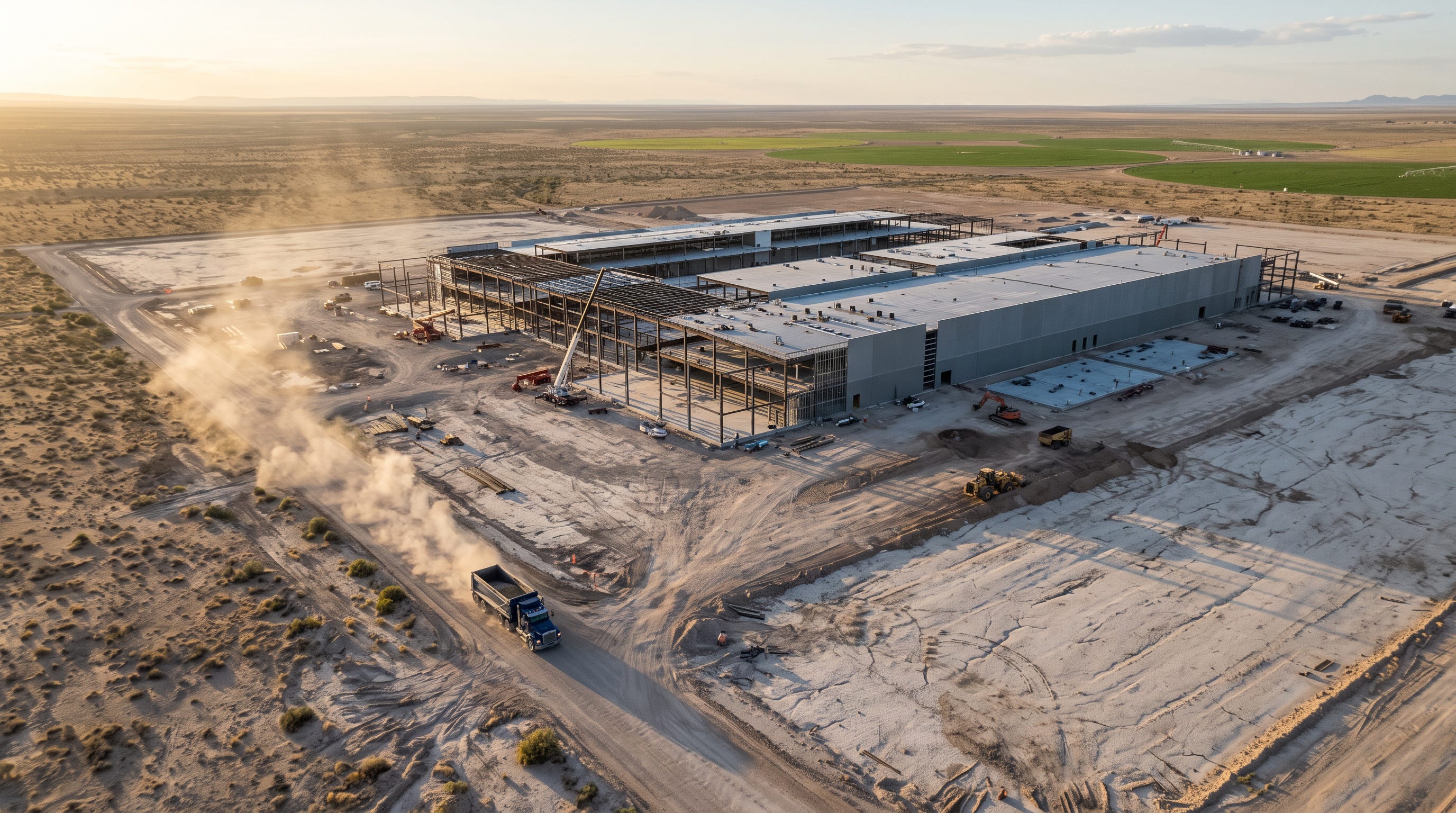
Now the numbers sitting on top of that map. When the Guardian published in June, more than 60% of the contiguous United States was at varying stages of drought — the largest such expanse for spring in modern records. Large data centers, some the size of small towns, can require up to 5 million gallons a day — the use of up to 50,000 people. And so many of them go up on dry ground not by carelessness but by design: developers are drawn to arid, sparsely populated places by cheap land and generous tax breaks, and because dry air is thought to cause the least corrosion to equipment.
Read that again. Dryness is not a side effect here. It is one of the things being selected for.
A second dataset gets blended into this one constantly, and it should not be. In May 2025, a Bloomberg News analysis reported by DataCenterDynamics found close to two-thirds of US data centers built or in development since 2022 were in locations with high water stress, with five states accounting for 72 percent of all new data centers in locations of acute water stress: Virginia with 67, Arizona with 26, Texas with 26, Illinois with 23, California with 17. Different researchers, different year, different definition of stress. Same silhouette.
And when the industry replies that its water use is a rounding error next to agriculture, it is answering for one leg of a three-legged animal. As Tom's Hardware put it, counting only cooling excludes the chip fabrication and the electricity generation created by the same infrastructure — where most of the growth is concentrated.
Now let me take apart my own headline
I promised the strongest version of the other side. It is stronger than I would like.
The best-sourced national estimate comes from Lawrence Berkeley National Laboratory, whose 2024 report for the Department of Energy puts direct US data center water consumption at 66 billion liters for 2023, with hyperscale facilities alone expected to consume between 60 and 124 billion liters in 2028. In the gallon units everyone quotes: 17.4 billion gallons in 2023, projected to increase to between 38 and 73 billion gallons by 2028. Note the range. The number that reaches headlines is 73 billion, which is the ceiling of a projection, not a forecast.
Set that against everything else Americans do with water. The Information Technology and Innovation Foundation — a tech-friendly think tank, not a critic — published a report in July worth quoting rather than summarizing: there are real water concerns in certain parts of the country, "and also that there is no universal national water problem." Adding direct use to the water consumed generating the electricity, ITIF totals data centers at less than 1 percent of US water consumption.
The growth math cuts the same way. New research from Xylem, the water technology company, projects that AI will add roughly 30 trillion liters of annual water demand by mid-century — of which data center expansion is about 4%, against roughly 54% for power generation and 42% for semiconductor fabrication. (You will see that figure repeated in gallons. Xylem's own release says liters. In water arguments the units are not a detail; they are most of the argument.)
Even the critics' numbers are contested from inside. Brian Potter, an engineer who writes about construction economics, publicly corrected his own data center water estimate upward — "I misread the Berkeley Report and significantly underestimated US data center water consumption" — then argued the Berkeley Lab's indirect figure is itself inflated, because it counts evaporation from hydroelectric reservoirs that would happen whether or not the dam generated a kilowatt. He is careful: he is not certain the report accounted for that, though he suspects it did not. Nobody's numbers here are clean, including the ones I like.
If you came for "AI is drinking your town dry," the national arithmetic does not support it, and I am not going to pretend otherwise to keep your attention.
Here is where things get interesting. Read the skeptics to the end and they do not stop where the headlines stop. The same analysis that calls the per-prompt statistic inflated also says plainly that individual data centers can sometimes stress local water systems, and that its author is not claiming otherwise. ITIF's own text notes significant shortages in arid regions such as Arizona and drought-stricken California, says each watershed has a different capacity and different existing users — and recommends watershed-stress review and water-performance standards at the siting stage.
One small outlet put the whole thing in a sentence I cannot improve on: national totals make the panic look overstated, while local water stress makes some projects genuinely hard to defend. Both things can be true.
They are. And only one of them is a decision somebody has to make.
What survives the debunking is the pipe, not the bottle
Throw out every inflated per-prompt claim — you should — and three findings are left standing. Each is about place and timing rather than totals.
First: the binding constraint is the hottest day, not the year. A team led by Shaolei Ren of UC Riverside reframed the question in a paper submitted on March 3, 2026. What limits a facility is not its annual average but its peak withdrawal on the days a community can least spare it. On that basis, and if today's water use intensity persists, US data centers could collectively require 697 to 1,451 million gallons per day of new capacity through 2030 — comparable to New York City's average daily supply of roughly 1,000 million gallons a day. The university's summary makes the mechanism vivid: annual totals look modest, but daily demand from evaporative cooling can spike six to 10 times higher than average usage in hot weather, and the infrastructure to serve that runs an estimated $10 billion to $58 billion depending on growth.
A bottle is an average. A pipe is a peak. Utilities are built for peaks.
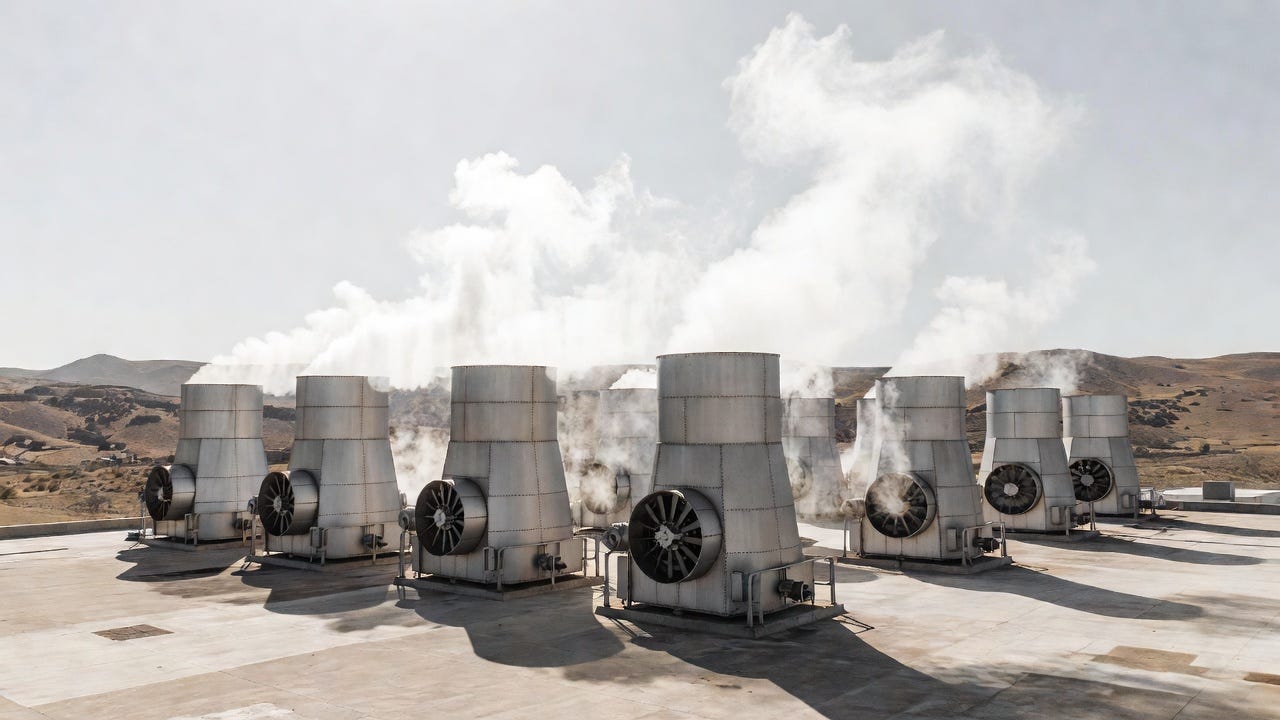
Second: the water you can see is the smaller half. Ceres, the investor-facing sustainability nonprofit, found in September 2025 that while on-site cooling gets the attention, indirect water use — primarily from power generation — has an even greater impact, and that the real risk is cumulative: facilities clustered in one small geography. Which is why "we switched to air cooling" is a partial answer at best: it trades on-site water for electricity, and electricity is made with water somewhere else in the same region.
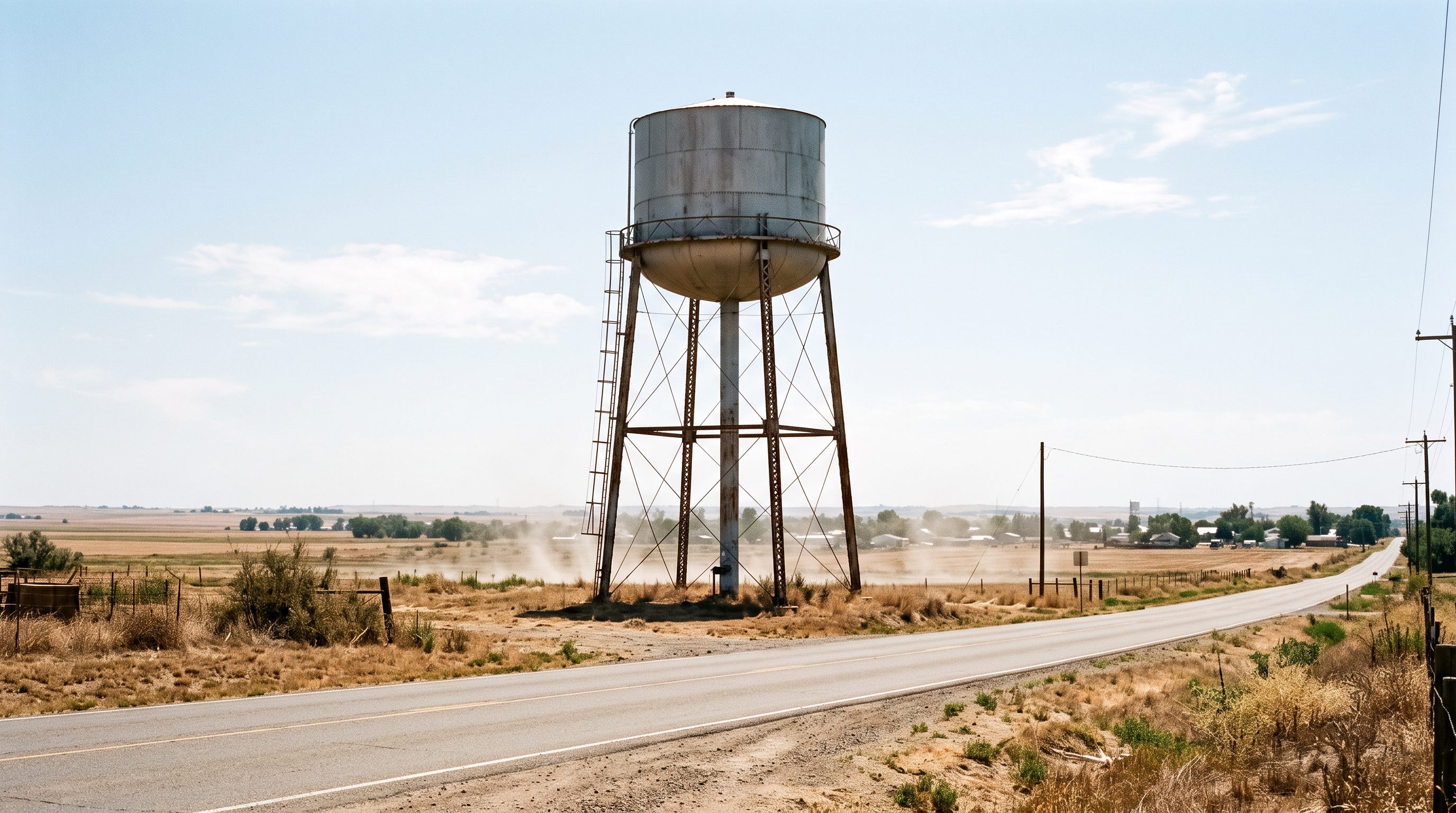
Third: whoever supplies the water sends somebody the bill. A Water Foundation white paper from July states the siting problem more bluntly than I expected from an advocacy group: developers have so far prioritized cheap land and energy, "often without considering water needs or impacts." Its second finding is the one that lands on your kitchen table — municipal systems supply 97% of data centers' water, those systems face costly upgrades, and the costs can fall on residential ratepayers rather than developers.
And the planning apparatus meant to catch this? Consider Texas, with 400-plus facilities operating or under construction. Researchers at UT Austin estimate data centers could potentially account for 3% to 9% of Texas' water use by 2040, up from under 1% today — a wide range, honestly stated, because nobody has the data to narrow it. Meanwhile the state's draft 2027 water plan does not allude to data centers at all, and most of its data, the Texas Water Development Board's own supply planning director told E&E News, is from 2020.
A plan written on 2020 numbers, next revision in five years, in the state adding data centers faster than almost anywhere on earth.
Federally, the picture is thinner and stranger than "no rules." The Congressional Research Service, in a July 31, 2026 report, notes that data center water use is difficult to quantify comprehensively and that, to date, the federal government has not conducted a systematic assessment of water use by data centers. ITIF makes the complementary point about the law: federal water rules concentrate on wastewater standards for what leaves a facility, not on what it draws in and evaporates.
We are making a continental infrastructure decision without a federal count of what it consumes.
What this looks like at ground level
Abstractions are comfortable. The record is not.
In the first week of May 2026, two data center developments — one in Arizona, one in Georgia — were caught taking public water without authorization. In Fayette County, Georgia, the county water system had written to the operator QTS a year earlier, in May 2025, about two meters, one installed without the county's knowledge and one not connected to the company's billing account; more than 29 million gallons had been consumed. In Tucson, the city manager wrote that a contractor had obtained a construction water meter inside the city's service area and trucked the water outside city limits to the Project Blue site — roughly 650,000 gallons. Drought conditions in Georgia, Fortune noted, have worsened since that project was announced.
Tucson is the case worth studying, because it shows what local power can do and exactly where it stops. In August 2025, the city council voted unanimously against annexing the Project Blue land — annexation being how the developer would have reached city water — ended negotiations, and began work on ordinances to hold large water users accountable. Fox Business, covering the same vote from a very different editorial direction, reported that the council directed all staff to stop work, and that the finished project would have demanded more water than four golf courses.
Then the sentence that belongs under every "town beats data center" headline, from the local newsroom that covered it closest: the vote does not mean Project Blue is over for the region — the developer wanted annexation to reach city supplies and can consider other locations outside city limits. A city can decline to sell you water. A city cannot generally stop you drilling next door.
Further west, the proposed Imperial Valley Data Center — 880 acre-feet of water a year for cooling — is tangled in a county freeze and a challenge under California's environmental review law, with two court rulings that could decide its future pending as of early August 2026. One judge is weighing whether the freeze can stand; another whether the project needs a full environmental study, with a decision expected within 90 days of a July 29 hearing. Nothing there is settled, and I will not write it as though it were.
The politics have arrived too, which HAIA has covered elsewhere: opponents held 142 protests across 42 states on one Saturday in July, and a June Reuters/Ipsos poll of 4,531 people found just 33% of Americans agreed that building data centers at a rapid pace is mainly a good thing.
You can dismiss that as nimbyism if you like. You cannot dismiss an unmetered connection.
Three states just wrote the rule Washington hasn't
Here is where things change, faster than most people following this story realize.
Minnesota went first. Its 2025 session law created a genuine water trigger: a data center whose proposed consumptive use exceeds 100,000,000 gallons per year and needs a new or amended permit gets special review from the Department of Natural Resources, which must ensure public health, safety and welfare are adequately protected. A number, a threshold, a consequence — more than the federal government has.
Then, three days before I wrote this, Pennsylvania went at it from another angle. Executive Order 2026-05, signed August 18, 2026, tells the Department of Environmental Protection not to begin reviewing permit applications for large data centers — peak demand above 25 megawatts, where the applicant has not signed a consent order agreeing to the state's grid requirements — until that applicant has documented consistency with the local comprehensive plan and all local approvals, and has obtained any water withdrawal or wastewater discharge authorization the project requires. It also requires annual reporting of total water consumption along with the maximum day demand, broken out by month, by source, and by whether the water went to cooling or something else.
Maximum day demand. The peak — the exact metric the UC Riverside work says is binding — written into a state reporting requirement by an order that also observes, in its own recitals, that most of these proposals are speculative in nature, with no identified end user.
Virginia, the state holding 67 of those acute-stress builds, took the third path: disclosure. For reporting that begins January 1, 2027, waterworks operators will have to break out data center withdrawals from domestic, industrial, commercial and other uses, potable and non-potable. Real progress, with a real ceiling: the duty falls on the utility rather than the facility, and individual data centers' numbers stay protected as trade secrets. Meanwhile 10 of Virginia's 11 drought monitoring zones have been under a drought warning since May 2026.
This is a wave, not a one-off — water language is showing up in more state bills through 2026, with Minnesota as the precedent others are following.
What about the companies? Some are disclosing, to their credit. Google's 2026 environmental report states that its water stewardship projects replenished approximately 7.7 billion gallons in 2025, roughly 78% of our 2025 freshwater consumption, in the company's own words. A serious program and a real number — and also, notice, a ratio: a percentage of consumption everywhere, replenished somewhere. Which is precisely the move I made with my water bottle: a defensible average standing in for a map.
Follow the same question down to Santiago
If you want to see where this argument ends up, do not look forward. Look south. Chile ran a version of this experiment years ahead of the United States — and then quietly took the paperwork out of it.
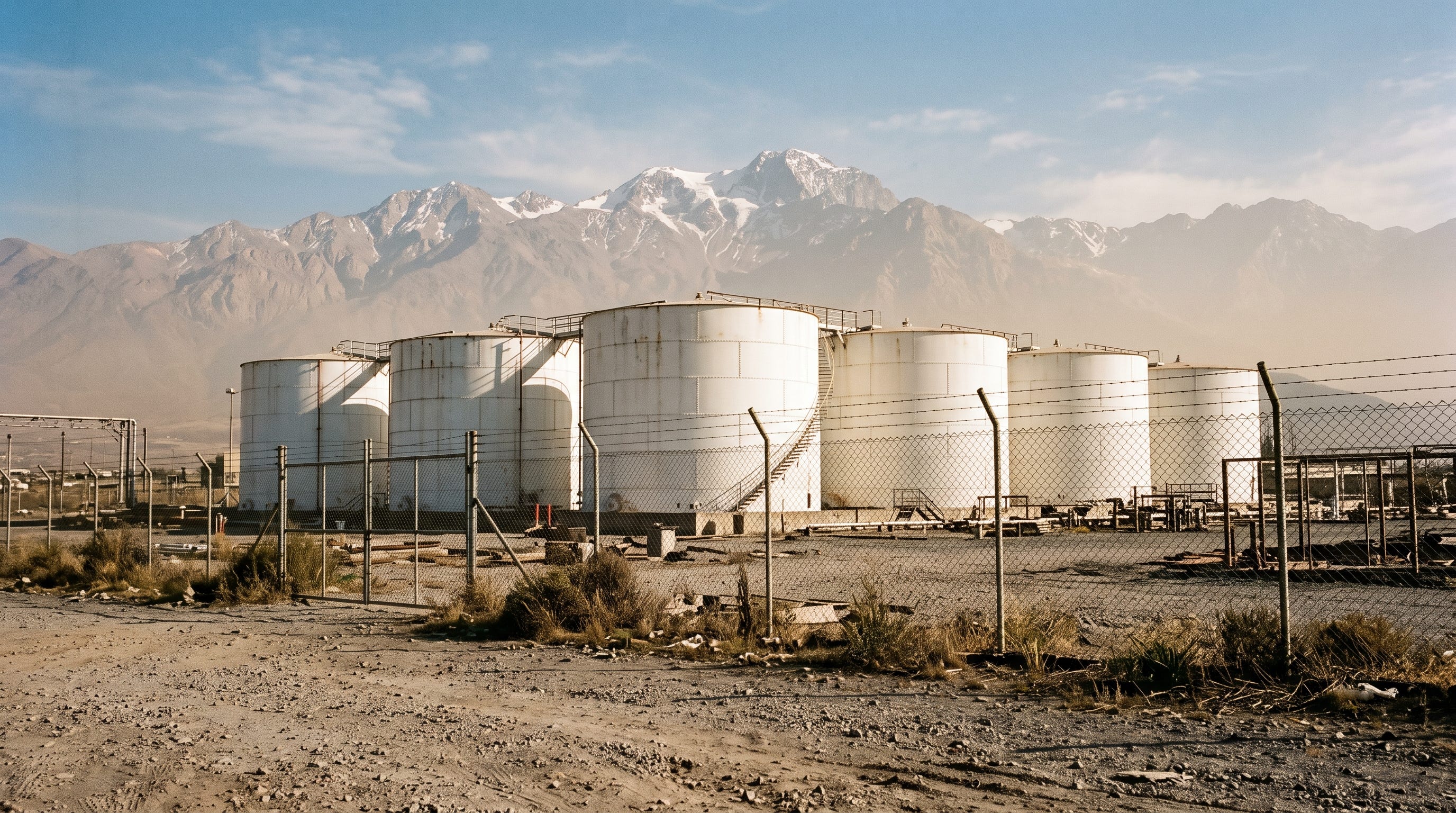
The setting first. In April 2022, Chile announced possible plans to ration water in Santiago under a four-stage alert system — rationing to bite only once a red alert is declared — after a drought that has lasted more than a decade. Into that regime went the data centers: 16 approved in Santiago's metropolitan area over 12 years, according to Rest of World, including a second Google facility authorized in 2020, per official environmental filings, to extract 228 liters of water per second — more than 7 billion liters a year.
Then Cerrillos. A Chilean environmental court partially reversed Google's permit for a $200 million data center in that Santiago district over concerns about the capital's strained aquifer; a court fight revealed the cooling towers would need 7.6 million liters — about 2 million gallons — of potable water a day. Reuters reported the court was asking the U.S. company to revise its application to take into account the effects of climate change. The case record is more precise: on September 26, 2024 the Second Environmental Court partially upheld the Municipality of Cerrillos' claim and ordered the assessment service to revert the evaluation process to incorporate consideration of the effects of climate change in assessing the water component — in a case where the company holds water rights on three wells of the Santiago Central Aquifer. Google's answer, months later, was to revise the project entirely: "A new process will start from scratch."
Read from Arizona, that looks like the ending Tucson could not get. A court, an aquifer, a hyperscaler sent back to redo its homework.
Except that is not the lesson, and this is the part that changed how I think about the American fight. In Chile's system, water was never what pulled a data center into review. Diesel was. Facilities entered evaluation because they stored large volumes of backup generator fuel — and in early June 2025 the Council of Ministers approved a change raising the ceiling on stored flammable substances from 80,000 liters to 1 million, twelve times higher. The environmental foundation Terram ran the obvious calculation: of the 17 data centers evaluated and approved in Chile because they stored more than 80,000 liters of fuel, 15 "habrían podido aprobarse sin evaluar sus impactos ambientales" — could have been approved, under the new standard, without their environmental impacts being evaluated at all. Conditional, note. Not "were approved."
What came next is not conditional. On July 24, 2026 the regulator issued its first ruling exempting a data center — the Alto Jahuel project, from DC Terranova SPA, in the commune of Buin — from entering environmental impact assessment at all. The reason it can go that way is structural: the regulations still contain no specific category for data centers. There is no water door. There was only ever a diesel door, and the diesel door has been widened.
To be fair, the regulator has not been idle. In January 2026 it published an evaluation criterion for data center projects entering the assessment system, developed with the water authority and four other agencies, under the country's National Data Centers Plan — a strategy launched in December 2024 to attract $2.5 billion in investment, whose sustainability leg is a voluntary clean production agreement rather than a binding water rule. Guidance for projects that enter; not a trigger that makes them enter.
Which brings us to two weeks ago. On August 6, 2026 the trade outlet BNamericas reported that Google has revived the same $200 million Cerrillos project, now designed around air cooling — and that, according to a relevance letter filed with the regulator, the project could be exempt from a formal environmental impact assessment, since the redesign would fall below the thresholds that trigger one. Google's press office is careful: the letter is a necessary administrative step "in case we decide to move forward with this project in the future." The company has not said it is building.
Hold the two halves together, because the irony only works assembled. A court forced a water assessment onto a project. The project came back with a design that may not require an assessment. Nobody broke a rule. The rule was a threshold, and thresholds are design briefs.
One more thread, and it cuts both ways. The digital rights group AlgorithmWatch, writing about the Quilicura facility, notes that Google's water figures there are self-reported and have not been independently verified by anyone outside the company, and that no reliable studies were conducted beforehand to estimate the local impact. And yet the same account records that after years of sustained activism, the people of Cerrillos negotiated with Google, and the company moved to a less water-intensive technology.
Organized residents got a better outcome than the rulebook required. That is genuinely hopeful and completely unsustainable as policy. You cannot run a continent's water strategy on the assumption that every affected neighborhood produces a decade of activists.
Run the tape forward to the summer of 2031
Now let me be imaginative — in the way that only asks you to believe trends already in the record.
It is late July 2031, day nine of a heat dome. Out on the county line, a campus that promised — accurately — to use less than one percent of the county's annual water is drawing six to ten times its own daily average, because that is what evaporative cooling does when the wet-bulb temperature climbs. Its annual report in December will be unremarkable. The number that matters is the one it hit at 3 p.m. on a Thursday, and until Pennsylvania started asking for maximum day demand, almost nobody had to write that number down.
Now imagine the design responses, because they are already legible in today's rules. In Minnesota, a facility engineered to a projected 99 million gallons a year sits one gallon under review. In Pennsylvania, a 60-megawatt campus arrives as three phases of 24 megawatts, none individually crossing the line. Everywhere, air cooling spreads as the responsible-sounding retrofit — moving evaporation from a building the county can inspect to a power plant it cannot, exactly the indirect water Ceres was pointing at. The county's water report improves. The watershed's does not.
Imagine the markets that grow in that gap: operators quietly leasing agricultural allocations for the ten worst days of the year, because peak capacity is the scarce good and farmers hold it; a utility issuing bonds for an emergency interconnect built for one customer and paid for by everyone, surfacing on residential bills three budget cycles after the ribbon-cutting, long after anyone connects the two events.
And then imagine the better version, available and not expensive. Watershed capacity printed on the site plan the way flood zones are printed on a listing. Peak-day water sold as firm capacity with a price attached, so a project that wants the hottest ten days pays what they cost. Interconnection charges falling on whoever triggered them. Facility-level reporting that is public because it was never really a secret — the water leaves a public system and goes into the sky.
None of that requires a new national number. It requires the map to be admissible.
The people who agree on nothing else agree on this
Here is what made me want to write this rather than just correct my old talking point: the convergence.
On the skeptical side, AEI's Faster, Please podcast hosted Andy Masley in August to argue that the evidence on data centers' impact on water, land and electricity is widely misread — a conversation in which Masley notes that the physical buildings occupy something like one-fifteenth of the land America gives to Christmas trees. ITIF, from a firmly pro-build position, denies any universal national water problem — then sends the decision to the watershed and the siting stage anyway, and counts more than 200 data center bills introduced across all 50 states in 2025, of which more than 40 were enacted.
Across the room, Brookings argues the answer has to move beyond ad hoc, site-specific concerns precisely because water infrastructure is hyper-fragmented — more than 50,000 local water systems nationally, which guarantees that fifty thousand separate fights produce fifty thousand separate answers. Ceres, looking through investor risk, reports that 32% of data centers sit in areas of high or extremely high water stress — a figure it attributes to Planet Tracker — and that annual water use tied to data center electricity demand in the Phoenix region is expected to rise 400%. The Lincoln Institute of Land Policy names the structural flaw: even a small data center can place an immense, concentrated burden on local infrastructure, and, as one regional planner tells it, "the locality is not looking at the regional impacts."
A tech-industry think tank, a right-of-center policy shop, a center-left institution, an investor coalition, a land-use research center and a team of computer scientists disagree profoundly about how big this problem is — and agree almost word for word about where it has to be decided. At the watershed. At the siting stage. On peak days. With the numbers written down.
The argument about the national average was never the argument. It was the thing we did instead of the argument.
So what does this mean for you?
Whether you live near a proposed site, three counties away, or simply on the same utility bill, here is what actually helps.
Look up your own ground before you form an opinion. The federal drought portal will tell you which category your county has been in and for how long. D0 is "abnormally dry" and does not count; D1 through D4 do. That alone makes you the best-informed person at the hearing.
Ask for maximum day demand, not annual average. A yearly figure answers a question the utility does not care about. Ask what the facility draws on the hottest day of a heat wave, and what the local system's peak capacity is.
Find out where the water comes from, because it decides who pays. Municipal systems supply the overwhelming majority of data center water. If the answer is "the city," upgrade costs are a ratepayer question — and you are the ratepayer. Ask who funds any new interconnect, main or treatment capacity the project triggers.
Ask about the electricity, not just the cooling. Indirect water used to generate a facility's power can exceed what it evaporates on site. A project that switches to air cooling has not removed the water; it has moved it, usually beyond your county's reach.
Check whether your state's water plan counts data centers at all. Several still rest on pre-2020 usage data and never mention the sector. If yours does not, that is a concrete thing to ask a state legislator to fix — and more tractable than fighting each project separately.
Read reporting rules for where they stop. A rule that makes the utility report categories is not a rule that makes the facility report its use. Ask whether facility-level figures are public or shielded as trade secrets, because that determines whether anyone can check the promises.
Watch the thresholds, not just the projects. Every numeric trigger is an instruction to designers about where to draw the line. When a proposal lands suspiciously just under one, or arrives split into phases, that is the story.
Retire the bottle. If you have been using the per-prompt water statistic, drop it. It is inflated, the other side knows it is inflated, and saying it hands them the whole conversation. Bring your county's drought classification instead — smaller, truer, unanswerable.
The lesson, as I read it
I spent two years arguing about a raindrop.
The honest reckoning is that the people who debunked the water panic were right on the merits and mostly right in tone, and that the side I was cheering for kept making a national claim it could not support while an entirely defensible local claim sat unmade on the table. That is not a small failure. In a fight about infrastructure, whoever makes the sloppier argument loses the technical ground first and the moral ground about six months later.
But notice what the debunking did not touch. Not 517 planned facilities on land the federal map graded as in drought over the past year. Not a peak-day draw six to ten times the average, or a New York City's worth of new capacity needed by 2030 if today's water intensity holds, or 97% of that water coming from public systems, or a Texas water plan that does not mention the industry reshaping Texas, or two projects caught taking public water without authorization in a single week, or a federal government that has never systematically counted any of it.
And Chile shows where the road goes when the argument stays at the level of averages: a court can order one company to assess its impact on one aquifer, the company can return with a design that falls below the threshold, and nothing will have been broken — because the rule was never pointed at water in the first place.
Data centers are not going to stop being built, and I would not want them to; the useful version of this technology has to live in a building somewhere. The only question on the table is whether we decide where, using numbers that describe the actual place, before the concrete is poured rather than during the third summer of a drought.
My vote? Argue the map, not the mean. The average was always going to be defensible. That was the problem with it.
The HAIA Foundation was built for arguments like this one — the kind that only ever resolve at the level of a watershed, a permit hearing and a utility bill. More of them, weekly, at the Substack. Bring your county map.