
There is a small speaker on my grandmother's kitchen counter, and I am the one who put it there.
At eight every morning it says good morning, tells her whether she will want a coat, and reminds her about the blue pill. At six it asks whether she has eaten. When I travel I can say a sentence into my phone and it arrives in her kitchen in my own voice. Nine seconds.
I set it up during a week when I felt guilty about not calling enough, and it worked exactly as designed: the guilt lifted almost immediately, which should have been the tell. I still use it. I used it this morning.
Here is what the speaker does not do. It does not get her out of bed, into the shower, or dried afterward. It has never noticed the sore starting on her heel, because it has never touched her heel. That is done three mornings a week by a woman I have met twice, who visits four houses before lunch and is paid roughly what you are about to see.
I automated the part of caring for someone that I enjoy. The part I dread is still done by a human being who is not paid enough to keep doing it.
That is not really a confession about me. It is a description of the entire eldercare robotics industry.

What the shortage is actually a shortage of
You have seen the headline number. There are three of them, and most people quote the wrong one.
The current figure comes from PHI, which has tracked this workforce for decades: an estimated 9.7 million total job openings in direct care from 2024 to 2034. The 9.3 million you see in most press releases comes from a 2023 analysis of an older projection cycle running 2021 to 2031 — same workforce, superseded arithmetic, usually deployed as proof of a crisis so vast that only a machine could fill it.
Fine. Call it roughly ten million openings over ten years. Openings for what, exactly?
PHI's own description of the job is deliberately unglamorous: assisting older adults and people with disabilities with daily tasks, such as dressing, bathing, and eating. There are 5.4 million such workers today; the median wage was $17.36 an hour in 2024.
The federal government has run the comparison. In 2023, home health aides and personal care aides earned lower wages than other entry-level workers in all fifty states and the District of Columbia, at an average median of $15.18 an hour. About half of direct care workers live below twice the federal poverty line. That is not a mysterious supply problem. That is a price.
The work is also physically punishing, in a way that reaches the injury statistics. OSHA reports that in 2017 nursing assistants recorded a musculoskeletal-disorder rate more than five times the average for all industries, driven largely by overexertion in repeated manual handling — transferring and repositioning people. (That is 2017 data, and OSHA calls manual lifting one major source of these injuries, not the only one.)
Here is the question that ought to organize this whole conversation, and it already has an answer. When researchers reviewed what nursing staff want from a care robot, the most desired capability was assistance with physically demanding tasks — nine of fifteen studies — meaning bathing, toileting, feeding, and transferring or lifting patients.
The same review makes a subtler point. Bathing someone is not a hygiene task: staff described using that time to build a relationship, to motivate the person, and to watch for health changes — to notice, for instance, the skin breaking down. The physical work and the human work are the same work, done at the same moment by the same underpaid person.
What the funded machines actually do
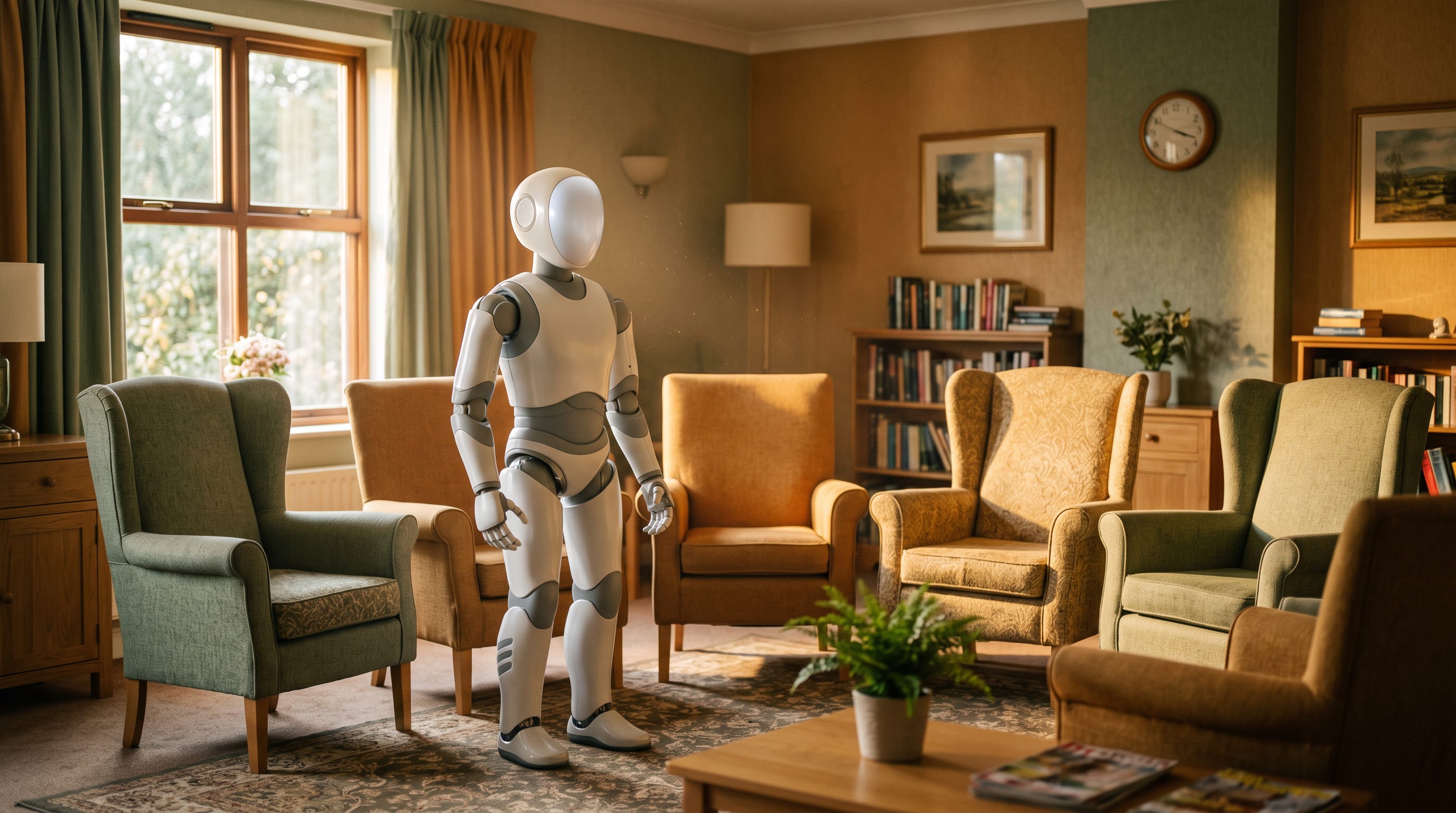
In May, UC Davis launched what it calls the first long-term US study led by nurses of a humanoid robot in dementia care — a year, up to 25 residents, at Eskaton Village Carmichael in Northern California. The robot is called Abi, and the heading on the university's own announcement is the most honest sentence this industry has produced: "A robot designed for companionship, not tasks."
Eskaton, the nonprofit running the site, uses the same register: the robot is there to spark conversation, lead small group activities such as singing and games, and offer one-to-one companionship, and the stated hope is that she frees care partners to do what only a human can do.
The money is real. Abi's maker, Andromeda — whose robots the Australian provider mecwacare has deployed, 22 of them across residential aged-care homes in Victoria for more than 1,500 residents — closed a $23 million Series A led by the San Francisco firm Forerunner Ventures in September 2025, reportedly at a $100 million valuation; the company is headquartered in Melbourne. That round is eleven months old, which is the point: not breaking news, just a settled fact about where the capital went.
Nor is it confined to facilities. New York State's Office for the Aging runs a companion-technology program with Intuition Robotics: approximately 900 ElliQ units made available to older adults in the community. In 2023 the office issued a report showing a 95 percent reduction in loneliness among users — self-reported, three years old, published by the agency running the program. It may well be true. It is not the same species of fact as an injury rate.
At the consumer end sits the home humanoid. 1X prices its NEO robot at $20,000 outright or $499 a month, says deliveries begin primarily in the US this year, and states that NEO will arrive to early owners with the ability to handle basic tasks. Then comes the sentence that made me sit up: "For any chore that NEO doesn't yet know, owners can schedule a 1X Expert to guide it."
A 1X Expert is a person. Somewhere, in an office, a human being puts on a headset and drives your robot through the thing your robot cannot do.
Hold that image. We come back to it.
The strongest case against everything I just said
Machines that physically handle human beings are not science fiction. They exist, some are old, and pretending otherwise would be the cheapest version of this argument.
Eleven years ago, Japan's national research institute RIKEN unveiled an experimental nursing-care robot capable of lifting a patient from a bed into a wheelchair — Robear, 140 kilograms. And at Waseda University in Tokyo, a machine does the genuinely hard version: in a demonstration reported on the Reuters wire last year, an AI-driven robot leaned over a man lying on his back, put a hand on his knee and another on his shoulder, and rolled him onto his side — the maneuver used to change diapers or prevent bedsores. Its lead researcher does not expect it in nursing-care and medical facilities until around 2030, at no less than 10 million yen — about $67,000.
So my headline is a claim about a market, not about robotics. The machines that touch people exist — as experimental units, as single-task furniture, or half a decade and a hospital-sized budget away. The ones with product pages and funding rounds are the ones that talk.
On whether any of this helps staff, the evidence cuts both ways — so here is the strongest finding against me. An NBER working paper on Japanese nursing homes found that robot adoption increases employment by augmenting the number of care workers and nurses on flexible employment contracts, and decreases difficulty in staff retention. Not substitution — augmentation. It is a working paper, explicitly not peer-reviewed, and it is the best evidence anyone has that this technology lifts a workforce rather than papers over it.
Against it sits the most thorough experiment anyone has run. By 2018 the Japanese national government alone had spent well in excess of $300 million funding research and development for care devices; by 2019, only about 10 percent of care facilities reported having introduced any care robot. MIT Technology Review's wording is careful in a way I want to keep exactly: a growing body of evidence is finding that robots tend to end up creating more work for caregivers. Not "the robots failed." A growing body of evidence. Tend to.
Why more work? Because, as the researcher James Wright found in his ethnography of Japanese eldercare automation, these are not the autonomous technologies of the futuristic narratives — they rely on additional labor from already stretched care workers to operate, store, move and explain them. His summary runs to five words: care robots themselves require care.
The Dutch ran the same pilots. Something else is what scaled.
The easy version of this story is wrong, so let me kill it first: the Netherlands did not look at care robots and say no.
It said yes, twice. A care robot called Zora was monitored and evaluated across fourteen Dutch nursing care organizations over two years; staff hit barriers including long start-up times and software failures, and the researchers concluded it was still in the pioneer phase. Then Vilans, the national long-term-care knowledge center, kept going with companion dolls — in 2024 the pilots continued at three care organizations, where music calmed agitation, residents in later stages of dementia sometimes acted disoriented by the spoken prompts, and the interaction faded as the demo repeated its limited music content.
Music helped. Then the demo ran out of songs.
The squeeze is identical to ours. Dutch projections put the country short 266,000 healthcare workers by 2035. Statistics Netherlands puts health spending in 2025 at 120.2 billion euros, up 6.1 percent, with long-term care under the Wlz up 7.6 percent. The government's flagship program, WOZO, sets the norm as taking care of yourself if possible, at home if possible and digitally if possible, backed by roughly 1.5 billion euros.
What differs is which bet scaled. In 2006 an organization called Buurtzorg was founded by Jos de Blok and a small team of professional nurses on the theory that the problem was not the nurses but the machinery stacked on top of them. The unit is small and fixed: self-governing teams of ten to twelve nurses responsible for the holistic care of fifty to sixty patients in one neighborhood, now implemented or piloted in more than 24 countries, with a back office kept deliberately tiny — overhead of 8 percent against a Dutch average of 25 percent. As of June 2026, Euronews describes it as the Netherlands' largest home-care organization, around 15,000 people, with decisions taken collectively by the nurses and no manager leading the discussion.
Now the part most write-ups skip. Is it cheaper? Nobody has proved that. A 2022 scoping review of Buurtzorg-derived models found reliable findings on cost-effectiveness are lacking, that assumed administrative savings were not conclusive and varied between study sites, and that implementation is complex. Analysts at the Urban Institute wrote that Buurtzorg appears to provide high-quality home care at lower cost than other organizations — and left the hedge in, so I will too. (The Conversation piece above is excellent on structure; its author also discloses past advisory work with Buurtzorg.)
So the contrast is not that the Dutch skipped the robots. They bought them. The robots stayed in the pilot. What scaled was a change in who decides how a nurse spends her afternoon — and even that has not been proved to save a euro.

Just imagine 2034
The projection window runs out in 2034, so let us go there.
You are eighty-one. Or your mother is. There is a device in the living room that knows her name, plays the songs she was nineteen for, notices she has not moved since ten, and calls you when something looks wrong. It is genuinely good, and cheaper per month than a week of home care.
At 6:40 in the morning, someone still has to come and get her out of bed.
In the good version of 2034, that someone has a ceiling lift bolted into the bedroom, six houses on the round instead of eleven, a wage that finally cleared the entry-level line, and forty minutes in the room instead of eighteen — because the device took the reminding and the company, and handed the time back.
In the other version, which requires no new inventions at all, the machine has arms and manages 80 percent of the transfer. For the remaining 20 percent it schedules an expert: a person in a headset, three time zones away, paid by the task rather than the hour, guiding a pair of borrowed arms through the intimate business of getting a stranger out of bed. The touching still happens. A human is still doing it. She has simply been moved out of the room, off the local payroll, and out of the frame.
That is not a dystopia I invented. It is a business model already published on a product page, extended by eight years and one better robot.

What the people who study this are saying
The striking thing is how little ideological daylight there is.
The Bipartisan Policy Center, working from an earlier projection cycle, counted 8.9 million openings and framed the response as a bipartisan call to action; it also counted about 38 million unpaid caregivers in 2021, whose labor it valued at roughly $600 billion. The Niskanen Center, market-oriented and immigration-friendly, notes that immigrants make up 40 percent of home health aides and calls immigration one practical and effective short-term solution. Brookings, from a different tradition and back on December 2, 2020, wrote that low wages and part-time status keep roughly half of nursing assistants and home health aides living in or near poverty, and that this likely drives the turnover employers complain about.
Different premises, same diagnosis: a wages-and-conditions problem wearing a technology costume.
Meanwhile the one federal lever that touched staffing levels directly moved the other way. On December 3, 2025, CMS published an interim final rule repealing the minimum staffing standards for long-term care facilities, effective February 2, 2026 — removing the requirement that a registered nurse be on site around the clock, and the floor of 3.48 total nurse staffing hours per resident day. The reason given is statutory: section 71111 of Public Law 119-21 bars enforcement of those provisions until September 30, 2034. A federal judge in Texas had already vacated the same two provisions on April 7, 2025, holding that CMS exceeded its statutory authority.
Read those together and the shape of the decade appears. The federal floor under how many humans must be in the building comes off, and stays off until 2034 — precisely the year the ten-million-openings projection runs out.
What does this mean for you?
If you are thirty-five, this is about your parents. If you are sixty, it is about you. Either way, five concrete things:
Ask what the robot is for, then ask the staffing question. A companion robot on the tour is fine; loneliness is a real harm. The follow-up is what matters: how many aides are on this floor at 6 a.m., and has that changed since February? There is no federal answer anymore — only a local one.
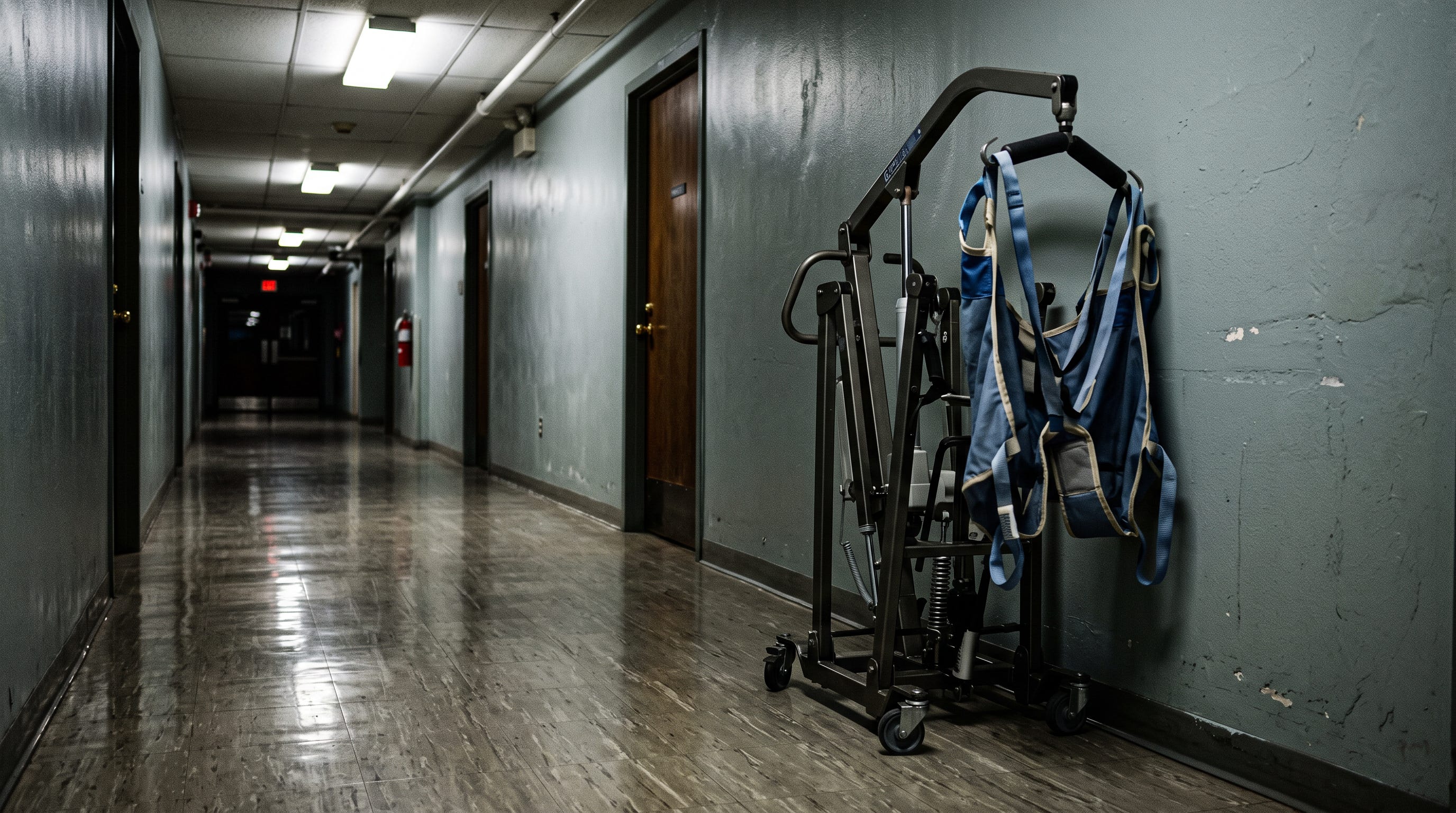
Ask about the lifting equipment, not the robot. A meta-analysis of mechanical patient lifting and transferring devices describes its own evidence as limited and still recommends them on a favorable cost-benefit ratio. Ceiling lifts are unglamorous, unphotogenic, and the thing most likely to keep both bodies in the room intact.
If you buy a companion device, buy it for what it is. When a lab at the University of Houston asked older adults what they wanted from one, the answers were mundane — setting timers, setting reminders, and providing weather updates — and the same researchers found that fear of severe surveillance can stop older adults adopting these things at all. Set it up with the person, not for them.
Find out what your state pays. In 2024, every responding state reported direct care workforce shortages and 48 raised payment rates. Medicaid rate-setting is the biggest lever on what the woman visiting four houses before lunch earns, and it is pulled in your state capital by people who answer email.
Have the conversation before it is an emergency. Someone in your family will absorb this — in wages paid, in hours given, or in a career quietly abandoned. Decide who, and how it gets compensated, while it is still a kitchen-table discussion and not a decision made in a corridor at 11 p.m.
The lesson I take from the speaker on the counter
I am not unplugging it. It is useful, my grandmother likes it, and the next version will be better.
But I have stopped telling myself it is care. It is company — and company was never the bottleneck.
The bottleneck is that roughly ten million openings over the next decade are for work that means putting your hands on another person's body at seven in the morning — and we have arranged things so that the person doing it earns less than other entry-level workers in every state in the union, and just removed the federal rule about how many of them must be in the building.
You cannot venture-fund your way out of that. You can only pay for it — in wages, in immigration policy, in the kind of organizational redesign the Dutch actually scaled, or in the uncompensated labor of somebody's daughter. It was always going to be one of those four.
The robots are not the plan. They are what we bought instead of having one.
Buy the robot if it helps — just don't confuse it with a plan. And forward this to whoever in your family is quietly doing the lifting.