
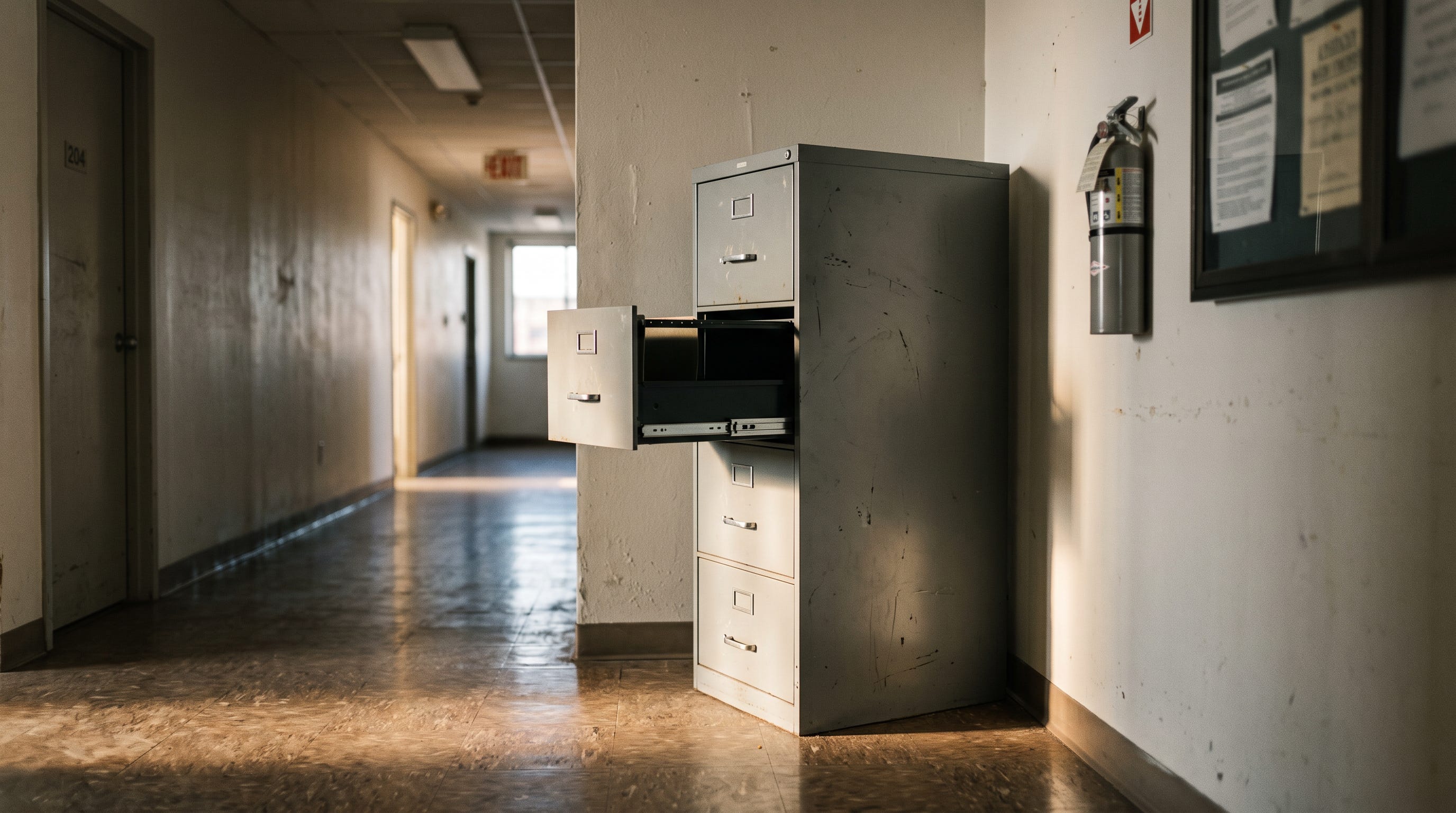
Somewhere around 2014 I started dragging anything I was not sure about into a folder called "hold." It was never a system, just a reflex — receipts, half-finished drafts, screenshots of conversations I thought might matter later. Every few months I open it, decide most of it was never important, and delete in bulk.
I have never written down the rule I am applying, and I am not certain I could. Here is the part I had never questioned until this month: I am the only person who makes that call, I make it while thinking about something else, and nobody will ever ask me to justify it.
That is fine. I am a person. My laptop is not the government.
On August 21, 2026, the National Archives and Records Administration published something that, read twice, sounded uncomfortably like my "hold" folder — scaled up to the entire executive branch.
What the memo actually says (it is narrower than the headlines)
Let me be precise, because this is easy to get wrong in both directions.
NARA issued AC 11.2026, "Guidance on Applying the Federal Records Act to Artificial Intelligence Materials," as a memo to federal agency records officers, signed by William Fischer, the acting Chief Records Officer for the U.S. Government. It fences its own scope: records management under the Federal Records Act only.
The core holding is two sentences. Agencies' "use of AI platforms does not, in and of itself, result in the creation of federal records." And then, immediately: "Subsequent use of AI-generated materials in agency business may result in the creation of federal records."
Read that again, because the headlines flattened it. NARA did not say your government's chatbot conversations are not records. It said opening the tool is not the trigger. What you do with the output is.
So what makes it one? Whether the agency "relies on it in decision-making, uses it to conduct official business, circulates the material to others, or incorporates it into an agency system." A prompt saved and passed to colleagues, or an AI summary that becomes the official minutes — likely records. Queries nobody acts on, private notes kept to refresh your own memory, audit trails used "solely for the employee's personal convenience" — likely not. Information "passively retained by a third-party platform such as ChatGPT or Claude," the memo adds, is not necessarily received by the agency unless somebody captures it.
Honestly? As law that is defensible; it tracks how the Federal Records Act has always worked. Nextgov/FCW reported it accurately: agency AI use does not automatically create federal records. FedScoop zeroed in on the carve-out for AI used for personal convenience. FEDweek called it the first such guidance of its kind — its characterization, not NARA's. And this is guidance, not a rule: the memo series is provided for reference purposes only.
So far, so reasonable. Here is where it gets interesting.
The subsection almost nobody quotes
The statute being interpreted defines records as all recorded information, regardless of form or characteristics — 44 U.S.C. § 3301, technology-neutral long before anyone worried about chatbots. It also says a record is something "preserved or appropriate for preservation." Note the or: a thing can qualify because it deserved keeping, whether or not anybody kept it.
Then comes subsection (b), added by Congress in 2014, which I have not seen quoted in a single news story about this memo:
Determination of Definition. The Archivist's determination whether recorded information, regardless of whether it exists in physical, digital, or electronic form, is a record as defined in subsection (a) shall be binding on all Federal agencies.
There it is: a mechanism to answer this question once, centrally, in a way no agency can argue with.
And what does AC 11.2026 do with it? The guidance itself says: "Each agency has principal responsibility for determining whether an AI material is a federal record, based on its business needs and practices. Agencies may reach out to NARA on a case-by-case basis for specific guidance."
To be scrupulous: "principal" is not "sole." NARA did not renounce subsection (b), did not say it never will, and explicitly invited agencies to call. Nothing here is unlawful. But the shape matters — the power to answer once sat on the shelf, and the first call went to the agency that used the machine.
Why does that matter more than it sounds? Because of the default it routes around. The rule for non-records tells agencies to err toward keeping when they cannot tell: "If a clear determination cannot be made, the materials should be treated as records." And for non-record materials, "NARA's approval is not required to destroy such materials." That is the whole game. Record means a schedule, a retention period, and a request somebody can file. Non-record means the trash, on the agency's own say-so — and the memo puts the first hand on that switch inside the agency whose work product is being classified.
And if an agency gets it wrong? Under 44 U.S.C. § 3106, when records go missing and the agency head does nothing, the Archivist cannot go to court — the Archivist "shall request the Attorney General to initiate such an action, and shall notify the Congress when such a request has been made." Ask someone else, then tell Congress you asked.

Now the strongest case for NARA — and it is a real one
First: appraisal has never been a checkbox. NARA's own doctrine says it is not a rote exercise but "requires informed judgments," and the people who know whether a prompt drove a decision are the people who were in the room.
Second, and harder: discarding is not a modern surrender to volume. The archivist Geoffrey Yeo took up this question in a chapter called Can we keep everything?. "Decisions about destruction have been made since the earliest days of record-making," he writes; "systematic destruction practices, however, have a much longer history" than the twentieth-century bulk problem people blame. Keeping everything is the novel idea. Selecting is the craft.
Third, the arithmetic. The Office of Management and Budget's repository lists 3,611 individually-reported federal AI use cases — and the parenthesis is load-bearing, because that count spans all stages of development, not 3,611 systems humming in production. Meanwhile the institution that would absorb all of it is shrinking: NARA employed 2,744 staff as of June 16, 2025, down roughly 150 since late January, a figure Federal News Network drew from archived versions of the agency's own website. That same month the administration laid off nearly 100 employees there, while former Archivist Colleen Shogan called the coming digital wave the single biggest challenge facing the National Archives in the next decade.
So who, exactly, was going to make thousands of central determinations? At current staffing, the honest answer is nobody — which is both the strongest defense of this memo and, I think, its indictment. The decision not to decide was made by an agency given less every year and handed the largest classification problem in its history.
London never had to write this memo
Here is a comparison that earns its keep, and not the one you would expect. The United Kingdom did not answer this question faster than Washington. It answered it in 1958, structurally.
Start from the same place. Under section 3 of the Public Records Act 1958, the duty to select what gets permanently preserved sits with "every person responsible for public records" — the body that holds them. Identical premise. The holder selects.
Then subsection (2) adds a sentence the Federal Records Act has no equivalent to. Those duties are performed "under the guidance of the Keeper of Public Records and the said Keeper shall be responsible for co-ordinating and supervising all action taken under this section." The Keeper heads The National Archives. Supervision is not a courtesy there; it is the statute. TNA's own pages put its standing role the same way — it "guides, co-ordinates and supervises the process on behalf of the Keeper" — which is, precisely, the difference between the two systems. Nor is it advice you can ignore quietly: TNA collects and publishes data on compliance and reports to the Secretary of State.
The definitional problem? Solved before anyone had a computer. The 1958 Act says records include not only written records but records conveying information by any other means whatsoever. A chatbot transcript walks into that sentence unassisted.
Now the honest part: I went looking for a British equivalent of AC 11.2026 — a National Archives document telling departments whether prompts and AI outputs are public records — and could not find one. Not because the UK is behind. Because the question was already routed. The statute names a supervisor, so "who decides?" has a standing answer and needs no fresh one each time a technology arrives.
What TNA spent its AI attention on points the other way from NARA. Its October 2021 guidance, Using AI for Digital Records Selection in Government, aims machines at the selection problem itself — finding that "while AI cannot replace the expertise of Records Managers," commercial tools can help, and asking how much human checking is needed "before a tool's predictions become records selection decisions." TNA grades departments on their thinking rather than their tooling: in its maturity assessment tool, reporting no use of AI "is a not necessarily a poor score. It is more about 'considered versus unconsidered use of AI'."
And no, this is not a country holding AI at arm's length: it handed civil servants a package of AI tools for transcription, consultation analysis and legal research, and called it Humphrey. Same machines, different answer to who says what counts.
This is not hypothetical — and then run it forward
Consider a case that has already been decided.
Inside Higher Ed reported in March 2026 on how grants at the National Endowment for the Humanities were terminated, working from documents produced in discovery. Those documents, the reporting says, include the literal screening prompt: "Does the following relate at all to DEI? Respond factually in less than 120 characters. Begin with 'Yes.' or 'No.' followed by a brief explanation." More than 1,400 grants — roughly 97% of the agency's grants, over $100 million — were terminated between March 12 and April 1, 2025.
Say this carefully. "In the motion filed Friday," Inside Higher Ed reports, "those associations and the Authors Guild called the terminations 'unconstitutional'" — that was the plaintiffs' word, in March. The material surfaced when discovery was released on March 6, 2026 with a motion for summary judgment in a lawsuit brought by three scholarly associations in the Southern District of New York. Two months later the word stopped being theirs alone: on May 7, 2026, Judge Colleen McMahon granted that motion: "The Mass Termination is DECLARED unlawful, unconstitutional, ultra vires, and without legal effect." The reason, on the undisputed evidence, was that "DOGE officials exercised decisive authority over the selection and termination of NEH grants without any statutory authority to do so." The government has appealed to the Second Circuit. Separately, American Oversight sued over what it calls systemic violations of the Federal Records Act in April 2025 over the use of Signal and Google Docs — that one is still open, and still allegations.
But notice what made the first one provable: somebody kept the prompt. It existed in a form discovery could reach, and it ended up in the undisputed record the judgment rests on.
So run the tape forward, to about 2031.
The agent does not wait to be asked. It watches a queue, pulls an applicant's file, checks three databases, drafts a denial, routes it to a human who approves forty that morning, and sends. The letter goes out over a civil servant's name, and it is unquestionably a record.
And the reasoning? The standing instructions, the retrieved sources, the intermediate drafts, the moment a threshold was crossed — that sits in the vendor's platform as an audit trail. Mere retention inside the AI system, the memo notes, does not establish a record; the agency would have to capture it. Nobody does, and no schedule requires it, because nobody ever determined it was a record.
Five years later, a journalist asks why 4,000 people were denied. She receives 4,000 letters. Every one genuine, complete, preserved exactly as the law requires. Not one of them contains the decision.
That is not a failure of storage. Storage is the cheapest thing in the building.
What the people who do this for a living are saying
The sharpest published critique came not from an advocacy group but from an archivist. Andrew Potter put it in a sentence I cannot shake: NARA is applying a user-dependent test "to a new class of information being produced at precisely the scale that led it to abandon user-dependent email management." NARA learned this lesson once, with email, and the guidance proceeds without revisiting the appraisal policy that lesson produced. "The recordkeeping decision has not disappeared," he writes. "It has moved upstream." In a follow-up on what happens when AI acts for government, he names the exact gap in my 2031 scenario: "A response without its prompt may be unintelligible. A prompt without the surrounding instructions, sources, and actions may be misleading."
Industry analysts landed in the same place. One records-management firm's read was that NARA relocated a burden rather than removing one: "The old anxiety was volume: how do we possibly keep all of this? The new burden is judgment: which of this counted, decided by whom, at the moment it happened." And then: "Volume problems get solved with storage. Judgment problems get solved with people, and people are the part that doesn't scale."
The transparency question underneath is unsettled, and the lawyers say so. There is not yet a reported federal appellate decision squarely addressing whether chatbot conversation histories are reachable under the Freedom of Information Act; the test asks whether an agency created or obtained the material and controls it when the request arrives. Which means an agency's own "non-record" call can settle a legal question by deleting first.
The worry is not partisan. The National Security Archive at George Washington University says flatly that executive-branch agencies "have persistently attempted to thwart" effective implementation of FOIA. From the free-market side, the Americans for Prosperity Foundation argues that rising volume and complexity have placed "significant strain on agencies." Different premises, same diagnosis: the system is under load, and under load is when defaults decide outcomes.
Agencies are deploying AI on the other side of the counter too, testing it to help fulfill public records requests, with the ACLU's Brett Max Kaufman warning there that agencies "regularly over-redact and over-withhold information under FOIA." Abroad, the Archives and Records Association's February 2026 guidelines call automation a constrained necessity, not a magic solution.
Nobody serious is arguing for keeping everything. They are arguing about who holds the pen, and whether anyone can watch them use it.
What does this mean for you?
If you work for a federal agency, the test is your next move, not your tool. Save the prompt into an agency system, circulate the output, or rely on it in a decision, and you have probably made a record. Reach for "personal convenience" only when it is true — and when you cannot tell, the regulation already says which way to lean.
If you file public records requests, stop asking for "documents." Ask by name for prompts, inputs, outputs, system instructions and audit trails, and ask where each was captured. Control at the moment of the request is the operative test.
If you supervise people who use AI at work — public sector or private — write the rule down before you need it. Which conversations get captured, by whom, into what system. The failure mode is not malice; it is fifty small reflexive calls a day that nobody ever recorded.
If you vote on budgets, notice what the coverage keeps reporting separately: an agency asked to classify the largest volume of new material in its history, after shedding roughly 150 people in the first half of 2025, will make the choice that fits its capacity.
The lesson, as I see it
I keep coming back to the "hold" folder, and to why it is genuinely fine that I never wrote the rule down: nothing depends on it. Nobody will ever need to reconstruct why I deleted a screenshot in 2019.
Government is the opposite case. The entire point of a public record is that the reconstruction happens later, by someone who was not there, who does not trust you, and has every right not to. That is not an insult to civil servants. That is the design.
AC 11.2026 is not a scandal. It is a cautious reading of an old statute by an agency that shed roughly 150 people in the first half of 2025, and its author would tell you it changes nothing. That is almost the problem. The moment a new class of evidence arrives — with the reasoning behind consequential decisions living inside conversations — is exactly when "nothing changes" becomes a decision in its own right. Congress saw enough of this coming in 2014 to write that the Archivist's determination binds every agency. That sentence is sitting there, and using it would spare hundreds of agencies from each inventing the answer alone.
My vote? Ask for the determination. Not because agencies cannot be trusted with judgment, but because judgment exercised in private, at speed, by the party with the most to lose from the answer, is how an archive quietly becomes a pile of letters with no decisions in it. The volume problem was always going to get solved. The judgment problem is the one we still get to choose.
The HAIA Foundation reads the sentences inside the documents, because a public that cannot reconstruct a decision is a public that cannot argue back. New pieces go up over here, and they cost nothing but your attention.