
Chances are this headline reached you before the study did. That is how it is built to travel: a story about children's brains and chatbots crosses your phone, you feel the cold drop in the stomach (if you have kids, you know the one), and you forward it to two people who have children too. Some hours later — if ever — somebody opens the paper.
Which means you did — in miniature — precisely the thing the story was warning about. You took a finished answer and skipped the effortful part. No chatbot required; a headline did it for free.
So let me do the effortful part now, out loud, because the gap between the document and the coverage is wide enough to teach something.
What the study measured, twice
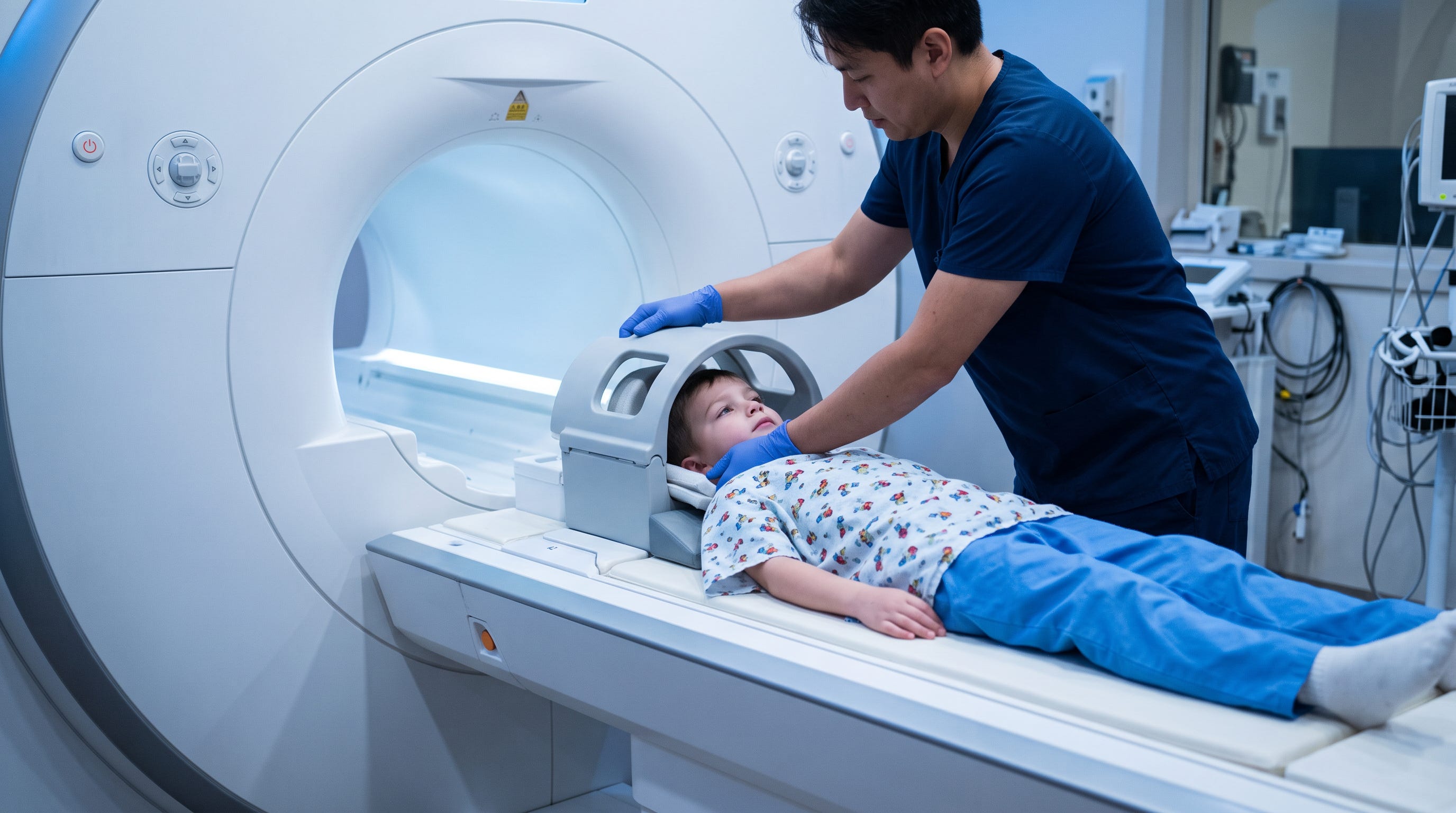
The study everyone is citing comes out of the Technion – Israel Institute of Technology. Researchers put fifteen six- and seven-year-olds and sixteen adults through one five-minute conversation each — a co-creative dialogue with ChatGPT, same prompt for everybody, inside a functional MRI scanner tracking blood flow across seven large-scale brain networks. Everyone was asked to design a store.
The finding that traveled: the children's control and attention networks — frontoparietal, salience, dorsal attention — were less connected than the adults' while both groups talked to the chatbot. The newspaper version rendered this as less synchronized blood flow in regions "associated with attention and information processing" than in the adults'. That part is fair.
What didn't travel? The paper measured creativity twice, and the two measurements do not agree.
The first happened before anyone went near the magnet: both groups sat the Divergent Association Task, where you produce ten words as unrelated to one another as you can manage and your score is how far apart they land in meaning. Children averaged 28.61, adults 26.16, t = 0.33 — noise. On raw divergent thinking, the six-year-olds were not measurably behind the grown-ups. That is the sentence in the abstract. It is also the only creativity sentence in the abstract.
The second happened inside the conversation. Each participant's five minutes of talk was transcribed and scored for Divergent Semantic Integration — how far apart the words in your own transcript sit in meaning, which the authors treat as "the general diversity, or richness, of the conversation with ChatGPT." Here the groups came apart, and the results section does not hedge: "However, creative interaction with ChatGPT (DSI) were significantly higher in adults compared to children." The discussion returns to "the lower DSI scores from their generated ChatGPT script." The paper's own title leads with it: lower engagement of control and attention networks, and lower creativity, in children using ChatGPT.
So the study did find a creativity difference, and I had it backwards until I read past the abstract. Now look at its size. Children scored .81. Adults scored .82 (standard deviations of .01 and .005). That one-hundredth of a point clears p < .001 precisely because the scores cluster so tightly: a large effect in statistical terms, and in every other sense of the word almost nothing. Not a gap you could see in a child's imaginary store. Not a gap a teacher could notice. A gap a cosine-similarity model can resolve and a human being cannot.
Which leaves the paper arguing with itself. The abstract reports "similar creativity scores" and builds its conclusion on them — that similar scores alongside divergent neural profiles suggest developmental differences in the implementation of creative cognition may be "more pronounced than baseline capacity." The title says lower creativity. Both are defensible; they describe different measures. Only one reached the coverage.
How far does that half travel? A peer-reviewed commentary in Frontiers in Developmental Psychology sums the Technion result up in one clean sentence: a clear difference in the brain came with no difference in what the children actually made. True of the outside-the-scanner measure, and only that; the commentary never mentions the in-conversation score, because the abstract it worked from does not. Peer review caught nothing because there was nothing to catch — the narrowing happened upstream. The commentary's real argument survives intact: reduced engagement cannot be read straight off as reduced ability.
Three more things about that document, because they matter and are easy to lose.
It is a preprint, and as of September 30, 2026 it has not been peer reviewed. I checked five ways, because this is exactly the kind of fact that rots: the bioRxiv page carries no "now published in" banner, the index that tracks preprints into journals still returns nothing for it, and Crossref and Europe PMC both still class it as a preprint. Version one went up on November 10, 2025, version two two days later. The Los Angeles Times said as much in the piece that set this running — the study is "still undergoing the process of peer review." That line was in the coverage. It just was not in the headline.
There was no control group without a chatbot. Every participant used ChatGPT. The comparison is children against adults, not AI against no-AI. So "using ChatGPT reduced their brain engagement" — roughly what you may have taken away — is not a thing this study is built to say.
Fifteen is fifteen. Not a gotcha; the field's standing condition. Work in Communications Biology opens by noting that task-based fMRI studies often suffer "from a lack of statistical power due to too-small samples", and that underpowered studies keep proliferating anyway. The Frontiers commentary volunteers the same caution about this very paper.
And one more thing, which I find disarming. Tzipi Horowitz-Kraus, who heads the Educational NeuroImaging Group at the Technion and led the study, is quoted in that same newspaper story saying six years old is "probably too early to use generative AI tools" — then immediately: when is a good time? We don't know. More research is needed. The researcher is more careful than the coverage. She usually is.
The word "stunting" is not in the paper
So where does the phrase come from? "Cognitive stunting" is not a finding from a brain scan. It is a framing, and it has an author and a date.
Rebecca Winthrop, who directs the Center for Universal Education at the Brookings Institution, wrote on May 19, 2026 that she had come to describe the risk AI poses to children not as cognitive offloading or cognitive decline, or even cognitive debt or atrophy, but as cognitive stunting. Her concern is specific and serious: overreliance on AI reduces children's opportunities to engage in effortful thinking. When young people systematically use AI to complete schoolwork or other thinking tasks (her word, and it matters), they are not offloading skills they already possess; they are shortcutting the process of developing those skills in the first place.
Look at what her piece is, though. It is titled as a question, it proposes building a way to measure something we cannot currently measure, and it says in the same breath that narrow, targeted AI use can circumvent these issues and even support thinking and learning.
So here is the sequence. A think-tank director proposes a word for a risk she wants instrumented. A small, unreviewed preprint finds a developmental difference in attention networks, plus a hundredth of a point between two sets of chatbot conversations. A newspaper, reporting both honestly, sets them side by side. What arrives on your phone is: AI is stunting children's brains. No single step is a lie. The composite is a verdict nobody issued.
So the alarm is manufactured? No — and here I have to be careful
It would be satisfying to stop with a tidy "the media got it wrong" and take a bow. I won't, because the underlying worry is not silly and the people carrying it are not fools.
Start with exposure. Anne Maheux, an assistant professor of psychology at the University of North Carolina at Chapel Hill, reports pilot data indicating that 20% of 10-12 year olds and 42% of 13-14 year olds are using generative AI, and thinks the real figures are higher. On the school bans her position is explicit: the right decision with the current evidence we have, given tools still being built by designers answering to profit incentives that may not align with children's development.
Then there is the adult evidence, and here I have to hold myself to my own standard. The MIT Media Lab study that dominated the brain-and-AI conversation in 2025 ran fifty-four participants across three sessions, with eighteen returning for a fourth (and it, too, is a preprint). It reported up to 55% reduced neural connectivity in the AI-assisted writers — a real result deserving attention. But every participant was between 18 and 39, people whose executive functions, as the Frontiers authors put it, "were already largely built." Which is the sharpest thing in this debate: the study with the big percentage used grown-up brains, and the study with the child brains produced a gap of one hundredth of a point.
And there is the interpretive trap under all of it. In studies of expertise, lower neural activity need not mean worse cognition — it often marks more efficient processing. A quieter brain can be a struggling brain, or one that stopped struggling because it got good at something. A scan alone does not tell you which. So: the developmental hypothesis is plausible, important and testable. The Frontiers authors are careful to call it a hypothesis. It is not yet a measurement.
Sweden already ran a version of this experiment — on itself
Cross the Atlantic and you find a country that did not wait for a brain scan, and whose experience is the best available preview of where American districts are heading.
Sweden had pushed digital tools deep into its schools, down to tablets in nursery classrooms. In April 2023, when the government put a proposed national digitalization strategy out for consultation, the Karolinska Institutet (a medical university) filed a response signed by five professors of developmental psychology, cognitive neuroscience, psychology and neonatology. It urged a return to knowledge acquired through printed textbooks and the teacher's subject expertise, and stated in a section heading that small children should not use digital tools at all.
Now follow one sentence in that document. The Swedish text says there is clear scientific support that digital tools riskerar att försämra — risk impairing — rather than improving students' learning. The wire-service English that circled the globe was flatter: "There's clear scientific evidence that digital tools impair rather than enhance student learning," the Karolinska Institute said. Translation is hard and the sense is close — but a risk became an effect somewhere between Solna and the front page, which is the same move that turned .81 against .82 into a verdict.

The policy followed the flattened version. Sweden's schools minister at the time, Lotta Edholm, said her country's students needed more textbooks and that physical books matter for learning; the government moved to reverse the education agency's decision making digital devices mandatory in preschools. Money followed: 685 million kronor for book purchases in 2023, plus 500 million kronor annually in 2024 and 2025. The trigger was a reading slump — fourth graders averaging 544 points, down from 555 in 2016 on the international reading assessment.
Three years on, three things are true at once.
The reversal held, and it grew. Mobile phones have been banned in Sweden's compulsory schools since August 1, 2026, as part of "a broad, international reversal on the use of screens in classrooms." The textbook money is still flowing: the Swedish schools agency lists 555 million kronor to distribute for the 2026 grant year. A new curriculum built around books is due in 2028.
What was enacted is narrower than what was announced. What the ministry told the Associated Press in 2023 was that it planned to completely end digital learning for children under age 6. What exists in rule says children under two use only nondigital materials, and that preschoolers in general face no requirement to use digital learning tools — a statement about the children, not about the institutions. A mandate was removed; a ban was not imposed. Even the minister most identified with the turn had moved on — in the government that went into caretaker mode on September 17, 2026, Edholm held the upper-secondary, higher-education and research portfolio rather than compulsory schools.
And it is genuinely contested. Neil Selwyn, a professor of education at Monash University, allows that the Swedish government has a valid point about the absence of evidence that technology improves learning — but only because, in his words, there is no straightforward evidence of what works with technology. An absence of evidence is not evidence of harm; it is an absence. The Swedish edtech trade body counters that 90% of all future jobs are expected to require digital skills. The then-chair of parliament's education committee answered bluntly that they were rolling the screens back because they believed books and more traditional ways of learning were better for kids. And underneath it all, the harder number: in PISA 2025, the OECD's international student assessment, 31% of Swedish 15-year-olds did not reach a basic level of reading comprehension, up from 24% in 2022, and Sweden's reading score fell to 466, its lowest ever in PISA (results also fell in most OECD countries).
Sweden did not act because the science was settled. It acted because its reading scores fell and it decided the burden of proof belonged to the screens — a defensible political judgment, not a finding, and any honest account says so.
Now imagine the next five years of this
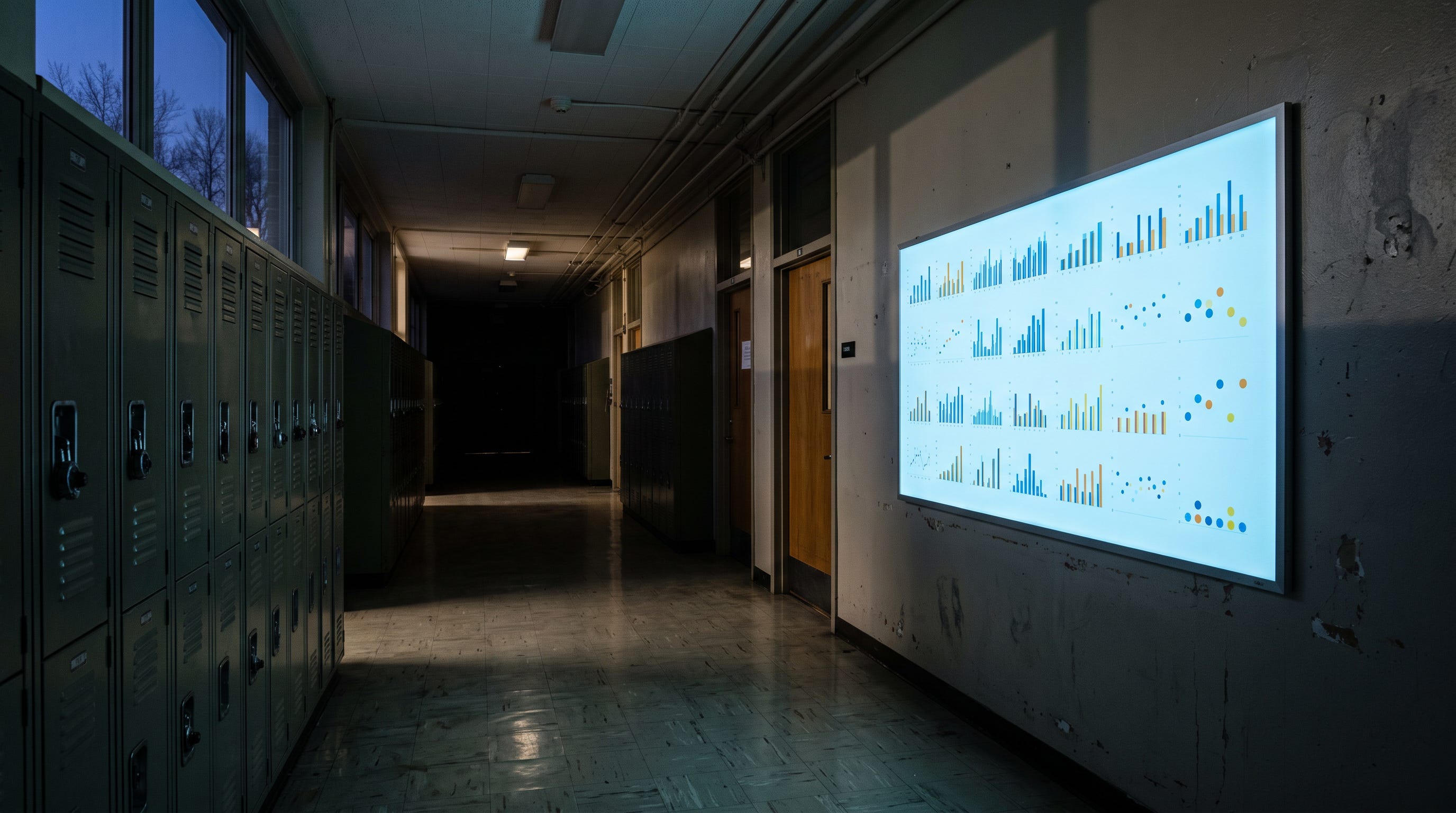
The instrument is coming. The Brookings proposal is to develop metrics for children's cognitive development in relation to AI use — and once a measurement exists, it gets used. Picture 2031: a district adopts "cognitive development screening" the way it adopted reading benchmarks, every third grader sits a twenty-minute battery twice a year, and the scores are age-normed, reported to parents, posted to a dashboard.
Now picture the second-order effects, which always arrive faster than anyone plans for. An edtech vendor advertises that its tutor is "stunting-safe," certified against a framework four years old. A charter network markets a rival's below-average cohort score as proof the rival lets kids use chatbots. A custody hearing enters a screening result into evidence. An insurer asks. And somewhere in year three, a study finds the screening mostly measures household income — which is what nearly every other proxy for childhood cognition has mostly measured — by which point two thousand districts have written it into policy.
I am not against measuring. I am against the failure mode where a plausible hypothesis acquires a number, the number acquires authority it never earned, and the authority outlives the caveats. Remember that the number at the bottom of this one is a hundredth of a point. The caveats always travel slower than the metric.
What the people who study this for a living say
The striking thing, once you read past the headlines, is how little daylight there is between camps that are supposed to disagree.
From the center-left, Brookings wants the thing measured before it is asserted. From the right — or at least from the venue where this argument got its hearing on the right — the American Enterprise Institute carries a Q&A in which Frederick M. Hess puts the question to Michael Horn, a lecturer at the Harvard Graduate School of Education and co-founder of the Christensen Institute, in a piece that ran first in Education Week. Horn's answer: "We should be very wary about promoting blanket bans." His grounds: "The learning model will always matter more than the technologies being used." A school with a coherent design gets different results from the same tools than one without, which makes the tool a poor place to put the rule. Others make the opposite case plainly, arguing that schools should do to generative AI what they did to cellphones. UNESCO's global education monitoring work has spent years on the same knife edge, examining the problems appropriate technology can solve while recognizing that many solutions proposed may also be detrimental.
Meanwhile the districts are not waiting. New York City imposed a one-year moratorium on student-facing AI tools from 2-K through 8th grade for 2026-27, reaching 600,000 students — two-thirds of its public school enrollment. Los Angeles Unified restricted all students from AI tools on district devices while the nation's second-largest school system reviews its policies. You can think those are the right calls (Maheux does) while still noticing they were made on a record everyone involved describes as thin.
What does this mean for you?
You are not going to read every preprint. No one does. So here is the shorter discipline:
Ask three questions of any brain-and-technology headline. How many people were in it? Was it peer reviewed? And how large is the effect in units you can picture? Here: fifteen children, no, and one hundredth of a point on an index you have never heard of. "Significant" answers the third question in statistics and nowhere else.
Learn to spot the borrowed word. When a vivid term appears in quotation marks, find out whose it is. "Cognitive stunting" is a proposed framing from a Brookings scholar, not a result reported by the researchers who ran the scanner. Those quotation marks are doing real work and they are easy to read past.
Watch for the word that disappears. "Risks impairing" is not "impairs." "May suggest" is not "shows." The Swedish example is the cleanest case I have found of a qualifier dissolving in transit, and that dissolution is what makes most alarming science coverage alarming.
Judge the school policy on its own terms. Whether your district should pause chatbots for eight-year-olds is a question about risk tolerance, teacher capacity, and what class time is for. Fifteen scans do not settle it, and nobody should sell it to you as if they did.
At home, protect the struggle, not the device. The mechanism everyone worries about is the missing effortful moment — the child who receives a finished answer instead of a hard one. Ask what the chatbot suggested and what your kid changed. That question costs nothing and goes straight at the thing. Then keep your own hands dirty: adults outsource first and most, and children who will sit with a hard problem need to watch someone do it.
The lesson, as I see it
The fair summary is neither comforting nor alarming. We have a serious developmental hypothesis, a handful of small studies pointing in interesting directions, two of America's largest school districts acting well ahead of the evidence, and a national conversation running on a phrase that no scanner produced.
That is not a scandal. It is what an early field looks like. What worries me is not that the science is thin — thin is normal at the start — but how fast thin science hardens into policy vocabulary, and how rarely the hardening gets undone. Sweden bought the books back because reading scores fell, and that may prove wise. But it made the call on a judgment about who carries the burden of proof, not on a measurement, and it has been candid about that. We are heading for the same decision with considerably less candor.
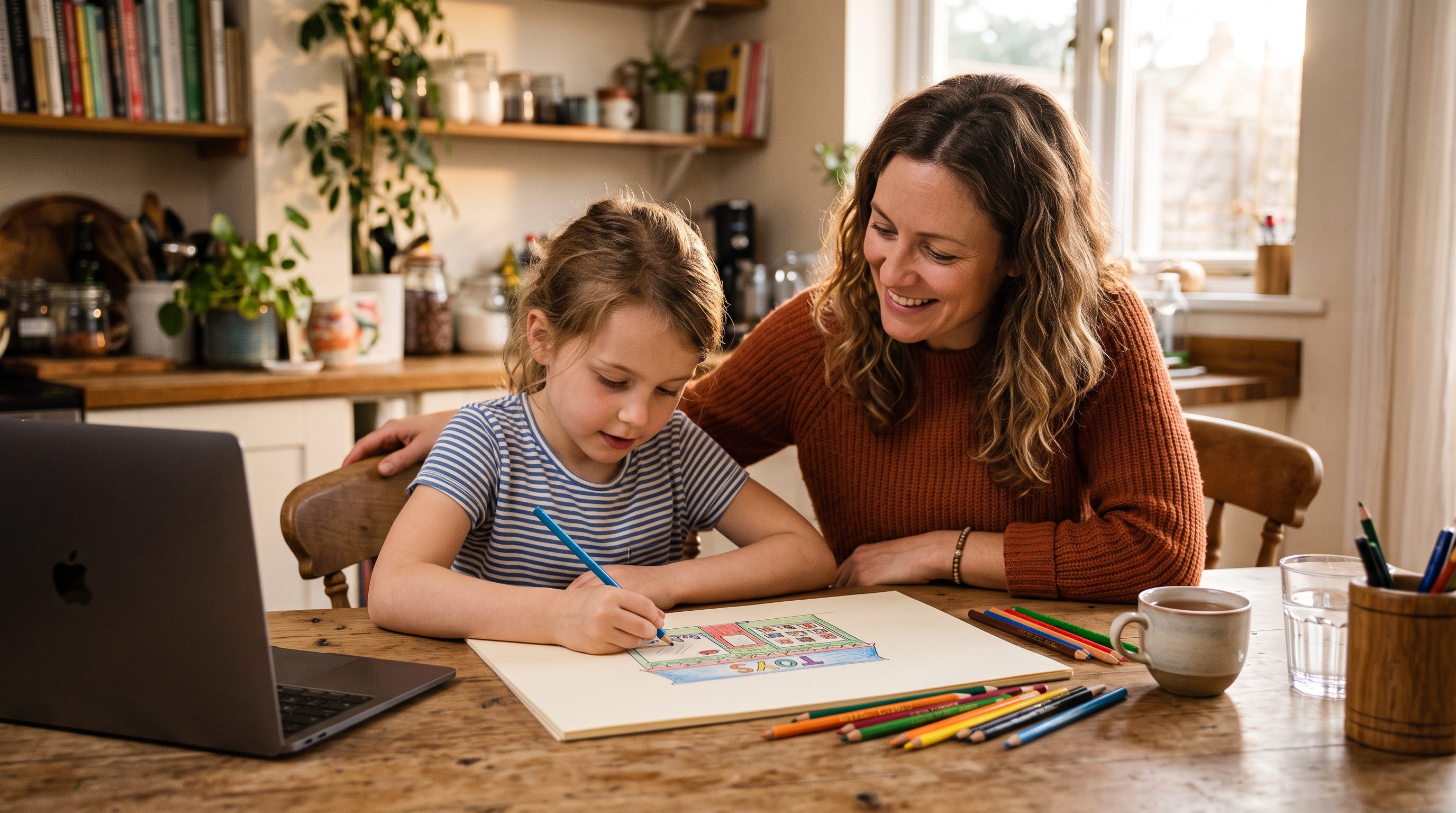
Fifteen children designed fifteen imaginary stores. Their brains lit up differently than the grown-ups' did. Their conversations scored .81 where the adults' scored .82.
Hold all three of those facts at once — in that order, and at that size — and you are already doing the effortful thing everyone is worried children will stop doing. My vote? Start there.
The HAIA Foundation works to keep human judgment in the loop while the machines get louder — and that includes the judgment you bring to a headline about machines. If this was useful, subscribe and read the next one before you forward it.