
The catch is in the fine print, and it’s a big one. Here’s what the bargain actually says, who’s fighting it, and why the price tag should worry you no matter which party you vote for.
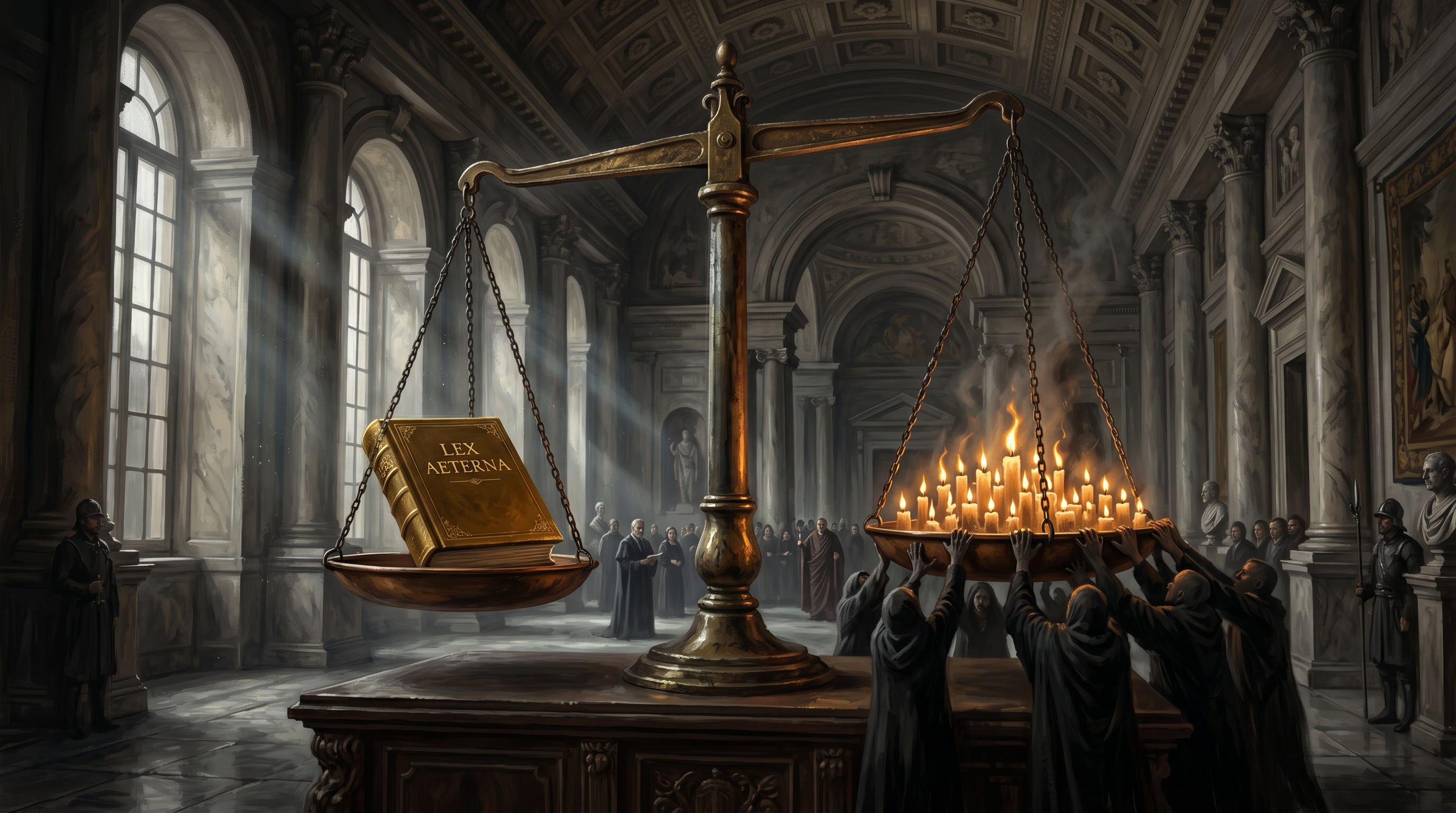
I’ll admit something that may cost me a little credibility with friends who police the boundaries of federalism for sport. There are days I would trade a great deal for one clear rule.
I’ve spent enough of my working life inside overlapping, contradictory regimes — a privacy rule that means one thing in Sacramento and the opposite in Austin, a disclosure obligation that’s mandatory in one state and forbidden in the next — to know how maddening a patchwork can be. You don’t end up with fifty laboratories of democracy. You end up with fifty compliance binders, a small army of lawyers, and a quiet advantage handed to whichever giant company can afford to read all of them. So when I first heard that Congress was finally drafting a single national framework for the most powerful AI systems on Earth, some tired, practical part of me exhaled. Finally. Adults in the room. One rulebook.
Then I read the rest of the sentence.
Because the rulebook comes with a condition, and the condition is the whole game. In exchange for America’s first real federal safety rules for frontier AI, the states would have to agree — for three years — to stop writing their own rules about how these systems get built. One floor goes up; fifty floors, in part, come down. And the closer I looked, the harder it became to tell whether I was watching adult supervision finally arrive, or a moratorium with a ribbon tied around it. Let me walk you through what I found, because I changed my mind twice on the way, and you might too.
First, the part that isn’t really in dispute
Let’s get the facts on the table before we argue about what they mean. I’ll show my work, and I’ll flag where the ground is still moving — because it is moving, fast.
On June 4, 2026, two members of Congress who don’t agree on much — Rep. Jay Obernolte, a Republican from California, and Rep. Lori Trahan, a Democrat from Massachusetts — released a discussion draft of something called the Great American AI Act. Four more members, evenly split between the parties, co-released it. The pitch is right there in the title of the press release: this is bipartisan legislation to create a federal framework for how the United States governs artificial intelligence.
Now, the single most important thing I can tell you about this bill is also the thing most easily lost in the noise: it is not law. It hasn’t even been formally introduced. A “discussion draft” is exactly what it sounds like — a 269-page trial balloon, floated to gather feedback before anyone files it as an actual bill. The revenue thresholds, the penalties, the audit schedule, the sunset date — all of it can change before a single committee votes. So everywhere I describe what this bill “does,” read it as “what this draft proposes to do.” Nobody is barred from anything yet. The fight is over whether they should be.
So what does the draft propose? Strip away the page count and it’s a trade with two halves.
The first half is the part that genuinely impressed me. The bill is organized into four titles — Frontier AI Governance, Workforce, Cybersecurity, and Research, Development, and International Cooperation — and at its heart it would create, for the first time at the federal level, binding development obligations for the largest AI companies. Not a voluntary pledge. Not a blog post promising to be careful. An actual legal duty.
Here’s the texture of it. According to the Future of Privacy Forum’s clause-level read of the draft, the heaviest-hitting companies — what the bill calls “large frontier developers” — would have to write and publicly post a frontier-AI safety framework and a pre-deployment transparency report explaining how they tested a model before unleashing it. And then comes the part regulators almost never demand of software: within one year, and every six months after that, those companies would have to retain a licensed independent verification organization — an outside auditor — to verify compliance and assess whether the company’s risk mitigations are actually adequate for catastrophic risk. Semi-annual third-party audits of whether the most powerful models on the planet are safe enough not to cause a catastrophe. That is, on paper, a real safety regime — the kind of thing those of us who worry about this technology have wanted for years.
(One precision note, because the numbers get muddled in the coverage: the draft reportedly sets a lower bar — a “frontier developer” — at companies above roughly $50 million in revenue, who carry lighter disclosure duties, while the heavier audit-and-framework obligations attach only to the much larger “large frontier developer” tier. Don’t flatten the two. And treat every dollar figure as a draft number that can move.)
So far, so good. A federal floor, with teeth, applied to exactly the handful of companies powerful enough to matter. If that were the entire bill, I’d be writing a very different essay.
But it isn’t the entire bill. Here’s the second half of the trade — the price.
In exchange for that federal floor, the draft would preempt state laws “specifically regulating the development” of an AI model, with a three-year sunset. For three years, no state could write, keep, or enforce its own rules about how a frontier model is built. As one plain-English summary of the draft put it, states would keep the power to regulate how AI is used inside their borders, but states would lose the ability to legislate on how those systems are built.
I want to be scrupulously precise here, because this is where breathless coverage tends to overshoot. This is not a blanket gag order on every state AI law. The preemption is development-only. Roll Call’s reading is explicit: the freeze would not apply to laws about the use or deployment of AI models. If your state wants to ban AI-generated election deepfakes, or regulate how a hospital deploys a diagnostic model, or police algorithmic discrimination in hiring — as drafted, it still can. What it could not do is reach back up the pipeline and set rules about how the underlying model was trained, tested, and constructed in the first place. The federal government takes that floor and claims it as a federal ceiling, too.
That’s the bargain in one breath: a national safety floor for the biggest developers, bought with a three-year freeze on the states’ power to govern how those developers build. Adult supervision, or a moratorium with a bow on it? Hold that question — we owe the other side a real hearing first.
Now, the strongest case for the trade
Let me make the argument for this bill as forcefully as the people who believe in it would — because they are not fools, and a few of them have a point I had to sit with for a while.

Start with the people who drafted it. Trahan and Obernolte don’t frame this as silencing anyone — they frame it as finally holding the powerful accountable. In the rollout, Trahan said the bill establishes real accountability for the most powerful frontier systems while positioning the United States to set the global standard. Obernolte cast it as a clear federal framework that promotes innovation and protects Americans from emerging risks without smothering American innovation. Read charitably, their case is: the states were never going to deliver real frontier-safety auditing — most of them lack the technical capacity to even attempt it — so a strong federal regime that does deliver it is a net upgrade, even if the price is a temporary pause on the states trying.
Then there’s the argument from the market, and here is where I had to be honest with myself, because I started this essay agreeing with part of it. A coalition organized around the free-market R Street Institute argues that federal preemption is “a sensible and well-established legal tool” — something Congress has used for decades to give the country a single, predictable standard instead of fifty conflicting ones. Their warning is concrete: a patchwork raises compliance costs that get passed to consumers, and — crucially — it disproportionately crushes smaller companies and new market entrants, who can’t afford fifty sets of lawyers the way an incumbent giant can. Push that to its logical end and you get an uncomfortable conclusion for regulation fans like me: a patchwork doesn’t just annoy Big Tech. It entrenches Big Tech, because only Big Tech can pay to comply with all of it.
This is the part of the case I can’t wave away, because it’s the same complaint I opened with. I have lived the patchwork. I do believe a single clear rule can be more honest and more enforceable than a dozen muddy ones. Hand me the question in the abstract — “should one national standard replace a contradictory state-by-state mess?” — and my answer would not be a reflexive no.
So why didn’t the case close there? Because the abstract question isn’t the one on the table. The question on the table is whether this specific trade — this floor, for that freeze, on these terms — is a good deal. And the more carefully you look at the two halves, the less they look like equals.
Here’s the tell that turned me around. A freeze is certain, statutory, and nationwide on day one. The safety floor is slower, narrower, and — like every regulatory regime — only as strong as its enforcement turns out to be. You give up the states’ authority immediately and completely; you receive a federal protection that has to be stood up, staffed, and actually used. And after three years, the freeze sunsets — but by then the technology and the lobbying will have moved so far that “we’ll revisit it in three years” is doing an enormous amount of quiet work. Trades where one side pays now and the other side pays maybe, later, if everyone keeps their word are not trades I sign without reading the fine print twice.
To be clear, that’s an argument, not a verdict — and it’s the argument the bill’s defenders dispute. But it’s why “one clear rulebook,” a phrase I genuinely love, isn’t enough to win me over by itself. It matters what’s in the rulebook and what you had to burn to get it.
Meanwhile, Europe already bought the single rulebook — and we should study the receipt
Here is where it helps to leave the American argument entirely and look at the one place that actually ran this experiment. Because the United States is debating whether to trade fifty rulebooks for one. Europe already made that trade. It’s worth seeing what the single rulebook bought them — and what it cost.
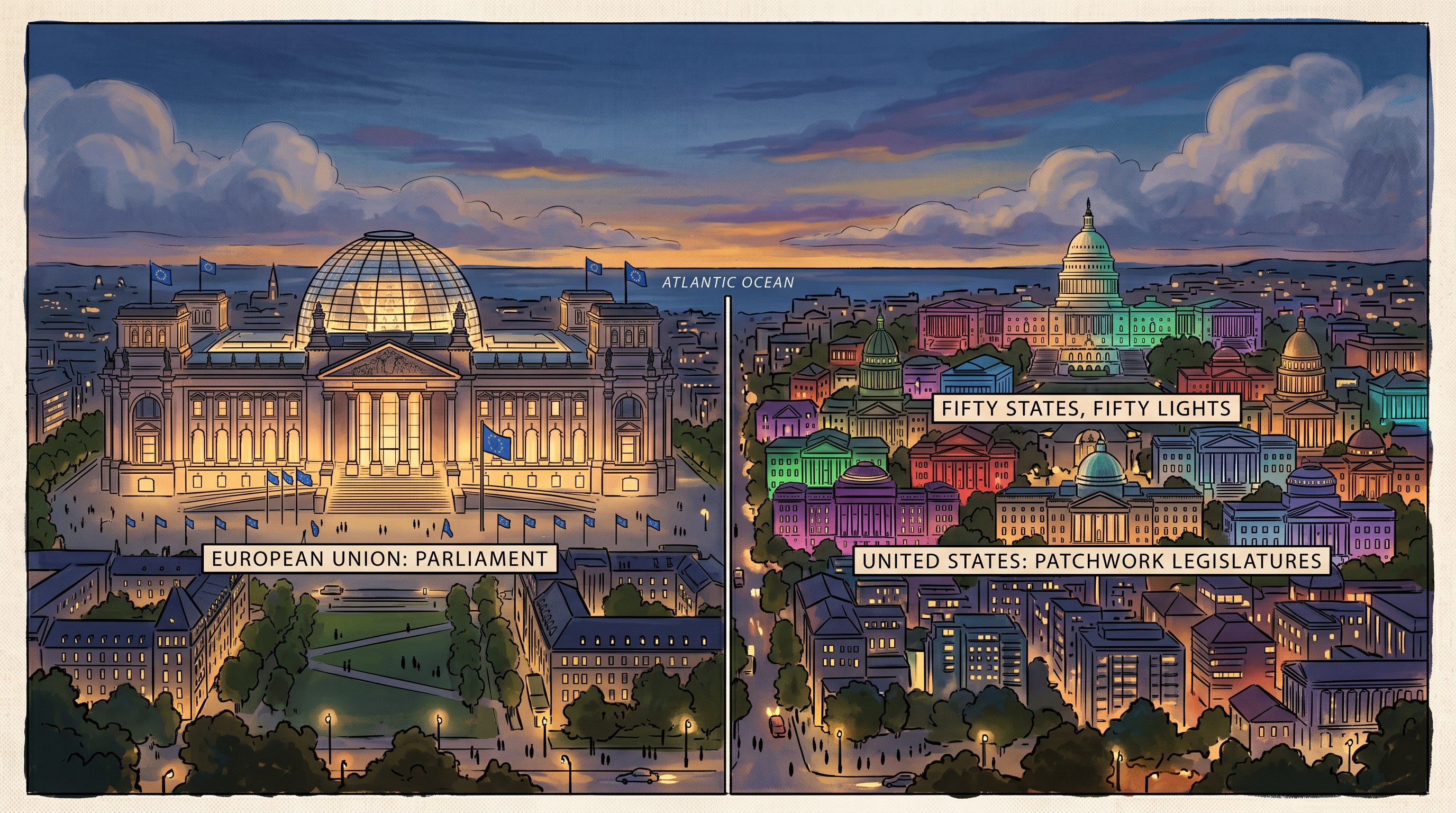
The European Union’s AI Act is the thing American debaters keep gesturing at and rarely examining closely. It is, structurally, exactly what the Great American AI Act dreams of being: one law, binding across an entire continent of member states, sorting AI systems into risk tiers and imposing the heaviest obligations on the riskiest uses. No French rulebook fighting a German one. One floor, one ceiling, one regime. If a single predictable standard is the prize, Europe has the trophy.
And here’s the honest part, the part the bill’s supporters are right about: it did buy real things. A company building an AI product for the European market reads one statute, not twenty-seven. The compliance department has one map. The small startup, in theory, faces one clear set of hoops instead of a maze that only a multinational can navigate. The dignity of a single answer to “what are the rules?” is not nothing — anyone who has stood in two regulatory regimes at once knows the relief of it. That relief is genuine, and I won’t pretend otherwise just because it’s inconvenient for my skepticism.
But now read the rest of the receipt, because there are two lines on it that should give an American pause.
The first: a single rulebook is a single point of failure. When the rule is good, everyone is protected at once. When the rule is captured — written too soft, riddled with carve-outs, watered down by whoever lobbied hardest while it was drafted — everyone is under-protected at once, with no jurisdiction next door doing it better to shame the first into improving. Europe’s single market in AI rules is also a single market in AI loopholes. The patchwork I complained about up top has one redeeming feature I undersold: when California overreaches, Texas can show a better way, and vice versa. Fifty experiments produce fifty results. One experiment produces one — and you’re stuck with it.
The second line on the receipt maps most exactly onto our fight. Europe built its single rulebook by agreeing on the floor before it harmonized everyone up to it. The Great American AI Act would do something subtly but importantly different: it would impose the ceiling first — the three-year development freeze lands the day it’s enacted — while the floor is still being built and tested. Europe harmonized upward. This draft would harmonize the states downward on development for three years, and only then hope the federal floor proves strong enough to justify it. Same destination, opposite order of operations — and in a trade, the order of operations is everything. You want the protection in hand before you surrender the alternative, not after.
So the European mirror cuts both ways, which is why I trust it. It vindicates the dream — one rulebook really can be cleaner, fairer to small players, more honest than a patchwork. And it indicts the method — a single rulebook is only as good as the single rule, and you’d better be very sure that rule is strong, and already standing, before you make it the only one allowed.
Now run the tape forward three years
Let me do the thing I always do, which is to stop arguing about the present and imagine, as plausibly as I can, where this actually goes. Not the paranoid version. The boring, bureaucratic, entirely-on-brand-for-Washington version.

It’s the summer of 2029. The Great American AI Act, or some negotiated descendant of it, passed two years ago. The three-year development freeze is alive and well. Here’s what the intervening time did.
In year one, the federal safety regime worked roughly as advertised. The big labs posted their frontier frameworks, hired the independent auditors, filed the transparency reports. It was real, and reassuring, and it generated exactly the headlines the sponsors hoped for. Adults in the room.
In year two, the technology jumped — the way it always jumps — into territory nobody drafting a 2026 bill had imagined. A new class of autonomous agentic systems started doing things the 2026 definitions didn’t cleanly cover. Somewhere in the country, a state legislator who’d spotted the gap drafted a sharp, narrow law to address it — exactly the kind of fast, local, front-lines response states are supposed to be good at. And the law died in committee, because the state’s own counsel warned it might “specifically regulate the development” of a model and run straight into federal preemption. The freeze did its job. The state stood down. The gap stayed open.
In year three, the sunset arrived — on paper. But by then a comfortable equilibrium had set in. The federal regime had been thoroughly lobbied into a shape the largest incumbents could live with. The auditors, it turned out, were paid by the companies they audited — a structure nobody loved but everybody had gotten used to. And when the sunset came up for renewal, the same coalition that had once called fifty state laws an intolerable patchwork now argued, with a straight face, that letting the freeze lapse would “reintroduce regulatory uncertainty.” The temporary became the permanent, the way temporary things in Washington tend to. Nobody decided to close the fifty laboratories forever; everybody just kept declining to reopen them, one renewal at a time.
I’m not predicting this. I’m describing the path of least resistance — and water finds those every single time. The danger here was never a jackboot. It’s a sunset clause that quietly forgets to set, a “temporary” freeze that becomes the new normal because un-freezing requires political will that no one, by year three, has any incentive to spend. The most plausible bad outcome isn’t tyranny. It’s inertia, with good intentions.
What the smart people are saying — and watch who’s standing where
This is the part where I’d normally tell you to brace for a predictable partisan split. Except the split didn’t happen, and the way it didn’t happen is the most useful thing in this whole story. When you can’t sort the critics by team jersey, pay attention — it usually means the objection is about structure, not ideology.
Start on the left. The Center for American Progress, a progressive institution that is generally friendly to federal regulation, draws a careful and damning distinction. The problem with blanket preemption, it argues, is that — unlike a normal federal regulatory framework — a bare moratorium offers no federal protections in return: it strips the state floor without putting a federal one underneath. Now, the Great American AI Act is precisely an attempt to answer that objection — it does put a floor underneath. So the live question CAP forces you to ask is sharp and specific: is the floor it builds genuinely worth as much as the state authority it freezes? That’s the right question. The whole fight lives inside it.
Now cross all the way to the other pole — and find a free-market, First-Amendment-minded conservative making a structurally identical complaint. The James Madison Institute looked at the broader preemption push and warned, memorably, that a preemption won on these terms would be a Pyrrhic victory — a win that costs more than it’s worth. Sit with that. A progressive think tank and a free-market one, who agree on almost nothing else, independently looked at this bargain and concluded the same thing: the freeze is outrunning the protections. When free-marketeers and Center-for-American-Progress progressives land in the same place, the partisan read is the wrong read. The objection is to the shape of the deal, and the shape of the deal doesn’t have a party.
The named voices sharpen it further. Brad Carson — a former congressman now running Americans for Responsible Innovation — gave the revolt its defining line, calling the preemption a “generational mistake” that turns it into a federal ceiling — taking the current floor of state AI legislation and inverting it into a cap that stops states from addressing harms the federal regime missed. Brendan Steinhauser of the Alliance for Secure AI offered the cleanest one-sentence test I’ve heard: “A national AI standard should protect at least as much as it preempts.” That’s the whole thing. Measure what you’re giving up against what you’re getting, and if the giving-up is bigger, it’s not a framework — it’s a moratorium wearing one as a costume.
And this isn’t a few pundits grumbling. A coalition of state lawmakers — more than 260 of them, from both parties, organized through Americans for Responsible Innovation — has urged Congress to reject the preemption, warning that freezing the ability of state lawmakers to address AI harms violates the basic principle that states are on the front lines of new technology. Roughly twenty-two state attorneys general have pushed back as well. According to the trade press, the draft landed within hours to near-universal rejection from labor unions, consumer advocates, and a House Democratic commission — though “near-universal” is that outlet’s characterization, and the bill does have six bipartisan sponsors, so it isn’t universal at all. The opposition is loud and broad. It is not the whole of Washington.
I should also be fair about the supportive view, because it’s serious. Plenty of analysts think a federal frontier-safety regime is overdue and that the patchwork really is a problem worth solving — the sponsors’ framing, and R Street’s, that I gave a full hearing above. This is a genuine disagreement among serious people, not a morality play. I’m telling you where I’ve landed, not pretending the other side is empty.
The part that makes this more than a bill
Here’s the context that turns a discussion draft into something I think you should actually track — because this bill didn’t appear in a vacuum. It’s the legislative capstone of a six-month campaign to do by any means what the Constitution makes hard to do by executive means.
Rewind to last December. On December 11, 2025, an executive order — Executive Order 14365 — directed the Attorney General to stand up an AI Litigation Task Force whose sole responsibility shall be to challenge State AI laws deemed inconsistent with national policy — on commerce-clause and preemption grounds. Then, on June 2, 2026, a frontier-model executive order titled “Promoting Advanced Artificial Intelligence Innovation and Security” set up a framework under which developers can give the government access to their covered frontier models for up to 30 days before public release. And along the way, the President posted that he’d sign a “ONE RULE” executive order to preempt state and local AI laws and create “one rulebook” for the technology across the country.
But here’s the catch, and it’s a constitutional one that matters enormously: an executive order cannot, by itself, preempt a state law. This isn’t my opinion; it’s settled doctrine. As the legal analysts at Epstein Becker Green lay out, the Supreme Court’s anti-commandeering doctrine — built on New York v. United States (1992) and Murphy v. NCAA (2018) — holds that the federal government may neither force states to enforce a federal program nor pass regulation prohibiting certain state action by fiat. An EO can pressure; the litigation task force can sue. But genuine, durable preemption of state law requires an act of Congress — which is the entire reason the Great American AI Act exists. The executive orders are the battering ram; the bill is the door. You can’t understand the bill unless you see it as the legislative finish to a fight the executive branch has already been waging in the courts.
And it has been waging it — we’ve already watched a federal-versus-one-state preview. When xAI sued to challenge Colorado’s AI law, the Department of Justice intervened against Colorado — the first time the DOJ has sought to intervene in a lawsuit challenging a state AI law, the first real-world deployment of that December executive order — and within days the court suspended enforcement of the Colorado statute. The Great American AI Act is the federal-vs-all-states main event: same logic, much bigger stakes.
Two more pieces of context tell you how hard this rock has been to move. First, the precedent: almost exactly a year ago, the Senate stripped a 10-year state-AI moratorium 99-1 out of a major bill — a near-unanimous rejection that is the backdrop against which this narrower three-year development freeze is being sold as the reasonable compromise. Second, the maneuvering: a moratorium was rumored for the defense authorization bill and then omitted from the 2026 defense bill amid bipartisan resistance. And the broader strategy has reportedly involved trying to weld AI preemption to kids’ safety legislation — bundling the freeze with a popular online-safety package so that voting against the freeze means voting against protecting children. The preemption keeps coming back wearing different outfits. This bill is the best-tailored one yet.
So no, this isn’t a done deal. A bill stripped 99-1 last summer doesn’t have an easy road. But it also has six bipartisan sponsors and a year of executive-branch groundwork behind it. The odds are genuinely contested — which is exactly why now is the moment your attention is worth something.
What does this mean for you?
You’re not a frontier AI developer. You’re not a state attorney general. So why should a 269-page discussion draft land anywhere near your kitchen table? Because the question underneath it — who gets to set the rules for the most powerful technology of your lifetime — is one you have a real stake in, and a few concrete moves you can actually make.
Learn to read “one rulebook” as a question, not a gift. The next time you hear that a single national standard will replace a messy patchwork — and you’ll hear it, because it polls beautifully — ask the two questions that actually matter: How strong is the one rule? and What did we have to give up to get it? A single rulebook is wonderful when the rule is strong and standing. It’s a trap when the rule is weak and the alternatives have already been bulldozed.
Know which of your state’s protections are at risk and which aren’t. This matters and it’s widely garbled. As drafted, the freeze hits state laws about how frontier models are built — training, testing, construction. It does not, as written, touch your state’s power to regulate how AI is used: deepfakes, hiring discrimination, deployment in hospitals and schools. If someone tells you this bill wipes out every state AI protection, they’re overstating it. If someone tells you it’s harmless, they’re understating it. The truth is in the word “development,” and now you know to look for it.
Watch the sunset clause like a hawk. Three years sounds temporary. In Washington, “temporary” is the most permanent word there is. If this becomes law, the single most important date isn’t enactment — it’s the sunset, and whether the same voices that called the freeze a reasonable compromise quietly argue to extend it. Put it on your calendar. Temporary freezes that nobody is watching have a way of never thawing.
Tell your representatives the floor and the freeze are separable. This is the leverage point, and it’s real. No law of nature says you must take the development freeze to get the federal safety audits. You can want binding third-party audits of frontier models and want your state to keep its authority. A “framework” and a “moratorium” are not the same product, no matter how tightly they’re bundled — and the place to say so is now, while it’s still a discussion draft open for comment, not after it’s been introduced and whipped.
Don’t outsource the judgment to your team’s talking points. I cannot stress this enough: a progressive think tank and a free-market one both came out against this bargain, for the same structural reason. If your first instinct is to support or oppose this based on who proposed it, you’ve already lost the thread. Judge the trade on the trade.
Where I’ve landed, and the line worth holding
I came into this wanting the rulebook. Part of me still does. The patchwork is real, the compliance burden is real, and the advantage it hands to the biggest incumbents is real. Show me a single national framework that genuinely protected people and left room for the states to keep watching the front lines, and I’d sign it tomorrow and write you a much sunnier essay.
But that’s not the trade on the table. The trade on the table asks the states to pay the full price up front — surrender their authority over how these systems are built, immediately and completely — in exchange for a federal protection that is slower, narrower, and only as good as its enforcement turns out to be over years we can’t yet see. Brendan Steinhauser’s test keeps ringing in my ears, because it’s the only test that matters: a national standard should protect at least as much as it preempts. By that measure, this draft hasn’t earned its freeze. Not yet. Maybe a revised one could.
So my read isn’t “kill all federal AI rules.” We need them — badly. My read is narrower and, I think, harder to argue with: don’t let the thing we need become the wrapper for the thing we should fear. A real federal safety floor is worth fighting for. It is not worth buying with a three-year mortgage on the states’ ability to protect their own people — especially not when Europe’s single rulebook already showed us that one rule is only ever as good as the one rule, and you’d better get it right, and get it standing, before you make it the only one allowed.
The good news, the genuinely hopeful note, is that none of this is decided. It’s a draft. The comment window is open. The coalition fighting it spans from labor unions to free-market institutes, from blue-state legislators to red-state attorneys general — the rarest and most encouraging thing in American politics: a fight that hasn’t yet been captured by either team. That’s not a fight you watch. That’s a fight you join.
The HAIA Foundation exists because the rules for the most powerful machines of our age are being drafted right now — sometimes 269 pages at a time, in rooms most of us will never enter. We read the fine print so the bargain doesn’t get signed in our name without us noticing. If that work matters to you, come stand with us: read more at the HAIA Foundation, and subscribe over on our Substack so the next discussion draft doesn’t slip by quietly.