
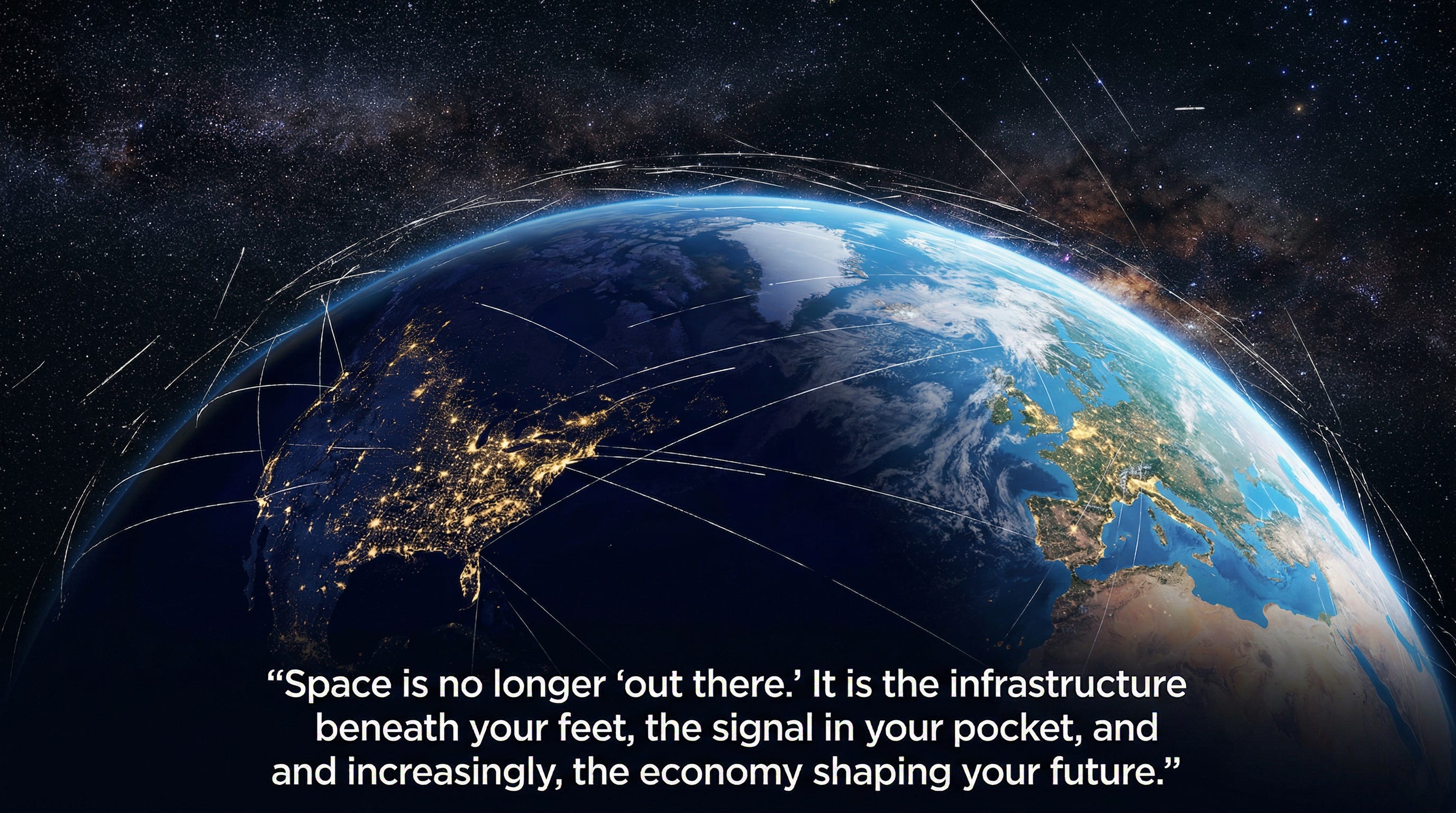
Let me ask you something. When was the last time you used a GPS? Checked the weather forecast? Paid for something with a credit card at the gas station? Good. Then you used space today — and probably didn’t think twice about it.
Here is the thing most people don’t realize: the space industry is no longer the exclusive playground of astronauts and government agencies. It is rapidly becoming the backbone of your daily life — your internet, your food supply chain, your climate data, even the timing signals that keep financial markets synchronized down to the microsecond. And if McKinsey and the World Economic Forum are right, this $626 billion industry is on track to triple to $1.8 trillion by 2035. That is not a typo. Triple. (SpaceX alone expected to IPO at a $1.8 trillion valuation within the year).
So why should an average person — someone who has never thought about orbital mechanics or satellite constellations — care about any of this? Because the same artificial intelligence that is automating your customer service calls and writing your emails is now driving rovers on Mars, managing thousands of satellites to avoid catastrophic collisions, and — if we are not careful — making decisions in orbit at speeds no human can oversee.
And that convergence — space plus AI plus automation — is where things get both extraordinarily promising and deeply unsettling.
Space Race 2.0 Is Already Underway (And It’s Not Just Elon)
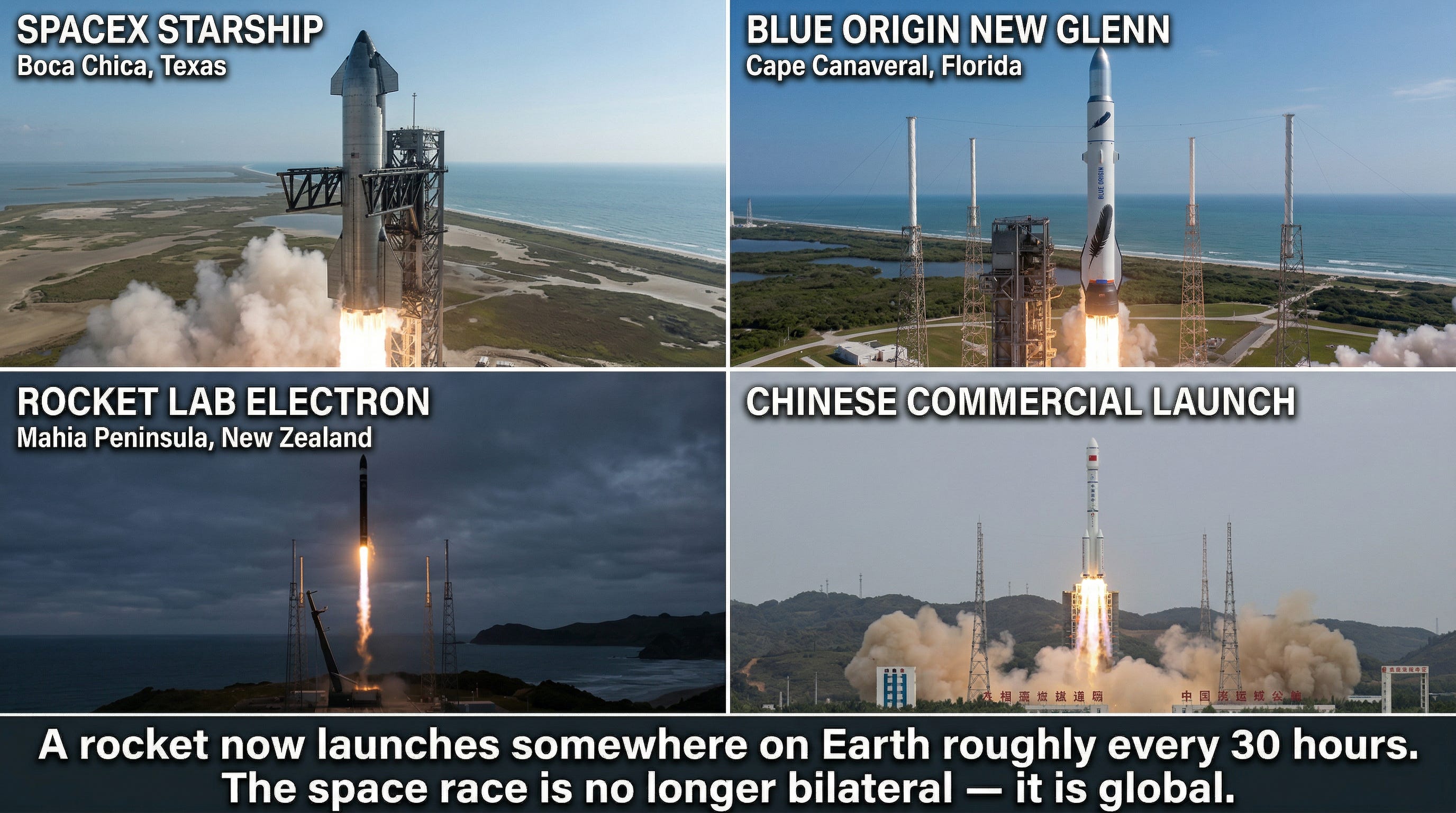
Most people, when they think about space, think about SpaceX. And fair enough — SpaceX operates over 7,000 Starlink satellites serving 9 million subscribers worldwide, commands more than 60% of the global launch market, and carries a private valuation approaching $800 billion. But here is where things get interesting: SpaceX is no longer alone, and arguably no longer the most important story. Many other players are moving ahead with re-usable rockets as well.
Blue Origin successfully launched its massive New Glenn rocket to orbit in January 2025 — a 322-foot methane-fueled vehicle designed to compete directly with SpaceX’s Falcon 9. Rocket Lab, the New Zealand-founded company led by Peter Beck, now dominates roughly half the $3.5 billion small satellite launch market with a 98% success rate. Relativity Space — which 3D-prints its rockets — made headlines when former Google CEO Eric Schmidt took over as CEO, bringing Silicon Valley money and philosophy directly into rocket manufacturing, space cargo transport and defense.
And then there is China. This is the part that should sharpen your attention. China now has over 500 commercial space companies, and its commercial space market is projected to exceed $348 billion in 2025. LandSpace demonstrated China’s first reusable rocket landing. Shanghai Spacecom’s “Thousand Sails” constellation launched 90 satellites in under a year, with plans for potentially 54,000 satellites across five Chinese companies within the decade. One Chinese company, CGSTL, achieved a 1,000 Gbps space-to-ground laser transmission in January 2025 — surpassing anything Starlink has demonstrated publicly.
India is preparing its first crewed spaceflight (Gaganyaan) for 2027. The UAE’s space program is advancing so rapidly that it expects to land a robot on the Moon’s far side in 2026. Japan’s Astroscale is pioneering the entirely new industry of orbital debris cleanup. Saudi Arabia has invested $2.1 billion. The African Space Agency is headquartered in Cairo.
In short? This is not your parents’ space race. It is not even a race anymore — it is a global economic transformation happening at a pace that governance frameworks, international treaties, and public awareness have not kept up with.
AI Is Already Driving on Mars (Literally)
Now, here is where space and artificial intelligence collide — and I mean that almost literally.
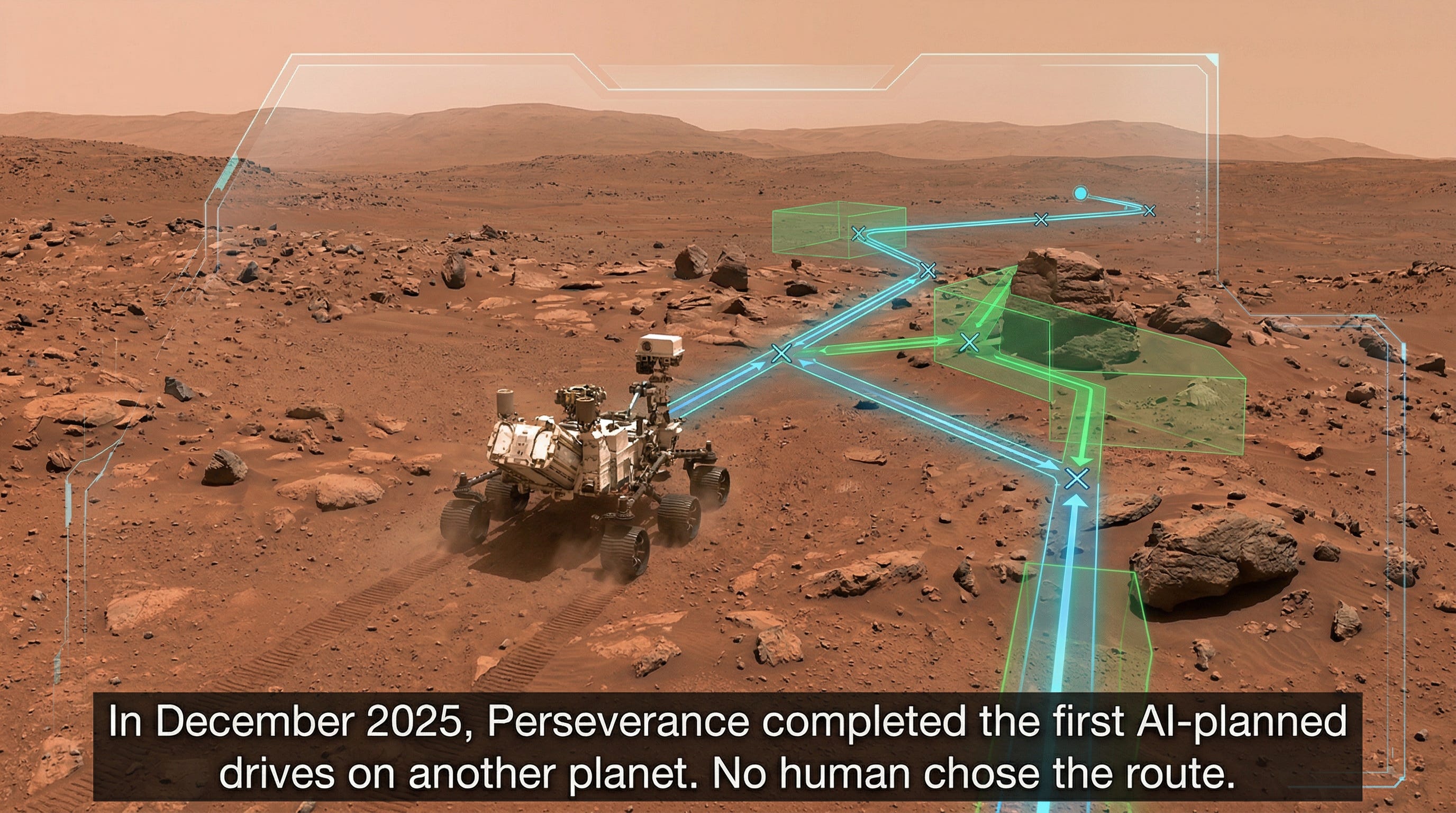
On December 8 and 10, 2025, NASA‘s Perseverance rover completed the first-ever AI-planned drives on another planet. Not AI-assisted. AI-planned. A generative AI model analyzed orbital imagery and terrain data, created waypoints, and the rover drove 456 meters without any human being choosing the route. The AI in question? Built on technology from Anthropic, one of the leading large language model companies. JPL roboticist Vandi Verma described generative AI as showing enormous promise for off-planet navigation — perception, localization, planning, and control.
Think about what that means for a moment. We have reached the point where an AI system can look at a photograph of the Martian surface taken from orbit, reason about terrain hazards, plan a safe driving route, and execute it — all without a single human in the loop. Perseverance now completes roughly 90% of its driving autonomously.
But Mars rovers are just the beginning.
The European Space Agency‘s Hera spacecraft, launched in October 2024 and headed to the Didymos asteroid system, possesses what its engineers describe as autonomy comparable to a self-driving car. During a Mars flyby in March 2025, Hera autonomously locked onto dozens of surface features using sensor fusion — visual tracking, lidar, inertial sensors, and star trackers — the same combination used in terrestrial self-driving vehicles. The implications are profound: the same AI architecture navigating your future autonomous taxi is navigating spacecraft between asteroids.
And here is a number that should make you sit up straight. Between December 2024 and May 2025, Starlink satellites executed over 144,000 autonomous collision-avoidance maneuvers — without human intervention. Academic research found that without these AI-managed maneuvers, the expected time until a catastrophic orbital collision has dropped to just 2.8 days. Close approaches at Starlink’s orbital altitude now happen roughly every 11 minutes.
Let me say that again: every 11 minutes, two objects in space come dangerously close to each other, and AI systems — not humans — are making split-second decisions to avoid disaster.
The Double Dual-Use Problem
So far so good, right? AI making space safer, rovers exploring more efficiently, satellites dodging debris. What is not to like?
Well, here is where things change.
The Brookings Institution published a striking analysis in January 2026 warning that the convergence of AI and space creates what they call a “double dual-use technology” problem. Both AI and space technology are individually dual-use — meaning each can serve civilian or military purposes. But when you combine them, you generate entirely new risk categories that existing governance frameworks were never designed to handle.
As Brookings Senior Fellow Landry Signé put it: AI-driven space-based decisions happen in microseconds, which means governance structures that assume human decision-makers are in the loop simply do not apply.
Think about that in practical terms. An AI system managing a satellite constellation can autonomously decide to reposition a satellite, change its sensor focus, alter its communications relay — all in fractions of a second. Now imagine that satellite belongs to a defense contractor. Or a foreign government. The line between a “collision avoidance maneuver” and a “strategic repositioning” becomes vanishingly thin.
The CSIS Space Threat Assessment confirmed that multiple nations are developing anti-satellite weapons — Russia is reportedly working on a nuclear-capable variant that would violate the 1967 Outer Space Treaty. RAND Corporation studies warn that the proliferation of space capabilities could lead to unstable competition and unintended military escalation. The Atlantic Council has called for governance reform with a blunt warning against allowing a “wild west environment” in orbit.
And this is before we even get to the debris problem. ESA’s 2025 Space Environment Report documents over 35,000 tracked objects and an estimated million-plus debris fragments larger than a centimeter. The agency’s assessment is unambiguous: even if we stopped all launches tomorrow, debris numbers would keep growing through cascading collisions — the dreaded Kessler Syndrome. The only solution, ESA says, is actively removing five to ten large objects per year, starting now.
Just Imagine: Three Scenarios for 2035
Let me get creative for a moment — because the trajectory of these technologies permits it, and the stakes demand it.
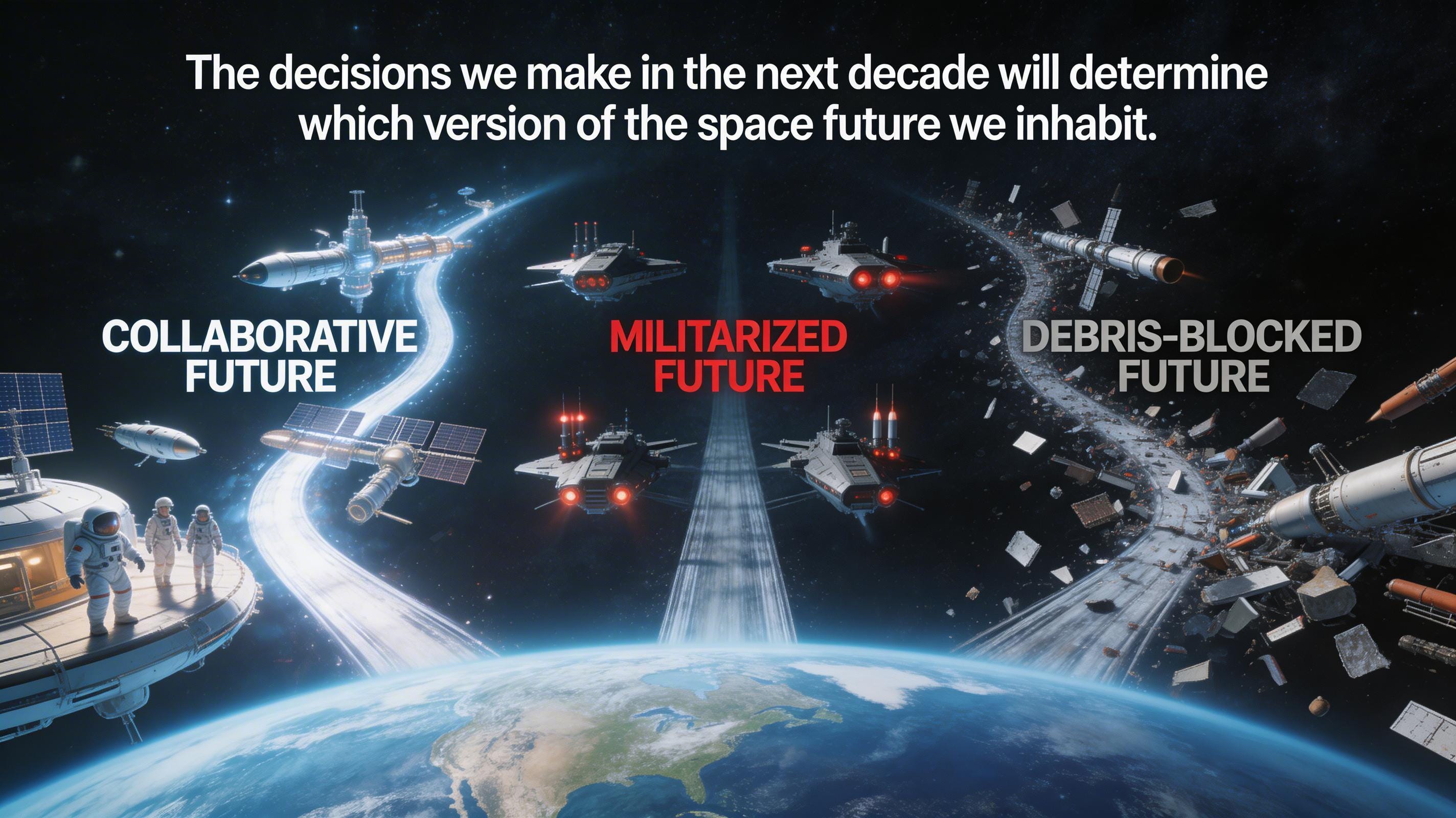
Scenario One: The Connected Commons. By 2035, a combination of Starlink, Amazon Leo, and Chinese and European constellations has delivered broadband internet to every inhabited corner of the planet. AI-powered Earth observation satellites — running models like NASA-IBM’s Prithvi — provide real-time wildfire detection, crop health monitoring, and flood prediction to farmers in sub-Saharan Africa and island nations in the Pacific alike. Stanford‘s CAESAR Center has developed autonomous spacecraft that can repair, refuel, and reposition satellites without human intervention — extending their lifespans by decades and reducing the need for new launches. Community platforms have given citizen scientists genuine participatory roles in space governance. Asteroid mining companies have delivered their first water payloads to orbital depots, dropping the cost of deep-space missions by an order of magnitude. Space is not a luxury — it is infrastructure, as invisible and essential as electricity.
Scenario Two: The Orbital Arms Race. The same technologies — AI-driven autonomous spacecraft, rapid satellite deployment, on-orbit servicing robots — have been weaponized. Nations have deployed AI systems capable of autonomously disabling or capturing adversary satellites. A cascade of debris from a single anti-satellite test has rendered a critical orbital band unusable for a decade. GPS spoofing, powered by adversarial AI, has disrupted civilian aviation and financial markets simultaneously. The governance gap that Brookings warned about in 2026 was never closed. Space has become what the Atlantic Council feared: a domain where might makes right, and the rules are written retroactively by whoever controls the high ground.
Scenario Three: The Digital Feudalism. Three or four mega-corporations control the critical orbital infrastructure — internet access, Earth observation data, launch services, and in-orbit manufacturing. They set the terms. Governments, having outsourced their space capabilities to private contractors, discover they have lost leverage. The average citizen benefits from the services but has no say in how orbital resources are allocated, who gets access, or what data is collected about their communities from above. The space economy reaches $1.8 trillion, but the wealth concentrates exactly the way terrestrial tech wealth has — dramatically upward.
Which of these futures do we get? That depends — in part — on whether ordinary people engage with these questions now, before the architecture is locked in.
Enter Astra Origins: The Case for Grassroots Space Community
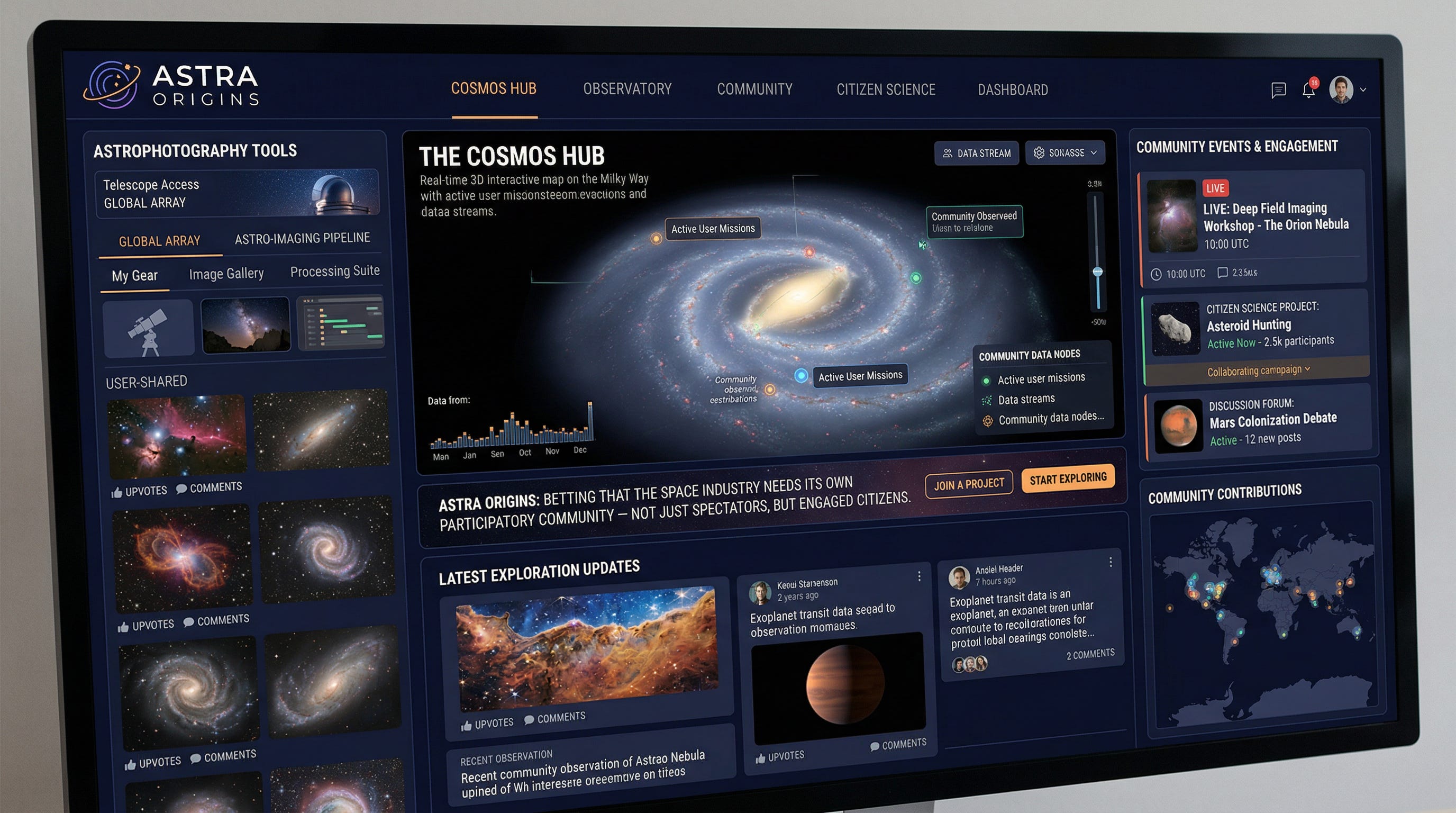
This is where a platform like Astra Origins enters the picture — and why it matters more than its modest footprint might suggest.
Founded by Bryan Khairallah and launched in 2023, Astra Origins is a user-interactive platform dedicated to space exploration community, education, and engagement. It is not a news site. It is not a corporate product. It is something rarer: an attempt to build participatory infrastructure around the space industry at the grassroots level — a social hub where space enthusiasts can share astrophotography, organize stargazing events, track industry achievements, discuss the legal frameworks governing space, and stay informed about the commercial forces reshaping the cosmos.
Why does this matter? Because as the Brookings Institution has noted, NASA once had near-complete control over space launches, but now often relies on private companies — raising fundamental questions about how the public interest is represented when commercial actors dominate. The UN Office for Outer Space Affairs runs programs specifically targeting the “space divide” between space-faring and non-space-faring nations. The EU’s Copernicus program provides 78+ petabytes of free Earth observation data to anyone — a radical act of data democratization.
But data access alone is not enough. What is missing — and what platforms like Astra Origins are trying to build — is community. A space for (pun intended) informed citizens to discuss, debate, and ultimately influence how the space industry develops. NASA already runs over 35 citizen science projects; its Kilonova Seekers program mobilized 2,000+ volunteers across 105 countries who made 20 new astronomical discoveries. The SETI Institute‘s Unistellar Network had its biggest year ever in 2025, with citizen astronomers tracking asteroids whose observations were published in Nature.
Astra Origins positions itself squarely in this tradition — but with a social networking layer designed specifically for the space community. Its Cosmos Hub covers topics from solar system science to space launch vehicles across companies like SpaceX, Blue Origin, and Rocket Lab. Its Space Events feature lets users organize live launch watch parties and stargazing meetups. Its astrophotography tools (added in 2024) give amateur astronomers a dedicated platform to share their work. And its focus on the legal and business frameworks of the space industry reflects an understanding that the future of space is not just about technology — it is about governance, access, and who gets a seat at the table.
Is it a small platform today? Yes. But so was every meaningful community movement before it scaled.
The Automation Question You Can’t Avoid
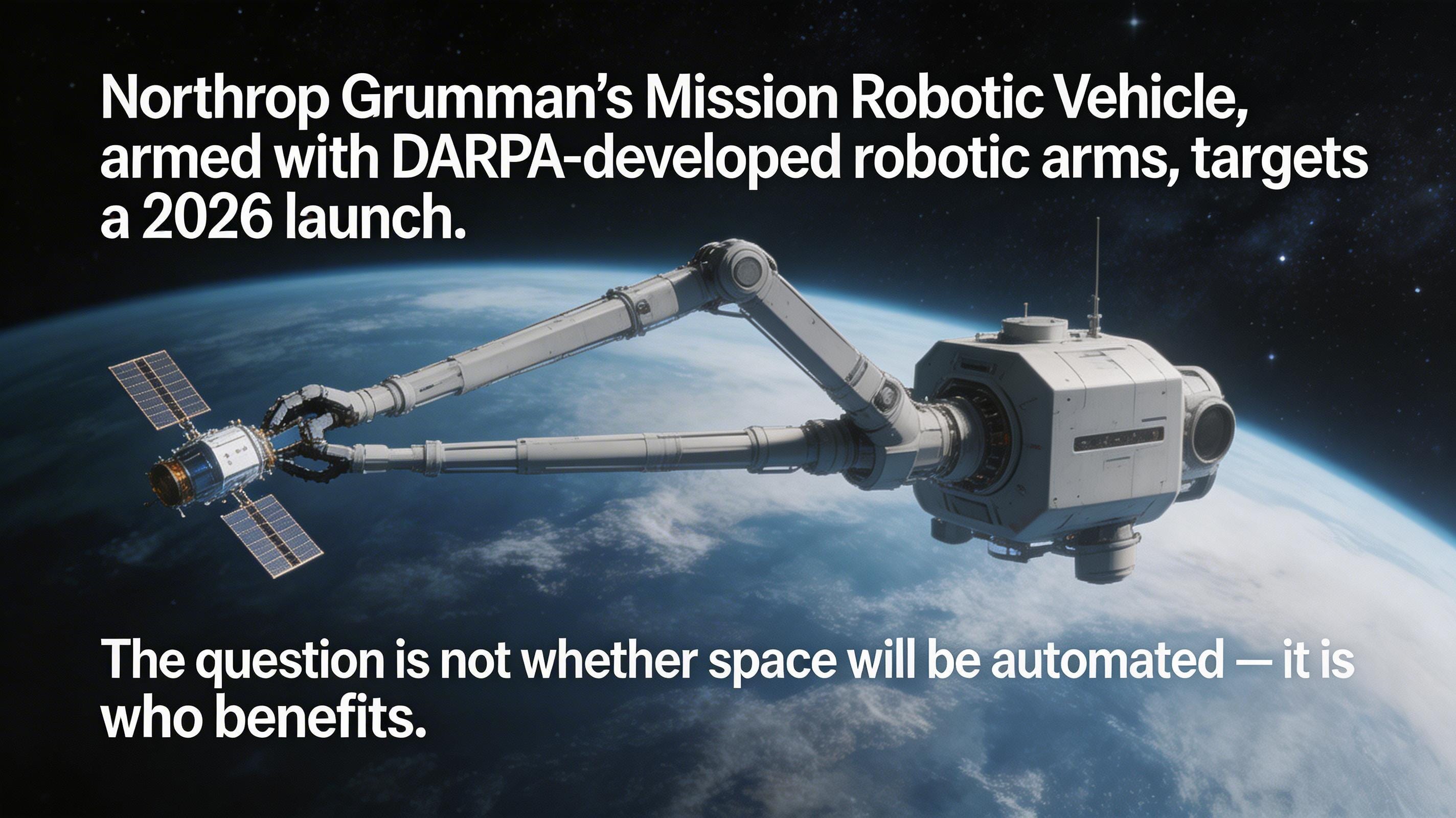
Let me bring this back to Earth — literally — because the space-AI convergence is not just an orbital concern. It is a mirror for what is happening in every industry.
The same AI architectures driving Perseverance on Mars are driving autonomous vehicles on your highways. The same sensor fusion powering ESA’s Hera spacecraft is powering warehouse robots. The same transformer models enabling Stanford‘s ISS robot to plan movements 50-60% faster than traditional methods are enabling the large language models automating white-collar work.
The World Economic Forum projects 6.4 billion space-connected devices by 2035 — up from 3 billion in 2024. China’s Geely subsidiary already operates a satellite constellation providing centimeter-accurate navigation specifically for autonomous vehicles. The connections are not metaphorical. They are architectural. The AI that learns to navigate asteroid fields is the AI that learns to navigate your city.
Which means the questions are the same, whether we are talking about a Mars rover or an autonomous truck: Who controls the system? Who benefits from the efficiency gains? What happens to the workers displaced? And who is accountable when something goes wrong at a speed no human can intervene?
At the HAIA Foundation, we focus on precisely these questions — responsible and safe AI governance, ethical frameworks for emerging technology, and empowering individuals and organizations to navigate a world where autonomous systems increasingly make consequential decisions. The space industry is not separate from this mission. It is perhaps the most vivid illustration of it.
What Does This Mean for You?
Here is the honest answer: more than you think, sooner than you expect.
If you are a parent, the career landscape your children will enter is being reshaped by space-derived data and AI automation right now — precision agriculture, autonomous logistics, satellite-based insurance risk modeling, climate resilience planning. The space economy will create millions of jobs that do not exist yet, while automating many that currently do.
If you are a citizen in a democracy, the governance decisions being made (or not made) about orbital space in the next five to ten years will determine whether the final frontier becomes a global commons or a private fiefdom. The 1967 Outer Space Treaty — the foundational international law governing space — was written before the internet existed. Before AI existed. Before any private company had launched a single rocket. It is, to put it diplomatically, overdue for an update.
And if you are someone who simply finds wonder in looking up at the night sky — and let us not pretend that is a trivial thing — then platforms like Astra Origins exist to remind you that this wonder is not just entertainment. It is a legitimate form of civic engagement. Every citizen astronomer who tracks an asteroid, every astrophotographer who documents the heavens, every enthusiast who learns enough about space law to ask informed questions of their representatives — they are participating in humanity’s oldest and most consequential conversation: where do we go from here?
The universe, as Astra Origins likes to say, awaits discovery.
The question is whether we will discover it together — or let a handful of corporations and governments decide on our behalf.
One can only dream that we choose wisely. But dreaming, as any space enthusiast will tell you, is where every great mission begins.
This article was published by the HAIA Foundation, a nonprofit organization dedicated to responsible and safe AI governance. For more on the intersection of AI, automation, and human futures, subscribe to our Substack.