
Twice now I have written that when a company blames artificial intelligence for a round of layoffs, the claim is unfalsifiable — a story that works in an earnings call precisely because nobody outside the building can check it. I was pleased with that argument. I am less pleased this month.
An argument nobody can check is comfortable for whoever makes it — the finance chief on the call, and me. While the AI-did-it claim lived in press releases, I could call it convenient and never be asked what would prove me wrong.
Connecticut has taken that comfort away from both of us. Starting October 1, an employer laying off enough people to trigger a federal notice must tell the Connecticut Labor Department whether the layoffs are — this is the actual statutory word — related to its use of artificial intelligence. One sentence, in a seventy-four-page law, dragging the claim onto a state form where somebody can go and count.
So why am I uneasy rather than triumphant? Because another state ran this experiment first, and the answer does not vindicate me as cleanly as I would like.

The whole duty is one sentence, and the word in it is not "caused"
Read the provision itself; the whole architecture lives in one preposition. Each employer serving a written layoff notice on the Labor Department under the federal WARN Act "shall disclose to the department, in a form and manner prescribed by the Labor Commissioner, whether the layoffs that are the subject of such written notice are related to the employer's use of artificial intelligence or another technological change." That is all of it: one sentence, sitting at section 26 of a seventy-four-page act, which the legislature's analysts summed up in a single line under the heading "LAYOFF NOTICES".
Not caused by. Not contributed to. Related to.
Which does something awkward to my own headline. I have spent a year arguing that "AI caused the layoff" is unanswerable — and Connecticut's drafters seem to agree so completely that they declined to ask it, reaching instead for the loosest connective in the language. A careful general counsel could answer it either way for almost any modern layoff, particularly since section 17 defines artificial intelligence as any system that "infers from the inputs such system receives how to generate outputs." Your scheduling software infers.
So far so vague. The architecture matters more than the wording. The duty attaches only where a federal WARN notice already exists, reaching employers with a hundred or more full-time workers cutting fifty or more jobs, on sixty days' notice. Not an exemption for small layoffs; a threshold, which is a different animal. And the answers will be public: every filing lands in a public document library anyone can read. That, not the question, is the part that bites.
The law arrived quietly. Final passage came on May 1; the Legislative Commissioners' Office stamped it Public Act 26-15 on May 11; the record shows it was signed by the governor on May 27, 2026 — though one national firm's alert says May 29 while walking employers through the staggered effective dates. The press release that introduced the law to the public, on June 2, never mentions layoffs at all: it is about children's online safety — also the statute's official caption, "An Act Concerning Online Safety." The name everybody uses — the Connecticut Artificial Intelligence Responsibility and Transparency Act — appears nowhere in it; the bill was rebranded on a Friday late in the session, on its way to passing the House 131 to 17.
The number this form exists to check
In its July report, the outplacement firm Challenger, Gray & Christmas recorded that AI led all stated reasons for job cuts for a fifth consecutive month, and that AI has now been cited in 112,713 job-cut announcements this year — roughly 24% of all cuts.
Read that carefully. It is not a count of jobs destroyed by AI. It is a count of announcements in which companies said the word — corporate speech: exactly the right yardstick here, and exactly why it cannot settle anything. The same report admits the trouble: when a firm says technology drove the cuts but will not say what technology, the analysts file it under a category called "Technological Update (possibly AI)" — 20,219 cuts in 2025 alone. The people who count this for a living need a hedge category.
The economists are less generous. Oxford Economics told Fortune in January that firms "don't appear to be replacing workers with AI on a significant scale", putting AI at 4.5% of total reported job losses on its own reckoning. Peter Cappelli of Wharton, in the same piece, was blunter: the headline says it is because of AI, but read what companies actually say and it is "We expect that AI will cover this work." Hadn't done it. And The Budget Lab at Yale shows no clear effects yet — while noting it could help track them if and when they appear.
Yet. Keep that word.
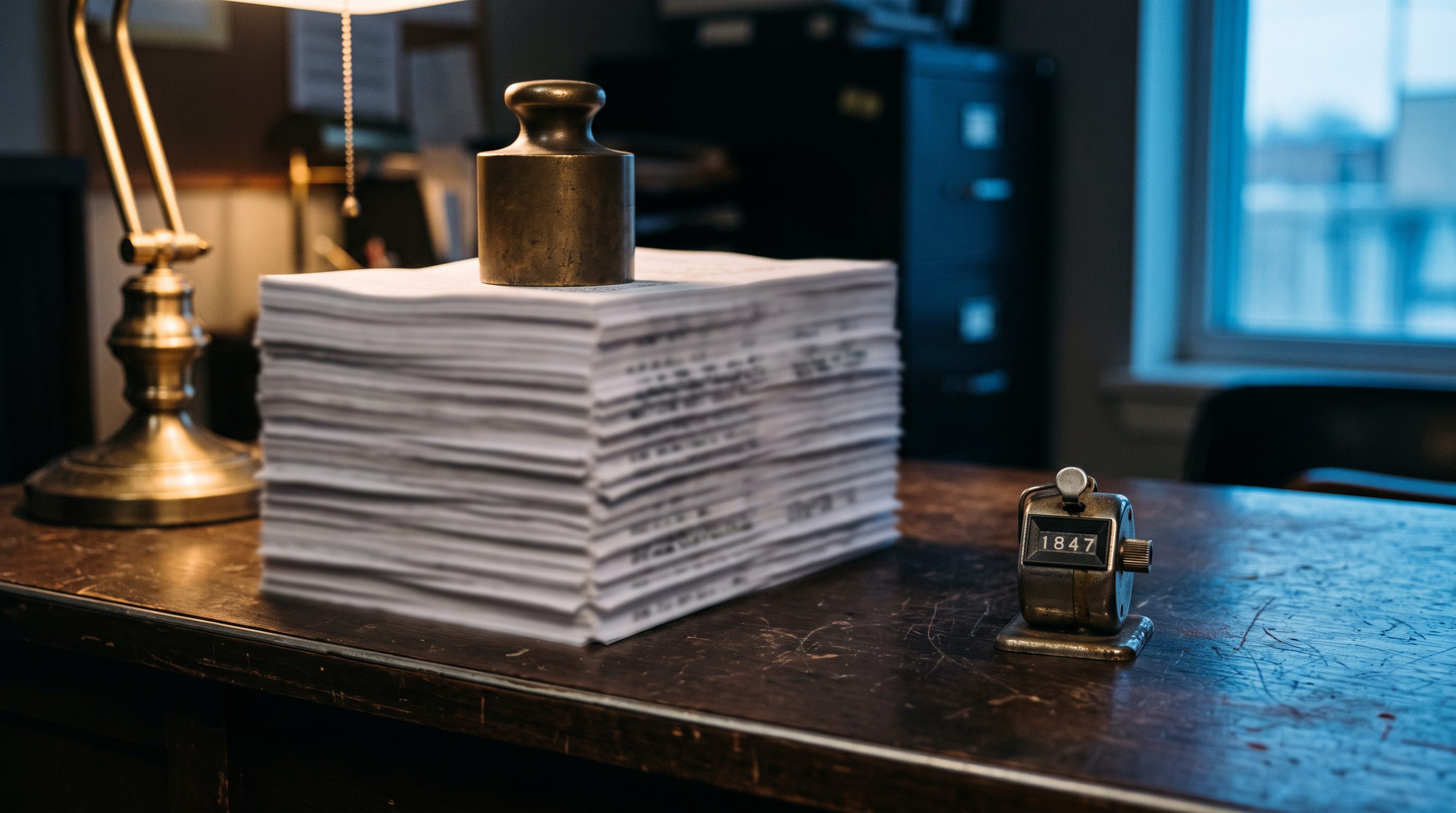
New York already ran this experiment, and almost nobody ticked the box
Connecticut is not first at this. It is first at doing it by statute.
New York's Department of Labor simply added the question to its WARN system in March 2025 — a checkbox asking whether technological innovation or automation contributed to the layoffs. A year on, a review found that although more than 160 different companies had filed notices, not a single notice had attributed layoffs to AI technology or automation.
Not one.
Why not? The generous reading is that those layoffs genuinely were not about AI. The practical reading is that nobody told employers whether the question meant "the reason" or "a reason" — the same analysis notes employers lack guidance, may question whether the disclosure is even mandatory, and lack clarity on how "technological innovation or automation" is defined. Handed an undefined question, counsel does what counsel does: leaves it blank.
As of mid-August, the count for the year is one. Writing in Forbes on August 17, Alonzo Martinez reported that New York's 2026 data include one employment action expressly identifying AI as a reason — a Nespresso notice covering 46 workers — and made the point that belongs at the top of Connecticut's form: the eventual statistics "will therefore depend on thousands of individual decisions about what counts". Anyone can check it: New York runs a public dashboard where you can count the boxes nobody ticked.
Then there is the case these forms cannot see. In the Bronx this summer, a nurses' union said Montefiore was planning to lay off twelve utilization-review nurses and replace them with AI software; the hospital called that account "inaccurate and misleading." The union called it a violation of a contract it had just won by going on strike. Twelve nurses sits far below any WARN threshold: one of the year's most bitterly contested AI-layoff disputes would not produce a single form entry in either state.
Nothing happens if the answer is wrong
This is where my own angle broke, and I would rather say so than write around it.
I had assumed that the moment a claim becomes a filing, it acquires a penalty for being wrong. That is not what section 26 does. The act's enforcement clauses are written section by section — the unfair-trade-practice clause covers sections 8 to 11, enforced solely by the Attorney General — and none names the layoff-notice section. Proskauer restated the duty with the exact "related to" wording without naming a consequence; Ogletree Deakins observed that the law does not define what counts; the Future of Privacy Forum's five-point read of the new law details Attorney General enforcement for other provisions and, for this one, nothing; and Epstein Becker Green, calling it a further obligation on employers whose layoffs qualify as a mass layoff or plant closing, notes that the act's cure period runs to its AI-decision provisions, not this one.
The accountants agree in another dialect: the fiscal note prices sixteen sections by number, one university study at up to half a million dollars, and gives the disclosure line no price at all.
Two more things are missing. The form: the statute says the disclosure happens "in a form and manner prescribed by the Labor Commissioner," and as of this writing, six weeks out, the department's WARN page — which tells employers what a notice must contain — does not mention artificial intelligence anywhere. And the method: the same act commissions a University of Connecticut institute to study how to track layoffs associated with AI, due January 1, 2027, three months after the duty begins.
The sharpest objection comes from the man whose firm keeps the count. Andy Challenger has noted that naming AI in a layoff announcement can win over investors while pushing employees away, and added that as regulations take shape, companies will be more careful in their announcements — which, he said, would make tracking the impact of AI on jobs more opaque. The state finally asks, and everybody stops volunteering the answer anywhere else.
Spain skipped the checkbox and asked for the algorithm itself
If you want to know what happens after the form exists, look at Spain, which asked a braver version of this question five years ago and has had half a decade to find out what it produces.
In May 2021 Spain passed what everyone calls the Ley Rider — the riders' law, written for food-delivery couriers. Tucked inside was something much larger: a new letter (d) in article 64.4 of the Workers' Statute giving a works council the right to be informed of the parameters, rules and instructions on which the algorithms are based where those algorithms affect working conditions, access to employment, and profiling. Not "was AI involved?" — show us the rules.
A note on the paperwork: the decree of May 11, 2021 came into force that August and was implicitly repealed weeks later by Law 12/2021 of September 28, which reproduces the clause word for word. A constitutional challenge was dismissed in 2023.
How far does it reach? The sources disagree, and I would rather show that than pick a winner. Eurofound, the EU's own labor agency, records that the provision applies to all companies using algorithmic management and not only the platform companies, and a Barcelona employment firm reads it the same way, listing scheduling software, productivity trackers, recruitment algorithms and performance scoring systems; Garrigues, Spain's largest law firm, frames the duty more narrowly, around delivery platforms. EU-OSHA called it algorithmic transparency at a national regulatory level for the first time, and Social Europe reported that platforms would have to make an algorithm available to trade unions.
So what did five years produce? That same Barcelona firm, writing in October 2025: implementation is still at an early stage; many works councils remain unaware the right exists; most companies have yet to design procedures to comply effectively; and — the sentence I would tape to the Connecticut Labor Commissioner's monitor — the law does not specify the format or frequency of disclosures, nor what to do when the algorithm comes from an outside vendor. A national guide followed in 2022; Garrigues was careful to record that these are guidelines, which are not regulations.
Enforcement? Spain has been ferocious about the other half of that law: its Labor Inspectorate fined Glovo nearly €79 million, over more than 10,600 workers treated as falsely self-employed. But I could find no fine or judgment anywhere for withholding the algorithm information itself. That half produced guidance, a literature, and quiet.
Connecticut is about to relearn this at smaller scale: Spain left the format unspecified and got silence, and Connecticut has handed the format to a commissioner who has not published one. Europe has since generalized the idea into its Platform Work Directive, which member states must bring into force by December 2, 2026 — two months after Connecticut's question goes live.

Picture the first hundred notices
Here is how I think this actually goes.
October arrives. The form, whenever it appears, is most likely a checkbox, because that is what forms are made of. General counsel, handed an undefined term and no penalty, answers "no" — not out of malice, but because "no" cannot be wrong until somebody defines the question. Within a year a house standard emerges, written by law firms rather than the Labor Department: tick "yes" only where a named system replaced a named function on a named date. Nobody voted for it.
Then the interesting turn. Somewhere in 2027 a plaintiff's lawyer in an ordinary wrongful-termination case subpoenas the WARN filing and asks why the box said "no" in October when the earnings call in November said "AI." That is when the filing grows teeth — not from the statute, which grants none, but from litigation using its paperwork as an admission. Elsewhere, a company ticks "yes" as a boast because investors like that story, and finds it has authored a document a laid-off worker's attorney can read for free.
None of that requires a new law. It requires only that the answers be public and dated.
The people who fought this bill, and the people who wanted more of it
The fight over this bill did not split the way you might guess.
CT Mirror's reporting explains the strategy: lawmakers targeted specific uses of AI rather than specific users, an approach that mostly sidesteps regulations that would create new requirements for the state's businesses — the thing that had sunk previous attempts. In the same debate Senate Minority Leader Stephen Harding said this should be done federally, on a technology "evolving by literally the second"; Senator Tony Hwang warned of a roadblock to business innovation.
Business objected in specifics. The Connecticut Business and Industry Association's Chris Davis said AI is already deeply embedded in hiring and HR systems, and that the provisions could unintentionally penalize employers for using common, lawful tools. Adam Thierer and Logan Kolas at the R Street Institute counted more than 1,500 bills with an AI nexus sitting in the states. NetChoice testified against SB 5 outright, warning of overlapping obligations that will generate confusion.
On the other side, the Transparency Coalition's bill guide states the duty plainly — employers are now required to disclose whether the layoffs are related to the employer's use of AI — and organized labor's policy arm has long asked for this genre of rule, listing preventing and tracking potential displacement among what good AI legislation does. For all the noise, the vote was not close: 131-17 in the House, 32-4 in the Senate.
So what do you actually do with this?
If you are in Connecticut and your employer files a WARN notice after October 1, the notice and its AI answer become public records in the state's document library. Read the filing, not the press release; only one of them counts the people.
If you sit in HR or legal at a covered employer, settle your answer before you need it. Fisher Phillips — which calls Connecticut one of the first states to require this — tells employers to evaluate whether AI adoption or other technological change contributed, and to document your reasoning for any characterization you make in a WARN notice. Write it down while it is a judgment call and not a deposition.
If you are laid off in a group smaller than fifty, no form will record it. Keep your own: the dates, the tools introduced beforehand, what your tasks were reassigned to.
Check the tense in the next AI-layoff headline. "AI will cover this work" is a forecast; "AI does this work" is a claim. Companies say the first and get reported saying the second.
If you belong to a union or a works council, treat this as a bargaining item, not a compliance footnote. Spain's warning: a right nobody knows about is a right nobody uses.
Diary two dates: October 1, 2026, when the question starts being asked, and January 1, 2027, when Connecticut's study of how to track any of this is due.
What I got wrong, and what I still think
I still believe "AI caused the layoff" is not a question a state form can answer, and Connecticut's own drafting is my evidence: the legislature had one sentence to write, and it would not write caused.
What I got wrong was the mechanism. I assumed a filing matters because it makes lying punishable. It doesn't — nothing in section 26 punishes anything. A filing matters because it makes an answer exist: dated, attributable, public, sitting beside the number of people who lost their work. That is not accountability. It is the raw material accountability gets made from later, the way a land registry is not justice but is what every property fight runs through.
The gap between a filing and a penalty is where the next five years of this argument will be fought. New York has stood in that gap since March 2025 with a box almost nobody ticks. Spain has stood in it since 2021 with an unused right. Connecticut steps into it in six weeks.
My vote? Publish a form that defines its own question before October 1 — because a question nobody can answer wrongly is one nobody has to answer honestly.

A claim nobody can check is just a mood; from October 1 in Connecticut it becomes a document, and documents keep. The HAIA Foundation reads them so you don't have to — though honestly, you should, and the rest of that work is over here.