
The first time I moved to a city where I knew nobody, I put holding deposits on three apartments in one week, and I only ever intended to live in one of them.
I want to be clear that I did not think of this as dishonest. I thought of it as prudent. I had four days, a suitcase, and no way to tell from a listing which of these places would turn out to sit above a bar with a Thursday night DJ. So I paid three small deposits and took three apartments off the market while I made up my mind.
Here is the part I did not think about for roughly fifteen years. Two of those landlords stopped advertising. They turned people away. They planned around a tenant who was never coming, because from where they stood, my deposit looked exactly like a decision. It wasn't. It was an option, and I had bought three of them for the price of being slightly inconvenienced when I let two go.

I have been thinking about those two landlords all week, because the United States is currently running the same arrangement at the scale of the national power grid, and the paperwork that decides who absorbs the cost of it is due tomorrow.
What actually happened on June 18
On June 18, 2026, the Federal Energy Regulatory Commission — FERC, the federal agency that regulates the interstate transmission of electricity — issued six orders at once. One to each of the country's regional grid operators: PJM, MISO, SPP, CAISO, ISO New England and NYISO. Between them, these six run nearly two-thirds of the country's electricity load.
The orders are what lawyers call show-cause orders, under Section 206 of the Federal Power Act, and they came with a clock. Each operator was given sixty days to justify the rules it already has or file new ones, preceded by a thirty-day report on whether it has enough generation to keep the lights on. Sixty days from June 18 lands on August 17 — tomorrow.
The subject is what the industry calls large load — a single customer drawing more than twenty megawatts, which in practice means a data center, a chip fab, or a very ambitious factory. And FERC's opening position is deliberately careful: it preliminarily finds that those tariffs appear to be unjust and unreasonable because they do not adequately address the integration of large and co-located loads. Not "are." Appear to be. That hedge is doing real work — a show-cause order is an invitation to argue, not a verdict, and the six operators are about to argue.
Each order got its own numbered docket: PJM is EL26-67, SPP is EL26-68, NYISO EL26-69, MISO EL26-70, CAISO EL26-71, ISO New England EL26-72. I am giving you the numbers because they are the actual addresses of this argument, and almost nobody outside the industry has ever looked one up.
Most of the coverage read this as a story about speed — six tailored orders to accelerate grid interconnection for AI data centers, which it substantially is. But buried in the five things FERC told the operators to fix is a provision that has almost nothing to do with speed, and it is the reason I am writing this.
The sentence about the building that never arrives
FERC told the six operators to establish standardized cost recovery agreements to reduce cost shifting associated with stranded assets if the large load customer fails to materialize.
Read that again, because it is not a sentence about data centers. It is a sentence about empty fields.
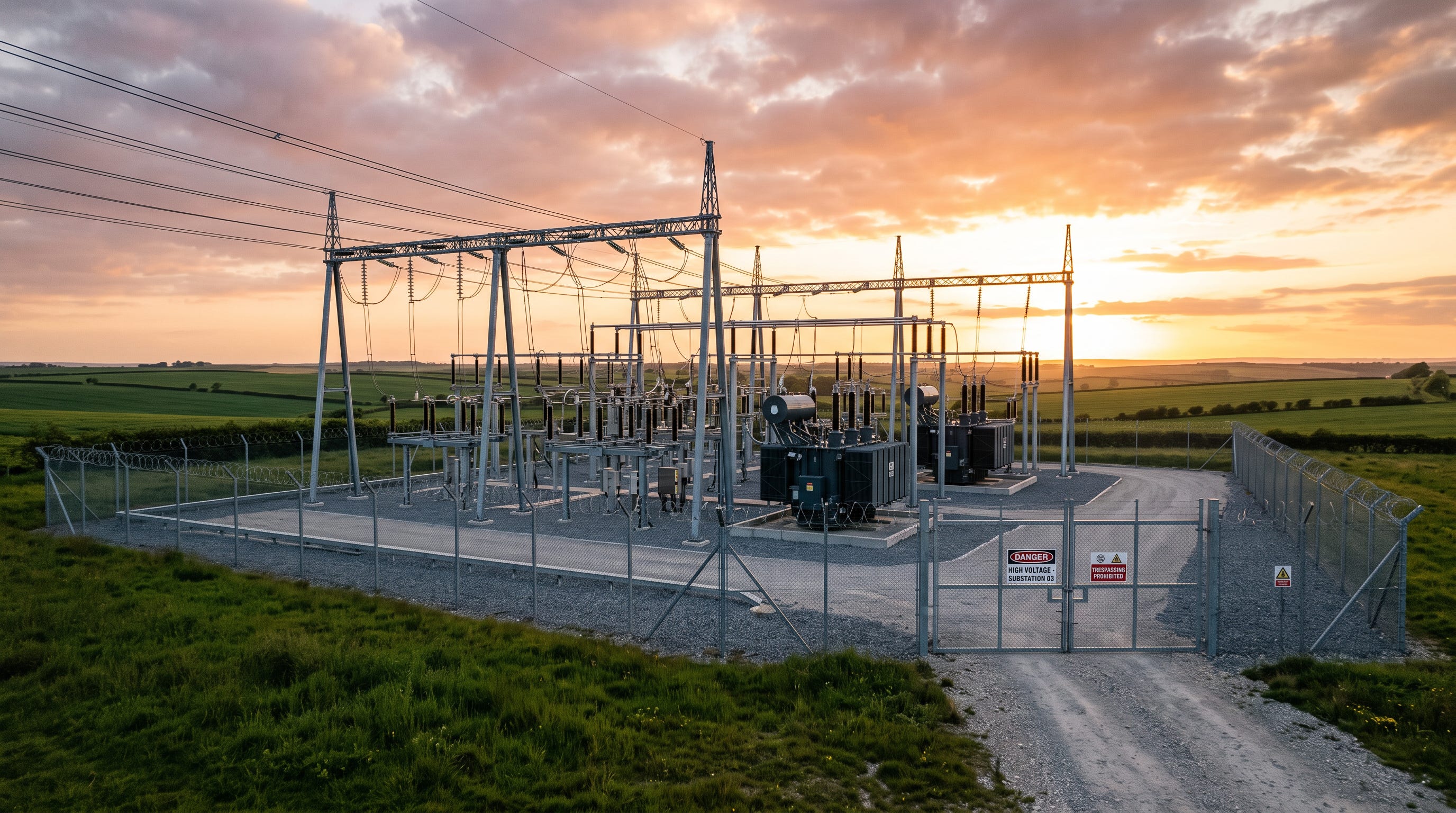
Here is the mechanism in plain language. A developer announces a data center. To serve it, the utility has to build real things — a substation, transmission lines, sometimes a great deal more. Those things cost hundreds of millions of dollars and take years. The utility starts building on the strength of the announcement.
Then the data center doesn't get built.
The substation exists. The line exists. The money has been spent (and, in the way of these things, financed over thirty years). And under the rules as they stand in most of the country, that cost does not vanish and it does not land on the developer who walked away. It gets spread across everybody else on the system — socialized among ratepayers even where those ratepayers will never use the new infrastructure. You pay for a wire to a building that isn't there.
FERC's proposed fix is almost boringly sensible, and it is precisely what my third landlord should have demanded of me. The host utility would have to post financial security toward the transmission owner's revenue requirement, sized to the network upgrades the load actually requires. And the interconnection process would carry financial deposits or milestone requirements, plus disclosure rules to cut down duplicative requests from different utilities all chasing the same customer.
Deposits and milestones, instead of a promise.
How often does the building actually not arrive?
This is where I expected to find a modest problem and found something closer to a hall of mirrors.
Astrid Atkinson, the chief executive of Camus Energy, put it at five to ten times more interconnection requests than data centers actually being built. That is her conservative number.
The Electric Power Research Institute surveyed twenty-five large utilities. Ten of them reported that data center requests amounted to half or more of their current peak load — an extraordinary figure, the kind that justifies building a great deal of steel. And of those ten, not one expected actual demand five years out to exceed 35% of peak. They were reading their own inboxes and quietly discounting them by more than half.
Why the gap? Partly because forecasting this is genuinely hard and not merely a matter of bad faith. But partly because of my three apartments. Developers submit load requests to several providers at once, gauging which one pans out first — so a single planned building can appear in four queues in four states, and every one of those queues counts it as real demand.
And to be fair to the grid: the queue was already creaking before any of this. The AI buildout did not invent the problem. It just arrived at scale, and the crack widened.
Some utilities have stopped waiting for Washington. A Minnesota cooperative, Great River Energy, now bills applicants for the cost of vetting them, and its director of resource planning, Zachary Ruzycki, has pointed out that of the eleven proposals in or near its territory, only one had actually broken ground. Industry-wide the skepticism is hardening into procedure: about 30% of utilities surveyed now discount proposed loads against benchmarks like public announcements, land acquisitions and signed load-serving agreements. In Virginia, utilities went further still, proposing large-load rate classes that would hold a data center to 60 to 100% of its contracted demand — a floor it pays whether or not it ever draws the power.
That is a landlord finally asking for a lease instead of a maybe.
So that settles it — data centers are freeloading. Right?
No. And this is the part where I have to argue against my own framing, because the honest version is more complicated than the satisfying one.
Amazon commissioned the consultancy Energy and Environment Economics to look at exactly this, and the study reports that Amazon fully pays for its own electricity costs, and then some — a typical 100-megawatt facility contributing about $3.4 million above its costs in 2025, projected to reach $6.1 million by 2030. Money a utility can spend on everyone else's grid.
You should weigh that knowing Amazon paid for it. But you should not dismiss it, because the underlying economics are real: a large data center is a creditworthy customer with a flat, predictable load, and in some regions that genuinely does spread fixed costs across more kilowatt-hours. And researchers looking at the practicalities have concluded it may be almost impossible to make data centers pay a clean "fair share", because the accounting genuinely is that tangled.
There is a second complication, and it is bigger. I have been describing these orders as a consumer protection measure. Their origin is the opposite. On October 23, 2025, Energy Secretary Chris Wright directed FERC to reform and hasten large load interconnection — because developers in some regions were waiting as long as seven years to get power. June's orders answer that request. The trade press read them, accurately, as an acceleration order; one pro-buildout institute frames the whole design as a speed-for-security bargain.
So the stranded-cost protection is not the point of this proceeding. It is the guardrail bolted onto a proceeding whose purpose is to go faster. That is worth knowing before you get too warm about it.
And the third complication is the one that should temper everything above. Even if FERC gets exactly what it wants, FERC is not the final arbiter of retail electricity rates — how a utility recovers infrastructure costs from you, specifically, on your bill, remains with utilities and state public utility commissions. Federal action here changes the wholesale plumbing. Your bill is decided closer to home.
Meanwhile, in Britain: the same surgery, on a different patient
Here is what makes me think the fix is workable, and also that it will take longer than anyone wants.
Great Britain ran this experiment already. Its connection queue had swollen to almost 400 gigawatts of projects, well in excess of what was needed — Ofgem's own word for them was zombie projects, holding places in line without moving. In November 2023 the regulator, Ofgem, gave the system operator the power to write strict milestones into connection agreements and terminate projects that miss them, a change it described as a big step toward phasing out first-come, first-served. Readiness, not arrival time.
It worked. By an April 2026 open letter from the energy department and Ofgem, 221 gigawatts of projects that were not needed for 2035, or no longer progressing, had been moved out of the main queue. Not canceled — moved. The distinction matters, and the letter is careful about it.
Two honest caveats, because the comparison is not free. First, Britain reformed the queue for generation — power plants wanting to plug in — while FERC is acting on load, customers wanting to plug out. Different subject, same disease. What transfers is the mechanism: milestones, financial commitment, and a credible power to terminate.
Second, it was slow and it was messy. That same letter concedes the program faced significant delays caused by data errors in historic connection agreements — years in, they were still fighting the spreadsheets. Notably, the industry welcomed the clear-out rather than fighting it, because serious developers hate being stuck behind unserious ones even more than regulators do.
That is the realistic picture of what tomorrow's filings start: not a fix, a decade-long cleanup.
Just imagine the next few years
Picture 2029. A county in Ohio or Virginia approves a data center campus with real enthusiasm — jobs, tax base, a ribbon to cut. The utility begins a substation and a transmission spur. Under the new rules, the developer has posted security and hit its first two milestones, so this one looks real.
Then the model changes. Inference gets four times cheaper, or the company consolidates three sites into one in a state with better power, and the campus quietly becomes a press release nobody follows up on.
In the good version of 2029, the security gets drawn down, the milestone schedule stops the build before the expensive half, and the loss is bounded and lands on the party that made the promise. In the bad version, the county has already rezoned, the utility has already ordered the transformers — there is a two-year lead time on those now — and the deposit turns out to have been sized for a smaller world.
Now imagine the same thing in nine counties at once, because that is roughly the ratio Atkinson's five-to-ten-times estimate implies. The question these filings are really answering is not whether some data centers will evaporate. Some will. It is whether, when they do, there is a number written down in advance that says who pays — or whether we find out afterward, the way we did last time.
What the people who study this are saying
The striking thing is how little ideological daylight there is.
The Union of Concerned Scientists — not an organization anyone accuses of being soft on big tech — went through utility filings across seven PJM states and found $4.3 billion of connection projects approved in a single year — 130 of them in 2024, with over 95% passing all their transmission connection costs to local customers. Virginia's share alone was $1.9 billion, Ohio's $1.3 billion. Mike Jacobs, their senior energy manager, does not hedge: "The big tech companies rushing to build out massive data centers are worth trillions of dollars, yet they're successfully exploiting an outdated regulatory process to pawn billions of dollars of costs off on families who may never even use their products." The same team later noted, with some satisfaction, that this is one of the few things everyone now agrees on.
From a very different institutional tradition, the Center for Strategic and International Studies scored all six operators against FERC's five criteria and found the gap sobering: on a conservative reading, only about 20% of the criteria are currently met — six of thirty boxes. Cost-shifting is the weakest column of all. Only PJM and SPP might qualify, and in the other markets, no operator has established tariffs designed to prevent cost-shifting at all. Joseph Majkut, who directs their energy program, expects not a clean sweep but a multiyear, piecemeal modernization.
Six boxes out of thirty. That is the honest baseline going into tomorrow.
What does this mean for you?
Not much tomorrow, and quite a lot over the next three years. Concretely:
Learn the name of your state public utility commission. This is the single highest-leverage thing in this article. FERC is arguing about wholesale plumbing; the commission in your state capital decides how much of any of it reaches your bill. Those commissioners are elected in some states and appointed in others, and their dockets are public.
Watch for the words "large load tariff" or "special contract" in your utility's filings. That is where the deposit-versus-promise question gets answered for you specifically, in language nobody wrote to be read.
If a data center is proposed near you, ask one question at the hearing. Not "will it use a lot of water" — everyone asks that. Ask: what does this company forfeit if it doesn't build? If the answer is nothing, you have found the actual risk, and it is not the water.
Treat the announcement number as a maximum, not a forecast. A press release announcing a gigawatt is a statement of intent, five to ten of which produce one building. Local officials rarely discount it. You can.
If you want to read the primary material, the dockets are EL26-67 through EL26-72 at FERC. Search the one for your region. The filings landing tomorrow are public.
The lesson, as I see it
I got away with my three apartments because the cost of my optionality was borne by people who had no way to price it. Two landlords lost several weeks each, and I never learned their names. The system worked fine for me and quietly badly for them, which is the signature of a rule that was never written down.
That is where the American grid has been for about five years, except the unpriced option is measured in gigawatts and the people absorbing it are everyone with a meter. The fix is not exotic and it is not anti-technology. It is a deposit. It is a milestone (the same two words any bank would use). It is the ordinary discipline that every other capital-intensive industry imposes on people who ask it to build something expensive on the strength of a plan.
The filings arriving tomorrow will not settle it — six of thirty boxes says otherwise, and Britain's grinding multiyear cleanup says otherwise more loudly. But for the first time, all six operators have to answer the question in writing, in public, with a docket number attached. That is worth more than it sounds. A question that has an address is a question somebody can eventually be made to answer.
And when the data centers that were never real quietly stop being mentioned — as some portion of them will — the interesting thing to watch will not be the announcement. It will be the bill.
Most of what decides your electricity bill gets decided in documents nobody is expected to read. Reading them is the whole job of the HAIA Foundation and of this newsletter — you can subscribe here and forward it to whoever on your street asks the good questions at the county meeting.