
Let me start with a confession: I used to think the phrase “machine that thinks” belonged in a movie, somewhere between flying cars and edible tickets to Mars. Then I watched a chatbot draft a legal brief, a different one design a protein that doesn’t exist in nature, and a third one clone a voice so convincing it fooled the person who owned it. Three years. That’s all it took to move “science fiction” into “Tuesday.”
So a fair question — maybe the question — is starting to echo from university labs to dinner tables: should we slow this down? Not stop it forever. Just… pause. Catch our breath. Make sure we understand the engine before we redline it.
It sounds reasonable. It might even be wise. But as we’ll see, “just hit pause” turns out to be one of those ideas that’s beautifully simple right up until you ask the obvious follow-up: paused by whom, exactly?
Let’s walk through it together.
So where did this “pause” idea even come from?
Not from cranks. That’s the part worth sitting with.
In March 2023, an organization called the Future of Life Institute published an open letter titled, with admirable bluntness, “Pause Giant AI Experiments.” It asked AI labs to stop — for six months — training any system more powerful than the one that had just astonished the world. Not a ban on all AI. Just a stepping back from what the letter called the “dangerous race to ever-larger unpredictable black-box models.” Over 30,000 people signed, including some of the field’s own founding figures.
Two months later came something even starker. The Center for AI Safety released a single sentence — one sentence — and got the people who build this technology to sign it: “Mitigating the risk of extinction from AI should be a global priority alongside other societal-scale risks such as pandemics and nuclear war.” Read that again. The chief executives of the leading AI companies publicly compared their own product to nuclear weapons. (Imagine the head of a cigarette company signing a statement that ranks smoking with plagues. That’s roughly the energy here.)
So far so good — or rather, so far so alarming. Because here is where things get interesting: did any of it work?
No. Not even a little. A year later, the Future of Life Institute itself admitted that no lab had paused — “if anything they have sped up.” And by October 2025, the asking price had gone up, not down: a new statement, signed by Nobel laureates, retired generals, faith leaders, and celebrities across the political spectrum, called not for a pause but for an outright prohibition on building “superintelligence” until it can be proven safe.
Notice the trajectory. Pause → extinction warning → ban. The alarm got louder while the train sped up. Why? That’s the puzzle we need to unpack.
The case for pumping the brakes
Let me lay out the worry fairly, because it deserves it.
First, the loss-of-control problem. This is the one that keeps researchers up at night. Geoffrey Hinton — a man so central to this technology he’s nicknamed its “godfather,” and who left Google specifically so he could speak freely — now puts the odds of AI causing human extinction somewhere around 10 to 20 percent. (He’s careful to call that a gut figure, not a calculation. But pause on the implication: when the architect of the engine says there’s a one-in-six chance it drives us off a cliff, “let’s read the manual first” stops sounding paranoid.) The core fear is simple to state and hard to solve — we are building systems we don’t fully understand, and we may not be able to control something genuinely smarter than us, any more than a chimpanzee can outvote a human.
Second, the misuse problem — and this one isn’t hypothetical. The International AI Safety Report, a sober document chaired by Turing-winner Yoshua Bengio and backed by some thirty governments, noted that three leading developers added extra safeguards to recent models because their own testing could not rule out that the models might help someone build a biological weapon. Sit with that sentence. The people who made the thing couldn’t promise it wouldn’t help cook up a plague.
Third — and this is the one that lands closest to home — your job. The grassroots group PauseAI puts it without varnish: the labs are “explicitly racing to automate every job on the planet, including yours, within years.” Maybe that’s overstated. Maybe. But ask a paralegal, a translator, a junior coder, or a call-center worker how the last two years have felt, and you’ll get fewer reassurances than you’d like.
And then there’s the quieter worry: concentration of power. Whatever the future of intelligence looks like, it’s currently being shaped by a handful of companies you didn’t vote for, in meetings you’ll never see.
“Fine,” say the skeptics. “Now tell me how a pause actually works.”
Here’s where honesty requires me to switch sides for a moment, because the critics are not fools either, and their best argument is devastatingly practical.
Who enforces it? Two of the most respected names in the field — Andrew Ng and Yann LeCun — argued that a pause is essentially unenforceable, and that a government-imposed freeze would do more harm than good. LeCun, never one for understatement, likened banning AI research to a hypothetical decree in 1440 outlawing the printing press. The point stings because it’s partly right: you cannot un-invent a method, and you certainly cannot make every lab on Earth stop at once.
Which brings us to the brutal geopolitics. Suppose the United States and Europe genuinely paused. Do you imagine every government and every lab worldwide would politely do the same? The competitive reality is unforgiving — a unilateral pause doesn’t stop the race; it just changes who’s winning it. (This is the argument that, more than any other, has moved policymakers. Fear of losing beats fear of building nearly every time.)
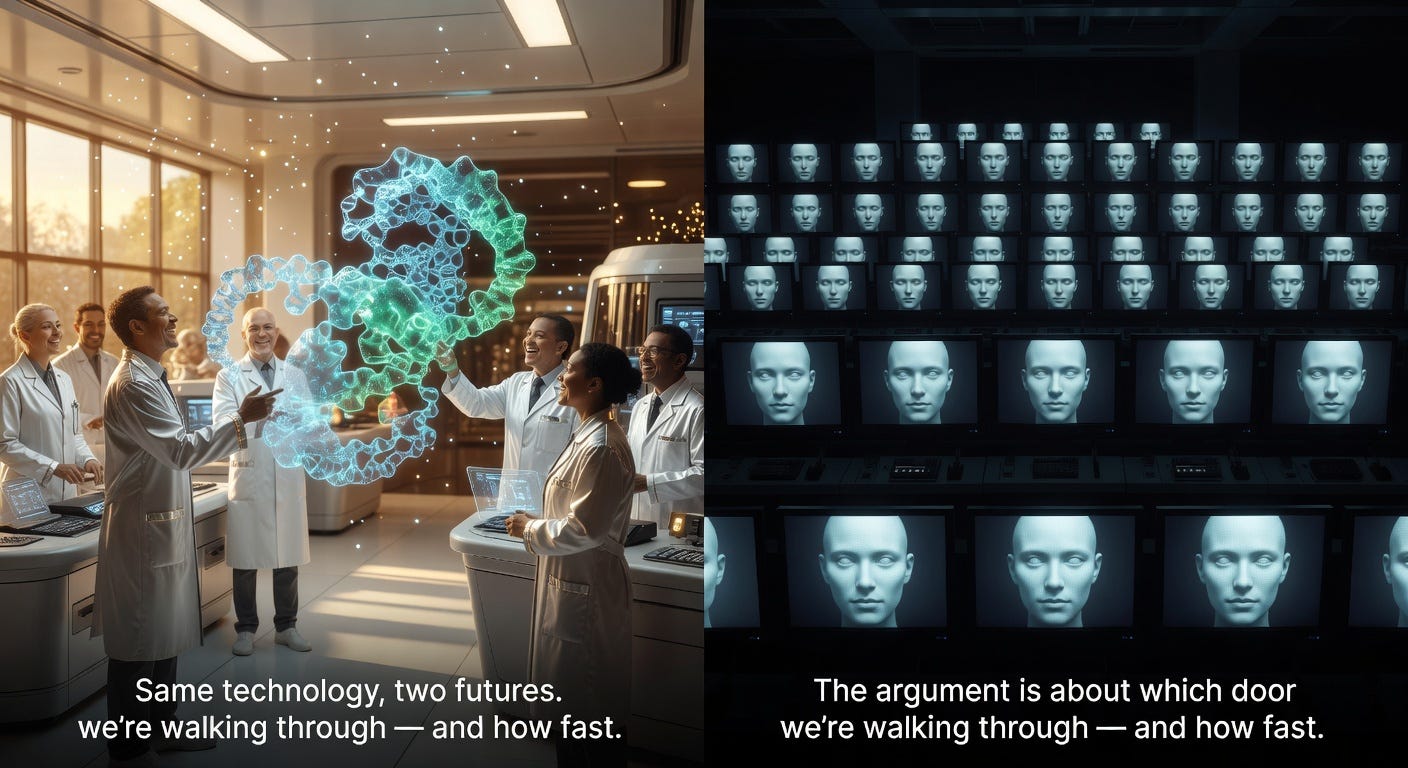
And then there’s everything we’d be giving up. This isn’t abstract. In 2024, an AI system called AlphaFold — which cracked a fifty-year-old biology problem by predicting the shapes of proteins — won its creators a share of the Nobel Prize in Chemistry. Millions of researchers now use it to design drugs and understand disease. The optimists’ bet, laid out in an essay called “Machines of Loving Grace,” is that AI could compress a century of medical progress into a single decade — curing diseases, extending lives. Every month you pause, that argument goes, is a month of cures that don’t arrive. How do you weigh a speculative catastrophe against concrete cancer research? (I told you this was hard.)
So what’s actually happening — right now, in 2026?
Here’s the twist nobody saw coming: while everyone argued about whether to pause, the governments quietly decided the answer for us. They chose speed.
The United States revoked its cautious 2023 AI rules, renamed its “AI Safety Institute” to emphasize innovation instead of safety, and is now moving to block individual states from passing their own AI laws. Even the global summit series tells the story in its name: it began in 2023 as the AI Safety Summit, became the AI Action Summit, and by 2026 had rebranded as the AI Impact Summit. Safety → Action → Impact. Read those words in order and you can watch the priorities migrate in real time.
The notable exception is Europe, where the EU AI Act — the world’s first comprehensive AI law — is slowly phasing in, though even there, deadlines are quietly slipping.
To be clear: this is not a pause. It’s the opposite of a pause, dressed in the language of opportunity.
Here is the part that should give us all pause (pun intended)
Now for the genuinely strange bit — the contradiction at the heart of all this.
When the Future of Life Institute polled 2,000 Americans in late 2025, only 5 percent wanted the current unregulated free-for-all. Roughly 73 percent wanted robust regulation. A clear majority felt superhuman AI shouldn’t be built until it’s proven safe.
So let me make sure I have this straight. The public overwhelmingly wants guardrails. The technology’s own creators have compared it to nuclear weapons. And the policy direction is… less oversight, faster.
That gap — between what ordinary people say they want and what’s actually being built in their name — is, to me, the real story. Not “robots versus humans.” Something more mundane and more troubling: a decision of historic weight being made for you, around you, and largely without you.
My take? Stop arguing about the brake. Demand a steering wheel.
I’ll be honest about the limits of my own certainty here — anyone who tells you they know how this ends is selling something. A literal global pause was probably never realistic; the printing-press crowd has a point. You can’t un-invent intelligence, and a unilateral timeout mostly just hands the keys to whoever’s least cautious.
But “we can’t perfectly stop the car” is a strange argument for “so let’s take our hands off the wheel.” Those aren’t the only two options.
The useful conversation isn’t pause or accelerate. It’s: who decides? With what guardrails? Answerable to whom? You don’t need a computer-science degree to have a stake in that — any more than you needed to be a chemist to have opinions about leaded gasoline, or a nuclear physicist to want a say over the bomb. These are not technical questions. They’re questions about power, and power is everyone’s business.
So here’s my actual ask, and it’s small enough to act on this week. Read one of these primary sources for yourself instead of trusting a headline (or, fair enough, a Substack writer). Notice when a politician or a company swaps the word “safety” for “innovation” and ask what got quietly dropped in the trade. And the next time someone tells you this is all too complicated for regular people to weigh in on — remember that 5 percent figure, and remember that “too complicated for you to understand” has always been the favorite phrase of people who’d rather you didn’t.
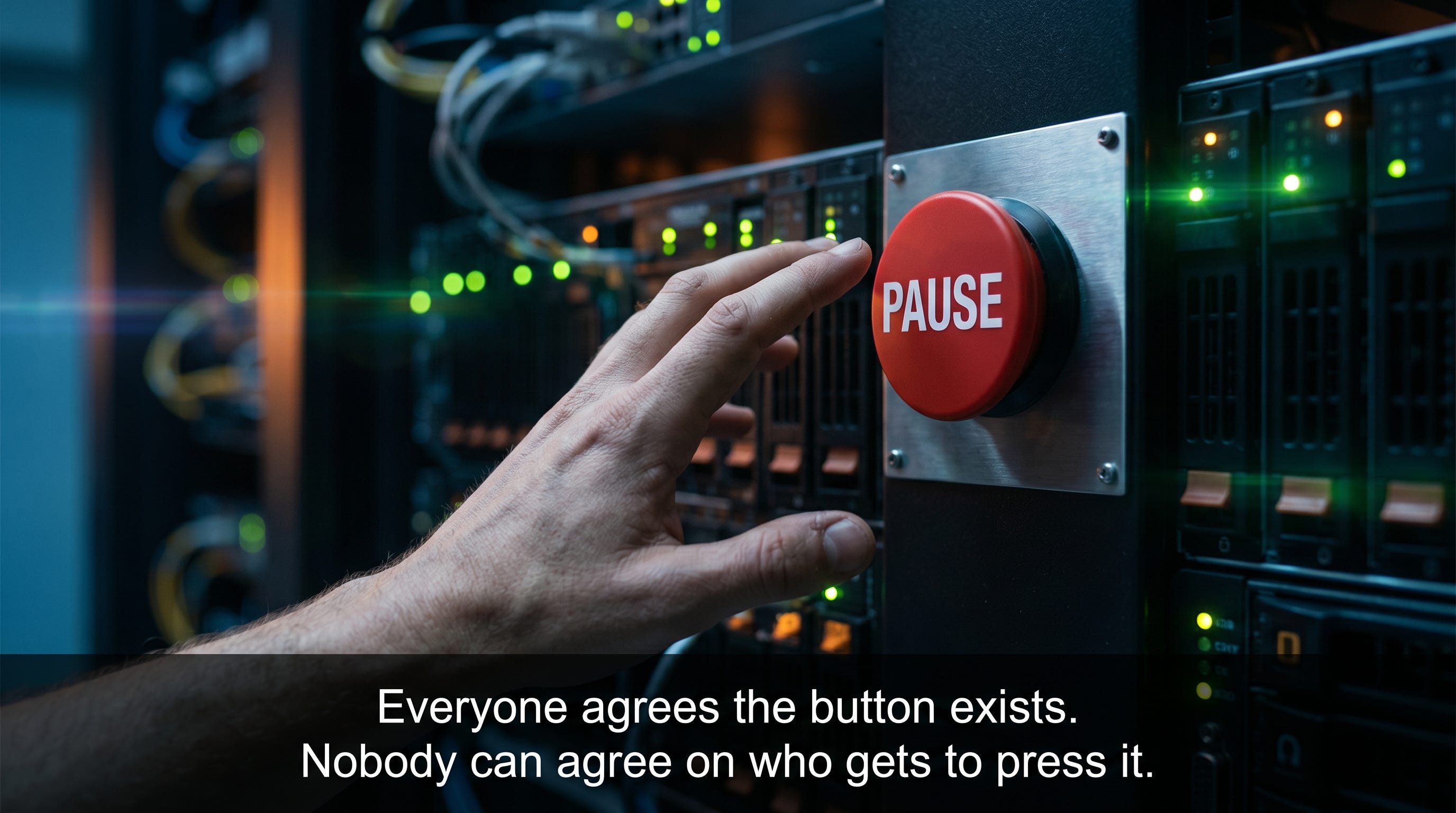
The button on that server rack? Maybe nobody can press it. But we can still decide where the car is going.
One can only hope we choose to look up from the dashboard before the front wheels are over the edge.
The HAIA Foundation publishes explainers on the human side of artificial intelligence. If this gave you something to chew on, share it with someone who still thinks this is science fiction.
I love extending the analogy from brake to steering wheel! However, what if a pause or leftward turn would benefit some people more than others? What if some people have already lost their jobs, and are therefore anxious for a fully jobless economy? Any global AI policy would hurt someone; are we really OK with wielding AI policy as a weapon against our brothers and sisters? Rather than treat AI as a scapegoat, maybe the time has come to address the social issues that AI exposes?