
I still have the email.
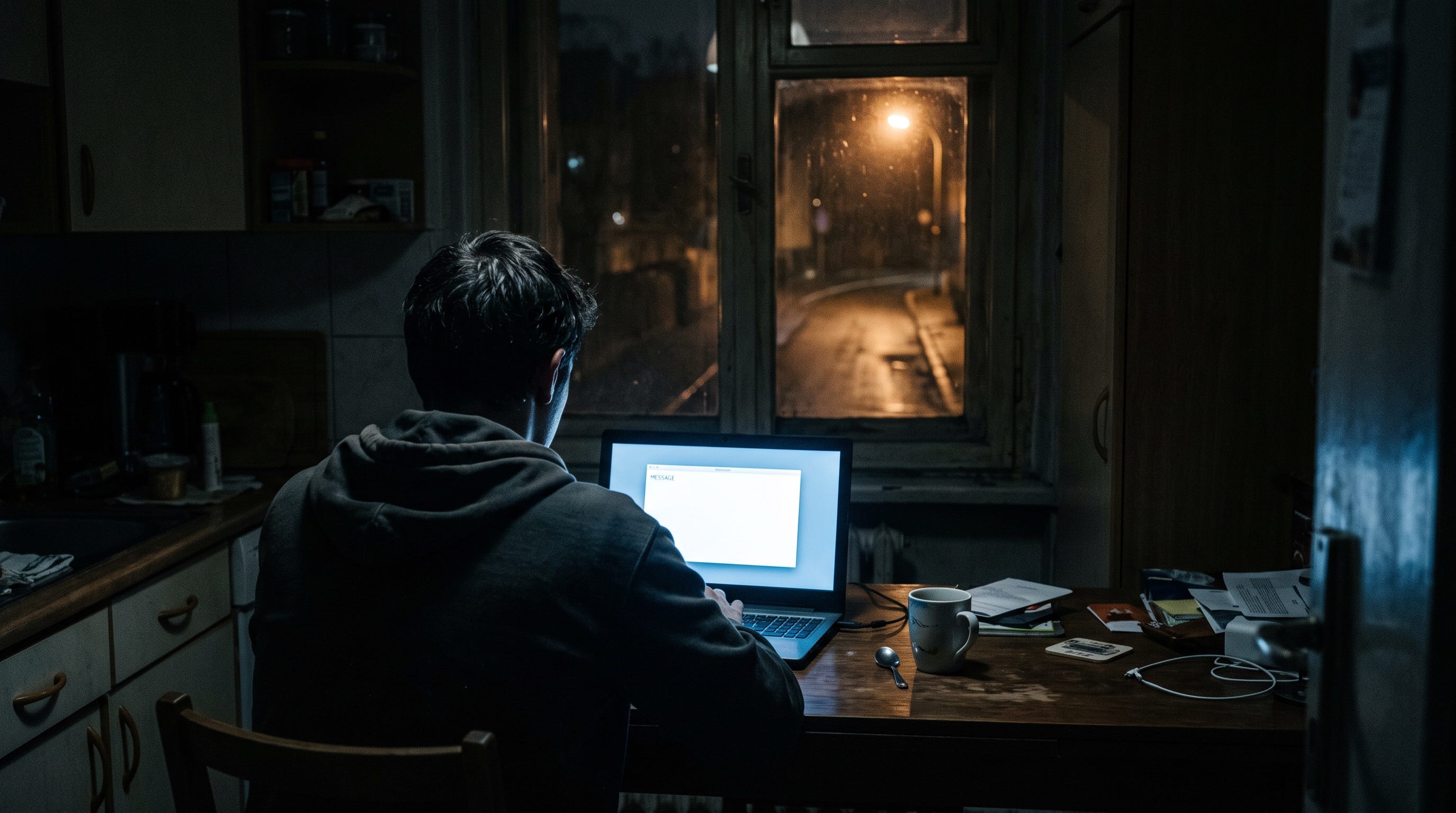
I applied for a job at 11:47 on a Tuesday night — I almost never do (recruiters reach out to me, usually), and I rewrote the cover letter anyway because the second draft was better. The reply arrived at 12:02. Fifteen minutes.
Nobody read that application. I know it the way you know a coin landed wrong: not with proof, just with arithmetic. Fifteen minutes, at midnight, and somewhere inside that quarter of an hour a human being was supposedly weighing my experience against a role I actually wanted. The message said "after careful consideration." Careful by whom?
For a while I told it as a dinner-party joke, because that was easier than saying the true thing — which is that the silence on the other side of the form bothered me more than the no did. Then, in January, a group of applicants filed a lawsuit in California alleging in specific detail the exact thing I could never prove about my own midnight rejection. And the argument they are making is not the argument everyone has been having about hiring software.
First, the part almost nobody is arguing about
Nearly every public fight over AI in hiring is a fight about bias — whether the model scores women lower, whether it penalises a name. That fight matters, and I will get to it. But the lawsuits actually live right now turn on something plainer and much harder to wriggle out of.
Notice. Whether anyone has to tell you the machine was there at all.
On 20 January 2026, applicants sued the hiring-AI company Eightfold AI in the Superior Court of California, Contra Costa County. Nothing in that filing has been proven, and I will fence every sentence about it accordingly. But here is what the complaint filed in Contra Costa County alleges: the platform ranks applicants "by 'likelihood of success' from 0 to 5," employers then use those reports to sift, "typically only reviewing highly ranked candidates," and "lower-ranked candidates are often discarded before a human being ever looks at their application."
Read that last clause again slowly. Discarded before a human being ever looks.
The complaint further alleges the score is built from data the applicant never handed over — "social media profiles, location data, internet and device activity, cookies and other tracking" — assembled into a portrait of their "behavior, attitudes, intelligence, aptitudes and other characteristics." One law firm's summary of the mechanics is brutally clean: applicants were never told, never shown a copy, never able to dispute an error.
Eightfold denies it. When Reuters reported the suit in January — noting the platform is used by Microsoft, PayPal and other Fortune 500 firms — a company spokesperson said flatly: "We do not scrape social media and the like. We are deeply committed to responsible AI, transparency, and compliance with applicable data protection and employment laws." Employment lawyers say the case may be the first of its kind and that "it is not clear whether the claims will survive litigation." This is an accusation, not a finding.
The law they are reaching for is fifty-six years old
Here is where it gets genuinely interesting, and where I changed my own mind about what kind of problem this is.
The plaintiffs are not asking for a new AI statute. They are reaching for the Fair Credit Reporting Act — the 1970 law that governs background checks. Under the notice the law has required since 1970, an employer who pulls a "consumer report" on you must make "a clear and conspicuous disclosure … in writing," in a document that "consists solely of the disclosure," before the report is obtained — and before taking adverse action on it, hand you "a copy of the report" and "a description in writing of the rights of the consumer."
Why does a fifty-six-year-old credit statute read like it was drafted for algorithmic hiring? Because Congress was worried about precisely this shape of harm. The complaint quotes the Senate report from the time, and it is the best sentence in the file: unless a person knows he is being rejected because of a report, "he has no opportunity to be confronted with the charges against him and tell his side of the story."
That is not a technology problem. That is a due-process instinct, written down in 1970, about secret scores.
To be clear — and this is what the headlines flatten — no court has decided whether an AI screening vendor counts as a "consumer reporting agency." Practitioners call it the plaintiffs' legal theory, not settled law. The duties are settled; whether they attach to a match score is the open question. If the theory lands, employers owe standalone disclosures, written authorisation, copies of reports and a chance to dispute. If it doesn't, we are back to nothing.
Meanwhile, a separate case has already survived its first real test. In the docket in Mobley v. Workday, a federal judge dismissed the theory that Workday was an "employment agency" — but allowed a different one through, holding that Workday could potentially be held liable as an "agent" of the employers who rejected the plaintiff's application. In May 2025 the court preliminarily certified an age-discrimination collective, and the court-authorized notice that went out this February reached anyone aged 40 or over who applied through the platform since 24 September 2020. That opt-in window closed on 7 March 2026 — if you are reading this now, it has passed.
The reasoning is what travels. As HR's own trade press reported, the court held that a vendor whose tool performs "screening, ranking, recommending, or rejecting" is acting as the agent of its employer-customers — Workday responding that "our technology looks only at job qualifications, not protected traits like race, age, or disability." Along the way, per Forbes on a 1967 law and a mountain of rejected applications, the company disclosed its tools rejected applications "numbering in the billions" in the relevant period, and the court said the collective could implicate hundreds of millions of people.
Not files. People.
Now the numbers — and I am going to be annoying about them
In May 2026, the recruiting platform Greenhouse surveyed 2,950 job seekers. Sixty-three percent had been interviewed by an AI. Fifty-one percent never heard back at all. And seventy percent said they were never clearly told that a machine would be the one evaluating them. A month earlier, a survey of 1,066 US job seekers found half had received a rejection with zero human feedback in the previous year, and 68.5 percent said AI was never disclosed to them.
That is the seven in ten in my title, and I want to be honest about which seven in ten it is — because there is a louder number going around, and it is much shakier.
You will see it everywhere: that roughly three-quarters of companies let the software do the rejecting on its own, from a Resume.org survey in August 2025 whose panel was 1,399 full-time workers — an odd group to ask about company policy. A May 2026 survey of 1,000 hiring managers similarly found seven in ten employers, by their own account, using AI in hiring decisions. Both are recruiting-industry surveys, not peer-reviewed research.
Now the awkward part. When the Society for Human Resource Management asked 1,908 HR professionals in December 2025, HR's own trade body put the number far lower: AI showed up in recruiting at just 27 percent of organisations. A four-fold gap, and I cannot reconcile it for you. So I am doing the only honest thing — telling you both, and hanging my headline on the number that is actually about you: what applicants were told.
The case for the machines is better than you'd like
Let me take the other side seriously, because there is a real argument here.
Recruiters are drowning. In March 2026, Robert Half found two-thirds of hiring managers saying AI-written résumés have slowed hiring down, and 84 percent of HR leaders reporting heavier workloads from the flood of AI-generated applications — the other side of the funnel, where the applications arrive. We used a machine to write the letters. They used one to read them. Neither of us started it.
There is also a serious legal objection to the whole regulatory push. Bradford J. Kelley — a former EEOC lawyer, so not a random contrarian — makes the strongest case against writing new rules at all in the Harvard Journal on Legislation: "existing federal law and regulations apply to AI, just like any other tool," and the notice-and-audit mandates already tried have been "widely panned as 'a toothless flop,' a 'bust,' and completely 'ineffective.'" From the free-market side, analysts at the R Street Institute warned in March 2026 that state mandates on "consequential decisions" impose "open-ended mandates on innovators" and are metastasising into a fifty-state patchwork.
Both points land. Neither answers the applicant's question, which is not "should there be a new statute" but "was I scored, and by what?" You can believe every word Kelley wrote and still think a person is owed one sentence telling them a machine made the call.

America already wrote this rule. Twice. Ask how it went.
Here is where the story turns, and it is not the turn I expected.
The usual shape of a piece like this is: some other country solved it, why can't we. But this one has already been legislated in the United States — repeatedly — and the results are the whole lesson.
New York City's Local Law 144 has required, since 2023, that employers using automated employment decision tools run an annual bias audit, publish it, and notify candidates. Exactly what I have been asking for. So researchers went and checked. Student investigators surveyed 391 New York City employers and found eighteen out of three hundred and ninety-one employers had published an audit report, and thirteen had posted a transparency notice. Five percent and three percent. The peer-reviewed write-up gave the phenomenon a name that deserves to enter the language: null compliance — a law obeyed in a manner that makes disobedience impossible to detect.
Why so low? Because the trigger conditions are self-assessed. A researcher who studied the rollout told The Register the quiet part: employers who paid for the audit and then simply declined to post it when the numbers came back ugly. The audit was real. The publication was optional in practice.
Illinois tried a cleaner version. As of 1 January 2026, Illinois started requiring notice before an employer uses AI for recruitment, hiring, promotion or discipline — building on the state's earlier video-interview law, which required consent and an explanation of how the system evaluates you. And since 1 October 2025, California's civil rights regulators have treated automated-decision systems as capable of violating state anti-discrimination law directly.
Federally, the direction of travel reversed. In January 2025 the EEOC removed its AI hiring guidance from its website; when reporters checked in March 2026, the federal guidance page was still gone.
So this is not a hard problem waiting on a breakthrough in policy design. Three American jurisdictions have already written the sentence, and the sentence is roughly: tell the applicant. What nobody has built is anything that makes silence cost something.
Now imagine the score follows you
Think a few years out, because the mechanism that worries me most is not bias. It is sameness.
Researchers got hold of something outsiders rarely see: the raw pipeline of a real algorithmic hiring vendor — 4,197,168 applications from 3,372,132 applicants. Their 2026 finding is that when the algorithm says "do not recommend," applicants are likely to be rejected without consideration by a human. Then the part that made me put the paper down: the first real-world evidence of systemic rejection at scale. Of applicants who apply to ten positions, four percent are rejected from all ten — and the rate decays more slowly than chance predicts. Stanford's summary puts it plainly: people screened by the same vendor are more likely to be rejected from every position than if those employers had decided independently.
They didn't. They only looked like they did.
So picture 2031. Three or four scoring layers sit underneath most of the labour market, the way three credit bureaus sit underneath consumer lending. Your score is not a conspiracy; it is an inference, drawn once from a stale data trail, then quietly consulted by four hundred employers who each believe they decided for themselves. You apply for two years. Nobody tells you a score exists, so you never ask to see it, so you never find the error — the abandoned account, the wrong middle initial, the six-month gap the model read as instability.
We built exactly this once, for credit, and hated it enough to pass a law in 1970. The difference is that a credit denial arrives with a letter telling you which bureau to call. A hiring denial arrives at 12:02 in the morning and says "after careful consideration."

What the people who study this for a living say
The concern is not confined to one side of the aisle, which is why I think it eventually goes somewhere.
Civil-liberties researchers have made the notice argument for years. The ACLU has warned that with algorithmic decision systems, impacted individuals and communities might not even know they are interacting with these systems — which is the whole ballgame, because a harm you cannot detect is a harm you cannot sue over. Technology-policy researchers at Upturn asked the EEOC to say so plainly, urging guidance on when vendors themselves can be liable for how their tools function.
The bias evidence has meanwhile stopped being speculative. In that same dataset, researchers found more than one in four applications from Black job seekers — nearly 40,000 submissions — went to positions where the algorithm produced outcomes federal guidelines define as discriminatory; the vendor's current owner did not respond to a request for comment. Separately, the ACLU filed a complaint against Intuit and HireVue on behalf of a deaf and Indigenous employee required to use an AI video-interview platform to apply for a promotion; HireVue's chief executive called it "entirely without merit."
And from the right, R Street and Kelley are not saying there is no problem — they are saying new statutes are the wrong instrument because existing law already reaches this conduct. Fine. The Eightfold suit tests exactly that proposition: can a 1970 statute reach a 2026 score? If the sceptics are right that old law suffices, they should be cheering the plaintiffs on.
The market, for its part, has priced in the risk. Lawyers are already advertising for the next plaintiffs in AI screening and interview cases. Whatever the courts decide, the litigation is coming.
So what does this mean for you?
You cannot fix the hiring market. You can change what you know and what you ask.
Ask, in writing, at the point of application. One line: "Please confirm whether automated tools will be used to screen or score this application, and whether a human reviews rejections." It costs nothing. In Illinois it is now your right. Everywhere else, the asking creates a paper trail.
Treat instant rejections as data, not verdicts. A no inside an hour is a filter result. It tells you about the pipeline, not your worth. I wish someone had told me that at 12:02.
Ask for the basis of an adverse decision. If a score was used, ask what it was and what data fed it. You may get nothing — or you may be the applicant whose email ends up as an exhibit.
Audit your own data trail. The complaint alleges these profiles draw on social profiles, device activity and cookies. Close abandoned accounts, tighten public privacy settings, assume anything scrapeable is scraped.
Keep the records. Save the confirmation, the timestamp, the rejection. Collective actions are built out of ordinary people's timestamps.
Know your jurisdiction. New York City, Illinois and California give you more than most states do. If you have a rule, use it. If you don't, that is a thing to say to a legislator who almost certainly has not been asked.
If you are ever the one hiring, insist on the boring clause: no automated rejection without a human reviewing the rejected pile. That is a procurement decision, not a moral one, and it is available today.
The lesson, as I see it
I spent a long time being told the problem with hiring AI is that it might be unfair. That framing always struck me as slightly off, and now I can say why: unfairness is arguable. You can dispute a judgement. What you cannot dispute is a judgement you were never told was made.
Every one of these cases — the Eightfold allegations, the Workday collective, the empty New York audit registry, the four percent rejected everywhere at once — is a variation on one missing sentence. Not "we found you unqualified." Just: a machine scored you, here is the score, here is how to correct it if it's wrong.
Congress wrote that down in 1970 because it understood something we keep having to relearn — the danger of a secret file is not that it is wrong, it is that you cannot answer it. Fifty-six years on, we have rebuilt the secret file, made it faster, pointed it at the labour market, and forgotten to attach the letter.
My vote? Attach the letter. It is one sentence, it is already law in three American jurisdictions, and nobody's machine breaks if we send it.
And if a rejection ever lands fifteen minutes after midnight — at least now you know which of you was careless.

Somewhere out there is a machine that read your application in four seconds and a company that will swear it took careful consideration. Both of those things cannot be true — and you are allowed to say so out loud.