
Here's how surveillance pricing actually works, and what you can do about a price built just for you.
Here‘s the small, slightly smug habit I have to own up to. When I shop online for anything that costs more than a dinner out, I do a little ritual: I check the price on my laptop, then on my phone, then — because I am exactly this person — in a private browser window with no cookies, sometimes on a different network entirely. I used to think of this as savvy. The diligent shopper, outmaneuvering the markup. For years it felt like a minor superpower.
Then one evening I caught the same pair of shoes sitting at two different prices on two devices in my own kitchen, and the smugness curdled into something colder. Because the obvious question — which price is the real one? — has an answer I didn‘t want. Neither of them. They were both real, and they were both fake. Each was a price computed for the version of me the seller thought it was looking at. I wasn‘t outsmarting the markup. I was producing data points for it.
That practice has a name now, and lawmakers in two dozen states are racing to outlaw it. It‘s called surveillance pricing — and the uncomfortable premise of this piece is that the store, the app, the airline, the grocery cart, may already know what you‘ll pay before you do.
What surveillance pricing actually is
Let‘s get the definition right before we get angry about it, because the precision matters.
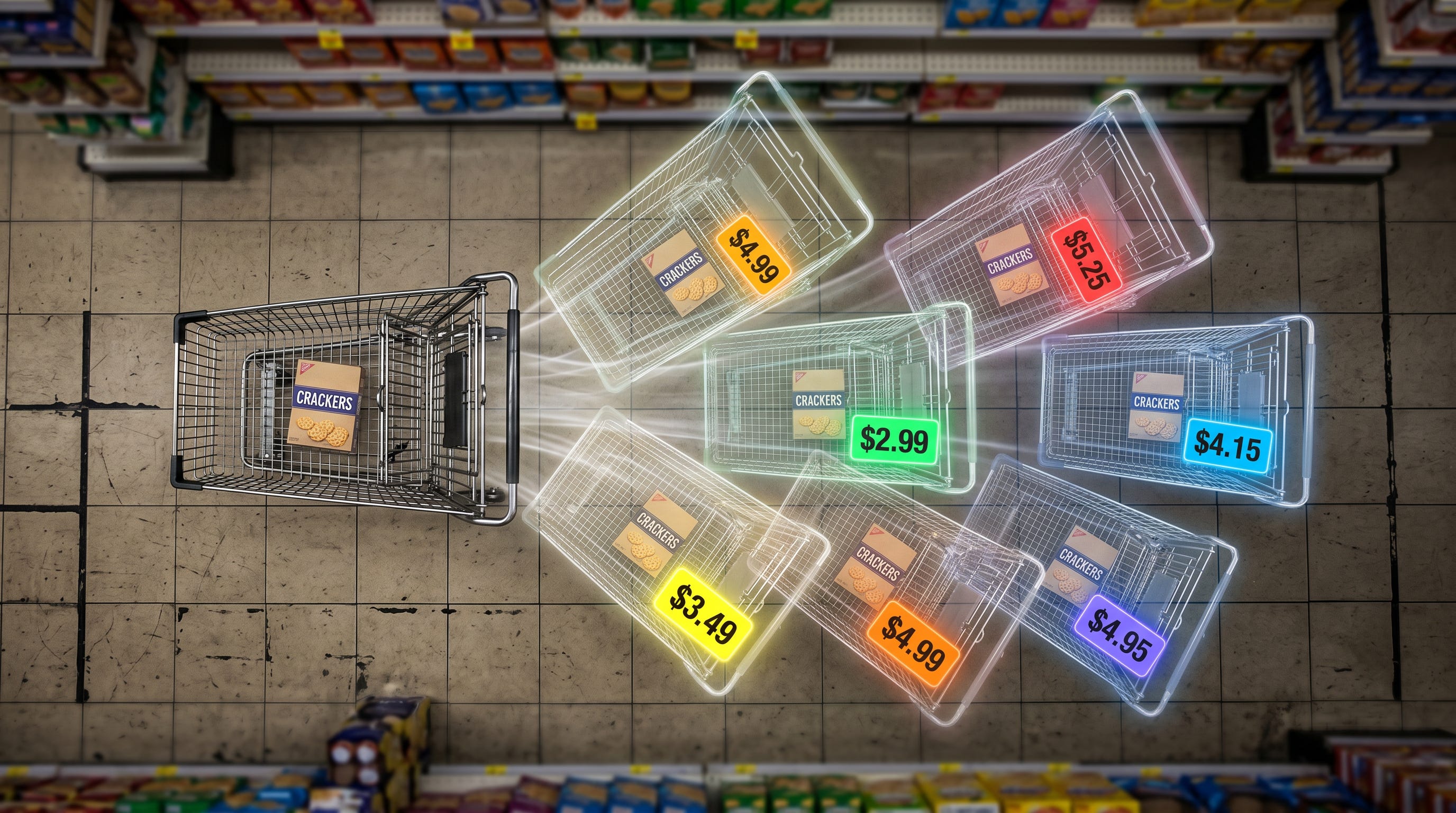
Surveillance pricing is not the airline fare that climbs as the plane fills up, and it is not the umbrella that costs more when it rains. Those are old, blunt tools — the same higher price shown to everyone in the same moment. What‘s new is the individualized version: a price built for you, specifically, out of what a company has quietly learned about you. As one legal summary of New York‘s new bill puts it, the practice means using a consumer’s personal data — browsing history, device type, income, location, or ZIP code — to charge different individuals different prices for the same product or service. Same item. Same instant. Different price tag, because the tag is reading you.
And this isn‘t theory. In January 2025, the FTC’s surveillance-pricing study — a formal look at how intermediaries actually do this — found that the inputs run from the mundane to the genuinely unsettling. A person‘s precise location, their browser history, their demographics — and, the agency noted, signals as granular as mouse movements on a webpage to the type of products that consumers leave unpurchased in an online shopping cart. Sit with that one. The fact that you hovered, hesitated, and abandoned a cart at midnight is not forgotten. It is an input. Your hesitation has a price.
Want the proof case, the one that actually happens at the checkout you use? Look at groceries. An investigation by the progressive research group Groundwork Collaborative — and notice the title, because it‘s where this article borrows its name — documented that Instacart‘s pricing engine offered, in their words, five different sales prices for the exact same grocery item, in the exact same store, at the exact same time. Not over a week. Not across different stores. The same can of something, the same shelf, the same minute, five prices — depending on who was looking. When CBS News covered the same testing, it found that for one Seattle Safeway, a box of Wheat Thins differed by as much as 23%, and that across a typical basket the price variations could cost families $1,200 a year. That is not a rounding error. That is a car payment, skimmed off the top of the grocery bill, distributed by an algorithm according to a logic you never get to see.
Then there‘s the near-miss that put the practice on every cable-news chyron. Last summer, Delta’s plan to set fares with AI — to run roughly a fifth of its domestic ticket pricing through an AI company called Fetcherr — drew an alarmed letter from Senators Ruben Gallego, Mark Warner, and Richard Blumenthal, who warned the technology could push fare price increases up to each individual consumer’s personal “pain point”. That phrase — pain point — is the whole game stated out loud. The most a given person will tolerate before they walk away, computed and charged. To be fair to Delta, the airline pushed back hard, saying it has no product that “targets customers with individualized offers based on personal information.“ Take the denial at face value. The point is that the senators understood exactly what the architecture is for — and so should you.
So that settles it — surveillance pricing is just robbery. Right?
Not so fast. If I‘m going to ask you to be suspicious of an algorithm, I owe you the strongest version of the argument I‘m trying to beat — and there is a real one, made by people who are not shills.
Start with the economists. To a free-market thinker, what I‘ve been calling surveillance pricing looks suspiciously like the thing markets have always done: charge what different buyers are willing to pay. From that chair, the writer Paul Schwennesen argues at the American Institute for Economic Research‘s outlet that surveillance pricing is just normal pricing, free-market economists counter, and that the real danger is the cure — that if lawmakers ban it, consumers will pay the cost — in higher prices, reduced choice, and stifled innovation. A coupon, after all, is a personalized price. A student discount is a personalized price. Where exactly, the argument goes, is the bright line between a senior discount and an algorithm that figures out you‘re a senior?
Then there‘s the equity twist, which genuinely caught me off guard. Writing in The Conversation, one University of Michigan marketing professor argues that personalized pricing might actually run progressive — that if the algorithm charges the wealthy more and the broke less, then wealthy customers pay more for identical goods, while lower-income customers pay less, effectively functioning as a quiet, means-tested subsidy. It‘s a clever point and I don‘t want to wave it away. (Though I‘ll note: nothing forces the algorithm to be Robin Hood. It optimizes for the company‘s margin, not your dignity — and a tool that can detect “low income“ can just as easily read it as “desperate, charge more.“)
And it isn‘t only op-eds. Peer-reviewed work matters here too. Research from Carnegie Mellon, with collaborators at MIT and Yale, challenges the reflex that using customer data to set different prices is automatically bad — finding instead that the welfare effects of these practices depend entirely on how the data reshape demand across the market. In plain English: it depends. Sometimes personalized pricing expands access; sometimes it just transfers money from your pocket to a shareholder‘s. The honest answer is that the practice is not uniformly evil — it is uniformly opaque, and that is the part I cannot make my peace with.
Because here is where the steelman cracks for me. Every benign analogy — the coupon, the student discount, the senior rate — shares one feature this technology destroys: you know it’s happening. You clip the coupon. You show the student ID. The discount is a transaction you can see and refuse. Surveillance pricing is the coupon turned inside out — applied to you, without your knowledge, based on a dossier you never consented to and can‘t inspect. The problem was never that prices vary. The problem is that the variation happens in the dark.
Which is exactly the thing Europe decided to drag into the light
So what do you do about a practice whose central sin is secrecy? Here the United States and Europe have, characteristically, taken opposite first steps — and the European one is more interesting than the slogans suggest.
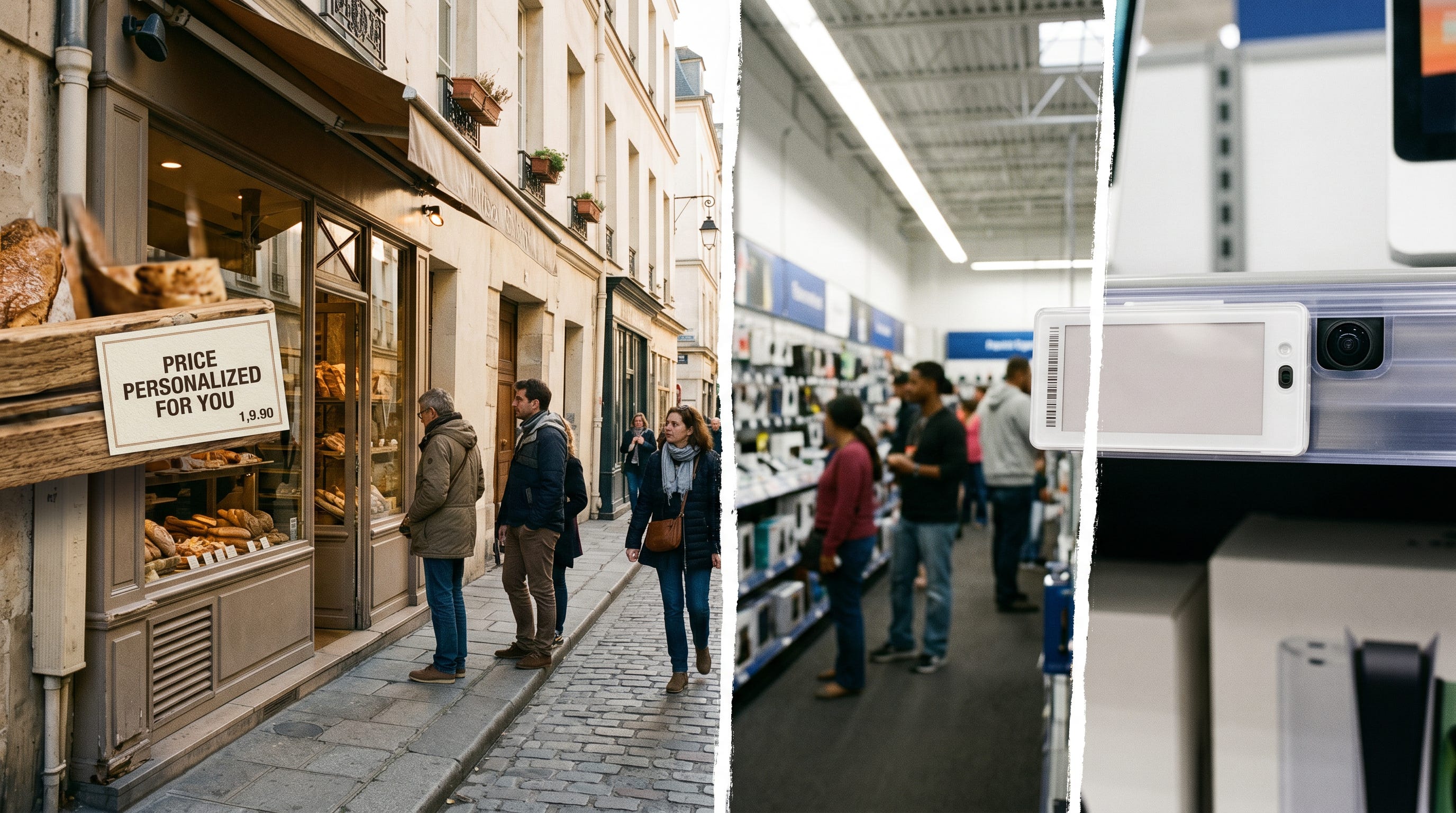
A quick myth-bust first, because it‘s everywhere: Europe has not “banned“ personalized pricing. That‘s not what happened. What it did is subtler and, I‘d argue, more clever. Under a reform to the EU‘s consumer-rights regime, traders now face a disclosure duty. As a European Parliament study lays out, a new provision of the Consumer Rights Directive requires traders to inform consumers if they apply personalised pricing based on automated decision-making — and the study presses that the notice should sit right next to the price, where it “cannot be overlooked.“ A practitioner summary confirms the shape of it plainly: the CRD requires traders to inform consumers if a price has been personalized based on automated decision-making, layered on top of European data-protection law that already constrains what companies can do with your personal data in the first place.
Notice the philosophy. Europe didn‘t (yet) outlaw the dossier. It outlawed the secret. The bet is that a personalized price, forced to announce itself — this price was set for you, by a machine, based on your data — mostly dies of embarrassment. People who know they‘re being read tend to clear their cookies, switch devices, walk away. Disclosure turns my paranoid kitchen ritual into a right. That‘s a different theory of regulation than a flat ban, and it‘s worth holding in mind as the American states reach, mostly, for the heavier hammer.
Now play it forward a few years
Let me put down the citations for a moment and ask you to imagine, because the trajectory is not hard to extrapolate — it‘s just hard to look at.
It‘s a few years from now. The dossier didn‘t shrink; it grew. The price you see for a flight knows that you searched it three times this week, that your calendar (synced, helpfully, to everything) shows a funeral in another city, and that people who search a one-way fare under those conditions don‘t haggle. So the fare firms — to your personal pain point, precisely. You‘ll never know, because there‘s no second price to compare it against; the “list price“ is a fiction maintained for nobody.
It‘s a few years from now, and your smart fridge has noticed you‘re nearly out of the oat milk you buy every week. The grocery app knows you won‘t drive across town for it. The price ticks up — quietly, two percent, beneath the threshold where you‘d notice — precisely because the app has learned you won‘t notice. Convenience and surveillance turn out to be the same product sold twice.
It‘s a few years from now, and the pricing engine has read enough of your bad nights to recognize the 1 a.m. signature of an anxious insomniac scrolling for something to buy, and it has learned — because the optimization is relentless and amoral — that this is the moment your resistance is lowest. The “deal“ that surfaces at that hour is not a deal. It is a read on your weakness, monetized in real time.
None of that requires a single new invention. Every input already exists; every technique is already deployed somewhere. The only question is whether we decide, as a society, that some things about you should not be for sale to the people setting your prices. Which, encouragingly, is a question a lot of serious people have finally started asking out loud.
What the smart people are saying
This is one of those rare fights where the interesting thing isn‘t that people disagree — it‘s where the agreement is forming, across lines that usually don‘t cross.
On the civil-liberties flank, the Electronic Frontier Foundation — not a group easily mistaken for anti-business — has come out backing state bans, defining the target with useful bluntness as a customized price based on personally identifiable information collected through electronic surveillance. On the other side of the steelman, you have the economists at AIER and the welfare researchers at Carnegie Mellon insisting that context is everything and that a clumsy ban could backfire. Those camps are not going to hold hands. But watch where they‘re converging anyway: almost nobody, across the spectrum, is defending secrecy. The argument has quietly narrowed from “should companies do this?“ to “should you be allowed to know when they do?“ — and once it narrows to that, the disclosure side has the easier case to make.
And the people who write the laws have stopped waiting for the academics to settle it. In March 2026, the House Oversight Committee opened an investigation into AI pricing, with letters to Booking, Expedia, Uber, Lyft, and Instacart, warning that firms could weaponize personal data to find each consumer‘s maximum willingness to pay. That‘s a Republican-led committee. Meanwhile, in New York, it‘s the One Fair Price Act, championed by Democratic Attorney General Letitia James, which would bar companies from using personal data to charge some shoppers higher prices than others for the same product — while explicitly protecting loyalty programs, coupons, and ordinary discounts. Left and right, the same instinct. That‘s usually the sign of something real underneath.
So what‘s actually happening in the law? More than you‘d think. The watershed was Maryland, which this spring became the first state to restrict surveillance pricing — Governor Wes Moore signed the Protection From Predatory Pricing Act, a food-sector law that goes into effect October 1, 2026. (It‘s narrow — large food retailers and delivery apps, with carve-outs for genuine discounts — so don‘t read it as a blanket end to dynamic pricing.) Then Connecticut became the second state to act. And now New York‘s legislature has passed its broader bill — making it the third to clear, though I‘ll be precise here, because the headlines are sloppy about it: the One Fair Price Act passed the legislature and sits on Governor Hochul‘s desk awaiting signature. It is not yet law. Underneath those headline states is a genuine wave: a patchwork of state bills that already runs to more than 40 bills across at least 24 states in 2026 alone, some demanding disclosure, others outright prohibition.
What does this mean for you?
You don‘t run a grocery chain and you can‘t pass a law this afternoon. But the dossier is built from your behavior, which means some of the leverage is genuinely yours. A few concrete moves:
Make yourself harder to read. My paranoid kitchen ritual turns out to be sound practice: clear cookies, compare in a private window, check the same item across devices and networks before you buy. You won’t beat the system every time, but a noisier signal is a worse input — and a worse input is a less confident price.
Treat your hesitation as data, because it is. That abandoned cart, that item you eyed for a week — the FTC confirmed those are pricing inputs. If something nudges up the longer you circle it, that’s not a coincidence. Decide before you browse, and walk away early rather than late.
Be suspicious of the perfectly timed “deal” — especially at odd hours. A discount that materializes exactly when you’re tired, anxious, or in a hurry is the algorithm reading your moment, not rewarding your loyalty. The best defense against a price set to your weakness is to not shop from your weakness.
Know which state you’re in — and use it. If you’re in Maryland or (soon) Connecticut, or New York if the governor signs, you have new rights worth knowing. If your state is one of the two dozen with bills moving, a single email to your legislator carries more weight on a live bill than it ever will on a dead one.
Push for the European question, not just the American one. “Ban it” is a long fight. “Tell me when you’re doing it” is a winnable one. Disclosure — the right to see that a price was personalized for you — is the reform with the broadest coalition behind it, and the one worth asking your representatives about by name.
The fair price, as I see it
I‘ll confess the ritual hasn‘t stopped. I still check the shoes on three devices, still open the private window, still feel that small flush of having beaten something. But I understand the game differently now. I‘m not a clever shopper outwitting a dumb store. I‘m one person, with my hesitations and my 1 a.m. weaknesses and my predictable Tuesday oat milk, sitting across a one-way mirror from a system that has studied a million people like me and priced accordingly.
The thing I keep coming back to isn‘t that prices vary — prices have always varied. It‘s that we‘ve quietly accepted a world where the price is set by what the seller knows about you, and you‘re forbidden from knowing the same about the deal. That‘s not a market. A market needs two informed parties. This is one party reading the other‘s diary and calling the result a price.
The good news — and it is genuinely good news — is that, for once, we‘re not too late. The technology is racing, but so is the response: dozens of states, both parties, a federal probe, and a European playbook that already shows the lighter, smarter move is to force the secret into the open. We don‘t have to outlaw every clever algorithm. We just have to insist on the oldest rule in any honest store: the price on the tag is the price for everyone — or, at the very least, you get to be told when it isn‘t. That‘s not anti-technology. That‘s just fair. And fair, it turns out, is still something we get to vote for.
If this made you glance a little differently at your own cart, do the most useful thing you can with it: forward it to the friend who shops at 1 a.m., or the one who swears their phone shows different prices than their laptop. They were right — and now they know why. The HAIA Foundation keeps watch on the quiet machinery deciding how we live with intelligent systems, one Substack post at a time.