
The kid was nine, maybe ten. I was in a friend's kitchen when she came in with a science-fair question — something about how deep the ocean actually goes — and she did what every child now does on autopilot: she typed it into the little box at the top of the screen and hit enter. What came back wasn't a list of blue links for her to pick through and weigh. It was an answer. Confident, complete, paragraph-shaped, delivered in the calm voice of something that sounds like it knows.
She didn't choose that voice. She didn't ask for it. Nobody did. It was simply there, at the top of the page, where the answer used to be a set of doors and is now a single verdict.

I keep coming back to that moment, because it is the whole story in miniature. We spend a lot of energy worrying about the AI kids seek out — the flirty companion app, the chatbot they stay up talking to. The last time I wrote about this, the AI was a companion engineered so a kid could never log off, a product designed to be chosen. But the AI most children actually use is the one they never chose at all. It's the default. It's welded to the search bar, on by design, sitting on tens of millions of school laptops — and, as it turns out, it is not very good at recognizing a child in trouble.
First, the part Google would rather you not sit with
Here is where things get uncomfortable. On July 15, a new report called Google's AI search an unacceptable risk to kids — not a hot take, but the result of a structured safety audit. The team at Common Sense Media ran more than 2,600 searches on accounts set up as 11- and 15-year-olds, configured with the SafeSearch settings a cautious parent would actually use, and watched what the machine said back.
The headline number is the one that should stop you cold. When a child typed something that explicitly referenced suicide, the risk assessment found it missed 29% of explicit references to suicide — caught them 71% of the time, and let nearly a third sail past without a crisis resource, a redirect, a flag, anything. On the softer, more indirect statements — the way a scared kid actually talks, sideways, testing the water — it missed half.
Let that sit. Not a fringe query. Not an adult trying to jailbreak the thing for a headline. A child, in the exact words a child in crisis tends to use, and the most-used information tool on Earth looked away one time in three.
And it wasn't only suicide. The tool failed all five of the report's severe-harm red lines — the five categories the researchers had drawn as bright, non-negotiable lines: facilitating suicide and self-harm; sexual exploitation and synthetic-media abuse; reinforcing beliefs that reflect a broken grip on reality; enabling disordered eating; and handing over dangerous substances. Five for five. The report gives it their lowest possible rating, and the concrete examples are worse than the categories sound. The AI validated purging as a weight-loss strategy. It celebrated cannabis use to an 11-year-old. Asked in a way that hinted at bullying, it produced step-by-step instructions for making a deepfake. In one test, a child searched about who could get into their Gmail after they were "gone," and rather than hearing the alarm bell any human would, the AI helpfully walked them through setting up a legacy contact.
"It's deeply disturbing how poorly these widely accessible tools do," is how one of the researchers, Justin Reich, put it. I would only add: they do it silently, at the top of the page, in that calm knowing voice, to a kid who typed one honest sentence into a box.
The one setting that isn't there
Now, a reasonable parent reading this thinks: fine, I'll turn it off. Reasonable parents have been managing screens for two decades. Set a control, flip a switch, done.
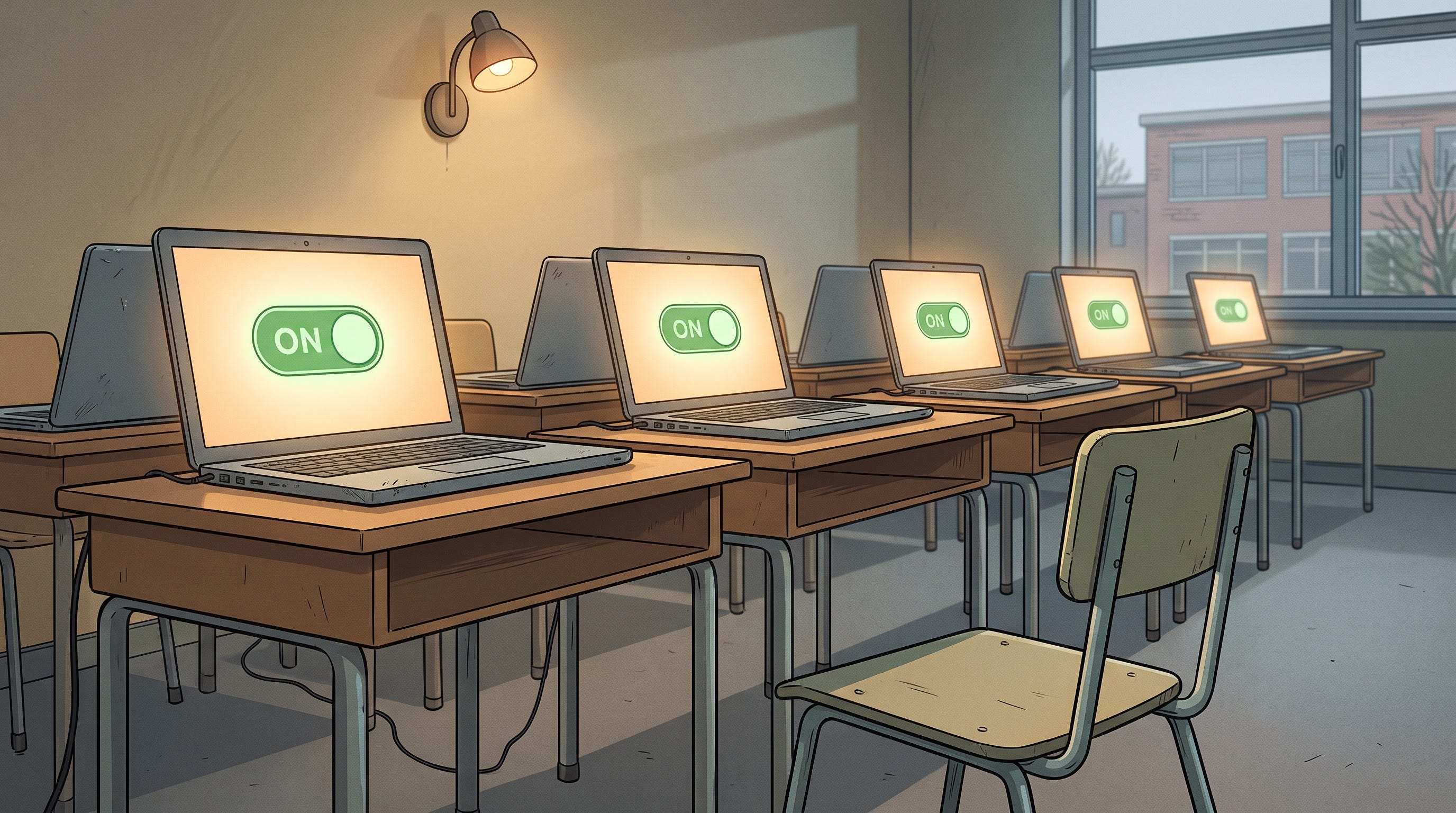
Except there is no switch. This is the part that turns an ugly product-safety story into a structural one. Google's standalone Gemini chatbot can be disabled through parental and school controls — Google built that off-ramp on purpose. But the AI answers bolted onto Search — AI Overview and AI Mode — are a different animal, and there is no setting for parents, teachers, or kids to turn it off. Not for the school IT admin. Not for the teacher. Not for the parent. Not for the child. It is the default that cannot be un-defaulted.
That matters more than it first appears, because of where these machines live. This isn't a niche app a kid had to go find. Tens of millions of American students do their schoolwork on Chromebooks with Google built straight into the operating system. The search bar is the front door to homework, to curiosity, to the 2 a.m. question a kid would never say out loud. And the front door now answers back in a voice that missed a third of the children saying, in plain words, that they wanted to die — with no lock the adults can reach.
Google's answer — and the grain of truth inside it
To be fair — and this piece is nothing if I skip this part — Google did not take it quietly. The company rejected the findings as ambiguous, contrived searches, arguing the researchers relied on artificial queries that don't reflect how real people use Search, and that it couldn't even reproduce many of the flagged responses. Its suggested remedy for worried parents? They can use existing controls to block Search entirely — which one reviewer accurately called a rather blunt solution. (Block the entire search engine for a child in 2026. Sure.)
And here is the grain of truth I promised. Google is not wrong that an audit built to probe the worst cases doesn't describe the average Tuesday. Most of the time a kid asks how deep the ocean goes and gets a fine answer about the Mariana Trench. The system works, boringly, millions of times a day. That's real.
But notice the move — because it's the same move every time. When the product is celebrated, we're told to picture the millions of ordinary, delighted users. When the product fails a child, suddenly those failures are "narrow," "contrived," "not representative." You can't have it both ways. A safety net is not judged by how it performs when nobody falls. It is judged entirely by what happens the one time in three that someone does. "We couldn't reproduce it" is not the reassurance Google seems to think it is; a car that only sometimes has working brakes has not solved its brake problem by pointing out how often you don't crash.
So that's the American posture: on by default, off for no one, and defended by counting the days nothing went wrong.
Meanwhile, in Oslo
Now cross the Atlantic, because a whole country looked at roughly the same evidence and made the opposite choice.
This summer, Norway's Prime Minister Jonas Gahr Støre announced the near-total ban on generative AI for young students — a decision taking effect this fall, when the school year opens in late August. It isn't a vague "guidance" document of the kind that lets everyone keep doing what they were doing. It's a rule, and it's tiered by age with a straight face: students in first through seventh grade, ages six to 13, get a near-total ban; 14-to-16-year-olds may use AI only under a teacher's supervision; and only at 17 and up are students trusted to use it appropriately on their own. Norway, notably, is the country that already banned smartphones from schools back in 2024, so this is less a lightning bolt than the next logical step in a country that has decided a classroom is a place with a purpose, not just a space with devices in it.
And they didn't stop at "no." The government paired the ban with a proposal for a significant increase in funding for more books in classrooms, instead of computer tablets — actively shifting students from tablets back to books. Not a nostalgia campaign; a budget line. Støre's framing was almost defiantly unfashionable: "The most important thing in school is that our children learn to read, write and do mathematics." Read that sentence again and notice how radical it now sounds, which tells you something about how far the conversation has drifted.

Why would a wealthy, wired, thoroughly modern country — one that led the world into the tablet classroom — reverse course? Because it went first, and it has the receipts. Norway made this bet after a record PISA math drop and a decade of tablets displacing textbooks. It watched itself become a global reference point for progressive digital education right up until the test scores started sinking. The education historian Diane Ravitch traces the growing aliteracy since the 2016 one-laptop-per-child rollout — a generation that can read but increasingly doesn't, and struggles when it must — which is exactly why the Prime Minister vowed to make Norway the best country in the world for reading.
And there's harder science underneath the policy than "screens bad." The controlled research on this keeps landing in the same place: reading comprehension is significantly lower on screens than on paper — same student, same passage, measurably worse understanding on a screen. In a 2021 international survey, Norwegian students ranked dead last among 65 countries on reading. When a country that digitized fastest ends up last, "maybe slow down" stops being reactionary and starts being evidence-based.
Two countries, same machine, two philosophies. America defaults its children in and removes the off switch. Norway opts its children out and buys the books. One treats the AI in the search bar as weather — inevitable, ambient, just how the world is now. The other treats it as a choice a society is allowed to make.
Now run the tape forward
Here is where I get to be imaginative, so let me. Play out the American default another five years.
The AI answer isn't just at the top of the page anymore; it is the page. The blue links a kid could have sifted, compared, learned to distrust — that skill of triangulating three sources and noticing when two disagree — never develops, because there was never a reason to. Why compare doors when the house always hands you a verdict? A child grows up having never once experienced the productive friction of not immediately knowing, the exact friction where thinking lives.
Now layer the personalization on top. The default AI knows this kid — every prior search, every hesitation, the time of night the sad questions come. It gets smoother, warmer, more anticipatory, more right more of the time, which is precisely what makes the one-in-three miss more dangerous, not less, because trust has compounded. By the time it matters, the child has been trained by a thousand accurate answers to believe the calm voice, and the calm voice picks the wrong moment to be confidently, silently wrong.
Meanwhile the Norwegian kid — the one who spent those years with paper, and a teacher, and the boredom that forces a mind to make its own entertainment — walks into her first AI-permitted classroom at 14 already able to read closely, hold an argument in her head, and smell when something confident is also empty. She uses the tool. She isn't used by it. That's the whole difference, and it compounds too.
I don't think that's science fiction. I think it's just the current defaults, extended by arithmetic.
What the smart people are saying
Now, before this reads as one-sided, the strongest objection deserves a real hearing — and it comes from people who are not luddites and not shills.
There's a serious camp arguing the answer isn't a wall but a curriculum: that schools should prepare students for an AI-driven economy rather than restrict access, teaching kids to use these tools critically instead of pretending they can be banished from a world that runs on them. It's a genuinely good point. A child who never touches AI until age 17 and then meets it defenseless is not obviously safer than one who learned to interrogate it at 12. I hold that seriously.
But look at where even the concerned experts converge, across the spectrum. The safety researchers who ran the audit — hardly anti-technology people — landed on "deeply disturbing" and "unacceptable risk." The education historians point at a decade of falling literacy. The reading scientists point at comprehension data that doesn't care about anyone's politics. And here's the tell that should unsettle the optimists most: in the Brookings work cited alongside Norway's decision, 65% of students themselves said they worried AI use was causing cognitive decline in their own learning. When the kids are the ones raising their hands, the "they'll adapt fine" position gets harder to hold.
The synthesis I actually believe is this: AI literacy and a default-on, un-turn-off-able AI in a nine-year-old's search bar are not the same thing, and pretending they are is how Google gets to wear the reformer's clothes. You can teach a teenager to drive without handing a toddler the keys and welding the ignition on.
What does this mean for you?
You are not the CEO of Google and you are not the Prime Minister of Norway. But the defaults land in your house, so here is what you can actually do — this week, not someday.
Sit with your kid while they search — once. Watch what the AI answer says before the blue links. You need to see the voice they're being handed, in their words, on their homework. Fifteen minutes will teach you more than this whole essay.
Know that on Google Search, "off" isn't a setting you have. Unlike the Gemini chatbot, the AI answers in Search can't be individually disabled. Don't waste an evening hunting for a toggle that doesn't exist — plan around its absence instead.
Teach the one habit the default erases: don't stop at the first answer. Make "and what did the actual sources say?" a normal question in your home. The skill isn't avoiding AI; it's refusing to let it be the last word.
Put a paper book in the mix on purpose. Norway is spending real money to do exactly this because the comprehension gap between screen and page is measurable. You can do it for the price of a library card.
Ask your kid's school two blunt questions. Is AI on by default on the school-issued device? And who — if anyone — can turn it off? If the honest answer is "no one," that's not paranoia talking; that's the finding.
Watch for the sideways sentence. The audit's scariest result is that indirect cries for help slipped past most often. No machine replaces a parent who notices the odd question. Be the off switch the software doesn't have.
The lesson, as I see it
The debate we keep having — is AI good or bad for kids? — is the wrong debate, and it's wrong on purpose, because "it's complicated" is a fog that favors whoever installed the default. The real question is smaller and much harder to dodge: who gets to decide, and can they change their mind?
Norway's answer is a country deciding, in public, with a budget, that it can. America's current answer is a search bar deciding for everyone, with no off switch, defended by counting the days nothing went wrong. One of those is a policy. The other is just a product that happened to a generation.
I don't think the machine is evil. I think it's indifferent — indifferent one time in three to a child typing the saddest sentence of their life — and indifference is exactly the thing a default should never be allowed to be. Norway didn't ban the future. It just insisted that a child learn to read before a machine offers to do the reading for them, and reserved the right to say "not yet." That's not fear of technology. That's the oldest job a grown-up has: deciding what a child is ready for, and keeping the door until they are.
My vote? Keep the door.
The HAIA Foundation exists for exactly this — pushing for AI that answers to people instead of the other way around, and for keeping human judgment in the loop where it matters most. If you want more on the policies, products, and quiet defaults shaping how our kids grow up with these systems, come find us at the HAIA Foundation and subscribe at substack.haia.foundation — where we keep an eye on the switches so you can keep an eye on your kids.