
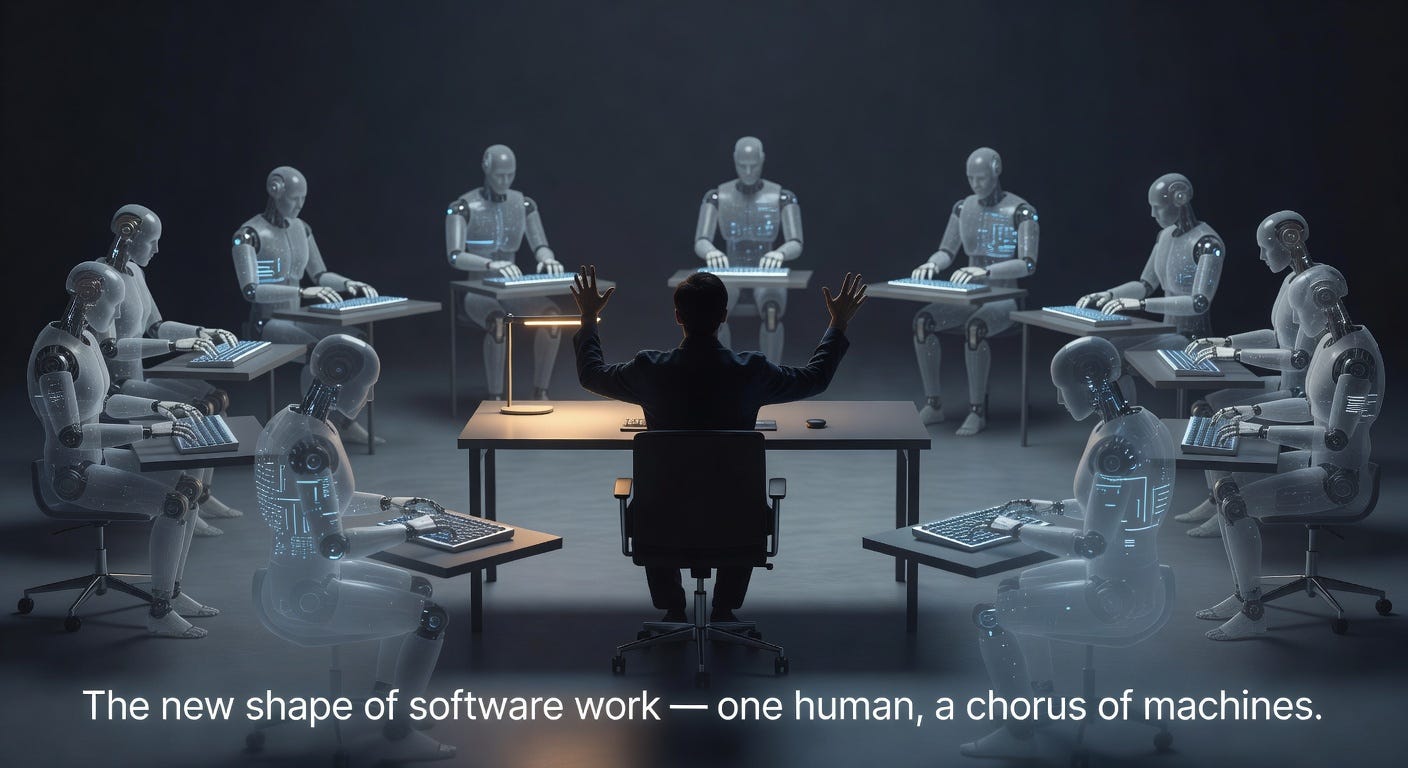
Let me start with a confession that might surprise you.
A large share of the code running the apps on your phone, the website where you check your bank balance, and the system that schedules your doctor’s appointment — a growing slice of it was not typed by a human being. It was generated by an AI, then glanced at (sometimes carefully, sometimes not) by a tired human who clicked “approve.”
I’m not telling you this to frighten you. I’m telling you because it’s one of the most consequential shifts in how things get made in the modern economy, and almost nobody outside the industry is talking about it in plain language. So let’s do that. No jargon walls, no hype, no doom. Just a clear look at what’s happening, why it matters to you specifically, and where this strange new road might lead.
First, what actually changed?
For about seventy years, “writing software” meant exactly that: a person sat down and wrote instructions, line by line, in a language a computer understands. It was slow, skilled, often tedious work — the digital equivalent of a master craftsman hand-fitting every joint.
Then, in the space of roughly three years, the craft inverted.
It started gently, with autocomplete tools that finished your sentences — GitHub Copilot being the one that put the idea on the map. But it accelerated fast. In early 2025, the well-known AI researcher Andrej Karpathy gave the new mood a name that promptly went viral: vibe coding — where you “fully give in to the vibes” and let the machine produce the code while you steer. (It was so culturally sticky that Collins Dictionary named it a word of the year.)
Here’s the thing, though — and this is the part that matters. The label was playful, but the underlying shift is not a gimmick. The people who build software are, increasingly, no longer authors of code. They are becoming managers of code-writing machines.
So far, so good — but “manager” is doing a lot of work in that sentence
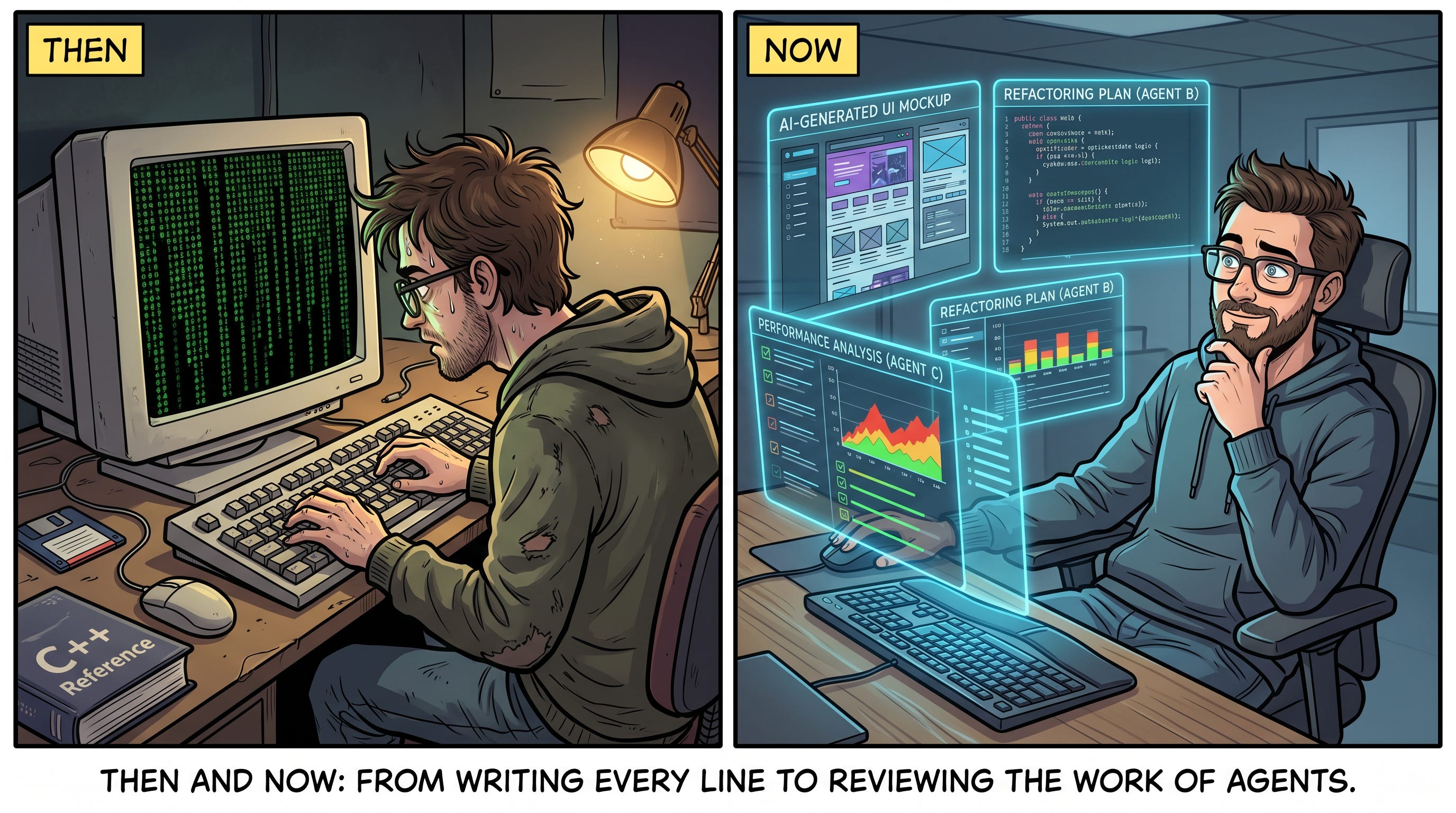
When I say developers are becoming managers, I don’t mean it as a loose metaphor. The industry itself is converging on exactly this language.
The trade press now openly argues that AI coding requires developers to become better managers — that you no longer say “build me a login system” and walk away, but instead write detailed specifications, demand small reviewable chunks of work, and check the output the way a manager checks a junior employee’s report. Harvard Business Review has gone further, arguing companies will soon need a whole new role: the agent manager, a person whose entire job is directing fleets of AI workers. One vendor put it vividly: developers are trading in their keyboards for control panels, directing the flow and stepping back in only when something breaks.
Kent Beck — a genuine legend in this field, one of the people who shaped how modern software teams work — described the experience with unusual honesty. Watching a swarm of AI agents work for him, he noticed something unsettling: “I was managing it. Watching which agent was doing what. Wondering when to interrupt. Holding state in my head that the system should have been holding for me.” He’s taken to calling these agents an “unpredictable genie.” Powerful, yes. Obedient, not exactly.
Think about what that means. We have taken some of the most skilled technical workers in the economy and quietly turned them into middle managers — of software that doesn’t get tired, doesn’t sleep, and doesn’t always do what it’s told.
Why this matters to you (yes, you, who has never written a line of code—or have you?)
You might be tempted to file this under “tech industry navel-gazing.” Resist that temptation. Here’s why it reaches into your life.
First, it’s about the things you depend on. When a human writes the code that runs a hospital system or a payment app, a chain of human understanding runs through it. Someone, somewhere, knows why it works. As machines write more of it, that thread of understanding gets thinner. And there’s evidence this isn’t hypothetical: the security firm Veracode tested AI-generated code across more than a hundred models and found that nearly half of it introduced a known security vulnerability. Not “needs polish” — an actual hole an attacker could climb through. Worse, the newer, bigger AI models weren’t meaningfully safer than the old ones. This is a structural quirk, not a temporary bug.
Second, it’s about quality you can’t see. A research outfit called GitClear studied hundreds of millions of lines of code and found a worrying pattern: as AI tools spread, the careful reorganizing that keeps software healthy collapsed, while copy-pasted and duplicated code shot up. Picture a city where new buildings go up at triple speed but nobody maintains the foundations or the plumbing. It looks like progress. It accumulates as hidden debt.

Third — and this is the human one — it’s about who gets to start a career. This is where things get genuinely sobering.
Here is where things get uncomfortable
There’s a romantic assumption that automation only replaces drudgery, freeing humans for higher things. Sometimes true. But a careful study out of Stanford’s Digital Economy Lab, drawing on payroll records for millions of workers, found something that should give us pause: young workers aged 22 to 25 in the most AI-exposed jobs saw a 16% relative decline in employment, while their experienced colleagues sailed on untouched. The flagship example of an affected job? Software developers.
Read that again. The senior people — the managers — are fine. It’s the entry-level rung, the place where a twenty-three-year-old learns the craft, that’s eroding.
And this is the trap. If AI now does the work that juniors used to cut their teeth on, where do tomorrow’s seniors come from? You cannot manage a genie you never learned to understand. Addy Osmani, an engineering leader at Google, captured the danger crisply: it’s dangerously easy to review code you can no longer write yourself. We may be quietly sawing off the branch we’re sitting on.
I’ll be fair here, because honesty demands it: not everyone agrees this is a one-way street. Kent Beck argues that AI, used well, can actually teach a junior faster than the old apprenticeship ever did. The tool is not the verdict; how we use it is. But “how we use it” is precisely the choice we’re sleepwalking through right now.
But wait — isn’t this all making us wildly more productive?
This is the part where I’m supposed to tell you the magic is fake. I won’t, because it isn’t — but the reality is more interesting than either the boosters or the doomers admit.
When GitHub and MIT researchers ran a controlled test, developers using AI finished a coding task nearly 56% faster. That’s real. McKinsey found similar speedups on routine work — though, tellingly, the gains shrank to almost nothing on genuinely hard problems, and junior developers sometimes ended up slower.
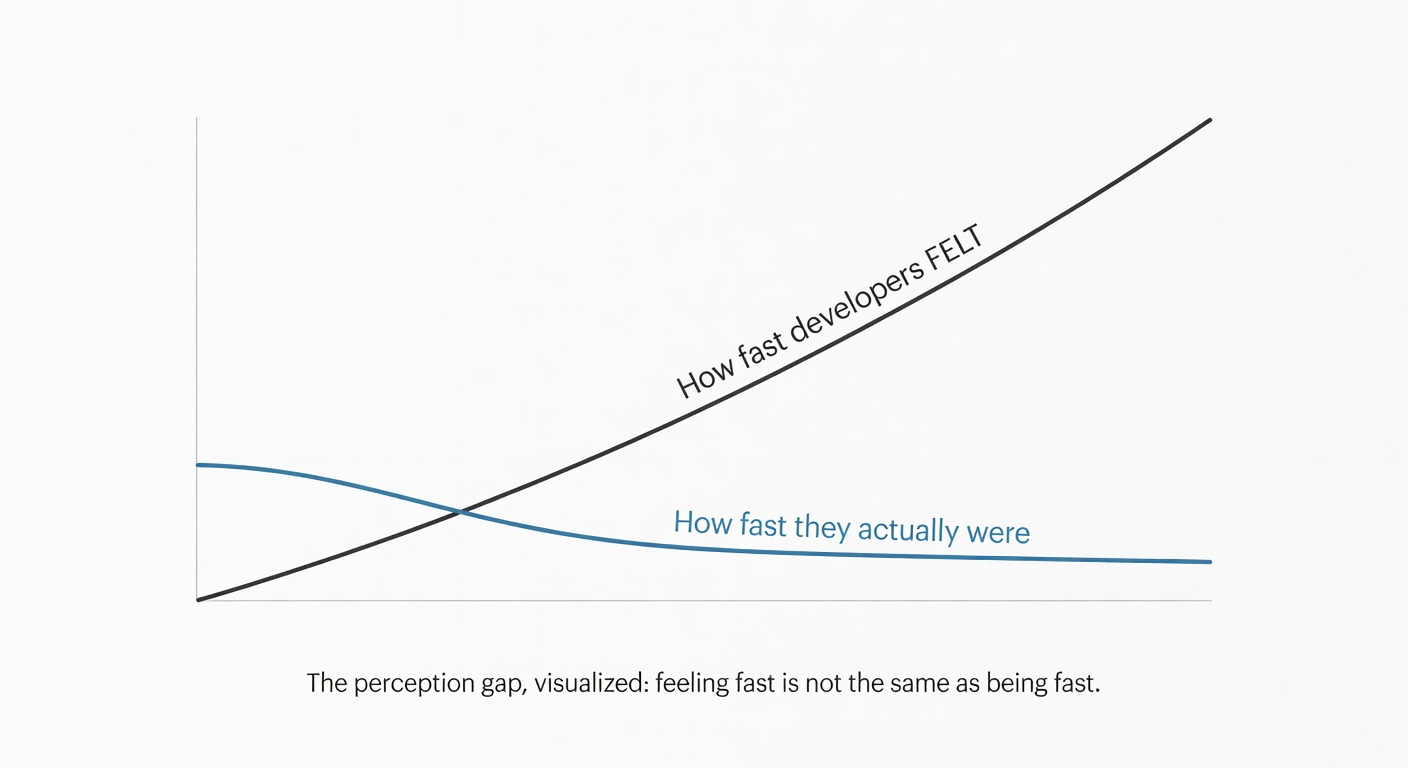
Now here’s the twist that keeps me honest. A research group called METR ran a different kind of test: experienced developers working on their own large, real-world projects. The developers predicted AI would speed them up by about a quarter. Afterward, they felt they’d been roughly 20% faster.
They were actually 19% slower.
Just sit with that gap for a moment. Not only did the tool slow them down on complex, real work — they couldn’t even feel it happening. The sensation of speed and the fact of speed had come apart. (If you’ve ever felt “productive” after a day of frantic emails that accomplished nothing, you already understand this in your bones.)
So which is it — faster or slower? The honest answer: it depends entirely on the task, the person, and whether anyone’s measuring. On simple, fresh, well-defined work, AI is a rocket. On gnarly, real, load-bearing systems, it can quietly become a tax — one you pay while feeling like you’re getting a discount.
What do the serious institutions think?
It’s worth zooming out from the keyboard, because this isn’t just a story about programmers. It’s a preview of what’s coming for a great many desk jobs.
The World Economic Forum, surveying employers across fifty-five economies, projects that by 2030 the churn will be enormous — many roles vanishing, even more being created, with a substantial net gain in jobs but a brutal demand for new skills. The Brookings Institution found that the workers most exposed to this wave are not the ones you’d expect from past automation panics — they’re the higher-paid, better-educated, white-collar professionals. The robots, it turns out, came for the spreadsheet before they came for the wrench.
And the better question isn’t “will AI take jobs” but “will it replace or assist?” Anthropic’s own economic research tracks exactly this line — and notes it keeps wobbling back and forth. The Stanford jobs damage, crucially, clustered in roles where AI automates rather than augments. That distinction — replace versus assist — may be the whole ballgame. It’s the difference between a tool that makes you stronger and a tool that makes you unnecessary. And here’s the uncomfortable part: that’s not a property of the technology. It’s a choice we make about how to deploy it.
Just imagine: three possible tomorrows
Let me put on my speculative hat — clearly labeled as speculation, because anyone who tells you they know where this lands is selling something. But knowing how the technology is bending, here are three futures worth picturing.
Just imagine the Orchestra. A single skilled person sits at a console directing dozens of AI agents — one writing code, one testing it, one hunting security holes, one writing the documentation. The human is a conductor; the machines are the musicians. This isn’t science fiction; early versions exist today, with companies reporting agents that merge hundreds of changes a week. In this world, one talented person does the work of a whole former department. Wonderful for that person. Less wonderful for the department.
Just imagine the House of Cards. The agents build faster and faster, each generation stacking new code on top of code no living human fully understands. It works — magnificently — right up until the morning it doesn’t, and there’s no one left who knows which thread to pull. One Microsoft engineer described the role of the future with dark wit: developers will be both the managers of their fleet of agents and the janitors mopping up the mess when there’s an accident.
Just imagine the Renaissance. The drudgery evaporates, and humans are freed to do the parts machines are genuinely bad at — understanding what people actually need, exercising judgment, taking responsibility, dreaming up things that don’t yet exist. The juniors of tomorrow learn faster, not slower, because the machine handles the rote and the human focuses on the wisdom. This is the optimists’ world, and I genuinely hope they’re right.
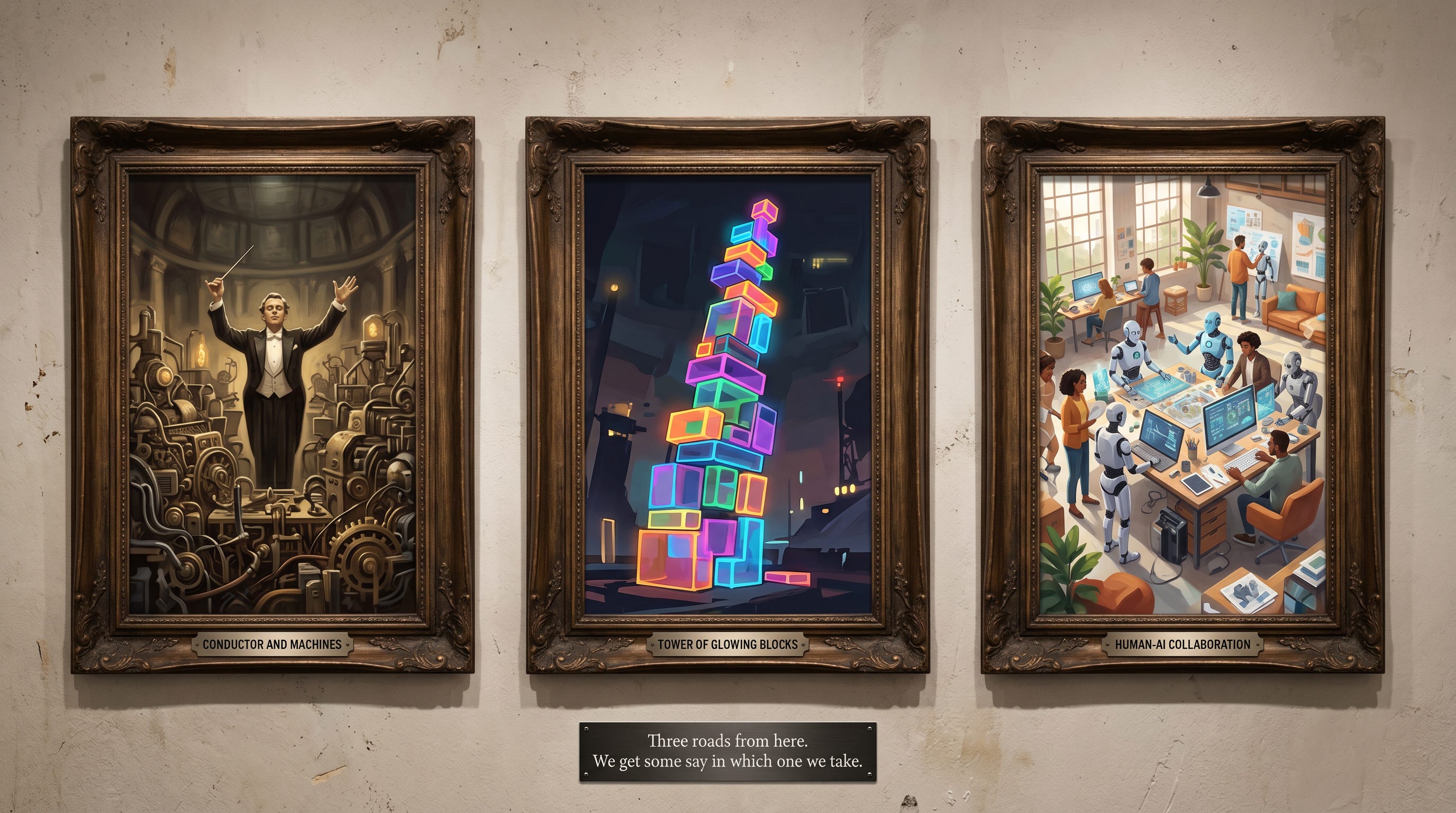
Which one we get is not written in the code. It’s written in the choices — by companies deciding whether to chase short-term speed or long-term soundness, by educators deciding how to train people who’ll manage what they didn’t build, and by all of us deciding how much understanding we’re willing to outsource.
What this means for you, practically
You don’t need to learn to code to take something useful from all this. A few lessons travel well beyond software:
The “manager of machines” role is coming for your field too. Whatever you do, ask not “will AI replace me” but “which parts of my work will I be supervising rather than doing — and do I understand them well enough to catch the machine’s mistakes?” That second skill is about to become priceless.
Speed is not the same as progress. Remember the developers who felt 20% faster while being 19% slower. When someone sells you AI-powered efficiency, ask the quiet question: measured how?
Protect the bottom rung. If the entry-level path into your profession is being automated away, that’s not just a young person’s problem — it’s everyone’s, because it’s where the experts of the next decade are supposed to come from. This is worth defending, in your workplace and your community.
Understanding is the thing worth keeping. You can delegate the labor. Don’t delegate the comprehension. The moment no human understands the system, we’re not its managers anymore. We’re its hostages.
So far, the genie is still mostly doing what we ask. The question — and it’s one we still get to answer — is whether we’ll stay clever enough to keep asking the right things, and to know a bad answer when we see one.
My vote? Keep your hands on the wheel. Even when the car insists it can drive itself.
This piece was written for the HAIA Foundation. If it gave you something to think about, the conversation continues over on our Substack.
A note on honesty, since this article is partly about it: the figures here come from named studies and named people, linked throughout so you can check my work. Some claims — especially the eye-catching “X% of all code is now written by AI” numbers you’ll hear from tech executives — are self-reported by the companies selling the technology, and I’ve deliberately leaned on independent research instead. When the boosters and the skeptics disagreed, I’ve tried to show you both. The future is genuinely uncertain. Anyone who tells you otherwise is, well — vibing.