
There is a quiet power in modern life that rarely announces itself. It doesn’t wear a badge or issue a court order. It simply flashes a notification:
Your account has been suspended.
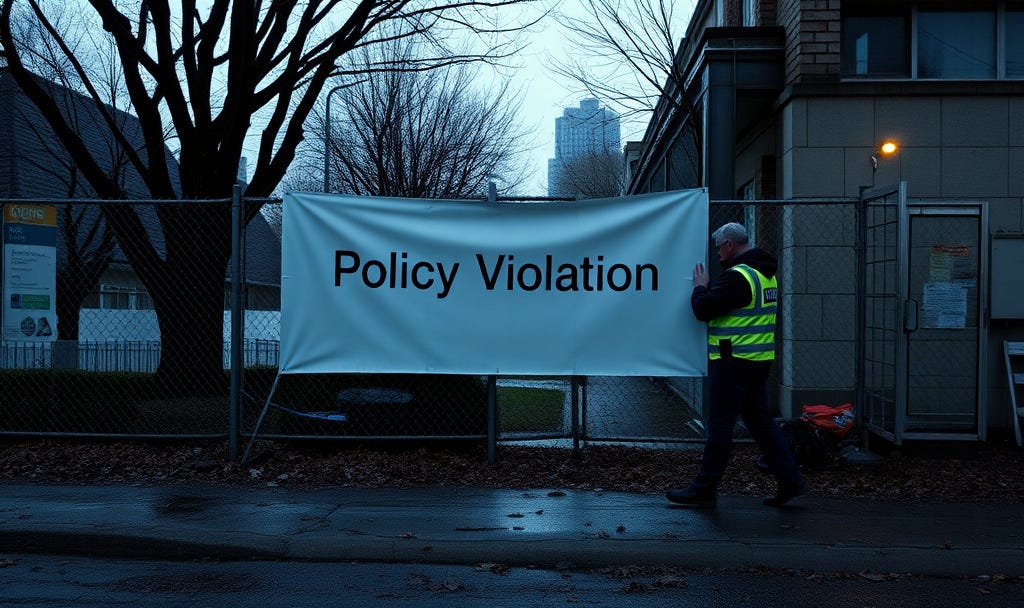
For many people, that message now carries more weight than a knock on the door ever did.
When an Account Becomes a Life
Consider what a single account represents today. A Google account, for example, is not just email. It is your phone line, your cloud storage, your photos, your navigation history, your authentication layer, your calendar, your documents, your social graph, and—through integrations—often your banking, healthcare portals, and work systems.
Losing it is not an inconvenience.
It is an exile.
And yet that exile can happen without warning, without explanation, and without recourse.
No charge sheet.
No evidence presented.
No meaningful appeal.
Just an automated judgment, enforced instantly.

Judge, Jury, and Executioner by Design
The standard defense is familiar: Google is a private company. Private companies, we’re told, can decide whom they serve.
This framing is legally convenient—and socially outdated.
When a platform becomes infrastructural, the moral and civic obligations change. When access to communication, money, work, and identity are bundled behind a single account, the decision to suspend that account is no longer analogous to refusing service at a café.
It is closer to cutting utilities, seizing documents, and freezing assets—simultaneously.
In the physical world, we have rules for this. You cannot shut off someone’s electricity or phone line because an algorithm suspects wrongdoing. You cannot confiscate property without notice. You cannot punish first and explain later.
Yet online, we have normalized exactly that.
A private entity can accuse you, judge you, prosecute you, and punish you—all in one step. The process is opaque by design, justified by scale, automation, and the supposed need to prevent abuse.

Efficiency has replaced justice.
Suspicion Is Not a Sentence
There is a fundamental distinction we have lost: suspicion versus guilt.
Suspicion should trigger process, not punishment.
If an account is suspected of violating rules, the response should look like this:
Notice
A clear, specific warning of what behavior is suspected—not a vague reference to “policy violations.”
Disclosure
Access to the evidence used to make the determination—logs, flags, reports—subject to reasonable redactions.
Contestability
A real opportunity to respond, explain, and correct errors, evaluated by a human with authority to reverse the decision.
Proportionality
Temporary, scoped restrictions when necessary—not total account annihilation as the default.
This is not radical–this is due process.
It is the minimum standard we already expect in every other domain where power can ruin lives.

Automation Is Not an Excuse
The most common justification for the current system is scale. Billions of users. Millions of violations. Automation is necessary.
This is true—and irrelevant.
Automation does not absolve responsibility. It amplifies it.

When systems operate at scale, errors are not edge cases; they are statistical certainties. And when those errors can lock someone out of their livelihood, relationships, and identity, the burden is on the system designer—not the victim—to mitigate harm.
We already know how to do this. Credit card fraud systems, tax audits, and medical billing disputes all operate at massive scale while still preserving notice, explanation, and appeal.
The difference is not technical capability–It is priority.
The Right to Be Heard
At its core, this is about dignity.
Being accused by a machine and punished without explanation is dehumanizing. It treats people as noise in a dataset rather than participants in a society.
Due process is not merely a legal construct. It is a recognition that power—even privately held power—must answer to the people it governs.
And make no mistake: platforms govern.
They set rules.
They enforce penalties.
They control access to essential services.
What they lack is accountability.

A Future Worth Insisting On
We do not need to nationalize platforms to fix this. We do not need to eliminate moderation or enforcement. We need something far simpler and far older:
Warnings before punishment
Evidence before judgment
Appeals that actually work
If an account truly poses harm, restrictions can and should happen—but as part of a process, not as an irreversible verdict issued in silence.
The alternative is a world where your digital existence can be erased by mistake, by abuse, or by misclassification—and where your only response is to shout into an automated void.
That is neither safety, nor order, nor justice.
And we should stop pretending it is acceptable simply because the executioner happens to be private.