
You would be forgiven for assuming that a law against being fired by an algorithm covers the workers its backers held up as examples. I searched California's new one for the app drivers its sponsor described to lawmakers in April. They aren't in it — and two documents, nearly six months apart, show how they left.
The first is the analysis the state Senate's labor committee prepared for its April 8, 2026 hearing. The bill it describes protected any "worker," defined as "any natural person who is an employee of, or an independent contractor providing service to, or through, a business or a state or local governmental entity in any workplace." Under "Proponent Arguments," the analysis quotes the bill's sponsor, the California Federation of Labor Unions, and among its examples are Amazon Flex drivers, "independent contractors who sign up for Amazon deliveries via an app." "Late deliveries," the sponsor wrote, "can lead to automated firing by the app's automated decision-making system." (That is an advocate's account. In 2021, when Bloomberg reported on a Flex driver cut off by automated email, Amazon called drivers' claims of unfair termination anecdotal and said it does "investigate all driver appeals.")
The same document carried a caution from the committee's own staff: the author "may wish to consider if and how the requirements in SB 947 may conflict with those of AB 1340," the 2025 law that lets rideshare drivers bargain collectively.
The second document is the law Gov. Gavin Newsom signed. It protects employees, and an employee is "any person employed by an employer." Somewhere in between, the Assembly "struck the applicability of this bill to independent contractors," as the Senate's analysis for the final vote put it. KQED was blunter: "Notably left out of the SB 947 party: rideshare drivers, who are classified as independent contractors under Proposition 22."
In short: if you are on a payroll in California, then from July 1, 2027, software may not fire or discipline you on its own, and when it is the main reason, a human has to check it. If you drive or deliver for an app as an independent contractor, this law doesn't reach you. (Whether someone truly is an employee is a legal question, not a company's label; drivers classified as contractors are outside it.)
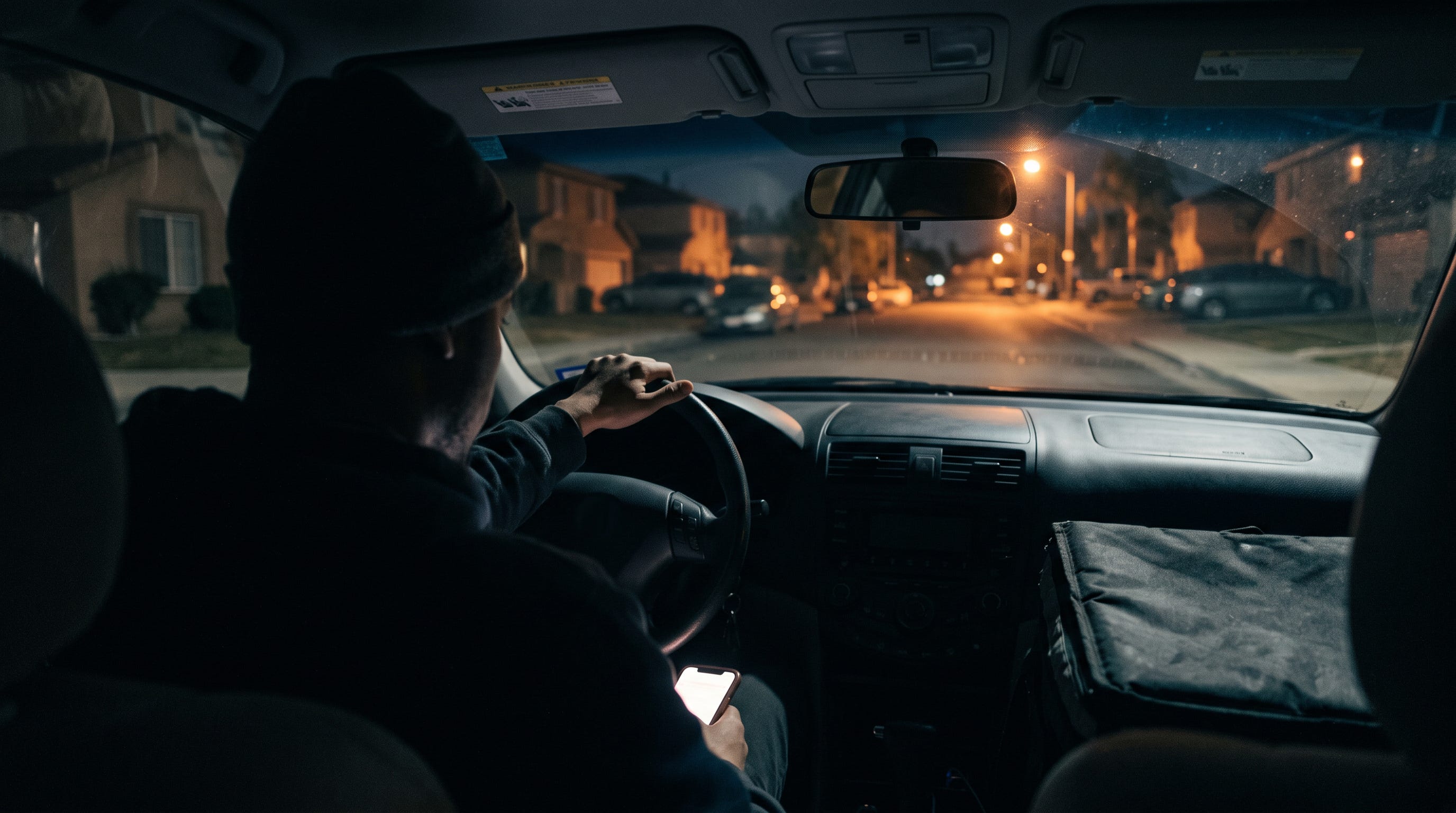
So what does SB 947 require?
Its author, Sen. Jerry McNerney, calls it the No Robo Bosses Act, and his office bills it as the first such law in the nation. Newsom signed it on September 30, 2026, a year after vetoing its predecessor, SB 7, over "unfocused notification requirements" and "overly broad restrictions" (as I wrote in September, California had vetoed a transparency bill). This version drops the advance notice. The governor's office says it ensures "real people review automated employment actions." It takes effect July 1, 2027.
It works in two tiers, and the gap between them is most of the law.
Solely. An employer "shall not rely solely on an ADS when making a disciplinary or termination decision." An ADS, or automated decision system, is any computational process built on machine learning, statistical modeling, data analytics or AI that issues simplified output, "including a score, classification, or recommendation," that is used "to assist or replace human discretionary decisionmaking and materially impacts natural persons." To be clear, AI can still be part of a firing decision — it just can't be the only part.
Primarily. If an employer "primarily relies upon an ADS output" to discipline or fire you, it "shall direct a human to corroborate the decision using data that was collected or used to produce the ADS output or other relevant corroborating or supporting information." Read that again: the human may check the machine against the machine's own inputs (yes, that counts), or look further, at sources ranging from personnel files to "Witness interviews, that may include relevant online customer reviews." If the employer can't corroborate the output, or the reviewer finds it "inaccurate, incomplete, or misleading," the output can't be used.
When software was the main basis, the employer owes you "a written postuse notice at the time the employer informs the employee of the decision" (postuse, so no warning beforehand), saying that a human "reviewed the decision and corroborated the ADS output" and giving contact details for a human you can ask. You may also request "a meaningful, objective description of the employee's own data used by the ADS."
It covers public employers as well as private ones, from "all branches of state government" to school districts (the University of California only "upon agreement by the regents"). Only the Labor Commissioner and public prosecutors can enforce it, and the civil penalty is $500 per violation, the same $500 figure as the emotion-reading ban I covered earlier this month, which Newsom signed the same day. And a union contract can switch the law off if, among other things, it "explicitly waives this part in clear and unambiguous terms" and "provides protection from algorithmic management."
How the drivers fell out of the bill
How do the workers who made the case for a bill end up outside it? The record is unusually clear (bear with me; the order matters).
The full Senate passed SB 947 29–9 in May, contractors and all. In June, in the Assembly's privacy committee, your right to sue came out, leaving enforcement to "the Labor Commissioner or public prosecutors." The contractors went out in the floor amendments of August 21, along with the bill's limit on "deactivations" (the industry's word for cutting a driver off an app) and the requirement that a human reviewer "conduct an independent investigation." The Senate concurred 28 to 10 on August 31. Before that vote, McNerney told his colleagues that dropping the contractors had removed another stumbling block, for a different set of people than the right to sue had been, according to Digital Democracy's machine transcript.

Weren't the drivers covered somewhere else?
It's the strongest objection, and it deserves a fair hearing.
Uber and Lyft, in the letter the April analysis quotes, argued that covering contractors "undermines that process with top-down rules," the process being AB 1340's bargaining, and that Prop 22 "fully governs certain processes for app-based workers, including appeals procedures for deactivations." A coalition led by the California Chamber of Commerce asked that contractors be taken out of the definition of "worker." And in vetoing SB 7, Newsom said that disciplinary, firing and deactivation decisions made with an ADS were "partially covered by forthcoming California Privacy Protection Agency regulations," which he said would let "employees and independent contractors" better understand how their data is used.
So what do drivers classified as contractors have? Three things, on paper.
Prop 22. The 2020 ballot measure makes an app-based driver "an independent contractor and not an employee" when four conditions are met, and says companies "shall provide an appeals process" for drivers whose contracts they terminate. (The state Supreme Court upheld it in 2024.)
AB 1340. It makes deactivations a mandatory subject of bargaining, and any sector-wide agreement must address an "Appeals process for deactivations" and drivers' representation in those appeals, unless both sides agree to waive it. On September 9, the state certified the California Gig Workers Union to bargain for Uber and Lyft drivers, which Uber called "the next step in delivering on AB 1340."
The privacy rules. From January 1, 2027, the privacy agency's rules can apply when a covered business uses automated technology to make decisions about "independent contracting opportunities," including "Demotion, suspension, and termination."
Now read the fine print on each. Prop 22's appeals clause requires "an appeals process" and says nothing about who decides it. AB 1340 leaves each company "exclusive control" over its "software, contract terms, algorithm," and the first contract is still ahead; meanwhile, drivers have charged that their challenges to deactivations are "typically handled by automated systems." (Uber and Lyft told lawmakers in their letter that they have "offered deactivation appeals and reviews processes.") The privacy rules reach only decisions made "without human involvement," and a business can skip the opt-out by offering "a method to appeal the decision to a human reviewer who has the authority to overturn the decision."
There is a fair case, the one Uber and Lyft made, that negotiation suits drivers better than statutory mandates. But none of these routes says what SB 947 says to an employee: software can't be the only basis, and when it is the main one, a human must corroborate it or the output can't be used. The drivers were routed somewhere. They weren't routed to that rule.

Spain wrote its law for the riders
What does it look like when a law starts with the workers California left out?
Spain's 2021 "Rider Law" began as an emergency decree that May to guarantee labor rights for people who deliver through digital platforms, took effect in August and then passed Parliament as Law 12/2021. It did two things. It gave works councils (a company's elected worker representatives) a right to be told the parameters, rules and instructions behind the algorithms or AI systems that shape working conditions, hiring and keeping a job. And it presumed that people paid to deliver goods for a company that organizes, directs and controls their work through algorithmic management on a digital platform are employees, a presumption the company can try to rebut. Both provisions are still in force, unchanged.
Then the EU went further. Its platform-work directive, adopted in 2024, says that "Any decision to restrict, suspend or terminate the contractual relationship or the account of a person performing platform work or any other decision of equivalent detriment shall be taken by a human being." That covers anyone doing platform work, "irrespective of the nature of the contractual relationship." Every member state must turn it into national law by December 2, 2026.
Spain wrote its delivery riders in. The EU wrote in everyone who does platform work. California wrote its app drivers out.
Now the fair counterpoint, and it is a big one. Spain's presumption covers delivery only, not ride-hailing. Spain's own labor ministry says the directive reaches further than Spanish law in scope and in the rights it protects. And Spain has only reached a public consultation on its version: comments closed August 14, 2026, and as of October 9 no draft bill had been published.
The platforms adapted. Deliveroo, citing a small market share (Spain was "less than 2%" of its gross transaction value) and, in TechCrunch's reading, worried about the cost of the new rules, said it would cease operations in all of Spain on November 29, 2021. Glovo's owner, Delivery Hero, announced only in December 2024 that Glovo would move its Spanish riders to employment, "to avoid further legal uncertainties." Uber Eats said it would stop working with self-employed riders only in January 2026, after the labor ministry threatened criminal action, adding that those riders could stay on as employees of its partner fleets (subcontractors, that is, not Uber).
Ane Aranguiz, a labor-law scholar, still called the law a breakthrough in "opening the black box of algorithms" as some platforms worked around it in 2021. In 2025, Fairwork researchers (in a study funded by a foundation of the CCOO union) found the sector still marked by low pay and "a lack of algorithmic transparency," with Glovo relying on "outsourcing through delivery fleets."
Coverage in Spain was slow, partial and dodged — but it was where the law began. In California, it was what the bill shed on its way to a signature.

Picture the summer of 2027
What follows is my extrapolation from the text, not a forecast about any company.
It is July 2027, and a productivity system at the California warehouse where you work flags you; your manager checks the same scan data the system scored and signs off. Your notice says a human "reviewed the decision and corroborated the ADS output," and every requirement is met, though the check came from the machine's own inputs. Did your employer "primarily" rely on the system? That word has no definition, so the first case before the Labor Commissioner could turn on a dashboard and a manager's signature.
Now picture a rideshare driver, classified as a contractor, cut off the same week. SB 947 doesn't apply. Prop 22 promises an appeals process, and the privacy rules can apply only if no human was involved. Whether a person hears that appeal could come down to what the new union wins in its first contract.
And picture the same kind of app in Madrid once Spain transposes the directive: a human being must take the decision to cut off any account, contract or no contract. Same work, two rulebooks.
Here is where things get interesting. A union contract that "provides protection from algorithmic management" can switch SB 947 off, and AB 1340 puts deactivation appeals on the drivers' bargaining table. The strongest rules on algorithmic firing in California may yet be written by negotiators — for employees and drivers alike — rather than by the Legislature.

Too weak, too vague, or a breakthrough?
Who's right? That depends on what you wanted from the law.
Labor got a law and wanted more. "It should be a stronger bill," Lorena Gonzalez of the sponsoring federation said in Khari Johnson's September 30 report for CalMatters. Nicole Moore, president of Rideshare Drivers United, wrote, as KQED reported, that "An algorithm decides what work we get, what we are paid, how our performance is judged, and too often whether we can work at all." Annette Bernhardt of the UC Berkeley Labor Center called the day's package of laws "a breakthrough moment in tech policy," and the Electronic Frontier Foundation, which praised the 2025 version for covering "employees and contractors," backed this one too.
Business and the tech industry see a vague standard and a litigation risk. Chamber of Progress, a tech-industry group, urged a veto because "primarily relies" — "that critical term is never defined" — leaves employers "no objective standard." The coalition led by the California Chamber of Commerce warned of "costly litigation for even the smallest of employers." SHRM, the HR profession's association, reads it to mean that human involvement "cannot simply amount to rubber-stamping an algorithm's recommendation," though it "strongly opposed the bill."
The right isn't of one mind either. Steve Hilton, the Republican nominee for governor, came out in full support, CNBC reported, calling the California Chamber's complaint about human review "a ridiculous thing for them to say" and adding, "In some ways, I don't think SB 947 goes far enough." From the libertarian side, Adam Thierer of the R Street Institute told Reason that California is "once again attempting to position itself as a super regulator for the entire nation," though he was discussing Newsom's separate September order on AI oversight, not this law.
Put them side by side and the critics cross over: the sponsor and the Republican nominee both say the law stops short, while the tech industry says its key word is too vague to apply and business groups warn of lawsuits. Both complaints can be true at once.
What does this mean for you?
If you work for a California employer, public or private, mark July 1, 2027, when the law becomes enforceable.
If you're disciplined or fired after that and software was the main basis, expect a separate written notice when you're told, with contact details for a human. Keep it.
Then ask for "a meaningful, objective description" of your data. It's a description, not a copy.
Complaints go to the Labor Commissioner; you can't sue under this law yourself. Retaliation is prohibited, and retaliation complaints can be filed online, in most cases within one year of the adverse action.
In a union? Read your contract. It may waive this law in exchange for its own protections against algorithmic management. Ask your steward.
If you manage people and a dashboard feeds discipline, the burden shifts to the employer once it's shown that a system was used, and "primarily relies" has no definition yet. Write down the human reasoning behind each decision.
If you drive or deliver for an app as an independent contractor, this law doesn't cover you. If Prop 22 covers you, you have its appeals process. If you drive for Uber or Lyft, ask your new union what it wants on deactivation appeals. And from January 1, 2027, the privacy rules can apply where a covered business decides without human involvement, though it may offer a human appeal instead of an opt-out.
The lesson, as I see it
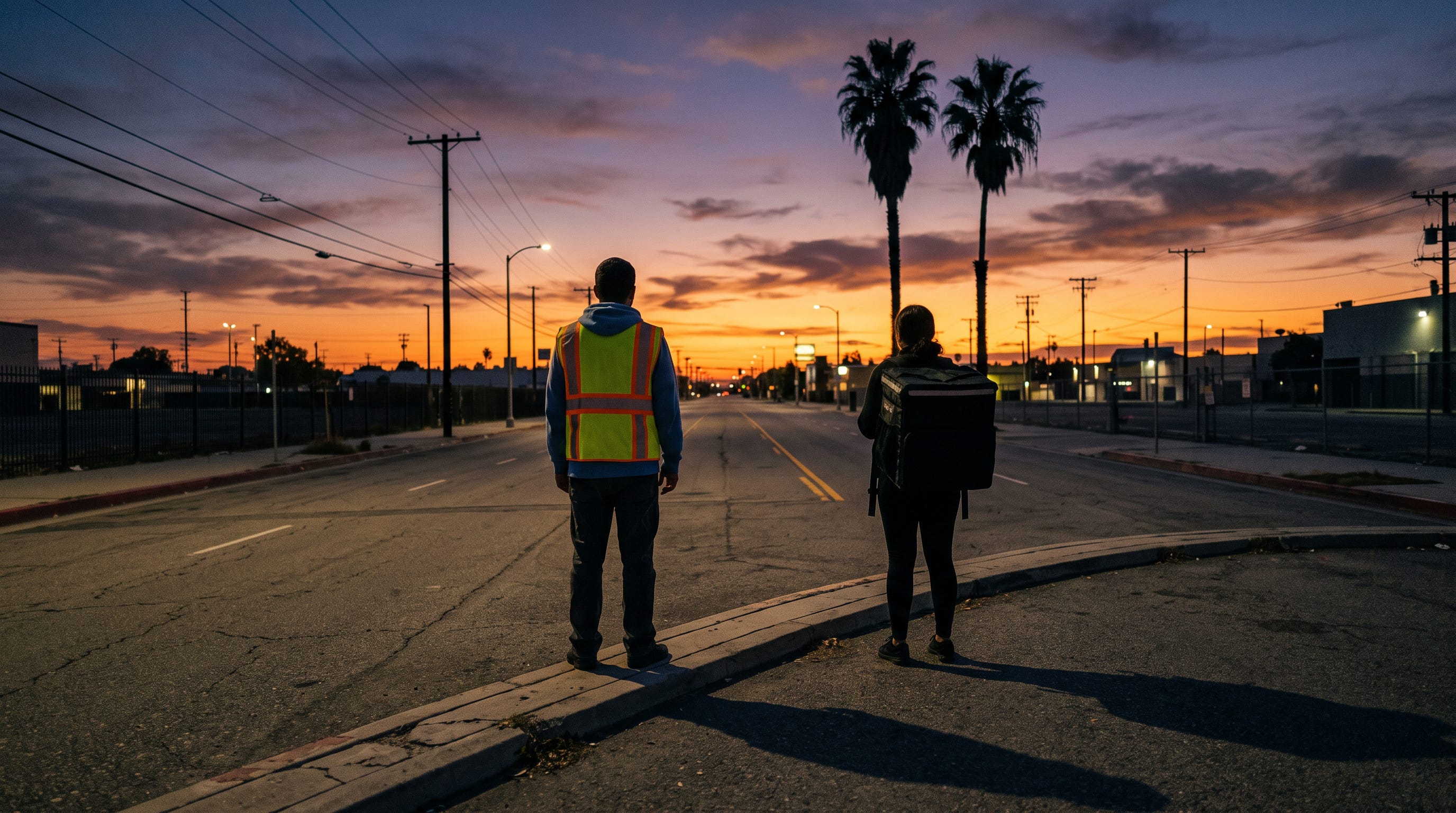
A law is its definitions. The promise is that software can't fire you on its own; the boundary is "any person employed by an employer," and the drivers the sponsor used to show why the law was needed stand on the other side of it. Compromise is how bills pass. It is still worth saying plainly who was left out.
What should you watch? July 1, 2027, when the law becomes enforceable. The drivers' union's first contract with Uber and Lyft. The privacy agency's preliminary look at employee data, where nothing had been proposed as of October 9, 2026. And December 2, 2026, the EU deadline, which Spain, for one, is approaching without a published draft. In Washington, a federal version has sat in a Senate committee since June.
My vote? Wherever software can cut off someone's income, a person should make that call — whatever the contract calls the worker. The EU has written that sentence for platform work. California has written half of it.
Know someone who drives or delivers for an app as a contractor, and someone whose shifts and reviews run through software? Hand this to both. Come July 1, 2027, this law covers one of them and not the other, and both deserve to know which is which.