
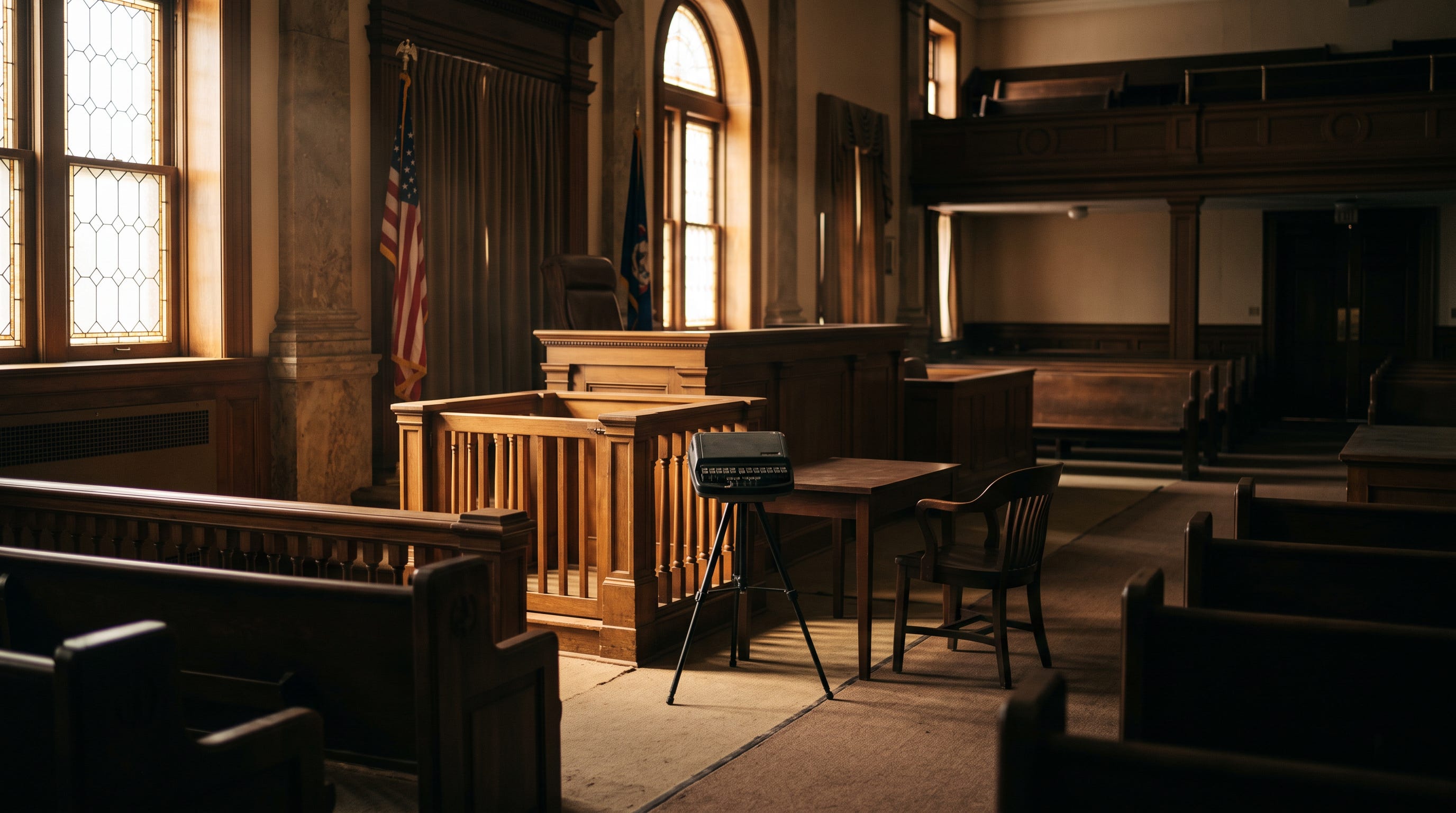
Here is something you probably believe about courtrooms, and have never once thought to check. When a judge says let the record reflect, there is a record. Somewhere in that room (behind a small machine, or inside one) every word is being caught, and if you ever needed to prove what was said, you could go and get it.
It is an easy assumption to make, for an unexamined reason: the phrase is said out loud. On the record. No one questions a sentence everyone in the room uses as if it describes the furniture.
It describes furniture that is, in California, frequently not there. And the proof is not an exposé — it is a state agency's own arithmetic, published on its own website.
Three million hearings, no record
Between April 1, 2023 and March 31, 2026, California's superior courts held 4,214,365 family law, probate and unlimited civil hearings. By the judicial branch's own accounting, approximately 3,007,651 of them — 71.3 percent — had no verbatim record. No stenographer, no recording, no transcript, nothing. Seven hearings in ten, in the cases where people lose custody of their children, lose their homes, and get restraining orders granted or denied.
That is the current figure. The number in this article's title is the older one, and the two get blurred constantly, so let me be precise. As of June 2025, CalMatters reported that since 2023 more than 1.7 million family law, restraining order, probate and other civil proceedings had gone without written transcriptions. That was the scandal that got this to the state's highest court. By August 2026 the same outlet reported more than 3 million proceedings with no written transcription since 2023. The number did not get corrected. It kept running.
It is not new, either. The petitioners pointed to a November 2024 issue paper from the California Access to Justice Commission, which reported that for the year ending March 31, 2024, "over one million hearings and trials took place in unlimited civil, family, and probate cases — for which California Superior Courts did not provide any means to create an official transcript." Los Angeles County Superior Court's own general order, quoted by the state's Supreme Court, put that county's share at more than 332,000 hearings in 2023 alone with no verbatim record.
So far, so grim. Here is where it gets interesting.
On August 10, 2026, the California Supreme Court decided Family Violence Appellate Project v. Superior Court of Contra Costa County, No. S288176, and issued a writ of mandate directing the respondent superior courts to give indigent litigants, on request, meaningful access in all cases to an official verbatim record — by electronic recording if no official reporter is available. The petition had been filed on December 4, 2024 by the Family Violence Appellate Project — represented by Covington & Burling and Community Legal Aid SoCal — together with Bay Area Legal Aid. Where a litigant asks for a record and establishes an inability to pay for a private reporter, Chief Justice Patricia Guerrero wrote, the superior court has a duty to provide some way for that litigant to obtain one. The continued failure to do that, she wrote, deprives indigent litigants of "meaningful access to the judicial process."
The legal move is narrow and rather elegant. Government Code section 69957 authorizes electronic recording in limited civil, misdemeanor and infraction cases — and nowhere else. The court did not strike it down; it read it. The broad prohibition, it said, does not specifically forbid such recording where that is necessary to ensure an indigent litigant has meaningful access to justice, so courts may imply an exception. Why does a missing record matter so much? Because, as the court restated from its earlier decision in Jameson, the lack of one "will frequently be fatal" to a litigant's ability to have claims of trial court error resolved on the merits. Frequently — not always.
Los Angeles had not waited. On September 5, 2024, Presiding Judge Samantha P. Jessner issued General Order 2024-GEN-011-00, allowing electronic recording in specified family law, probate and civil proceedings — and said plainly that the statute barring it violates the equal protection and due process clauses of the state and federal constitutions by depriving litigants of a meaningful appeal when fundamental rights are at stake.
Good ruling. Right result. And it leaves the actual question untouched.
Why there is nobody in the chair
No one engineered this shortage. It accumulated.
California's Legislative Analyst's Office laid it out for the Legislature in March 2024: reporters with active licenses fell from 7,503 in 2009-10 to 5,584 in 2022-23 — a decline of 1,919 licenses, which the Analyst puts at 26 percent. The same letter counted about 1,164 full-time-equivalent reporter positions filled against an estimated need of 1,865.5 — 691 unfilled — then added, in a quiet parenthesis, that the difference "may actually be greater." Vacancies had climbed from 152 FTE in July 2020, a 10 percent vacancy rate, to 400 FTE in July 2023, a 25 percent rate, despite the state pouring $30 million a year into recruitment.
The pipeline is worse than the payroll. The Judicial Council's January 2025 fact sheet records licensees down 20.9 percent and new license applications down 42.9 percent between fiscal years 2013-14 and 2022-23, with only eight court reporting programs recognized by the state still open, down from 17 in 2010. In fiscal year 2024-25 the branch issued 176 new licenses statewide (in a state of forty million people). As of June 3, 2026, 48.1 percent of active licenses had been issued at least thirty years ago. That is not a workforce. That is a cohort.
And it is not a pay problem, which should trouble anyone who reaches for money as the first answer. Median pay with benefits for a California court reporter is more than $200,000, per the judicial branch. Los Angeles has offered a $50,000 signing bonus and a $25,000 finder's fee to employees who refer one. The Judicial Council's figure for closing the gap is 458 additional full-time equivalent reporters. The chairs are funded. They are empty.
Which leaves the private market — exactly why this is a piece about poverty rather than technology. The California Lawyers Association, supporting the petitioners, told the court that a single day of trial with a private reporter can cost as much as $3,300, citing the Judicial Council's own January 2024 fact sheet. Now hold that against who is standing in these rooms. Writing in the California Law Review's online companion back in 2010, a Judicial Council staff author reported that at least one self-represented litigant appears in seventy percent of California divorce cases at the start, rising to eighty percent by judgment (there is no right to appointed counsel in family law, and private counsel is out of reach).
A person who cannot afford a lawyer is not about to buy a stenographer for the day. That is the case in one sentence, and the court agreed.
What a "certified" transcript is — and why it is a person, not a device
Here I have to slow down, because this is exactly where almost every version of this story goes wrong.
Can a machine produce an official record? You will hear that it cannot. That is false, and it is worth knowing why.
Start with the human baseline. Under California's Code of Civil Procedure section 273, the report of a duly appointed and sworn official reporter, once transcribed and certified as correct, is prima facie evidence of that testimony and those proceedings. The same statute is blunt about that reporter's unfinished work: a rough draft "shall not be certified and cannot be used, cited, distributed, or transcribed as the official certified transcript." Even the stenographer's own output is not the record until it is certified. The certification is the thing.
Now the machine track. Under California Rule of Court 2.952, written transcripts of official electronic recordings may be made by or under the direction of the clerk, or a person designated by the court — and that person must execute a declaration under penalty of perjury stating that it is "a full, true, and correct transcript." Rule 8.835 finishes the job: such a transcript is prima facie a true and complete record of the proceedings and satisfies any requirement in the rules or in any statute for a reporter's transcript.
Federal courts settled this shape decades ago. Since 1984, proceedings may be recorded verbatim by shorthand, mechanical means or electronic sound recording, and the transcript is prima facie correct when certified by the reporter or other individual designated to produce the record.
Read those three together and the architecture is unmistakable. A recording can absolutely become the official record. What makes it official is not the device and not the software. It is a human being who swears, under penalty of perjury, that these words are what was said.
So the accurate version of this article's headline is not "machines cannot make a record." It is this: certification is an act of swearing, and only a person can swear. Which raises the question the ruling does not answer.
I downloaded the forty-page slip opinion and searched its full text. The words artificial intelligence, automated, speech recognition, software and transcription service do not appear anywhere in it. Not once. The decision that orders California's courts to record millions of hearings is silent on who — or what — turns those recordings into words, and on who puts their name and their perjury exposure on the result.
That is not a criticism; the court answered the question in front of it. It is an observation about the shape of the hole, and the hole is three million hearings wide.
One more thing in section 69957, because it turns out to be the hinge of the argument. A transcript derived from an electronic recording must include a designation of "inaudible" or "unintelligible" for the portions of the recording that contain no audible sound or are not discernible. In other words: the law requires the record to admit where it failed.
Hold that thought.
What the machines produce
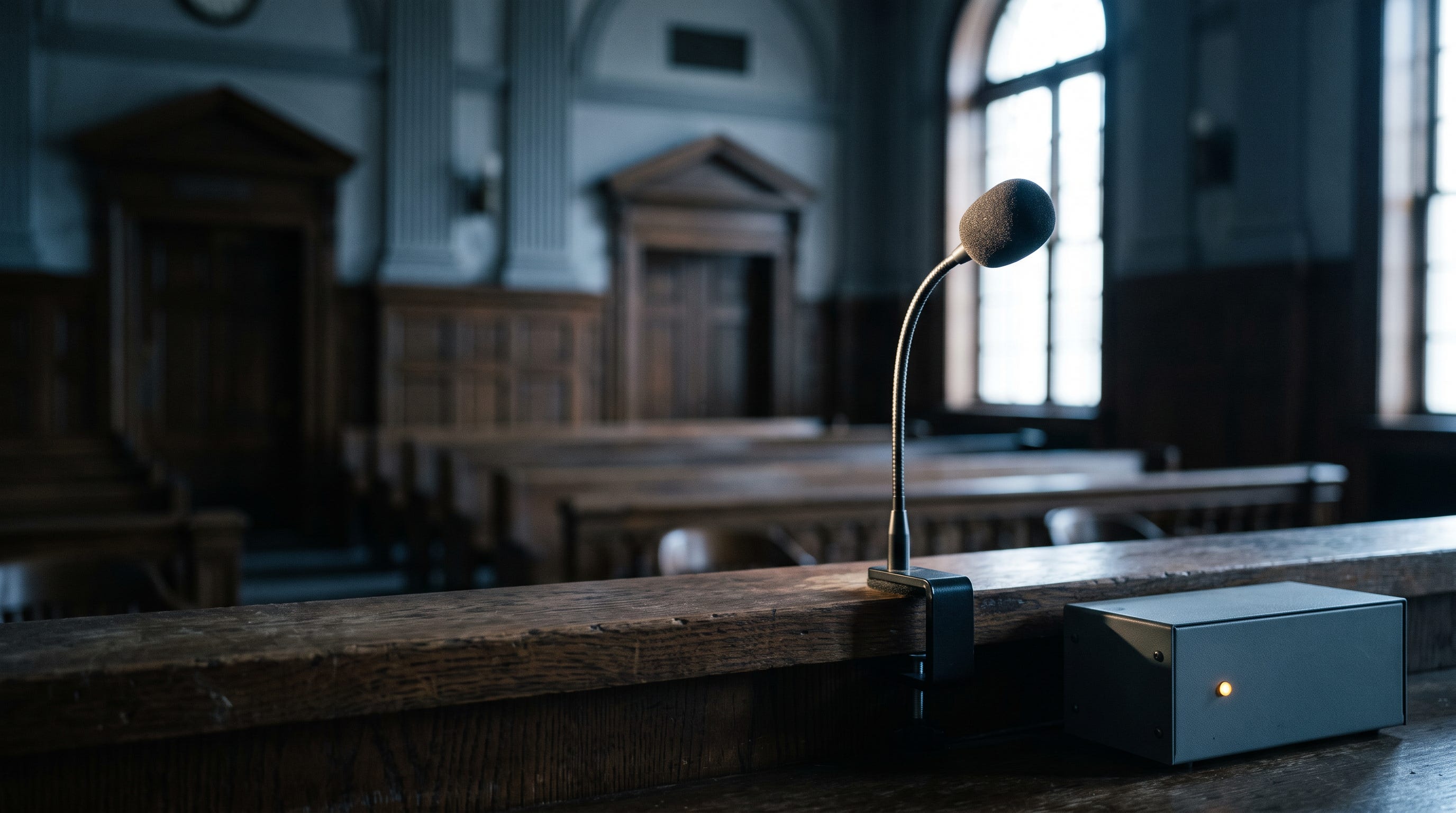
On July 23, 2026, the Indiana Court of Appeals published something unusual in Williams v. State. The panel catalogued errors in the transcript before it: a motion, presumably made by the State, attributed to the trial court; an objection, presumably made by Williams, attributed to the Bailiff. Then it wrote the sentence that has been circulating among appellate lawyers ever since — based on the types of errors reviewed, "it appears that generative artificial intelligence may have assisted with the preparation of this transcript."
Look at how carefully it is worded. Appears. May have assisted. Presumably. The court made no finding and did not throw the record out: the errors, it said, complicated but did not substantially impede its review, and it reminded the court reporter of the rule requiring certification. A near miss, reported as a near miss.
Why would a machine confuse a judge with a prosecutor? Because of what these systems do when the audio gets hard.
Associated Press reporting found that OpenAI's Whisper — the transcription model sitting inside an enormous amount of commercial tooling — is prone to making up chunks of text or even entire sentences, according to interviews with more than a dozen engineers, developers and academic researchers. One developer said he found hallucinations in nearly every one of the 26,000 transcripts he created with it. OpenAI itself recommends against using Whisper in "decision-making contexts, where flaws in accuracy can lead to pronounced flaws in outcomes." A courtroom is the decision-making context.
The academic work is more measured and, to me, more alarming. Cornell researchers examining more than 13,000 speech clips found that roughly one percent of transcriptions contained entire hallucinated phrases — and, critically, that the invention clustered in speech with longer pauses, including speakers with speech impairments.
Sit with the mechanism. A stenographer who misses something leaves a gap. So does a monitor who loses a speaker. The statute anticipates gaps; it demands they be marked "inaudible." A generative model does not produce gaps. Uncertainty comes out the other end as a fluent, grammatical, entirely plausible sentence that nobody said. The failure mode of the technology is precisely the failure mode the law has no way to see.
And it is not evenly distributed. A 2020 study of five commercial speech recognition systems measured racial disparities in automated speech recognition and found an aggregate word error rate of 0.35 for Black speakers against 0.19 for white speakers; assuming a rate above 0.5 makes a transcript unusable, 23 percent of audio snippets from Black speakers crossed that line, against 1.6 percent for white speakers. Allison Koenecke at Cornell, whose work sits at the intersection of economics, computer science and algorithmic fairness, is behind both findings.
None of this surprises the people who build these systems. As a Berkeley computer scientist put it years ago, the moment you go from humans talking to computers to humans talking to humans, things get much harder — which is why courts were slow to adopt speech recognition in the first place, dialects and accents very much included.
So hold the machines to the stenographer's standard. Except the stenographer was never a clean baseline
This is the objection I owe you, and it is the strongest one in the file — strong enough to shake the argument I am making.
In 2019, researchers tested 27 working Philadelphia court reporters, all certified at or above the 95 percent accuracy Pennsylvania's rules require, on transcription of African American English. Their average accuracy was 59.5 percent at the level of a full utterance and 82.9 percent at the word level — 12.1 percentage points below their lowest professional standard. Their transcriptions altered the who, what, when, where, and force of an utterance in 701 of 2,241 transcriptions, fully 31 percent. The study, "Testifying while black," was peer-reviewed and published in Language, the journal of the Linguistic Society of America.
So no: the human method is not a gold standard the machines are dragging down. On the very axis where I just criticized the software, the certified humans were tested and did badly too. Anyone arguing this honestly has to hold both numbers.
The California Supreme Court, to its credit, refused to do the comparison at all. In a footnote it noted the reporter organizations' concern that electronic recording may produce records less accurate than a court reporter's, then said: "We need not consider the comparative risks and benefits of the two approaches. It is sufficient to note that a verbatim record created by electronic recording is better than no record at all." It added that it expects accuracy concerns "can be mitigated with standardized procedures and safeguards."
Better than no record at all. That is the entire holding on quality, and it is a floor, not an endorsement. The court did not evaluate the machines. It declined to.
The reporters' side, for its part, is not making a nostalgia argument, whatever you may have heard. It is making one about answerability: unlike faceless electronic recording devices, a licensed reporter can be held accountable if the record they provide is incorrect. That is not sentiment — it is my perjury-declaration point arriving from the opposite direction. Several reporters and a family law attorney also told the court, in declarations, that recording is unreliable in their experience: the microphones do not capture every speaker, significant portions come out unintelligible, and the staff minding the equipment have other duties. Declarations from a party, not findings by the court. The organizations argued too that the shortfall is at least partially attributable to the courts' own management missteps and funding choices, and that supply will rise anyway through licensing reciprocity, certification of voice writers, and a remote-reporting pilot.
I find the last claim optimistic against 176 new licenses a year. I find the accountability claim unanswerable.
England and Wales already did this. Then they sold the record back
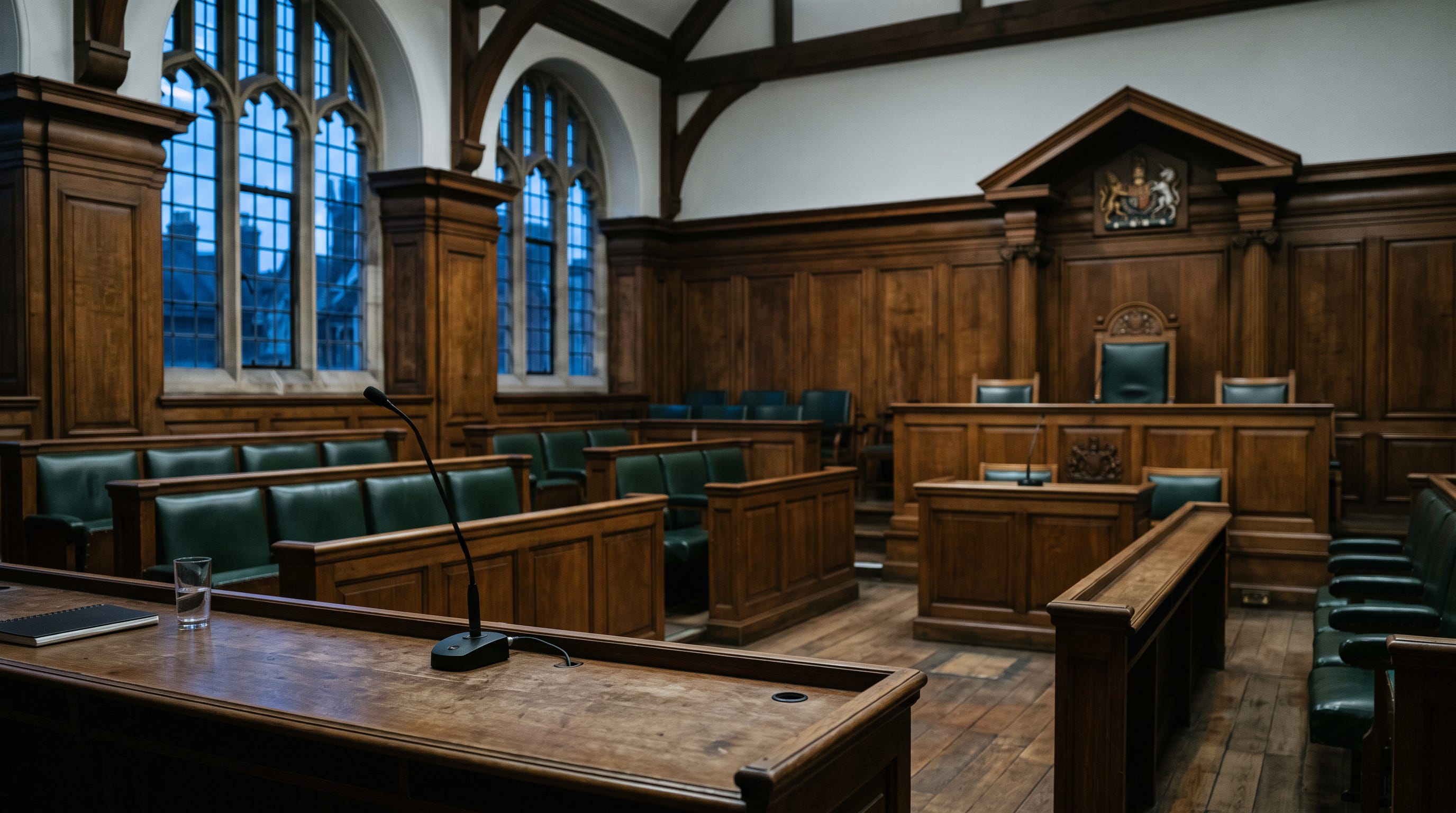
Californians are about to have an argument another jurisdiction finished fourteen years ago — and the useful thing about their answer is that it is neither triumph nor disaster. It is a lesson about where the cost moves.
England and Wales retired the court stenographer between June 2011 and March 2012, rolling the Digital Audio Recording Transcription and Storage system out across all 97 Crown and combined court sites. The Law Society's Gazette reported the operative conclusion at the time: there was no longer a requirement to use loggers and stenographers. The machines won that argument, and nobody proposes going back.
But the recording is not a transcript, and California has not yet priced that difference. The Ministry of Justice dispensed with stenographers and began recording cases instead — and those recordings still have to be transcribed by private companies. To read what happened in your own case you complete form EX107 and pay; the transcript comes from a company working under contract to the Ministry, priced per folio (a folio being 72 words) multiplied across however many your hearing ran to.
What does that produce? London's Victims' Commissioner, Claire Waxman, set it out in written evidence: her understanding, she wrote carefully, is that transcripts are charged by the folio at £0.74 to £2.30, plus copying charges — producing bills her office has seen range from about £30 for a copy to over £300 for sentencing remarks and, where victims wanted the whole case, figures including about £7,500 and about £22,000. She has said publicly that one woman was quoted £30,000 for a transcript of her full trial, and called the cost a "real block to recovery."
And you cannot do what you are already thinking of doing. Under section 9 of the Contempt of Court Act 1981, bringing a recorder into court and using it is contempt except with the leave of the court — with the statute's exception carved out precisely for official transcripts. The state records it. The state sells it back. You may not make your own.
The British government is now unwinding this from both ends, and both moves reward a careful read. On January 19, 2026, it announced free access to judges' sentencing remarks for all victims, noting that victims typically pay £40 and sometimes hundreds of pounds. Free — but sentencing remarks only, not the trial, and arriving "from Spring 2027." Then in April 2026 it announced a study of whether the department's in-house AI could meet required accuracy standards while cutting the time and cost of Crown Court transcripts currently produced by contracted providers. A study. Could meet. The pilot, overseen by the courts and tribunals service, will assess accuracy before the system is potentially rolled out nationwide.
The tool is called Justice Transcribe, and the government's own AI unit reports early pilot results in the Immigration and Asylum Chamber showing reduced administrative burden and faster decisions. What that public page does not state is any accuracy threshold, any human review process, or any acknowledged limitation. Reviewing the pilot, Brian Thornton of the University of Winchester granted that accuracy will be an issue — names, places, experts' technical language — then added the line that ought to be pinned above every procurement meeting on both sides of the Atlantic: "the greater issue may be AI hallucination."
One last thing from the English experience, and the least expected. Going digital changed what could be kept. Crown Court recordings were, by policy, to be kept for seven years and then destroyed — a policy an investigation reports has now been scrapped, with the courts service confirming that none have been deleted to date. Once the record is a file rather than a person's notes, retention is a setting. Somebody chooses it.
Now imagine the version that arrives by 2031
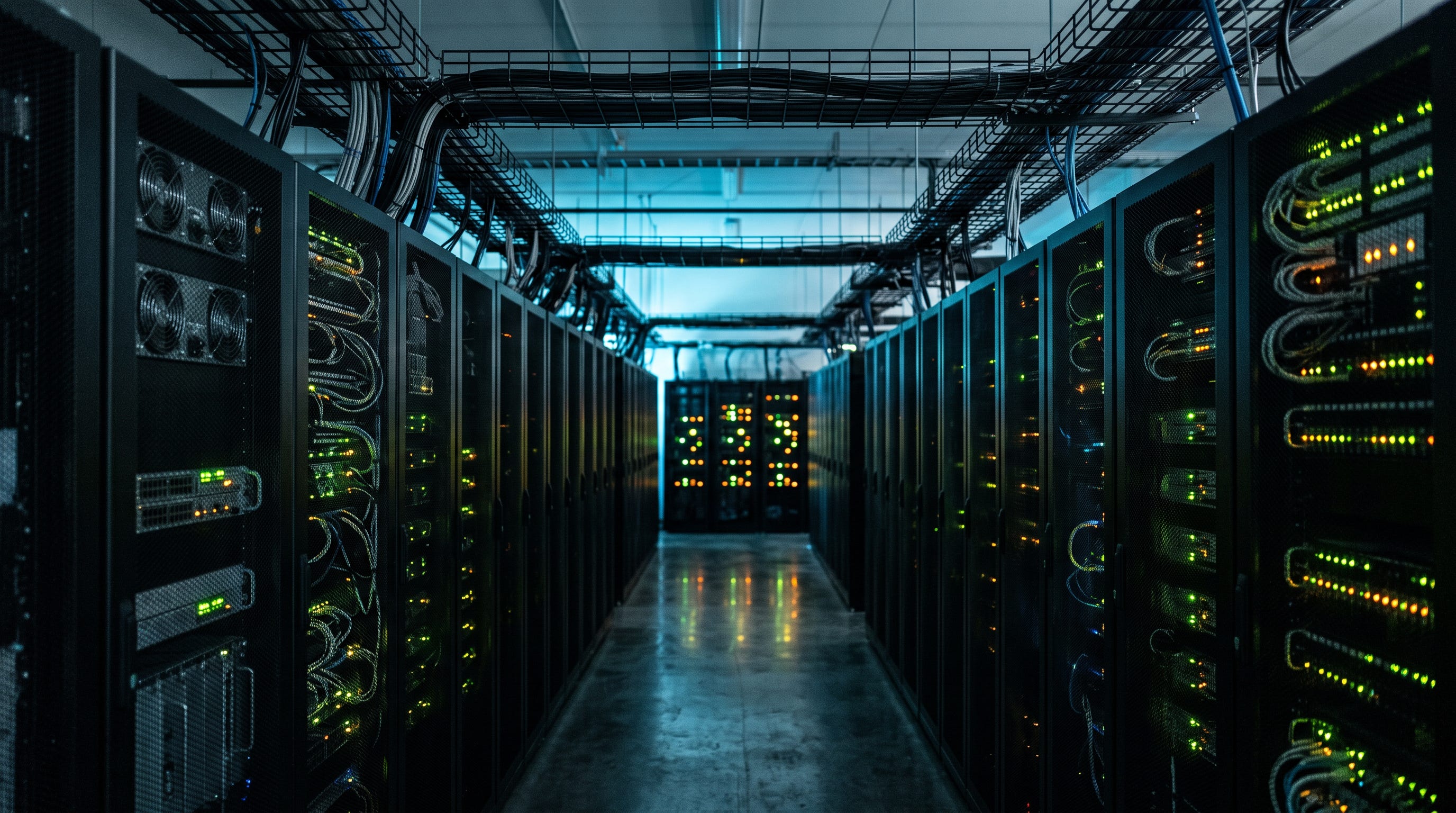
Let me run those trend lines forward, plausibly, using nothing that does not already exist.
It is 2031. Recording in California family law is routine, because the Supreme Court ordered it and the Legislature caught up. Transcription is automated, because 176 new licenses a year cannot staff 4.2 million hearings and nobody proposed a serious alternative. The audio goes to a vendor. Words come back in eleven minutes.
And somebody still has to sign. Rule 2.952 has not been repealed — a person designated by the court executes a declaration under penalty of perjury that the transcript is full, true and correct. So there is a clerk, in a windowless room, with a queue. Sixty declarations a shift. She has not listened to the audio; there is no room in a day to listen to sixty hearings. She is attesting to the output of a system whose error rate she has never been shown, in a document she signs under oath.
That is the future I expect — and nothing in it is illegal. Every box is ticked. The perjury declaration — the mechanism the whole architecture rests on — has quietly become a click.
Now the second-order effects, all following from what is documented above. The record no longer has holes, because the model does not leave holes: the disputed passage in a custody fight reads smoothly and wrongly, and the person who would have to prove it is the one who could not afford a lawyer. A two-tier record emerges without anyone legislating it — parties who can pay buy a human stenographer and a certified transcript, while fee-waiver litigants get the machine draft, a perfect inversion of the equal protection argument that won this case. And because the audio is now the only true original, retention becomes the central question, exactly as it did in England. How long does California keep the files? Who may listen, and for how long after the appeal?
One more, because it is coming and almost nobody is discussing it. Once every family law hearing in the largest state in the country exists as searchable text, it is a corpus. Corpora get analyzed, licensed, and trained on. The hearings that had no record at all were, accidentally, private. The ones with automated transcripts are a dataset about the worst week of several million people's lives.
Who else is worried, and from which direction
This is not a left or right fight, which is one of the reasons I trust it.
From the civil liberties side, the ACLU of Northern California told the court in an amicus brief filed on April 9, 2025 that section 69957 creates a classification based on wealth burdening a fundamental right, which could not survive strict scrutiny. An argument, not a holding — but the court reached a compatible destination by a narrower road.
From the industry that stands to gain, the American Association of Electronic Reporters and Transcribers reported in April 2025 that just 23,000 stenographers remain nationally, down 21 percent over the decade, and argues digital reporters can be trained quickly. Matt Riley of that association called the shortage a growing constitutional crisis. Read it with the appropriate squint — this is the trade body for the alternative — but Governing carried the figure too, crediting the same industry analysis, reporting that the national workforce declined 21 percent over the last decade and naming Arizona, Massachusetts, Michigan and South Carolina as seeing more than two-thirds decreases in reporters on payroll.
From the stenographers' own side, the National Court Reporters Association represents the captioners, reporters and videographers whose whole profession is capturing the spoken word — and whose accountability argument I have already said I cannot answer.
From the court-administration middle, the National Center for State Courts has documented for years that this is simply normal elsewhere: seventeen states and territories — from Alaska, Colorado and Connecticut through New Jersey and Oregon to Guam and Puerto Rico — use digital audio recording to make the record in all or most of their general-jurisdiction sessions, and Florida does it in 66 of its 67 counties. California's restriction, CalMatters noted, is matched only by Texas and New York.
And from the deregulatory side, a structural argument worth borrowing even though it was made about something else entirely: R Street has argued that middle-skills occupations are key to addressing workforce shortages and to expanding economic opportunity, particularly for women and for people without four-year degrees. That paper says nothing about court reporting (I checked). But a credential requiring years of training, held by a cohort approaching retirement, gating a constitutional right, is exactly the shape it describes.
Meanwhile the Legislature has settled none of it. AB 882, which would authorize recording in civil proceedings when a litigant who cannot afford a private reporter requests a record, was last amended in the Senate on July 17, 2025 and has sat there since. A rival measure, AB 1189, would have had the Court Reporters Board handle the certification of legal transcriptionists and digital reporters, authorizing them to certify transcripts for legal proceedings. That second bill is the one that would have answered the question this article is about — who signs — and it is dead. It never got a hearing: the one it was set for in April 2025 was canceled at the author's request, and on January 31, 2026 it expired under Article IV, section 10(c) of the state constitution, which retires any bill that has not cleared its house of origin by the January of the second year. The Legislature's status page files it now as an "Inactive Bill - Died" — no vote was ever taken on it.
What does this mean for you?
If you are headed into a California courtroom in a family, probate or civil matter — or supporting someone who is — this is no longer abstract:
Ask, before the hearing, whether a verbatim record will be made — then ask again on the record once it starts. "Your Honor, is a record being made of this proceeding?" is an ordinary question, and the answer may surprise you.
If you cannot pay for a private reporter, say so and request an official verbatim record. After August 2026 the duty runs to litigants who ask and establish inability to pay. A request you never made is a right you never exercised.
Know that a fallback exists — and know what it is not. California allows a settled statement: a summary of the proceedings approved by the superior court, which you may elect without a motion if your hearing was unreported or you hold a fee waiver. Genuinely useful — and a summary, not a transcript, resting on the memory of the judge whose ruling you are appealing.
If your transcript came from a recording, read it against the audio. Check the passages that decide your case, and look for the places a gap should be. If it never says "inaudible" anywhere, that is information, not reassurance.
Find out who signed it. There is a name on a declaration made under penalty of perjury. Ask what that person did first: listened, spot-checked, or clicked.
Do not record it yourself unless you have permission — in England that is contempt outright, and U.S. local rules vary. Ask the clerk. And outside California, check your own state: seventeen states and territories already make the record this way.
If this is your line of work, the bill that would have settled who signs is dead — watch for its successor. AB 882 authorizes the recording, and that is the easy part — the bill is still formally listed as active, but the Senate's last day to pass bills was August 31 and it never got a vote. AB 1189, which would have said who may certify the transcript, expired on January 31, 2026 without ever being heard. Certifying what the recording becomes is what decides whether any of it is worth anything, so whoever picks that question back up is the one to follow.
The lesson, as I see it
A record is the only thing standing between "the judge said X" and "I remember the judge saying X." That is its entire job — and the law has always done it by attaching a human being to a piece of paper and making them swear.
California just did the correct and overdue thing: it said a poor litigant may not be denied a record because the state cannot staff a chair. Good. But it authorized the capture and left the attestation dangling, and the pull toward filling that gap with software is strong, for the most sympathetic reason there is — three million hearings and 176 new licenses a year.
My vote? Make the signature mean something again, and do it before the volume arrives rather than after. Name in the rules who may sign a machine-derived transcript and what they must do first. Publish the accuracy — measured on real courtroom audio, broken out by the dialects and speech patterns the research has already flagged, not on a vendor's demo. Keep the "inaudible" designation and force the systems to produce it, because a record that admits uncertainty is worth more than one that never does. And decide now, in daylight, how long the audio lives and who may hear it.
England kept the record and sold it back for fourteen years before anyone in government called that a problem. We are at the earlier fork, still deciding what the record is. Better than no record at all is a floor the court was right to set. It would be a strange kind of progress to mistake it for the ceiling.
If you have ever assumed that somewhere in the building, someone was writing it all down — pass this to the next person who assumes that. The HAIA Foundation spends its time on the paperwork that turns out to matter most, and it all shows up here.