
I spent most of my adult life quietly against nuclear power. Not loudly — I never went to a march — but it sat in a mental drawer alongside leaded petrol and asbestos: a mid-century idea we were lucky to be walking away from. The drawer had a label. The label said settled.
Then, over about three years, I read my way out of it. The waste turned out to be small in volume and — unlike the waste from everything else — actually accounted for. The safety record, counted honestly rather than by which accidents made the evening news, turned out to be better than the alternatives I had been cheering for. And no large grid has decarbonized quickly without either a great deal of hydro or a great many reactors.
I did not become an evangelist. I became something duller and more useful — cautiously in favor. So when the AI companies started signing nuclear contracts, my first reaction was relief: the industry with the deepest pockets and the steepest demand curve was buying the thing I had reluctantly decided was probably right.
Then I read the delivery dates.
So this piece is not about whether nuclear is good — I lost that argument to myself already. It is about whether it arrives in time. Line the signatures up against a calendar, and it does not.
First, the part nobody disputes: the money is real
The cheap version of this article — "it's all hype" — is wrong. The contracts exist, and they are enormous.
Start with the one that opened the floodgate. In September 2024, Constellation announced it would restart Three Mile Island Unit 1 in Pennsylvania and sell the power to Microsoft under a twenty-year agreement. Unit 1 is not the reactor that partially melted down in 1979 — that was Unit 2: different machine, different owner, still being decommissioned next door. Unit 1 shut in 2019 for economic reasons.
The trade press covering it lists 835 megawatts, twenty years, $1.6 billion — and that $1.6 billion is what Constellation spends to bring the unit back, not the contract's value, which was never disclosed. (You will see "$16 billion" attached to this deal everywhere. Real number, wrong noun — it comes from an independent economic impact study projecting what the restart adds to Pennsylvania's GDP.)
Then the rest arrived, fast:
Google and Kairos Power. Up to 500 MW — by 2035, first small modular reactor targeted for 2030. Before that, Kairos is building two low-power test reactors in Tennessee, the first expected in 2027.
Google and NextEra. A twenty-five-year deal to revive Iowa's only nuclear power plant, the 615 MW Duane Arnold Energy Center. The company expects it back by early 2029, possibly late 2028 — earlier than some analysts had expected.
Amazon and Talen. A 1,920-MW power purchase agreement at the Susquehanna plant, running through 2042. Amazon separately said it would spend $20 billion on two data center complexes in Pennsylvania — data-center capex, not reactor money, though the two get conflated.
Meta. Up to 6.6 GW by 2035, announced this January — twenty-year contracts for existing plants, plus funding for two new TerraPower Natrium units.
One running tally — a tracker updated weekly — put it at 9.8 GW across thirteen announced projects in early July: one under construction, twelve planned. The Carnegie Endowment puts the ceiling at up to 13 GW. Either way, after thirty years in which America built almost nothing, private buyers have committed to a small national fleet.
That is the good news, and I am not being sarcastic.
Now put those numbers next to a calendar
Go back through the list and read only the years.
2028. 2029. 2030. 2032. 2035.
Amazon's contract is the clearest illustration, because Talen published the ramp: 840 MW to 1,200 MW in 2029, rising to 1,680 MW to 1,920 MW in 2032. Meta's new reactors won't start supplying power until at least 2032. The earliest big electron is Three Mile Island Unit 1, announced for 2028 and now, per reporting this July, targeting a 2027 reopening.
The demand is not in 2032. The demand is in the building that got energized last Tuesday.
And here is the detail that changed how I read all of it: the easiest restart in America has not happened.
Palisades, in Covert, Michigan, is a closed plant Holtec bought and set about reviving with a $1.52 billion federal loan. In August 2025 it hit a real landmark — the first decommissioned US plant returned to "operations" status — a milestone that produced no electricity, with the generator and turbine still to be reassembled. Holtec's own guidance said it would likely be back on the grid by the end of February 2026.
As I write this, in late July 2026, that date has come and gone with no firm start date announced. Holtec still says the plant will reopen sometime this year, and describes itself as in the final stage of work — the correct, safety-first thing for a nuclear operator to say.
Note what this is, though: the easy case. Existing reactor, existing site, existing license, federal loan, everyone from the White House down wanting it. It slipped. Not a scandal — simply what nuclear projects do, and the right prior when reading about a reactor that has never been built.
The milestone that is not the milestone
An executive order set a deadline: at least three advanced reactors outside the national laboratories were to reach criticality by July 4, 2026, under the Energy Department's Reactor Pilot Program. They made it — the government counted four. For an industry that spent decades unable to get anything through licensing alive, that is a genuine achievement, and deserves credit before scrutiny.
Now the scrutiny. "Criticality" means a self-sustaining chain reaction. It does not mean power, and it certainly does not mean power for a data center.
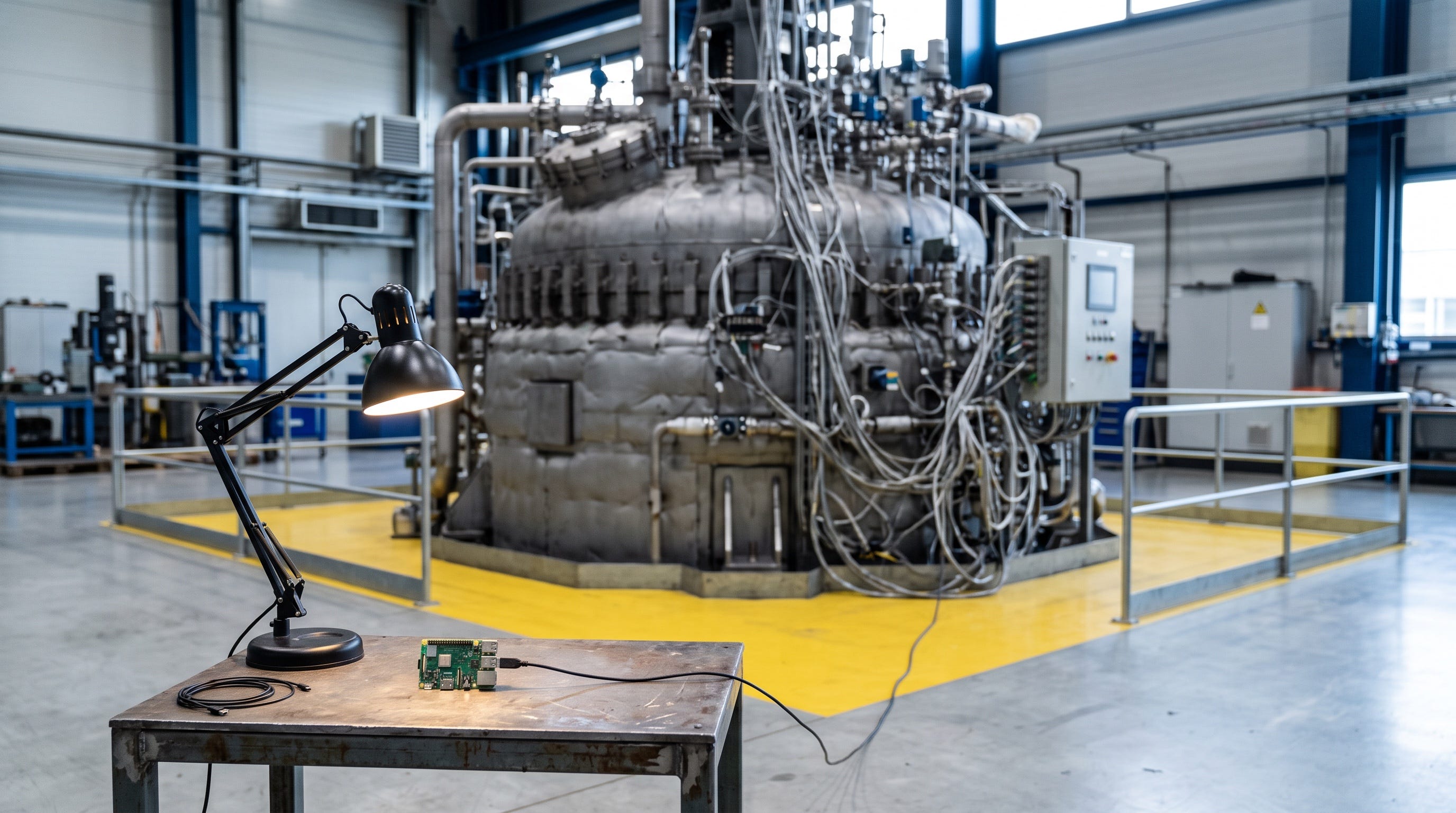
Coverage of the three mini reactors going critical put the scale plainly: Valar Atomics' Ward 250 generated 100 kilowatts and is roughly the size of a minivan. The company connected that output to an Nvidia Spark chip — a single developer board. Aalo's unit is, by design, a full-scale zero-power physics reactor.
One hundred kilowatts. A minivan. One chip. The demand under discussion is measured in gigawatts. Both facts are true at once, and only one of them fits in a headline.
So what is actually running the grid between now and then?
The answer is far less futuristic than the press cycle.
Coal that was supposed to be gone. In 2025 the American power sector retired 2.6 GW of coal capacity — the least coal retired in fifteen years — and more would likely have retired but for federal emergency orders under Section 202(c) of the Federal Power Act. There have now been more than 40 emergency orders and extensions since May 2025, stalling at least 4.4 GW of retirements, with the running log still growing this summer. Several states have gone to the D.C. Circuit arguing the department exceeded its authority — an allegation in a live case, not a ruling. Stranger still, the rescued plants are largely producing way less energy than before — one has not run at all under its order; another sits at a 46% capacity factor, down from nearly 66%. Kept alive, barely used, and paid for.
Gas that is sold out. If you want firm power this decade, the honest answer is a gas turbine, and you cannot get one. GE Vernova's order book is full until 2029, with orders booked as far out as 2031. A peer-reviewed account of the gas turbine shortage reports waits for the largest machines stretching to seven years, average around five. Two Penn State professors put it plainly: slots are booked into the late 2020s.
A capacity market that is screaming. In PJM, the mid-Atlantic grid, the auction for the 2027/28 delivery year hit a $333.44/MW-day price cap — a record for the third auction running — while procuring about 6,625 MW below the operator's own reserve-margin target. New generation and plant uprates that showed up and cleared: 774 megawatts. Not gigawatts.
And the bill arrived years ahead of the reactors. PJM's most recent auction, held this July for the 2028/29 delivery year, cleared at $325/MW-day — and the Citizens Utility Board notes that ComEd customers in Illinois now pay about 50 percent more for power than two years ago. The grid's independent market monitor, Joseph Bowring of Monitoring Analytics, calculates that data centers account for $6.3 billion — 38% — of the $16.4 billion in charges from that July auction. "You have to open your eyes and recognise that it is really a paradigm shift," he said.
Reactors in 2030. Invoices in 2026. That gap is the whole story.
The strongest case against everything I just wrote
The pro-nuclear reply is not weak, and much of it I find persuasive.
First, corporate demand is precisely the signal the industry never had. For forty years the problem was not physics but finance: nobody would underwrite a fifteen-year build for a market that might not want the output. As the R Street Institute argues, data-center companies are willing to pay a price premium for small modular reactor power, and the binding constraint is whether permitting and construction can move fast enough.
Second, permitting is moving. When the Nuclear Regulatory Commission issued a construction permit for TerraPower's Natrium reactor, the Breakthrough Institute noted the review finished significantly ahead of schedule — evidence, its nuclear-innovation director argued, that the agency is getting more efficient without loosening safety standards. And federal regulators ordered PJM to develop rules for co-locating data centers at power plants — a question the industry had waited years for someone to answer.
Third, the technology is real: MIT's technology magazine named next-generation reactors one of 2026's breakthrough technologies — while noting that the first demonstrations are still under construction.
All of that is true, and restarts genuinely deserve their own risk curve. None of it turns 2029 into 2026.
The country that already did this — and how long it took
Here is where I usually reach for a jurisdictional comparison. This time only one is worth making: one large industrial democracy has already done what everyone is now promising.
France derives about 70% of its electricity from nuclear energy — 68.1% of generation last year, by the grid operator's own count. Not "aims to." Does. That grid ran 96.3% carbon-free in 2025, and the country exported 103.6 TWh while importing 11.3. A country can run itself on atoms and still have surplus to sell the neighbors; France has been quietly proving it since roughly the time I was born.
So how long did it take?
The decision came in 1974, just after the first oil shock, when a French government with no oil and no patience resolved to expand nuclear capacity fast. What followed is the most successful reactor program in history — so look at what it took. All fifty-seven operable reactors belong to one utility, EDF, in three standard designs, which the World Nuclear Association calls a higher degree of standardization than anywhere else on earth. The thirty-two smallest units all started up across the late 1970s and early 1980s. One buyer, one builder, one regulator, one machine built over and over until the workforce got extremely good at it — and it still took the better part of two decades.
Now the coda. France's most recent reactor, the Flamanville EPR, was launched in 2007 on a 54-month schedule and connected to the grid on December 21, 2024. Seventeen years, for something planned as four and a half. The cost, POWER magazine records, "spiraled more than fourfold, from the original €3.3 billion estimate to at least €13.2 billion" — and France's national audit office went further in January 2025, putting the all-in figure at €20.4 billion in 2015 euros. That is the deepest nuclear bench on earth, building on a site it already owned.
France is simultaneously the best argument for nuclear power and the most rigorous argument about the clock. The fast era needed a national champion, one design, and two decades of unbroken state commitment. Without those, the recent era produced a seventeen-year build. Which of the two does the American 2020s resemble to you?
Now run the tape forward to 2032
Let me be optimistic on purpose. Assume everything lands.
Three Mile Island Unit 1 comes back on schedule. Duane Arnold returns in 2029. Palisades becomes the first American plant to come back from the dead. Susquehanna ramps to 1,920 MW by 2032, Kairos delivers its first commercial unit in 2030, TerraPower's Natrium units start supplying Meta. Ribbons get cut, politicians stand in hard hats, and it is genuinely a triumph.
Now look at what got built while we waited.
Every gas turbine ordered in 2026 and delivered in 2030 was financed on a thirty-to-forty-year life. That is not a bridge; it is a mortgage with a smokestack, and it will still be running in 2060. The coal units held open by emergency order will be on their eighth or ninth extension, because "temporary" is the most durable word in energy policy. And the new reactors — clean, welcome, expensive — arrive into a grid that already met the demand another way, and now pays for both.
Then there is the shape of it: co-location rules landing as owners want them, reactor inside the fence, data center beside it, a private wire between them, one customer taking the output. Meanwhile the public grid — the one your house is attached to — keeps bidding into an auction that keeps hitting its cap. You will not lose your power. You will simply notice that firm generation has sorted itself into two tiers, and you are not in the tier that signed a twenty-year contract.
Notice that this future contains no villains. Everyone in it behaves rationally. That is what makes it hard.
What the people who study this for a living are saying
Nobody should take my read on this. Take theirs — and note that they disagree.
The sharpest skeptical work is the Carnegie Endowment's Beyond the Hype. Its authors calculate that if every announced project comes to fruition, they would generate roughly 102 terawatt-hours a year — not enough to meet even the lowest data-center demand case. Their line stuck with me: hyperscalers are running a sprint; nuclear is a marathon.
On costs, M.V. Ramana — who holds the Simons Chair at the University of British Columbia — cites a 2014 study of 180 nuclear projects worldwide in which 175 out of 180 went over budget, by an average of 117%, taking 64% longer than projected. America has its own exhibit: the last two reactors the country finished, at Vogtle in Georgia, where $14 billion became more than $30 billion.
From the free-market right, Cato's Travis Fisher cuts against everyone in an interview with the Competitive Enterprise Institute: whatever this is, it is not a free market. Electricity subsidies, he estimates, could total $2.5 to $3 trillion over coming decades — enough, in his words, to badly distort the market. And from the safety-focused left, the Union of Concerned Scientists keeps Edwin Lyman on staff as a standing counterweight — which I cite for my own reason, not his: the fastest way to lose public consent for a nuclear era is to build it in a hurry.
Read all four and the picture is not "nuclear good" or "nuclear bad." It is about the clock.
What does this mean for you?
You are not going to change a hyperscaler's procurement strategy. You can stop being fooled by the calendar — and you have more leverage over the intervening years than you think.
Read the year, not the number. "Up to X by 2035" is a very different sentence from "X." Find the year first — it takes ten seconds and changes the meaning of most energy news.
Separate a restart from a new build. Three Mile Island Unit 1 and Duane Arnold are existing machines being switched back on. Kairos, TerraPower and Oklo do not yet exist. Different columns, different confidence.
Look at the capacity line on your bill. For the 67 million people in the PJM footprint — Illinois through Ohio, Pennsylvania, New Jersey, Maryland, Virginia — those prices arrive as a supply or capacity charge, set years in advance.
Ask the local question at the local meeting. When a data center is proposed near you, the question is not "is it clean?" It is: what generates its power in year one, who pays for the grid upgrades, and what happens if the promised reactor slips? Your utility commission takes public comment, and almost nobody files any.
Do not let "went critical" become "is powering AI." A hundred-kilowatt test unit is a fine engineering milestone and a rounding error against what one campus draws.
The lesson, as I see it
I changed my mind on nuclear power and I am not changing it back. These reactors should be built, the restarts should happen, the regulator should keep getting faster without getting sloppier — and the people who took four test reactors to criticality in a single year have earned their credit.
But I have read enough of these announcements to recognize the move, and it is not a lie so much as a substitution. A real solution to a 2035 problem is being offered as the answer to a 2026 problem — and because the solution is real, nobody feels obliged to answer the actual question: what burns between now and then, and who pays for it?
So far the answer is coal that was meant to be retired, gas that has not been manufactured yet, and a capacity charge on 67 million electricity bills. That is not an argument against nuclear power. It is an argument against letting a groundbreaking ceremony function as a receipt.
Build the reactors. Just stop pretending they are already here.
Every megawatt in this story is real. Ask each one what year it shows up — and if that question sticks with you, hand it to someone else who pays an electricity bill.