
Here's what that bait-and-switch means for every working musician, and for you the next time you hum along to something a machine made.

There is a song I have loved for fifteen years that I have never once been able to play correctly on a guitar — and I have tried. The chords are simple; the chart is online; I can hit every note in isolation. But the thing that makes the song the song — a hesitation before the chorus, the way the singer leans late into a line as if she only just decided to mean it — lives nowhere on the page. It lives in a body, in a room, on an afternoon that will never happen again. And that hesitation is precisely the thing now being copied at industrial scale, fed into a machine, and sold back to us as “AI music“ — while the people who own the recording of it just made a deal without asking the woman who sang it.
For most of the last two years, the story of AI music looked like a clean morality play. On one side: two startups, Suno and Udio, that built song generators by allegedly hoovering up the recorded history of popular music without permission. On the other: the major record labels, righteously outraged, marching into court to defend their artists. Easy to know whom to root for.
Then, late in 2025, the play got a rewrite. The labels didn‘t beat the machines. They joined them. And the terms of that peace tell you something uncomfortable about who “protecting artists“ was ever really for.
What actually happened — the suits, the settlements, the pivot
Let me lay down the verified sequence before we argue about what it means, because the spin in every direction here is thick.
It started as war. In June 2024, the Recording Industry Association of America — acting for Sony, Universal, and Warner — had the major labels first sued the two startups, filing twin copyright cases (Suno in Boston, Udio in New York) over what the complaint they filed described as recordings “copied and exploited without permission“ to train the models. The rhetoric was scorched-earth: an existential fight for the value of human music.
And then, eighteen months later, the war just... ended — for some of the combatants. In November 2025, Warner Music Group settled its copyright lawsuit with Suno and announced what the two called a partnership. A week earlier, Warner settled with Udio too, signing on for an AI music service; Universal Music Group had already gone first with Udio. The plaintiffs had become partners; the defendants, licensees.
Here‘s the part that matters most — the architecture, not the headline. Under these settlements, Suno and Udio vowed to retire their current models (the ones allegedly trained on everyone‘s catalog) and launch new ones in 2026 where the new models will be trained on only licensed works. A win for music, right? Read the fine print. On Suno, when the new models launch, downloading audio will require a paid account — free-tier songs become merely playable and shareable, locked to the platform. And on Udio‘s side, the service becomes a walled garden where, per the reporting, none of the creations can leave. The open, copy-it-anywhere song machine is being quietly rebuilt into a subscription you rent and a garden you can‘t carry anything out of — gated, licensed, label-partnered, with a toll booth the incumbents have a stake in. What gets retired isn‘t the machine; it‘s the open version of it. If that pattern rings a bell, hold the thought.

“But the deals protect artists” — the case I have to take seriously
Before I let my own suspicion run the show, let me make the labels‘ case as strongly as it deserves — because it isn‘t flimsy, and a fair reading has to sit with it.
The labels‘ framing is that these deals are a floor, not a betrayal — and there‘s real substance behind that. Under the Warner–Suno terms, the labels say it protects artists by giving them full control over whether and how their names, voices, likenesses, and compositions get used in AI music. That is not nothing. For two years the alternative was an open machine mimicking any voice it had swallowed, with no permission and no payment. A licensed system with consent and an opt-in compensation path is, on paper, a genuine improvement over lawless scraping.
And it isn‘t only the giants at the table. After the major-label settlements, Udio also signed independents via Merlin — the independent-label group spanning more than seventy countries and roughly fifteen percent of recorded music. So the lazy critique — only the majors got a seat — isn‘t fully true.
And here‘s the fact that should puncture anyone‘s “sued to death“ literalism, mine included. The machines are not dead. In June 2026, even while several rightsholders kept litigating, Suno raised another $400 million, valuing the company at $5.4 billion. The lawsuits didn‘t kill Suno; they herded it into the licensing tent — bruised, richer, and now wearing the labels‘ colors. Nobody got sued to death. They got sued into a partnership.
That‘s the steel-man: a chaotic, exploitative free-for-all replaced by a licensed marketplace with consent and a check at the end. If that were the whole story, I‘d close the laptop and call it a reasonable, imperfect peace.
It isn‘t the whole story.
Where the floor starts to look like a trapdoor
Here is where my suspicion stops being a temperament and starts being a reading of the documents. Start with the word doing all the heavy lifting: opt-in. The labels present it as protection — nothing of yours is used unless you say yes. True. But opt-in cuts both ways, and the second way is the quiet one. If the deals only cover artists who can opt in through a major label or Merlin, then everyone outside that arrangement — the independent who self-releases, the session bassist who played on a hit but doesn‘t own the master, the songwriter already sitting inside the old training data — was never invited. One intellectual-property lawyer argued that a vast share of the music in question belongs to independent artists who were never asked for permission or offered compensation — and that the real question is whether this “start fresh“ campaign is about protecting music or about protecting the largest catalogs while everyone else‘s work stays in the unauthorized pile.
Then there‘s the most damning thread — and I‘ll attribute it carefully, because it‘s a live allegation, not a finding. In a separate suit, the musicians’ union sued the labels: the American Federation of Musicians went after Universal and Warner directly, claiming the labels licensed members‘ recordings to Suno and Udio without paying or crediting the musicians who played on them. The corroborating reporting is sharper still: the union says the labels kept the money, that the companies “failed to share in the settlement proceeds and future revenue“ with the artists whose work trained the machines. Read that twice. The allegation isn‘t that AI stole from musicians. It‘s that the labels settled the AI theft, pocketed the proceeds, signed the licensing deals — and then, the union claims, declined to pass the money down to the players whose hands are inside those models.
That‘s the bait-and-switch in one sentence. The labels went to war in the name of artists. They came home with a revenue stream — and, the union alleges, left a lot of those artists exactly where they started.
And the “peace“ isn‘t even total. As of now, the talks stalled between Universal and Suno — a person in the room reportedly saying there is “no path forward with the current proposal“ — and Sony hasn‘t settled with Suno at all. Sony and Universal have instead moved to expand the list of allegedly copied Suno tracks from 560 to over 61,000, under which the potential damages ballooned to more than $9.1 billion (a theoretical maximum if they win and the expanded list holds — not a verdict). So the real map isn‘t “war over.“ It‘s: Warner signed, Universal half-signed, Sony still swinging a ten-figure club — and the holdouts‘ leverage is exactly what gives this settlement wave its shape.
We have watched this exact movie before — in a different theater
Here I want to step out of the music business, because the most useful way to see this is to look at an adjacent creative industry that already lived its own version of it — and how it played out for the people doing the work.
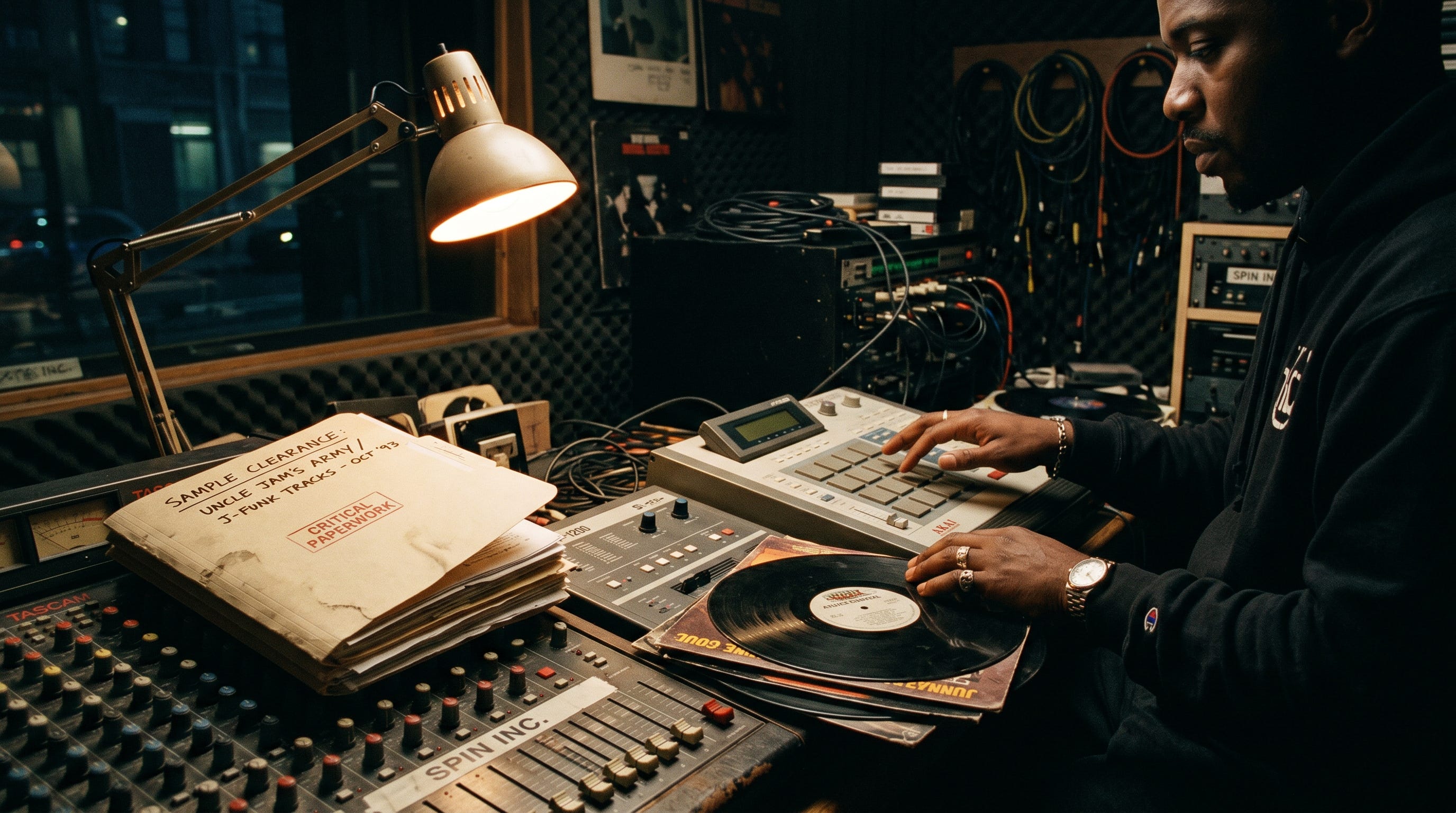
Think about sampling. In the late 1980s, hip-hop was built on a glorious, lawless practice: producers chopped up snippets of old records into something new — genuinely transformative art, and legally a free-for-all. Then the lawsuits came, and the courts and labels imposed a regime of clearance: every sample now had to be licensed, paid for, approved. On its face, fair enough — pay the people you borrow from.
But watch who it rewarded. Clearance is expensive, and the cost falls hardest on the small. The rightsholders who owned the back catalog got a new revenue stream every time someone built on the past. The wealthy artist could clear a dozen samples; the kid in a bedroom could not. The result wasn‘t a level field — it was a tollbooth the incumbents collected at, while the next generation got priced out of the very technique that built the genre. The “fair“ regime quietly became a moat protecting the people who already owned the most.
Then came Napster, and the labels ran the same play at scale: an unlicensed disruptor terrified the industry, got litigated into oblivion — and was replaced, a few years later, not by a return to the old world but by licensed streaming, a model the incumbents shaped and profit from to this day. (No single document hands me this analogy, so take it as my argument, not a cited fact.) The play runs like clockwork. Phase one: a new technology breaks the rules and threatens the gatekeepers. Phase two: lawsuits. Phase three: the gatekeepers don‘t kill the technology — they license it, fold it into a system they control, and emerge owning the toll road. The disruptor gets domesticated; the catalog owners get a new annuity. And the working creator is told, again, that this is for their protection.
AI music is phase three, right on schedule.
Now run it forward five years
Let me get specific, because the abstract version is too easy to shrug off. Picture it not as dystopia but as the boring, plausible Tuesday it‘s likely to become.
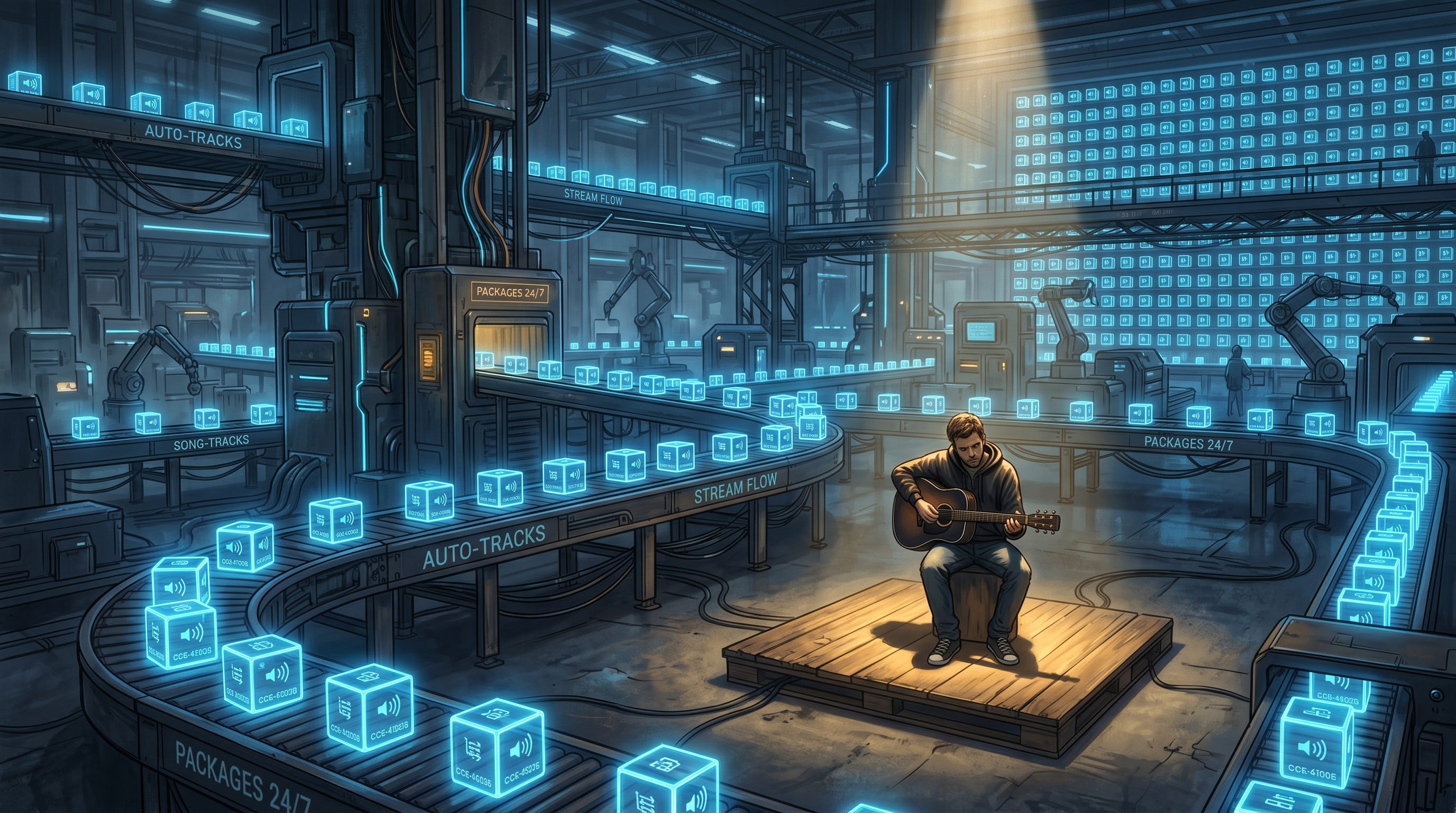
It‘s 2031. The licensed AI models have shipped and matured. You open your music app and the “For You“ station is, increasingly, for the machine — endless, frictionless AI-generated tracks tuned to your exact tolerance, licensed cleanly from the majors‘ catalogs. All perfectly legal: every voice opted in, every catalog paid for. The walled garden is lush, the gate is locked, and you don‘t even notice, because everything inside it is good enough.
Now look at the economics. The label that owns the catalog earns on two layers at once: the old recordings and the AI models trained on their licensed style — infinite new “product“ with no studio to book, no band to pay scale, no tour to insure. The session musician whose phrasing taught the model how a saxophone breathes got a one-time opt-in check years ago, if that, and now competes against a tireless synthetic version of her own sound the label generates for free. The independent who never opted in is simply absent from the garden, her work living outside the walls where the recommendation engine rarely points.
And here‘s the twist that keeps it plausible rather than paranoid: nobody has to be a villain. Each step is a reasonable business decision — the labels maximize assets they legally own, the platforms give users what they click on, the lawyers cleared everything. It‘s just that, at the end of a chain of entirely defensible choices, the human musician has been quietly engineered out of the loop — not banned, just un-needed — and the upside has pooled, as it always does, with whoever owned the catalog.
What the smart people are saying
Here‘s what‘s striking: the alarm bells aren‘t coming from one corner of the political map. They‘re coming from all of them — usually a sign that something real is going on underneath the partisanship.
From the labor side, the American Federation of Musicians‘ suit, above, is the working musicians saying out loud that the “deal made for us“ was made over their heads — not a think-tank abstraction, but the band suing the label.
On Capitol Hill, Representative Deborah Ross introduced a bill to let independent musicians bargain collectively — the Protect Working Musicians Act — explicitly because, under current law, small artists are shut out of the music marketplace, with little recourse against AI companies that scrape their work. Its endorsements span the independent-label association, the recording academy, and the performers‘ union — the breadth is the tell.
And now cross the aisle, because this is where it gets genuinely interesting. You‘d expect the digital-rights left and the free-market right on opposite sides of an AI-copyright fight. They land in the same place. The Electronic Frontier Foundation warns that overbroad licensing risks entrenching Big Tech‘s dominance and shutting out small developers — that copyright, wielded this way, becomes “a tool that gives the most powerful companies even more control.“ From the opposite premise, the free-market R Street Institute argues that sweeping licensing mandates would stifle innovation while fostering “a monopolistic environment dominated by large technology companies,“ raising barriers to entry.
Sit with that convergence. A civil-liberties group and a free-market institute, from opposite values, reach the identical warning: build the rules around licensing, and the people who already own the most to license win. When left and right independently spot the same trapdoor, I stop calling it a coincidence of ideology and start calling it a feature of the deal.
What does this mean for you?
You‘re not a record executive and may not even make music. So why should any of this reach your kitchen table? A few reasons, closer to home than they look.
Notice when “for the artists” is doing PR work. Next time a giant institution says it’s fighting to protect creators, ask the unglamorous follow-up: which creators, and where does the money actually land? Here, the slogan and the cash flow pointed different directions — and that gap is where to aim your skepticism.
Follow the gate, not the lawsuit. The headline was the courtroom drama. The thing that will shape music for a decade is quieter: the shift from open tools to walled, subscription-gated, opt-in-only platforms. When a free thing becomes a rented thing you can’t carry your work out of, that’s the moment that matters — louder than any verdict.
Support musicians directly, while it still moves the needle. Buy the album, not just the stream. Go to the small show. Pay for the thing made by a body in a room — because the part of the economy that pays a session player scale is exactly the part the synthetic version is built to replace, and your dollar is one of the few votes that doesn’t route through a label’s settlement.
Watch the collective-bargaining fight. Whether independent creators get to negotiate as a bloc — the heart of the Protect Working Musicians Act — is one of the few levers that could turn “opt-in for the powerful” into a real floor for everyone. It’s worth a constituent email; these bills live or die on whether anyone outside the industry is watching.
Don’t outsource your taste to the recommendation engine. The walled garden wins when “good enough” is enough. The simplest resistance is to keep seeking out the human, the strange, the imperfect — the hesitation before the chorus no model has a reason to invent.
The floor, the trapdoor, and the room you weren’t in
So — floor or trapdoor? Here‘s my honest read, holding both halves. It‘s a real floor for the people on the right square: the major-label artist with leverage, the catalog owner, the platform investor. For them, the free-for-all is being replaced by something licensed, consented, and paid. But for the session player whose phrasing trained the model, the independent who was never asked, the songwriter already baked into the old data — for them the same deal is a trapdoor that looks like protection while the value drops through the floor and pools with whoever owned the catalog. The labels didn‘t lie when they said they were defending artists. They just neglected to mention which ones.
And the deeper lesson outlasts this one fight, because it‘s the pattern itself: outrage, litigation, then a licensed peace that leaves the incumbents owning the toll road. The only variable that ever moves is whether working creators force their way into the room where the deal gets cut — or find out, as the musicians‘ union did, after the money was already split.
My vote? Stay loud while the rules are still wet. The licensed-AI-music era isn‘t built yet — the models haven‘t shipped, Sony is still fighting, the bargaining bill is still a bill — and that unfinished quality is the whole opportunity. This is being decided right now, in rooms most of us will never enter. The least we can do is refuse to be surprised by the ending — because, this time, we‘ve seen the movie before.
If you’ve got a friend who plays in a band, mixes in a bedroom, or just loves an album the way I love that one un-playable song, send this their way — they have more skin in this than almost anyone, and they deserve to see the deal being cut on their behalf. The HAIA Foundation is here to keep watch on exactly these rooms; come keep watch with us over on the Substack.