
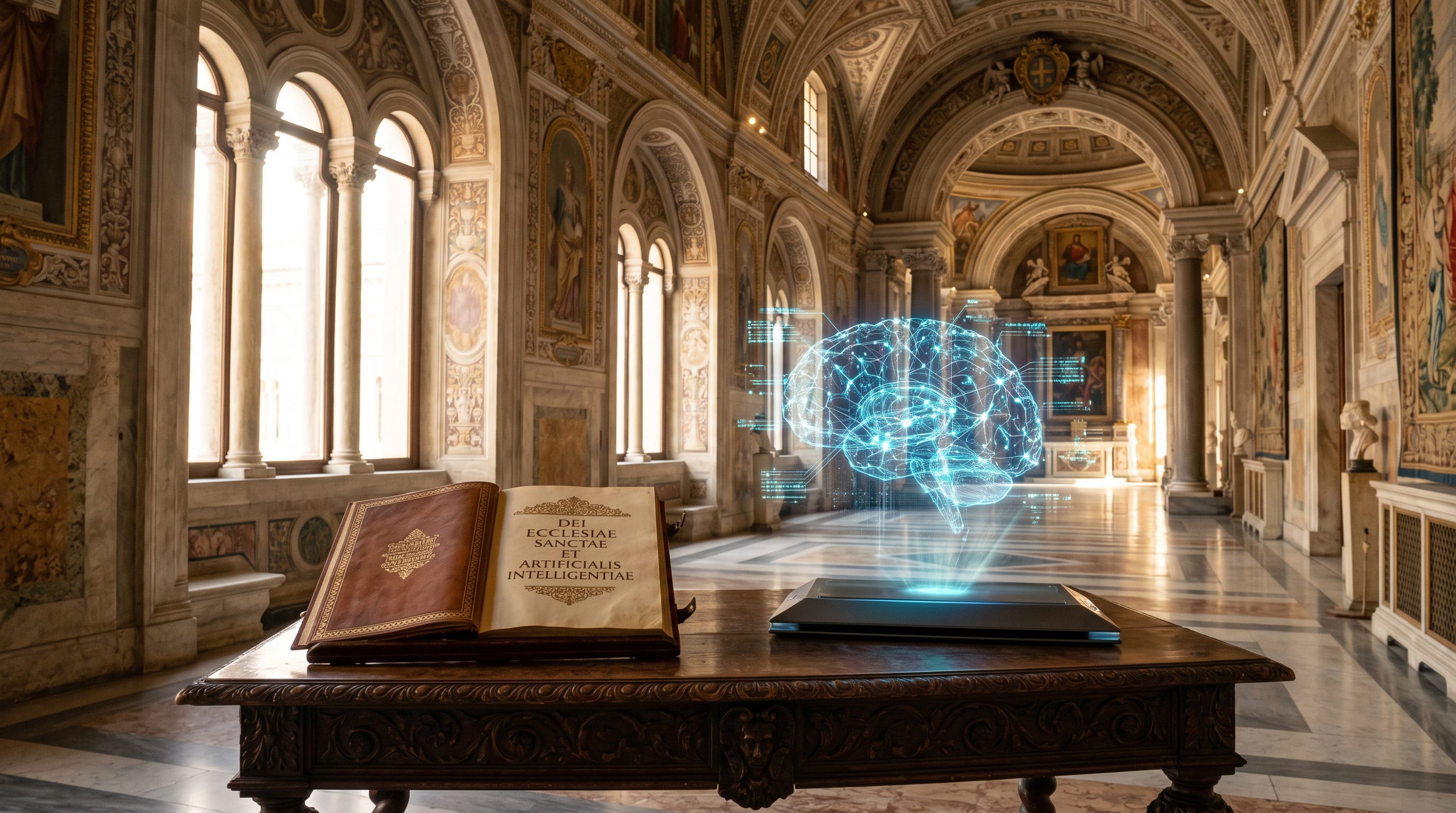
On May 25, 2026, Pope Leo XIV walked into the Vatican’s Synod Hall and did something popes don’t usually do: he personally presented his own encyclical. Standing next to him — and this is the part that made tech reporters do a double take — was a co-founder of a leading AI lab, there as an interlocutor rather than a celebrant.
The document they were there to launch is called Magnifica Humanitas — Latin for “Magnificent Humanity” — and its subtitle is On Safeguarding the Human Person in the Time of Artificial Intelligence. It is the first encyclical of Leo XIV’s pontificate. It is organized into an introduction, five chapters, and a conclusion. And whether or not you share the Catholic Church‘s religious commitments — I’ll be writing here for readers who range from devout to skeptic to “I just want to understand what this means for my kids” — the document matters. It matters because the Catholic Church is one of the largest non-corporate, non-governmental institutions on earth still willing to make a normative argument about what humans are for. And right now, in the middle of the AI build-out, that question is getting answered mostly by quarterly earnings calls.
So let’s do three things, in order. First, I’ll summarize what the encyclical actually says — clearly, without ecclesial jargon. Second, I’ll lay out what’s good about it, including the parts that anyone who works in or near AI ought to take seriously. Third, I’ll be honest about where it doesn’t quite work — where it misreads the technology, where its proposals run into hard governance problems, and where it leaves big questions hanging.
I’ll try to be fair throughout. This is a hard one to get right, because the document is at once a religious text written for believers and a public intervention written for “every person of goodwill.” I’ll respect both registers without proselytizing or sneering. Deal?
Why “Magnifica Humanitas,” and why now?
A bit of setup, because the timing is deliberate and the timing tells you something.
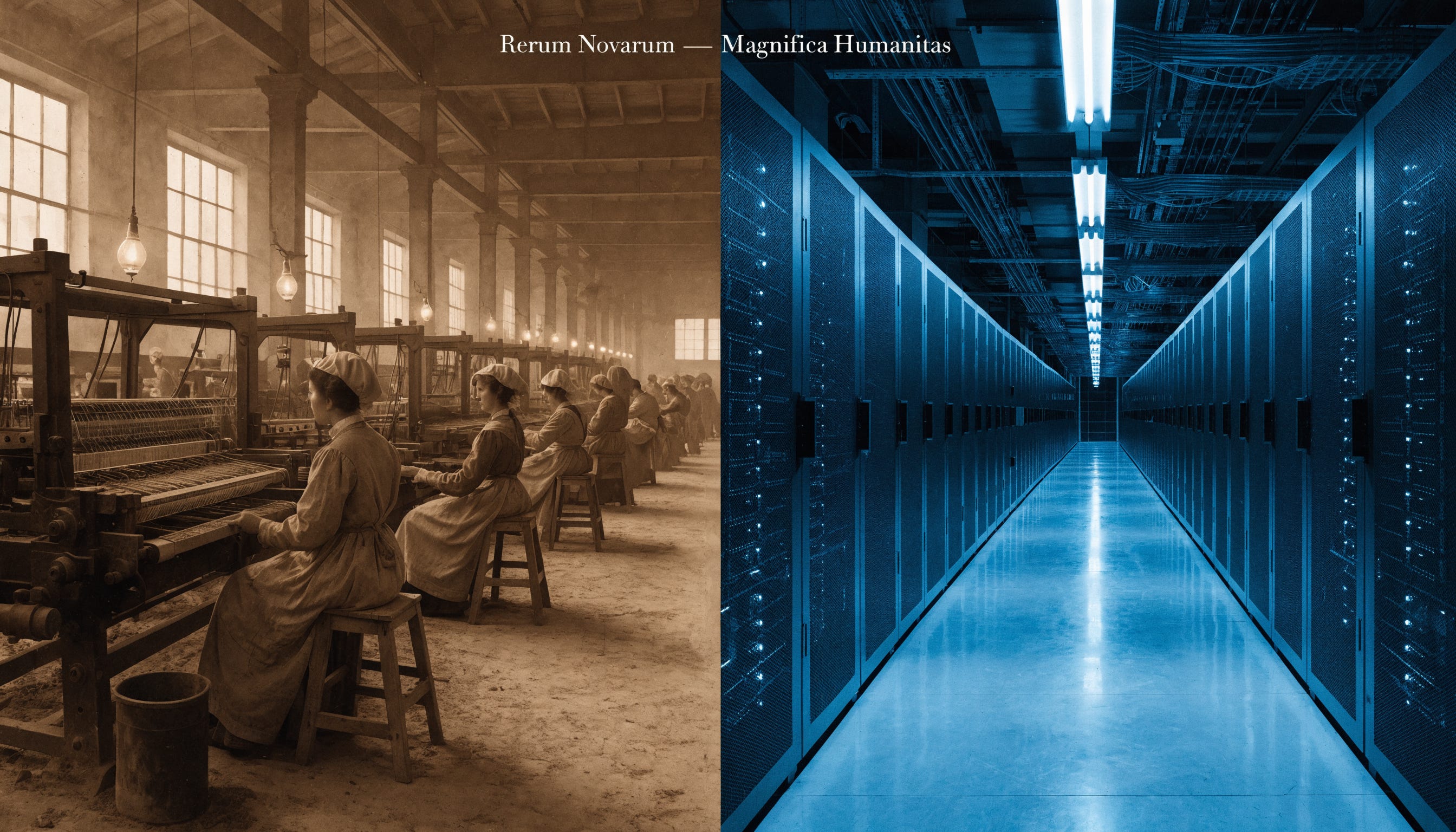
The signature on the document is dated May 15, 2026 — exactly 135 years to the day since Leo XIII signed Rerum Novarum (”Of New Things”) in 1891. That older document is widely considered the founding text of modern Catholic social teaching. It was Leo XIII’s attempt to grapple with the dislocations of the Industrial Revolution: factory exploitation, the rights of workers, the relationship between capital and labor. It influenced labor movements, social democracy, and Catholic political parties across Europe and Latin America for the next century.
The new pope picked his namesake on purpose. Leo XIII was the pope of social teaching during the first industrial revolution. Leo XIV is positioning himself as the pope of social teaching during what he sees as a comparable rupture — the AI revolution. Whether you find that analogy compelling or overheated, it is doing real work in the document.
(One more piece of context: a sitting pope personally presenting an encyclical in public, alongside an AI researcher and academic theologians, is itself unusual. Past popes have typically farmed that job out to cardinals. Leo XIV showed up himself. That is a signal.)
What the document actually says
The encyclical opens with what’s probably its most memorable image. Leo XIV says humanity faces a choice between two biblical building projects: the Tower of Babel (Genesis 11) — the prideful, uniform, godless mega-construction in which everybody speaks one language, builds one tower, and tries to reach heaven by sheer collective force — and the rebuilding of Jerusalem’s walls under Nehemiah (Nehemiah 2–6) — in which an exiled people return to a ruined city, assign each family a section of wall, listen to each other’s worries, and rebuild together.
His key line: the choice is “not between a ‘yes’ or ‘no’ to technology, but rather between constructing Babel or rebuilding Jerusalem.”
That’s the spine of the whole document. Technology, he says, is “not in itself a force antagonistic to humanity,” nor is it “inherently evil.” But it is also never neutral — “because it takes on the characteristics of those who devise, finance, regulate and use it.” That sentence alone is worth slowing down on. It’s a fairly mainstream position in academic technology studies, and it pulls the rug out from under the most common defense the tech industry makes of itself (”we just make tools; what people do with them is on them”).
The five chapters then unfold like this:
Chapter 1 is a guided tour of Catholic social doctrine from Rerum Novarum through to Pope Francis‘s Laudato Si’ and Fratelli Tutti. The crucial move comes when Leo XIV notes that, historically, social doctrine assumed the state was the main driver of innovation and the main entity to be persuaded or restrained. That is no longer the case. Today, he writes, “the main drivers of development are private, often transnational, parties that are endowed with resources and the capacity to intervene that surpass those of many Governments.” Hold that sentence; we’ll come back to it.
Chapter 2 lays out foundations and principles. The human person is created in the image of God; dignity is “infinite” and not earned by performance, productivity, or efficiency. Then he names five principles he wants applied to the AI age: the common good, the universal destination of goods, subsidiarity, solidarity, and social justice. The most technologically pointed move is in the principle of the universal destination of goods, where he explicitly extends what has historically been about land and physical resources to “patents, algorithms, digital platforms, technological infrastructure and data.” (Translation: the building blocks of the modern AI economy aren’t just private property to be optimized for shareholder return. They have a social purpose.) Chapter 2 ends, notably, with an examen — a self-examination — turning these standards on the Church itself.
Chapter 3 (”Technology and Dominance”) is where the document gets philosophical teeth. Leo XIV picks up Francis’s concept of the technocratic paradigm — the tendency to let efficiency, control, and profit alone shape every decision — and pushes back on two related ideologies he calls transhumanism (the project of using technology to overcome aging, biology, and the limits of the human body) and posthumanism (the project of blurring the line between humans and machines). He defends human limits, weakness, and what he calls “the heart” as features, not bugs. He quotes the German Catholic philosopher Romano Guardini: “Contemporary man has not been trained to use power well.”
Chapter 4 (”Safeguarding Humanity: Truth, Work, Freedom”) is the most directly practical. It calls for an “ecology of communication” against misinformation, defends democracy as requiring shared truth (and here he quotes Hannah Arendt on totalitarianism producing “people for whom the distinction between fact and fiction... no longer exists”), defends the dignity of work against automation that treats people as expendable, and warns against what he calls “new forms of slavery” emerging from digital dependencies, manipulative design, and the commercialization of attention.
Chapter 5 (”The Culture of Power and the Civilization of Love”) is the one generating the most secular headlines. Leo XIV warns that an age of autonomous weapons, drone swarms, and AI-targeted munitions strains classical just war thinking, and insists that the use of AI in warfare must be subject to rigorous ethical constraints — that lethal decisions should not be entrusted to machines. He warns of the “normalization of war,” the crisis of multilateralism, and the seduction of “a supposed political realism” that treats escalation as the only adult option.
The conclusion lands on the Magnificat — Mary’s song of praise in Luke’s Gospel — from which the encyclical takes its name. The cultural references throughout are unusually wide-ranging for an encyclical, drawing not only on Augustine and Guardini but on J.R.R. Tolkien, Beethoven, Martin Luther King Jr., and Arendt.
So: that’s the document. Now let’s talk about what it gets right, and where it doesn’t quite hold together.
What’s genuinely good about Magnifica Humanitas

Let me start with the strongest stuff, because there’s quite a lot of it, and the secular AI policy world should not let the religious framing scare it off.
First, the framing of power is correct, and unusually direct. When Leo XIV writes that the dominant actors in the AI build-out are private, transnational entities with resources exceeding those of most governments, he is not exaggerating. Per research from Epoch AI, a small handful of “hyperscaler” firms collectively hold over two-thirds of the world’s cumulative AI compute, a share that has been rising. That is an extraordinary concentration of strategic capability in a small number of corporate boards. Whatever you think of religion, the empirical claim about power concentration is well-supported, and the document is one of the few global moral interventions willing to name it bluntly. It echoes the concerns of researchers like Harvard’s Shoshana Zuboff, whose work on surveillance capitalism describes a “behavioral futures market” in which predictions about human conduct are bought and sold without our meaningful consent.
Second, the document is genuinely careful about not catastrophizing. Leo XIV repeatedly says AI is not inherently evil, that it can be a valuable tool, and that it can do real good — healing, educating, connecting, protecting the environment. This is important, because the temptation in religious commentary on new technology has historically been to either bless it unreservedly or denounce it as demonic. He does neither. He sits in the harder middle, which is also roughly where most serious AI researchers sit. (The International AI Safety Report led by Turing Award winner Yoshua Bengio, drawing on around 100 experts across dozens of countries, lands in roughly the same epistemic posture: AI is potentially transformative, the risks are real, and the outcomes depend on choices we are making right now.)
Third, the treatment of labor is the strongest single contribution. This is where the Rerum Novarum analogy actually earns its keep. The encyclical frames worker displacement as a moral problem, not merely an economic adjustment — and the data backs the seriousness of the concern. The IMF has estimated that around 40% of jobs globally are exposed to AI, rising to about 60% in advanced economies, and Goldman Sachs has projected that generative AI could expose the equivalent of 300 million full-time jobs worldwide to automation. The OECD’s Employment Outlook has found a substantial share of jobs in occupations at high risk of automation. MIT economist Daron Acemoglu, in Power and Progress, makes essentially the same argument from a secular direction: technology is not destiny; whether AI augments workers or merely replaces them is a political choice. The encyclical is right that this question is not solved by markets alone.
Fourth, the move to extend the “universal destination of goods” to data, algorithms, and infrastructure is intellectually serious. Whatever you make of the theology, the underlying claim — that the foundational inputs of the digital economy aren’t just private property but socially constructed goods with public consequences — maps directly onto secular debates about data trusts, public AI compute, antitrust, and the UNESCO Recommendation on the Ethics of Artificial Intelligence, adopted by all UNESCO member states in 2021. It also tracks the spirit of the EU AI Act, which classifies AI by risk tier and imposes stricter obligations on higher-risk systems.
Fifth, the section on autonomous weapons is, I think, the morally clearest part of the document. The insistence that lethal decisions should not be entrusted to machines is not a fringe view — it broadly aligns with the position of UN Secretary-General António Guterres, who has called lethal autonomous weapons “politically unacceptable and morally repugnant,” and with the Stop Killer Robots coalition of hundreds of NGOs. The encyclical’s force here is to insist that “meaningful human control” is not a slogan but a moral floor.
Sixth, the misinformation framing via Arendt is genuinely sharp. Quoting The Origins of Totalitarianism — that totalitarianism flourishes among “people for whom the distinction between fact and fiction... no longer exists” — and applying that to deepfakes, AI-generated propaganda, and algorithmic information environments is exactly the kind of cross-disciplinary move the moment requires. It echoes the work of Tristan Harris and the Center for Humane Technology, who have argued for years that engagement-maximizing systems are corroding our shared epistemic ground.
Seventh — and this matters more than it might look — the encyclical turns its principles on the Church itself. Chapter 2’s examen says, explicitly, that transparency, accountability, listening to victims of abuse, and resisting concentrations of internal power all apply to the institution doing the moralizing. That self-implication is rare in any institutional document about AI, religious or otherwise. (When is the last time you read a corporate AI ethics statement that said “and here is how we will hold ourselves to the same standard”? Exactly.)
So: serious document. Big themes, mostly accurately diagnosed. Now for the harder part.
Where the encyclical strains against how AI actually works
I want to be careful here. The encyclical is not a technical paper, and judging it as one would be unfair. Its job is to set moral direction, not to debug code. But the document does make claims — implicit and explicit — about how AI behaves and how it can be governed. Some of those claims don’t quite line up with the state of the technology.
1. The “tool” frame is partly outdated
The document leans on the framing of AI as “a valuable tool that requires vigilance.” Tools have users. Tools do what users want, with some risk of misuse.
That framing works for, say, a hammer or a calculator. It is increasingly strained for frontier AI systems. Modern large language models are not deterministic tools in the classical sense — they are statistical systems with emergent behaviors, including behaviors their own designers did not anticipate and cannot fully explain. This is precisely why Stuart Russell of UC Berkeley wrote Human Compatible: Artificial Intelligence and the Problem of Control, arguing that the standard model of AI as a “tool that optimizes a given objective” is itself a source of catastrophic risk. It is why the field of mechanistic interpretability exists at all: because nobody fully understands what is happening inside a model with hundreds of billions of parameters when it produces an output.
So when the encyclical insists on “transparency” and “accountability” for AI, the right response is yes, of course — and also: we do not yet have the science to deliver transparency at the level the document implies. The honest technical answer is that interpretability is a very early-stage research program, and “explain why this model said that” is sometimes literally impossible with current methods. The encyclical’s moral demand is correct; its assumption that the demand is technically tractable is shakier than it sounds.
2. “Subsidiarity” doesn’t have a clean institutional address
Subsidiarity — the principle that decisions should be made at the lowest competent level — is one of Catholic social teaching’s deepest contributions. Leo XIV applies it to AI by saying that platforms and AI labs should not impose conditions unilaterally; communities, schools, intermediary organizations, and democratic publics should have a voice.
Beautiful. Now: who enforces this?
The encyclical lists candidates — “States and transnational institutions” — but it does not grapple seriously with the fact that the largest AI developers operate across dozens of jurisdictions, route their data through cloud regions optimized for tax and latency, and are functionally beyond the reach of most national regulators. The EU has the AI Act, which is genuinely ambitious; the U.S. operates a patchwork of state laws and shifting executive orders; China runs its own model entirely. There is no global AI regulator. There is no AI equivalent of the Nuclear Non-Proliferation Treaty. The encyclical’s call for international cooperation is exactly right in principle and almost completely unaddressed in mechanism. Saying “the world should govern AI subsidiarily” without naming a venue or an enforcement architecture is, in the language of policy, a wish.
This isn’t unique to the encyclical — it is the central problem of global AI governance. But the document doesn’t acknowledge how hard the problem is.
3. The tension with market dynamics is real and unresolved
The encyclical calls for AI developers to put the common good over profit. But the largest AI labs are either publicly traded, controlled by publicly traded parents, or funded by venture capital with fiduciary obligations to limited partners. They are caught in what observers across the spectrum — from the Future of Life Institute (which in 2023 called for a six-month pause on training models more powerful than GPT-4) to Tristan Harris — describe as a race to the bottom on safety: every lab knows slowing down unilaterally means losing the market, so none of them does.
The encyclical’s response is essentially moral exhortation: the labs should prioritize the common good. But moral exhortation is not a mechanism. Without antitrust action, mandatory safety standards, liability rules, and possibly limits on training compute, “prioritize the common good” is a polite suggestion to a stadium full of sprinting competitors. The Future of Life Institute’s AI Safety Index has repeatedly given even the best-performing labs middling overall grades — and far worse marks on the specific dimension of “existential safety.” Goodwill is not yet converting into governance.
To be fair: the encyclical does call for “adequate regulatory tools.” But it never quite asks the harder question — should developing frontier systems above some capability threshold simply be paused, as Bengio, Geoffrey Hinton (the Nobel laureate who has publicly put the probability of AI causing human extinction within thirty years at “10 to 20 percent”), and others have proposed? The document leans against techno-utopianism, but it doesn’t go to the place the more alarmed scientific voices have gone. Whether that’s prudence or pulled punches is, honestly, a judgment call.
4. The transhumanism critique flattens a real distinction
Chapter 3 critiques transhumanism (life extension, biological enhancement, the project of overcoming the body’s limits) and posthumanism (the blurring of human/machine boundaries). Fair targets. But the encyclical tends to lump together two very different things: (a) the philosophical project of treating death and limit as problems to be engineered away, which is a coherent worldview that deserves the critique it gets; and (b) the medical and assistive use of AI-enabled prosthetics, neural interfaces, gene therapies, and longevity research that, in concrete cases, reduce suffering and restore capacity to disabled people.
A blind person who can read with a neural-image-to-speech model, a paralyzed person who can move a robotic limb via a brain–computer interface, a child whose rare genetic disease is cured by an AI-designed therapy — none of this is “denying human weakness.” It is using technology to expand the range of lives that get to be lived with dignity. The encyclical’s framework — dignity is not earned, weakness is not a defect — should be the strongest argument for those technologies, not a critique of them. The text does not always make that distinction crisply, and a casual reader could come away thinking the Church is more uniformly skeptical of biomedical AI than it actually is.
5. The “slow down” call meets a global game-theoretic wall
The encyclical’s instinct is toward restraint and a slower, more deliberate pace — an echo of one of the central themes in the safety community, that the current speed of capability gains has outrun our ability to ensure these systems do what we want.
The problem is that restraint only works if everyone exercises it together. If the U.S. labs slow down and labs elsewhere do not, the call has the opposite of the intended effect: it shifts the frontier to jurisdictions with even less appetite for democratic input. If one company slows down and its competitors do not, market share migrates. If governments hold the line and venture-backed competitors do not, the rules become a competitive disadvantage. This is not a reason not to exercise restraint; it is a reason that restraint needs to be paired with extremely specific proposals — verification regimes, compute thresholds, treaty mechanisms — that the encyclical doesn’t provide and probably can’t, since that’s not its job. But the asymmetry is real, and pretending it isn’t is part of why so many “AI ethics” interventions feel hollow to the engineers they’re addressed to.
6. The environmental angle is underdeveloped
Leo XIV gestures at the environmental costs of AI infrastructure, which is correct as far as it goes — but the document does relatively little to develop it, despite the obvious bridge to Laudato Si’‘s ecological framework. The International Energy Agency’s Energy and AI report projects global data-center electricity consumption roughly doubling by 2030, to a level comparable to the entire annual electricity consumption of Japan. Research on AI’s water footprint estimates that training a single large model in U.S. data centers can directly evaporate hundreds of thousands of liters of freshwater. The link between “rebuilding our common home” and “the kilowatt-hours required to train the next frontier model” is closer than the text makes it. (To be clear: nobody expected the AI encyclical to also be an energy white paper. But the connection was right there.)
Near-term scenarios this document is actually about

To bring this down from altitude: what does Magnifica Humanitas actually mean for the next two to five years, in scenarios you can picture?
The AI tutor in your kid’s classroom. Within the next three years, near-universal adoption of AI tutors in K–12 and university education is plausible. The encyclical’s worry — that schools will outsource not just rote drills but the formation of judgment, taste, and moral reasoning to systems whose values are inscribed by their designers — is concrete. Imagine a tutor optimized for “engagement” rather than “learning,” nudging your kid toward whichever topic keeps them clicking. Now imagine that tutor is the cheapest option for under-resourced public schools and the only option for rural ones. That is the inequity Leo XIV is naming when he talks about new forms of digital exclusion.
The white-collar layoff wave. The 300-million-job exposure figure is not a prediction of net job loss; it’s a measure of automatability. But the disruption to particular jobs and particular communities will be real, and it is already starting. Entry-level legal research, paralegal work, customer service, copywriting, basic coding, junior accounting, translation, and large parts of the creative industries are visibly compressing. The encyclical’s labor framing — that displacement is a moral problem, not just an economic adjustment — is going to be tested in the next election cycle, the next round of union contracts, and the next wave of policy debates around portable benefits, universal basic income experiments, and retraining programs.
The information environment in elections. The encyclical’s Arendt quotation lands harder when you remember that researchers at the Knight First Amendment Institute who catalogued dozens of election-related deepfakes found something counterintuitive: “cheap fakes” (lightly edited real footage) still outpaced AI-generated content by a wide margin. The bigger near-term worry is not the dramatic deepfake on a debate stage; it is the slow erosion of confidence that anything you see is real. And the UK’s AI Safety Institute found that a meaningful slice of voters were already turning to AI chatbots for electorally relevant information during a recent general election. By the next few cycles, expect that to be a dominant information source for a significant share of the electorate — and expect it to be tested by motivated bad actors.
The autonomous weapons scenario. This is the least theoretical of the near-term concerns. AI-augmented targeting is now operational in multiple active conflicts, and at least one documented case suggests a drone may have autonomously engaged human targets. The encyclical’s call for “meaningful human control” is exactly the language being negotiated, slowly, at the UN Convention on Certain Conventional Weapons. A large majority of countries support a treaty; a handful of the most militarized have abstained or opposed. The next few years either produce meaningful international rules or normalize a battlefield in which they’re absent.
The AI companion problem. Less dramatic but possibly more pervasive: hundreds of millions of people are likely to have ongoing relationships with AI chatbots — for friendship, romance, therapy, counseling, or just company. The encyclical’s warning about “new forms of slavery” and “digital dependencies” is, frankly, prescient here. The first wave of teen mental-health harms attributed to AI companion apps is already in litigation. Whatever your religious view, the question of whether children should be forming primary emotional attachments with engagement-optimized commercial products is not a fringe concern.
And the longer horizon

Now for the more speculative territory — where I am moving from “this is happening” to “this could happen,” with the honest disclaimer that nobody knows for sure.
The capability question. Bengio, Hinton, and a growing fraction of the people who actually built modern AI now talk publicly about the possibility — not the certainty, the possibility — of AI systems that match or exceed human cognitive performance across most economically and strategically meaningful tasks within the next decade or two. The probability they assign varies. The fact that they’re willing to put it on the table at all is new. If that capability arrives, the question Leo XIV puts at the center of his document — what is a human person actually for? — stops being abstract.
If much of what we have called “knowledge work” can be done better, faster, and cheaper by systems that do not require salaries, healthcare, or sleep, then we are no longer arguing about the labor market in the conventional sense. We are arguing about what kind of meaning structures, what kind of distributional arrangements, and what kind of political settlement a society can sustain when the historical engine of middle-class identity — your job — has been substantially decoupled from economic value creation. Acemoglu’s argument that the direction of technology is a political choice becomes existentially urgent.
The concentration question. If the gap between frontier-AI capabilities and second-tier capabilities widens, then a small number of entities will have abilities that look, from the outside, indistinguishable from sovereignty. They will be able to draft better legislation than legislators, make better forecasts than intelligence agencies, design better drugs than pharma companies, and — here’s the part that should worry secular liberals more than it does — set the terms of what the rest of us are allowed to do with the technology they built. The encyclical’s worry about Babel is, at its core, a worry about unaccountable concentrated power. You don’t have to be Catholic to share that worry. You just have to read the AI compute charts.
The relationship question. If AI companions become genuinely emotionally sophisticated — and there’s no clear scientific reason to think they won’t — then the line between human relationships and human–AI relationships will blur in ways earlier generations would have found alien. People will marry chatbots. (Already happening, in tiny numbers.) People will grieve them when a company sunsets a model. (Also already happening.) People will build practices and rituals around them — which is not the same thing as religion, but will function similarly in many lives. Magnifica Humanitas‘s defense of embodied, limited, incarnate humanness is, in this scenario, a counter-cultural stance — and whether you find it persuasive will depend on whether you think there’s something irreplaceable about being a creature that bleeds and dies and loves another creature that bleeds and dies.
The military question. The most chilling possibility is the one the encyclical addresses most directly. If autonomous weapons proliferate without binding international constraints, and if AI-enabled decision support shortens the loop in military command faster than diplomacy can catch up, then the era of human-deliberated war is, simply, ending. The future it points to is one of accelerated escalation chains, with moral and political accountability for killing diffused across many engineers, contractors, and command authorities — none of whom can be held to account the way the captain of a warship can. Leo XIV’s near-apocalyptic note here is, I think, not overheated.
So what should you actually do with this?

Three things, depending on who you are.
If you work in or near AI — as a builder, an investor, a policy person, a researcher — read the actual encyclical. It’s freely available on the Vatican’s site. You don’t have to share its theological premises to take its empirical and ethical claims seriously. The arguments about power concentration, labor displacement, autonomous weapons, and the epistemic environment are not religious arguments; they are arguments also held by Bengio, Hinton, Acemoglu, Zuboff, Russell, Harris, and most of the serious independent voices in the field. The encyclical’s contribution is to put them inside a coherent framework about what humans are for, which is exactly the framework most corporate AI strategies lack.
If you are an ordinary citizen — and that’s most of us — the document gives you permission to be uncertain. You are not required to be either a techno-utopian who thinks every release is liberation or a doomer who thinks every chatbot is the beginning of the end. You’re allowed to think AI is mostly amazing, sometimes dangerous, and currently governed by structures inadequate to the moment. You’re also allowed to demand more — from the companies whose products are reshaping your kids’ attention spans, from the elected officials mostly mumbling about this, and from yourself, on the modest question of whether you actually want your inner life to be an A/B test for an engagement loop.
If you are a religious person — Catholic or not — the document is a careful articulation of how a faith tradition can engage a transformative technology without either capitulating to it or hiding from it. Whether or not you share Leo XIV’s theology, his method — read the signs of the times, draw on a long tradition, invite the experts in, examine yourself first — is exportable.
A final thought. The most striking thing about the launch of Magnifica Humanitas was not the document itself but the staging: a pope and an AI researcher, sharing a stage, taking each other seriously. That is not a thing that happens often, in any field. Whatever Leo XIV’s specific arguments — and as I’ve laid out, some are stronger than others — the willingness to convene that conversation in public is part of the substance.
The encyclical’s central claim is that we get to choose what we build. Not whether we build — that ship has sailed — but what, and for whom, and under what restraints. The Tower of Babel and the rebuilt walls of Jerusalem are not predictions. They are options. The technology will not pick between them for us.
That, I think, is the part worth carrying out of the document, whichever way you pray.
The HAIA Foundation publishes essays on humane AI, governance, and the technologies reshaping ordinary life. If this piece was useful to you, share it with someone trying to make sense of all of this. We’re all rebuilding the wall together.